Thousands of courses for $10 728x90

الجمعة، 27 أكتوبر 2017

These 13 Careers Are Set to Take Off in the U.S. — No Bachelor’s Needed

Whether you like tinkering with mechanical gears, tweaking human muscles or cleaning folks’ teeth, the latest job growth projections will give you a reason to jump in the air and click your heels, 1920s-musical style.

OK, the last one sounded a little weird, but you’ll just have to read on to see where we’re going with this.

The U.S. Bureau of Labor Statistics has finally updated its forecast for job growth through 2026 — it previously just went up to 2024 — and the country is slated to add more than 11 million new jobs in that timeframe.

So if you’re a college student or experiencing the existential ennui of a job you don’t truly love, now may be a good time to start looking for a new career.

There are a few problems when you look at these numbers at face value, though.

First, let’s have a look at the fastest growing job field: solar photovoltaic installer. Yeah, fancy name aside, it’s someone who installs solar panels. But that growth, tho.

105%!

That sounds huge, but because the industry is so small right now, that only means a few thousand jobs a year over the next decade.

Womp, womp.

And many other others, like mathematician, physician assistant or nurse practitioner require advanced degrees, and we know you ain’t got time for that.

And on the other side of the coin, if you just look at the volume of job openings, the list has jobs that are really seasonal and not too glamorous, like waiters or fast food workers. Some don’t pay that well, with the median salary of those 21 jobs listed by the BLS falling a bit below $32,000.

So to bring you, our loyal readers, the best jobs you should consider based off of these freshly-released stats, we considered the percent of job growth projected, overall growth forecast and wage to bring you a list of jobs that are attainable and totally off the heezy for the next decade. You’ll see, some are stronger in one category than another.

The best part: None of these require a bachelor’s degree. Noice.

Top Careers Slated to Grow That Don’t Require a Bachelor’s

When you look at the best careers to consider for next decade, you’ll notice most are in the health care field. We’ve got an aging population after all, folks. A few of these were included in our list of the best jobs to attain with only an associate degree.

There are also some energy jobs, as well as a wildcard. These are pretty specific to certain industries, so if you don’t see anything that’s a fit for you, make sure to follow The Penny Hoarder Jobs page on Facebook for a wide variety of opportunities.

1. Physical Therapist Assistant

Projected Growth: 30.8%

Median Annual Pay: $56,610

This one’s personal.

My dad just had his second serious back surgery of the last half-decade, and rehab is going to require a ton of help from physical therapist assistants.

If you want to help folks like my father use their bodies to their fullest again, you’ll likely need a two-year degree and certifications.

2. Sonographer

Projected Growth: 23.2%

Median Annual Pay: $69,650

This is another health care job, but you’ll also some technical knowhow to become a diagnostic medical sonographer.

You’ll also need an associate degree for this gig, in which you’ll use imaging tools to look at new babies (aww), muscle tears and more. There are hundreds of good programs out there for you to check out, according to the Commission on Accreditation of Allied Health Education Programs.

3. Dental Hygienist

Projected Growth: 19.6%

Median Annual Pay: $72,910

If you plan to become a dental hygienist, at least promise me you won’t force me into a conversation while I’ve got a mouth full of cotton.

As you probably know, hygienists get the most face-to-face time with patients, so this is a plus if you’re an extrovert (but, please remember the previous point). The American Dental Hygienists Association has resources on where to start your career.

4. Respiratory Therapist

Projected Growth: 23.4%

Median Annual Pay: $58,670

Hey, all humans have gotta breathe, right?

As a respiratory therapist, you’d be caring for people of all ages with respiratory issues. And like the previous jobs, it requires an associate degree, which you can snag at one of these schools.

5. Oil, Gas and Mining Service Unit Operator

Projected Growth: 23.4%

Median Annual Pay: $48,610

Finally, a job that requires little schooling: energy service unit operator.

These workers operate those big, cool machines that bring us power. You will probably need a high school diploma, but check out the credential tool from CareerOneStop (toward the bottom of the page) to find certification information in your state.

6. Linemen

Projected Growth: 13.9%

Median Annual Pay: $68,010

Ah yes, the hurricane heroes we lauded after Hurricane Irma churned by The Penny Hoarder’s headquarters in St. Petersburg, Florida.

Becoming a lineman takes a high tolerance for heat and a healthy respect for the power of electricity. But, like infrastructure jobs we’ve highlighted in the past, you don’t need a college degree. Try an apprenticeship if you’re looking for an electric career choice.

7. Bicycle Repairer

Projected Growth: 29.4%

Median Annual Pay: $27,630

The wildcard!

Become a bicycle tinkerer and you’ll definitely have work over the next decade, although the pay doesn’t measure up as much as others on the list.

You can get certified through specific brands, such as Trek, or find a month-long class at your local technical school, according to Anne Fidanzato, the manager of Trek Bicycles in St. Petersburg, Florida.

8. MRI Technologist

Projected Growth: 13.6%

Median Annual Pay: $68,420

Similar to a sonographer, MRI technologists combine the love and care of a health care worker with the technological prowess to handle some pretty expensive machines.

Again, this is a career that requires an associate degree, but come on, two years is obviously better than four. And with that kind of growth over the next decade, you’ll have plenty of time to find a program right for you — then an awesome job.

9. Physical Therapist Aide

Projected Growth: 29.1%

Median Annual Pay: $25,680

The pay doesn’t match that of an actual assistant to a physical therapist, but you can help folks like my dad with only a high school education and some on-the-job training as a physical therapist aide.

This is another career that is set to take off because our aging demographics with chronic problems, like obesity or diabetes, according to the BLS.

10. Oil or Gas Roustabout

Projected Growth: 24.5%

Median Annual Pay: $37,340

Roustabout sounds like an awesome old-timey job you’d have hauling luggage for a traveling circus, but it’s also a solid career choice in the field of energy.

Roustabouts repair oil or gas extraction equipment, perform regular maintenance on job sites and can make way more than $37,000 a year, according to job listings on Glassdoor.

11. Massage Therapist

Projected Growth: 23.5%

Median Annual Pay: $39,860

As the current political and international climate remains apocalyptic, we’re going to need all the help we can to relax.

So we’ll need tons more massage therapists here in the U.S., and with a salary at just under $40,000, it’s not bad for a job where you can work from pretty much anywhere.

Certification and training requirements vary widely by state, so make sure you know what you’re getting into.

12. Web Developer

Projected Growth: 13.1%

Median Annual Pay: $66,130

Six years ago, the BLS didn’t even have web developer listed in its database of occupations; that should tell you how fast this career choice has taken off.

Now there are tons of routes to learn programming, some for free. And the actual amount of education you need depends on the type of web development you’ll do.

13. Hearing Aid Specialist

Projected Growth: 19.2%

Median Annual Pay: $50,250

Can you hear me now?

Another career set to take off thanks to an aging population is hearing aid specialist. These experts find the right fit and technology for folks with hearing impairments. The pay is pretty good for this one, especially if you consider that you only need a high school diploma.

You know the best part about most of these careers? You’ll be helping people — and in the end that’s what matters most.

Alex Mahadevan is a data journalist at The Penny Hoarder.

This was originally published on The Penny Hoarder, one of the largest personal finance websites. We help millions of readers worldwide earn and save money by sharing unique job opportunities, personal stories, freebies and more. In 2016, Inc. 500 ranked The Penny Hoarder as the No. 1 fastest-growing private media company in the U.S.


source The Penny Hoarder http://ift.tt/2gSuGWp

This Side Gig Will Let You Earn Up to $20/Hr — Just By Walking Around

If you wear or carry anything that displays a brand name or logo on it, you’re already a walking advertisement.

So why not get paid for it?

One startup is making that happen in a unique way.

Nomad Technologies, a Bellevue, Washington-based marketing platform, pays people to advertise for brands by walking around densely-populated areas with tablets displaying messages attached to their backpacks.

Nomad’s approach to advertising takes what would be a stagnant message on a sign or billboard and makes it mobile. The messages grab attention in a crowd like a sign spinner or a mascot might — they’re just geared for the 21st century.

Founder and CEO Jonah Friedl launched Nomad on the campus of Washington State University two years ago when he was still a student.

Friedl told us his plans for growth include bringing money-making opportunities to many more college students — and those who’ve long left college days behind.

‘Like Uber for Advertising’

Friedl described Nomad as being like “Uber for advertising” in that brands can launch advertising campaigns in almost any market, bringing work to people nationwide. Several of its clients, including Zipcar, Timberland, YouTube and LimeBike, are brands that advertise all across the country.

Nomad has branched out since its start at Washington State University. Friedl said the company is active on over 13 college campuses, including Stanford University, University of Washington, University of Texas – Austin, Boston University, New York University and Georgia Tech.

He plans to have coverage at 100 campuses and in 20 major metropolitan areas by the end of 2018.

Nomad also mimics popular ridesharing companies in other ways, particularly in the flexibility of the work. Those who sign on with the platform (fittingly referred to as Nomads) have the flexibility of choosing when they want to work.

Friedl said Nomads are paid between $10 and $20 an hour, with pay varying in the way that surge pricing works.

“They’re incentivized to walk during busy times and in busy areas,” he said. “Nomads get bonuses based on the more people they get in front of.”

Friedl said Nomad’s app will alert workers to special events, such as an on-campus concert, where they can have a chance to make more money.

What’s Needed to Become a Nomad

Friedl said Nomad has a network of over 2,000 people, ranging from college students to senior citizens. The startup continually welcomes more to join its ranks.

Those who end up being a good fit for the company are those who are easily able to speak to what the ad is selling.

“If it’s a campaign with Timberland — who’s a customer of ours at Stanford — we make sure those students are hiking enthusiasts, outdoor enthusiasts [and] already a fan of the brand so they’re extremely excited to be brought in to be representing it,” Friedl said. “Going into it, they’re well versed to speak on behalf of the quality of the product.”

Potential Nomads must check off boxes about their interests on the application, and they’re asked to give their social media handles so the company can match people up with the right ad campaigns.

Signing Up to Be a Walking Sign

Friedl said after the initial application review, applicants must complete an interview process.

“We do over-the-phone and Skype interviews with every single person that we hire,” he said.

If a campaign is not available when a person signs up to work for Nomad, their information is kept on a waiting list until workers are needed. That waiting period is sometimes as long as four weeks, Friedl said.

The wait time can be shorter in the areas where Nomad is already established, such as the college campuses in which they’ve deployed and in cities like Seattle, New York, San Francisco, Los Angeles and San Diego, he said.

“Those are really popular markets where we get a ton of requests and people stay pretty busy,” Friedl said.

Nomads are only assigned to work one campaign at a time. If they don’t already own a tablet, they can lease one through the company.

To make sure they’ll have the perfect response when a passerby stops to ask them about the ad on their backpack, brands provide the company with a one-pager with pertinent information.

“We run that through our system so that all the Nomads, a week in advance, are trained up and quizzed up on what they’re going to be promoting,” Friedl said.

More Than Just Money

Nomad may be a great way for people to earn money, but it also has a charitable aim to help the communities where it’s active.

Friedl said the company recently gave workers at Stanford University the option to divert 20% of their pay for one week to the American Red Cross’ disaster relief in the wake of the northern California fires — with Nomad matching the contributions.

It issued a similar invitation to Texas workers in the wake of Hurricane Harvey.

“We’re really big advocates of local philanthropy at the micro level,” Friedl said.

To sign up to work for Nomad, click here.

Nicole Dow is a staff writer at The Penny Hoarder.

This was originally published on The Penny Hoarder, one of the largest personal finance websites. We help millions of readers worldwide earn and save money by sharing unique job opportunities, personal stories, freebies and more. In 2016, Inc. 500 ranked The Penny Hoarder as the No. 1 fastest-growing private media company in the U.S.


source The Penny Hoarder http://ift.tt/2yPNdal

How to Start A/B Testing Your Email Marketing (A Beginner’s Guide)

It’s important for you to always try to improve your email marketing strategy.

The trends continue to change each year, and you need to adapt.

If you’re still sending out the same boring newsletter or promotional offer you used 5 years ago, it’s time for you to make some improvements and adjustments.

But where do you start?

You may want to try testing a couple of different templates or designs to see which one is the most effective.

A/B testing is not strictly for people who want to update their old email strategies.

It’s great for business owners and marketers who are actively trying to keep up with the new trends as well.

Making minor changes to your subject lines, color scheme, CTA buttons, and design could drastically improve your conversions.

If you’ve never attempted to A/B test your marketing emails, I’ll show you how to get started.

Test only one hypothesis at a time

First, decide what you want to test.

Once you decide what you’re testing, come up with a hypothesis.

Next, design the test to check that hypothesis.

For example, you may want to start by testing your call to action.

Let’s look at how Optimizely tested their CTA button.

image11 3

These two messages are identical.

The only thing that changed was the wording of their call to action.

They didn’t change the color, design, heading, or text of the message.

Optimizely simply tested “Watch Webinar” against “View Presentations & Slides.”

The results were drastically different.

Subscribers clicked on the variation nearly 50% more than the control group.

You may want to run further tests on other components of the message.

So, now that Optimizely knows which variation produces the most clicks, they can proceed with testing different subject lines that can increase open rates.

Where do you start?

Before you can come up with a valid hypothesis, you may need to do some research.

Decide which component of your subject line you want to test.

Here’s some great data from Marketing Charts.

image9 3

Based on this information, you could A/B test the number of characters in your subject line.

You already know that subjects with 1-20 characters produce the most opens.

Take that one step further.

Your hypothesis could be that 11-20 characters will produce more opens than 1-10 characters.

There’s your variation.

Let’s say the first thing you tested was a CTA button, like in the Optimizely example.

Now, you can move on to the subject line.

If you tested the CTA and subject line at the same time, you wouldn’t know which one was the biggest factor in your results.

You can’t effectively test a hypothesis with multiple variables.

Testing one thing at a time will ultimately help you create the most efficient message.

How to set up your A/B email tests

All right, now that you know what to test, it’s time to create your email.

How do you do this?

It depends on your email marketing service.

Not all platforms give you this option.

If your current provider doesn’t have this feature, you may want to consider finding an alternative service.

I’ll show you the step-by-step process of running an A/B test through HubSpot’s platform.

Step #1: Select “Email” from the “Content” tab of your Marketing Dashboard

image5 3

Your marketing dashboard is pretty much the home page for the HubSpot account.

Just navigate to the content tab and select Email to proceed.

Step #2: Click “Create email”

image3 3

Look for the “Create email” button in the top right corner of your page.

Step #3: Create your A/B test

image6 3

Once you name your email campaign and select a template, next you’ll see the editing tab.

Click on the blue “Create A/B Test” button on the left side of your screen.

Step #4: Name the variation

image1 3

By default, this popup will have the name of your campaign with “(Variation)” after it.

But you can name it something more specific based on what you’re testing.

For example, you can name it “September News CTA Button Placement” instead.

Step #5: Change the variation based on your hypothesis

image4 3

Now you can edit the two messages.

Remember, the content should be identical.

Change only the one thing you’re testing.

Step #6: Choose the distribution size of the test groups

image2 3

50/50 is the best distribution.

But if you want to modify it, drag the slide bar to change the distribution ratio.

Step #7: Analyze the results

image12 3

After you send out the test, HubSpot’s software automatically generates a report.

Based on the test we ran, Version B had a higher open rate.

So, that must be the clear winner, right?

Not so fast.

It was higher by less than 1% compared to the control group.

The difference isn’t significant enough to declare a definitive winner.

It’s an inconclusive test.

That’s OK.

These things happen.

If the results are within 1% like in the example above, it’s pretty clear they are inconclusive.

But what about 5%? 10%? Or 15%?

Where do you draw the line?

You need to determine your natural variance.

Run an A/A test email to determine this.

Here’s an example of an A/A test on a website:

image13 2

The pages are the same.

But the one on the right saw 15% higher conversions.

So that’s the natural variance.

Use this same concept for your email campaign.

Send identical emails to see what the open rates and click-through rates are.

Compare that number against your A/B test results to see if your variance results were meaningful.

Test the send time of each message

Sometimes you need to think outside the box when you’re running these tests.

Your subject line and CTA button may not be the problem.

What time of day are you sending your messages?

What day of the week do your emails go out?

You may think Monday morning is a great time because people are starting the week ready to go through emails.

But doing further research suggests otherwise.

image7 3

It appears more people open emails in the middle of the week.

You can run a split test between Wednesday and Thursday or Tuesday and Thursday to see which days are the best.

Take your test one step further.

Hypothesize what time you think your subscribers will open and click in your message.

Studies show people are more likely to open an email in the afternoon.

image14 2

Between 2:00 PM and 5:00 PM is the time when you’ll probably see the most activity.

Take this information into consideration when you’re running an A/B test.

Your opening lines are essential

Earlier we identified the importance of testing your subject line.

Let’s take that a step further.

Focus on the first few lines of your message.

Most email platforms give the recipient a preview of the message underneath the subject.

Here’s what it looks like on a user’s phone in their Gmail account:

image15 1

Play around with the opening lines of your message.

It’s a great opportunity to run an A/B test.

Look at some of the examples above.

Banana Republic doesn’t mention the offer in the first few lines.

Why?

Because it’s written in the subject line.

It would be redundant if they included that information again in the first sentence.

But if you keep reading, there’s probably room for improvement.

The next part of the message tells you that you can see all the images on their mobile site.

That may not be the most efficient use of their preview space.

There’s one way we can find out for sure.

Run an A/B test.

Changing your opening lines can help improve open rates by up to 45%.

Manually running an A/B test

As I mentioned earlier, not every email marketing platform has an A/B test option built into their service.

Other sites besides HubSpot that have an A/B test feature include:

But if you’re happy with your current provider and don’t want to switch for just one additional feature, you can still manually run an A/B test.

Split your list into two groups, and run the test that way.

It’s possible you already have your contacts segmented by other metrics.

image10 3

This can help increase open rates and conversions.

But it’s also an effective method for analyzing your hypothesis.

You’ll have to create two separate campaigns and compare the results, which is completely fine.

You just won’t see the comparison side by side on the same page as we saw in the earlier example.

If you’re doing this manually, always run your tests simultaneously.

Running tests on separate occasions could impact the results based on time, which plays a major factor in the analysis.

Test a large sample size.

This will help ensure your results are more accurate before you jump to definitive conclusions.

Running a manual test does not mean you should test more than one variable at the same time.

Stick to what we outlined earlier, picking a single variation for each test.

Experiment with the design of your email campaigns

Once you have your subject line, opening sentences, and calls to action mastered, it’s time to think about your existing template.

You can keep all your content the same, but change the layout.

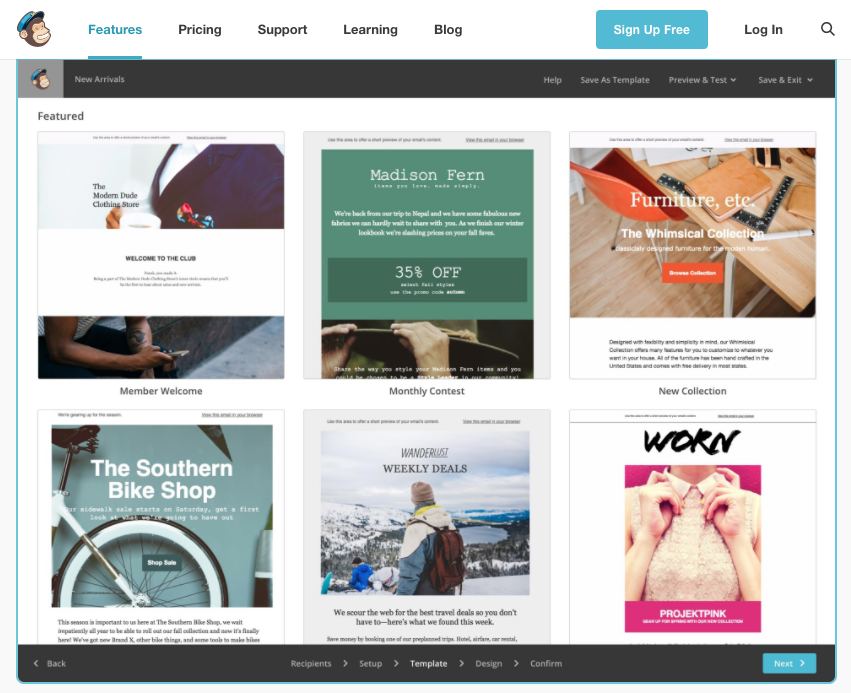
Here are some examples of different templates from MailChimp:

image16 1

What do all of these templates have in common?

The word count.

None of these templates give you space to write long paragraphs because it’s not effective.

Keep your message short.

Research from Boomerang suggests that your email should be between 50 and 125 words.

image8 3

The messages in their test sample got at least a 50% response rate.

While you’re experimenting with template designs, you can also try different images.

Try one large background image with text written over it.

Another option is to include a picture within the content.

Your A/B template test can help determine which method is more effective.

Swapping out one image for another is something else you can test.

For example, if you’re using a picture of a person, test the difference between a male and female.

Conclusion

A/B testing works.

If you used these tests to successfully optimize conversions on your website, the same concept could be applied to your email marketing strategy.

Before you get started, come up with a valid hypothesis.

Don’t start changing things without a plan.

Test only one variation at a time.

After you’ve come up with conclusive results for your first test, you can move on to something else.

Try testing your:

  • Subject line
  • Call-to-action wording
  • First few sentences of the message
  • Day and time of sending the email
  • CTA button placement
  • Templates
  • Images

The email marketing service you’re currently using may have an option for you to run and analyze the results from an A/B test.

If not, it’s no problem.

You can manually run an A/B test by creating two separate groups and two different campaigns.

This is still an effective method.

A/B tests will help increase opens, clicks, and conversions.

Ultimately, this can generate more revenue for your business.

How will you modify the call to action in the first variation of your A/B test?


Source Quick Sprout http://ift.tt/2llNGhn

These Paw-some Money-Saving Tips Will Help Your Cat Live Its Best 9 Lives

Want a Job You Can Relish? Apply Now to Drive the Oscar Mayer Wienermobile

When you were a kid, what did you dream of becoming when you grew up?

Maybe you thought you’d be a doctor, so that you could help people when they were sick. Or maybe you dreamed of being a firefighter, saving lives and rescuing scared kittens from trees.

Or maybe, just maybe, you knew all along that you wanted to be a Hotdogger.

What’s a Hotdogger, you ask?

Why, a Hotdogger is a person who drives the Oscar Mayer Wienermobile, of course!

Yep, that’s a real thing.

Oscar Mayer is currently looking for people to drive its famed Wienermobiles around the country, bringing wiener-shaped happiness to people across the U.S.

But What Does a Wienermobile Pilot Do?

As an Oscar Mayer Hotdogger, you’d spend one year driving around the country, making radio and television appearances, doing newspaper interviews and attending grocery store, military and charity events. You’d be “your own traveling public relations firm” and would be in charge of pitching TV, radio and print media, and organizing promotions.

Because this job isn’t just about driving a giant wiener around, candidates should have a bachelor’s degree in something like public relations, journalism, communications, advertising or marketing — though that’s not a hard and fast list.

You should, however, be creative and friendly and have a big appetite for adventure.

Become an Oscar Mayer Hotdogger

Apparently, everybody wants to be a Hotdogger. The application process is said to be pretty competitive, with as many as 1,200 people applying for just 12 spots.

But don’t let that deter your dreams! If you have “a love of people, a winning smile, driving skill and a desire to crisscross the country,” you’re already a pretty solid candidate.

And as if the honor of telling people you spend your days piloting a hot dog isn’t awesome enough in itself, there are some additional perks that might make your mouth water: You’ll receive a competitive salary plus expenses, benefits and meat-themed (I’m guessing) clothing.

You’ll also receive a company car (well, duh) — but it’s definitely shaped like a giant wiener.

We’ve reached out to the company to learn more specifics about pay and benefits, and we’ll update this post when we find out more information.

If, after reading this, you relish the idea of driving the Wienermobile, then you must(ard) apply to become a Hotdogger.

Oscar Mayer is accepting applications until Jan. 31, 2018, so if you still haven’t started working on your resume, you have plenty of time to ketch-up.

To find out more about what it’s like to be a full-time Hotdogger and to download an application, visit the Oscar Mayer Wienermobile website here.

I wish you the best of luck, and I hope to see you out there living your giant-hot-dog dreams next year.

Wienerspeed, my good friend.

Grace Schweizer is a junior writer at The Penny Hoarder. She’s all out of hot dog buns puns.

This was originally published on The Penny Hoarder, one of the largest personal finance websites. We help millions of readers worldwide earn and save money by sharing unique job opportunities, personal stories, freebies and more. In 2016, Inc. 500 ranked The Penny Hoarder as the No. 1 fastest-growing private media company in the U.S.


source The Penny Hoarder http://ift.tt/2gGAI8O

The “Commandment” of Treating Yourself

One of the most interesting phenomena to arise in the last twenty or thirty years is the concept of self-care as a widely accepted thing that people should integrate into their life. Spending time and resources to do the things you need to do to feel like a healthy, centered, and rested person is something that hasn’t really become a fully mainstream concept until recently.

The thing is, self-care isn’t really a new concept at all. You can find encouragement of self-care in the writings of ancient Greek philosophers, who encourage people to put aside time for thoughtful leisure and rest as a method of making yourself into a better and stronger person. Self-care is actually a sensible and smart idea with a long history before it became popular in mainstream culture.

However, the idea of self-care really easily lends itself to overspending and overindulgence.

A recent article by Ester Bloom at The Atlantic, entitled How ‘Treat Yourself’ Became a Capitalist Command, covers exactly how the idea of self-care is something that marketers love to manipulate in an effort to convince you to spend money on unnecessary things.

She starts by pointing to the strong philosophical basis for self-care:

In a 1982 lecture that went on to be published as an essay called “Technologies of the Self,” the French philosopher Michel Foucault argues that looking after oneself, rather than being a form of navel-gazing or narcissism, is a kind of “vigilance” that dates back to antiquity. For Socrates, Plato, and their ilk, Foucault writes, “taking care of yourself eventually became absorbed into knowing yourself.” As the thinking went, only with the proper amount of time set aside for the “active leisure” of reading, studying, and ruminating could a person come to grips with the profound nature of the universe and his own mortality.

In other words, self-care, particularly in terms of active leisure, is something that’s a healthy and productive part of human life. The core idea of self-care is a good thing.

Of course, the idea of caring for yourself and treating yourself well is easily bent into buying things.

American culture, with its typical anything-worth-doing-is-worth-overdoing attitude, has reduced self-care to buying stuff and, even more counter-intuitively, to trying to become a more productive employee. In other words, active self-care was originally considered necessary to be a philosopher, typically for elite white men who had the luxury to sit and think. Now, America has democratized it by making it seemingly available to all—at least, for a price.

The advertising industry has nudged self-care away from introspection and towards reflexive consumerism. According to copywriters, you “deserve” everything from “a break today” (at McDonald’s) to “brighter eyes” (with new make-up) from “a decent sandwich” (from Milio’s) to, simply, “the best” (in the form of Beats By Dre). The implication is clear: Consumers who fail to purchase such treats are depriving themselves, failing to meet their own needs.

The interesting part of all of this is that much of the rise of self-care as a modern concept is due to the fact that, as a society, we feel extremely overworked and overbooked, and that can lead to a lesser sense of personal value, that we don’t exist as much beyond being a cog in a machine.

As always, the solution that companies would give to us is to spend money.

The kind of self-care being peddled to the 21st-century American white-collar worker is a cure for a quintessentially 21st-century American problem: that jobs demand ever-increasing amounts of time, energy, and creativity. Capitalism, faced with a problem it created, is itself trying to provide a solution. Little wonder, then, that the suggested fix isn’t to convince workers to actually take their vacation days or to go back to a more humane schedule of 40 hours a week, both of which would help employees to prioritize their own well-being. Instead, to avoid burnout, people are encouraged to spend more and exercise harder.

The real truth is peeking out, right there. The most effective form of self-care is taking time for yourself. Self-care gives your body time to heal and to grow stronger and your mind time to refresh and rest and to absorb new ideas. Self-care enables you to do things that bring you joy and to build relationships that can bring continued value into your life.

Guess what? Those things don’t involve buying products. Those things don’t involve spending money. The best forms of self-care – the best forms of “treating yourself” – don’t involve throwing money at the problem.

Instead, we find ourselves often so overbooked that we don’t take time for self-care, and due to a deep realization that we need self-care, we look for an easy solution. Guess what? There’s always an easy solution for any problem, provided you’re willing to throw money at it!

The idea of buying something to “treat yourself” doesn’t actually solve the problem of self-care at all. While those products that you buy might bring a burst of pleasure, they don’t help alleviate any of the things that are actually causing us to feel devalued or to need self-care in the first place.

The true solution to the problem of self-care is time, and time is hard to come by when you’re overcommitted.

That’s right in line with Bloom’s conclusion:

Self-care may never have been easy, but it was once simple and certainly not expensive. It required little more than the ability and wherewithal for introspection. Foucault’s “active leisure,” the time “to study, to read,” is not impossible to carve out time for. Workers and employers alike only have to recognize that determining and meeting one’s needs has value, regardless if it can produce any profit.

So, what’s the real solution? The real solution is to de-commit. If you’ve put yourself in a position where there is no time left for any form of actual self-care – because the actual effective forms of self care, such as genuine leisure and rest and reading, involve spending time – then you’re overcommitted and you’re ensuring that you’re not able to give your best to the things you’re committed to. You’re like a rechargeable flashlight that’s slowly growing dimmer because you’re never recharging, you’re just hoping to squeeze a little bit more from the batteries.

Another solution is to realize that the act of splurging on a product that really isn’t in line with what you most care about isn’t really any kind of self-care at all. Instead, it’s just this little burst of short-term pleasure that, when it fades, leaves you feeling just as exhausted and just as uncared-for as you did before. You can’t buy the things that you need to refill the tank of your soul. That can only be refilled with quality time.

So, the next time you hear an advertisement talking about how you need to “treat yourself” or how you “deserve” something good and it’s followed immediately by something you should spend money on, recognize that trick for what it is. It’s merely preying on your internal sense that you really do deserve self-care, but it’s trying to route it in a way that involves you spending your hard-earned money on their product.

If you find that such ads really work well on you and you’re constantly wanting things, then that’s a sure sign that you need to find time in your life for real self-care – genuine rest, thoughtful leisure time, time spent on hobbies that matter to you, simple and nutritious foods, and so on. Find that time. In the long run, it will cost you far less to find time for self-care than it will cost you to stay on the treadmill of “treating yourself” and continuing to run yourself ragged.

Good luck.

The post The “Commandment” of Treating Yourself appeared first on The Simple Dollar.


Source The Simple Dollar http://ift.tt/2yS5lAH

Marketers Use This Trick to Get Your Money. Here’s How to Outsmart Them

A Chicago Local Reveals the Best Spots for Deep Dish Pizza and Dogs

الخميس، 26 أكتوبر 2017

10 Terrifying Fears We’ve Had About Credit Cards (And How to Ease Them)

Hints of Halloween have hung in the air this entire month. Which puts me on edge.

Yes, I’m a scaredy cat. But also, I’m not fond of little boys in Jason masks running up behind me with a T-ball bat in hand. Standing. Staring. Saying nothing. (Yes, this happened a few weeks ago, and I’m still spooked.)

Then there’s the wisps of ghosts and goblins my neighbors have suspended from their trees and porches. A slight breeze always catches them as I walk the dog around the block at night.

Then there’s credit cards.

WalletHub recently explored folks’ fears — on a financial level. It surveyed 530 people (so, no, it’s not totally representative) to rank the five scariest aspects of credit cards. These include:

  • Fraud (33%)
  • Interest rates (31%)
  • Overspending (19%)
  • Losing them (11%)
  • Fine print (5%)

We decided to rank our own credit card fears because, yes, they’re so real:

Our 10 Greatest Credit Card Fears — Exposed

Warning! Reader discretion is advised. You’re getting a glimpse into a Penny Hoarder’s brain here, deepest paranoias and all. It gets graphic.

  1. Not paying card(s) off in time. Even though we’ve set up automatic payments. And those automatic payments have proven to work for months now. We still have to double and triple-check that, yes, our card is paid. Or we might just opt to manually pay the balance off before it’s due, because why risk it?
  1. Sleep-talking to Alexa and ordering 100 useless items. Or: Getting a little tipsy one night and taking Zappos by storm. (Seriously, this happens.)
  1. Watching our credit scores drop by hundreds of points. Even though we’ve been perfectly responsible spenders. (I’ve had at least two nightmares about this, waking up in a cold sweat.)
  1. Scrolling through our statements, only to find a dozen random charges made across the country. Which then requires sitting on the phone with the credit card company (the horror!) explaining that, no, we did not buy a Nutribullet or rent a $500 professional carpet-cleaning machine thing. (True stories.)
  1. Finding our rewards points gone. Vanished. Into thin air. Without a trace. We’d been saving those to pay for our next vacation!
  1. Missing something in the fine print and finding out we’ve signed our lives away to insane fees. Because even though we should hang onto every word in the fine print, confession: We don’t.
  1. Signing the drink receipt at the bar and sliding it back to the bartender, with our credit card still with it. We’ve basically just invited them to have some fun on our tab. And now we have to hang out heads in shame as we tell the credit card representative we lost our card at 1 a.m. Yes, you’ve guessed what we’ve been up to…
  1. Getting approved for a higher credit limit. At first, this sounds awesome, but it’s also terrifying, because are we really that responsible? That’s a lot of power.
  1. Forgetting to let the credit card company know we’re traveling and feeling embarrassed and helpless when the waiter lets us know the card doesn’t work. We totally, definitely have money. We swear!
  1. Having your card rejected at the grocery store. “Let me try again. I swear I’ve paid it off.” And it doesn’t work. And the machine keeps buzzing in that disapproving way. And the line behind us stacks up. And we start sweating.

How to Ease Some of These Credit Card Fears

Since signing up for a credit card, I’ve taken a few precautions to ensure I keep my finances on track — and remember to pay my card off each month.

Let me share.

1. I Keep a Close Eye on My Credit

I didn’t check my credit score until after college. But now, I’ve built this simple task into my monthly routine.

I use Credit Sesame, a free service that gives me my score and delivers a graded credit analysis. This helps me see what I can do to improve my credit score. It also notes my accounts with negative marks as well as my total debt balance.

I’ve also set up monthly notifications, so if anything looks off, I’ll get an email.

2. I Signed Up for Spending and Payment Alerts

Sometimes I just need a gentle nudge, which is what Trim offers.

Trim is a cute little robo-advisor that’ll outline all your transactions. You can sort them by the most recent or the largest.

I’ve also set up personal alerts. Through Facebook Messenger, Trim notifies me when it’s payday (yay!), if I’m facing any overdraft or late fees or if there are any large transactions (over $100). It’ll also notify me if my credit card usage is too high or send me balance updates.

I can also add personalized reminders, for say, when utilities are due, so I’ll never forget.

Thank goodness for robot reminders, or else I’d probably have way more nightmares about my credit score plummeting — just like my heart does when a seemingly innocent trick-or-treater rings my doorbell.

Carson Kohler (@CarsonKohler) is a junior writer at The Penny Hoarder. You just got a deep look into the inner-workings of her brain. That, in of itself, is slightly scary.

This was originally published on The Penny Hoarder, one of the largest personal finance websites. We help millions of readers worldwide earn and save money by sharing unique job opportunities, personal stories, freebies and more. In 2016, Inc. 500 ranked The Penny Hoarder as the No. 1 fastest-growing private media company in the U.S.


source The Penny Hoarder http://ift.tt/2iCBwzI

Take Control of Your Cards With The TSD Credit Card Tracker

Credit cards are powerful tools that can help you build, improve, and even restore your credit score (which is increasingly important in today’s economy). The key is to use them correctly. And unless you have a ton of experience, managing all the aspects of your credit can be overwhelming.

Say hello to The Simple Dollar’s Credit Card Tracker. If you have at least one credit card, this customizable spreadsheet will help you keep track of your credit utilization, fees, and your overall financial health. It will also help you stay on top of credit card signup bonuses and organize your spending to help you earn bonuses and maximize rewards!

Mad About Proposed National Park Fee Hikes? Here’s What You Can Do About It

Thinking of visiting some national parks on your big family road trip next summer? You may end up needing to expand your budget.

Earlier this week, the National Park Service announced plans to increase peak season fees at 17 of the most frequently visited national parks — primarily those in the western United States.

The revenue from these price hikes, which the National Parks Service estimates will be around $70 million each year, will be used to repair and improve infrastructure and accommodations including roads, bridges, bathrooms and campgrounds, along with other visitor services.

The New Cost of Visiting These National Parks

Starting in 2018, the National Park Service intends to raise per-vehicle entrance fees by as much as $45, while per-person fees will go up by as much as $20.

Currently, the National Park Service charges a year-round entrance fees of $25 to $30 per vehicle, $10 to $15 per person on bike or foot or $12 to $25 per motorcycle.

If implemented, the new peak-season entrance fees would come in at $70 per vehicle, $30 per person or $50 per motorcycle across the board.

Park-specific annual passes will jump from anywhere between $35 and $60 to a flat $75, both during the peak season and not.

Peak season for 16 of the national parks in question runs primarily through the summer months, while Joshua Tree National Park has a peak season that lasts from January through the end of May.

The Push to Preserve the Parks

Perhaps anticipating backlash, the U.S. Secretary of the Interior, Ryan Zinke, stressed that the price hikes and subsequent improvements are vital to the long-term health of our national park system, saying that charging higher fees at the parks “will help ensure that they are protected and preserved in perpetuity.”

“We need to have the vision to look at the future of our parks and take action in order to ensure that our grandkids’ grandkids will have the same if not better experience than we have today,” he continued.

In the same statement, the National Park Service noted that out of 417 park sites under the National Park Service’s jurisdiction, only 118 currently charge entrance fees — and that out of those 118, only 17 will be affected by the proposed rate hike.

Additionally, the National Parks and Federal Recreational Lands Pass, which grants entrance to all federal lands for a one-year period, will remain at its current price point of $80.

Your Opinion Counts!

Still, while the National Park Service sees these rate increases as a necessary step in protecting the future of some of the country’s most visited parks, many people have stepped up to voice their concerns.

Some argue the new rates will price many visitors out of the parks, while others blame the $1.5 billion in cuts being made to the Department of the Interior’s budget.

Whether you object or agree with the National Park Service’s new plan, though, it wants to hear from you.

Those who want to make their opinion on the matter heard are being directed to a comment form that opened on Oct. 24 and will close on Nov. 23.

If you prefer the more old-school, snail-mail method, comments and opinions can be sent to: National Park Service, Recreation Fee Program, 1849 C Street, NW, Mail Stop: 2346 Washington, DC 20240.

They’re your parks, people — let your voices be heard!

Grace Schweizer is a junior writer at The Penny Hoarder.

This was originally published on The Penny Hoarder, one of the largest personal finance websites. We help millions of readers worldwide earn and save money by sharing unique job opportunities, personal stories, freebies and more. In 2016, Inc. 500 ranked The Penny Hoarder as the No. 1 fastest-growing private media company in the U.S.


source The Penny Hoarder http://ift.tt/2i8764A

Trick or Treat! Make These 5 Halloween Party Treats for Less Than $5

Most of Us Don’t Get Enough Sleep, and It’s Costing Us — Literally

How tired are you right now?

If you’re like many people, you’d probably like a nap and may even be chronically overtired.

A new survey from Glassdoor says 74% of us get only 6.9 hours on work nights – not the seven to nine hours per night healthy adults need.

School, hectic work schedules, fussy babies, stress and a myriad of other things contribute to sleep debt. Even working from home can take its toll on the amount of sleep we get.

To make matters worse, advice on becoming more productive often centers around getting up earlier in the morning to get more out of your day.

In fact, rising early to prove your ambition is quickly becoming an unhealthy competition. It’s not enough anymore to get up at 6 a.m. or even to pop out of bed at 5 a.m. Now some people boast about waking up at 4 a.m to get a start on their day.

What’s next? Sleep standing up in the corner from 1 to 1:45 a.m.?

Getting up before the roosters is fine if you’re going to bed early enough to get the recommended hours of sleep, but many people don’t do that. After all, Netflix isn’t going to watch itself.

If you need a nudge to get a good night’s sleep, how about this.

A chronic sleep deficit can cost you big bucks.

How Sleep Deprivation Costs You Money

There are lots of little ways that sleep debt adds up to monetary debt. For instance, we’re more likely to order takeout for dinner or shop at expensive convenience stores when we’re overtired.

But a chronic sleep deficit can also impact your wallet in bigger way.

“Study after study has revealed that people who sleep poorly are at greater risk for a number of diseases and health problems,” the Division of Sleep Medicine at Harvard Medical School says. That can lead to ongoing and expensive health care treatments, and huge medical bills are no joke.

Sleep deprivation can also adversely affect your work performance, which could get you passed over for promotions and raises.

In fact, “the negative effects of sleep deprivation are so great that people who are drunk outperform those lacking sleep,” writes organizational psychologist Travis Bradberry. Not a good look if you want to move up the company ladder.

Driving while drowsy also increases your chances of an auto accident. According to the National Sleep Foundation, around 100,000 crashes each year are a direct result of driver fatigue. Car repairs, moving violation fines and increased insurance premiums can take a huge toll on your budget.

How to Get a Good Night’s Sleep

Keep these tips in mind to get the best sleep possible and wake up feeling like you’ve won the lottery.

  • Stay away from your television, smartphone and tablet for at least an hour before you turn in. The light they emit is proven to promote wakefulness.
  • Make your bedroom a sanctuary with great bedding, comfortable pillows and light-blocking drapes.
  • Consider turning on a white noise machine to drown out noise that might keep you awake or interfere with sleep. Or try a free white noise generator app from GooglePlay or Apple’s App Store.

Lisa McGreevy is a staff writer at The Penny Hoarder. She’s perpetually exhausted so do as she says, not as she does.

This was originally published on The Penny Hoarder, one of the largest personal finance websites. We help millions of readers worldwide earn and save money by sharing unique job opportunities, personal stories, freebies and more. In 2016, Inc. 500 ranked The Penny Hoarder as the No. 1 fastest-growing private media company in the U.S.


source The Penny Hoarder http://ift.tt/2yTG9vm

Your Rent Is Expensive AF, Another Study Just Confirmed. Here’s How to Deal

For too many Americans, rent is still too high. So high that writing the rent check can cause panic on a monthly basis.

According to Apartment List’s annual survey of more than 41,000 renters, 18% of tenants couldn’t pay all or some of their rent within the past three months. For low-income renters — those who make less than $30,000 per year — 27.5% reported they didn’t pay their rent in full at least once in the past three months.

Apartment List’s data showed that 3.3% of renters surveyed have been evicted in the past, and 2.4% were evicted from their last residence. While those rates seem small, they indicate a larger problem.

With approximately 118 million renters in the U.S. today, Apartment List estimates that 3.7 million Americans have been evicted at some point.

Apartment List housing economist Chris Salviati, the report’s author, noted: “If we assume that some share [of] respondents fail to report informal evictions, this estimate is most likely understated.”

Salviati wrote that the eviction process can be expensive, “making it difficult for the evicted to get back on their feet, and having an eviction record can make it extremely difficult to find future housing.”

Previous Apartment List research found that rent prices have risen faster than wages. And although coastal areas tend to have higher rents, they also have stronger job markets and higher median wages that offset the rent, Salviati explained. That income reduces the rates of eviction in those areas; in addition, the rental markets in those coastal metropolitan areas are so competitive that people who struggle to pay rent would have a hard time initially obtaining an apartment in those areas.

Apartment List also points out that eviction rates are particularly high in the areas that were most profoundly affected by the foreclosure crisis almost a decade ago. We often talk of a recovering economy, but housing access in some of those hardest-hit areas is still a major obstacle.

How to Deal When the Rent is Too $#&! High

If you feel strapped for cash with the first of the month looming, check out this list of ways to make a few bucks in a flash.

Not sure where to turn for more help paying rent? Dial 211. It’s United Way’s hotline that provides information about rental assistance and other housing programs. The hotline is free and confidential.

If you need something to make the next few months easier, think about getting a roommate. Roommates can come with their own idiosyncrasies, and sharing your personal space isn’t necessarily fun, but if it can help you — and another person — get ahead financially, it may be worth the sacrifice.

And you can always commiserate with other renters. Really, the rent is too high for most of us these days.

Lisa Rowan is a senior writer and producer at The Penny Hoarder.

This was originally published on The Penny Hoarder, one of the largest personal finance websites. We help millions of readers worldwide earn and save money by sharing unique job opportunities, personal stories, freebies and more. In 2016, Inc. 500 ranked The Penny Hoarder as the No. 1 fastest-growing private media company in the U.S.


source The Penny Hoarder http://ift.tt/2iBiz0t

Commercial Break? You Can Make These Money Moves Before the Show’s Back On

Quick!

It’s a “Wheel of Fortune” commercial break.

You know what that means: It’s time to immediately ignore the TV, dig your phone out of the couch cushions and start aimlessly scrolling.

Unless that adorable Subaru commercial comes on; then you’ll stop and watch.

Otherwise, it’s scrolling. It might even be how you landed on this article. So, kudos to you.

Want to improve your finances throughout the next few commercial breaks?

Believe it or not, that’s totally possible with these simple money tips.

Pat Sajak just sent us to the first commercial break, so, quick, let’s do this thing.

1. Take a Peek at Your Credit Score

Your credit reports are basically the Holy Grail of your finances — and your life.

Financially, they can influence many of your big life decisions, like buying a house or a car. These decisions can become a whole lot more difficult if your credit reports have an error.

This is easy to prevent, though, especially if you just check in on your credit reports (you’ve got three major ones) every so often.

One option is to use a free app like CreditWise® from Capital One®. There, you’ll get a free TransUnion® credit report, which you can review for signs of error, theft or fraud. It’ll even give you personalized suggestions to help you improve your credit score.

OK, back to “Wheel of Fortune.” Can I buy a vowel?

2. Open an Investing Account

Dang it. That contestant definitely shouldn’t have bought a vowel. Instead, he should have invested the money.

With a micro-investing app like Acorns, this seemingly overwhelming personal-finance move becomes super simple.

Just sign up for an account and you’ll get a free $10 to start investing. It’ll walk you through the process and even explain some tricky concepts in a way that’ll leave you with enough brainpower to solve the next “Wheel of Fortune” puzzle.

3. Earn Money Back on Your Dinner

If you’re like me, your commercial-break scroll sessions are usually done with one hand on the phone and the other eating that evening’s couchside meal.

While you’re at it, grab your receipt from your latest grocery haul. (And, if you’re even more like me, it was earlier that evening. Meal-planning is my weakness.) Now download Ibotta, check off the items you bought and earn cash back.

Here are some deals available right now:

  • $2 back on Listerine
  • $2 back on Nutella
  • $3 back on Bud Light
  • 25 cents back on any variety of potatoes

Plus, when you claim your first cash-back offer, you’ll bank a $10 bonus.

Stay tuned for more.

4. Negotiate Your Cable and/or Internet Bill

You’re laughing, aren’t you? No way your cable provider will even take you off hold during a commercial break.

Well, there’s no need to pick up the phone. Install Trim, a little Facebook messenger bot that’ll negotiate your cable or internet bills down for you. It works with Comcast, Time Warner, Charter and other major providers.

You can sign up simply with Facebook, then upload a PDF of your most recent bill, and Trim’s AI-powered system gets to work — freeing you up to get back to Facebook for some quick lurking. Just until the show’s back on.

Oh, and if at first Trim doesn’t succeed, it’ll keep negotiating until it can save you some money. (If it saves you any money, it takes 25% of the savings tab.)

Vanna, I’ll buy a vowel now!

5. Score Cash Back on Your Latest Online Orders

At this point in the show — you know, toward the end, when you’re really invested and you’re on the edge of your seat waiting to see the final puzzle — the commercials become more and more frequent. Ugh.

But that’s OK today, because now you can find out if Amazon, Walmart or other retailers owe you any money on your recent orders.

Earny is another adorable bot. Connect your inbox, and he’ll take a look at your recent virtual receipts then search for price drops. If Earny spots one, he’ll claim the difference on your behalf, and you’ll find the amount back on your card.

Back to you, Vanna.

6. List Your Unwanted Belongings For Sale

This one might require you to leave the couch, but stick with me.

If you have a lot of stuff sitting around — clothes, appliances, you name it — but want to embrace that minimalist lifestyle, try listing some items on an app like Letgo.

It’s super easy. Download the app, sign up with Facebook or an email address, then take a photo of your product.

Shoes? Great. Once you capture the best angle, post it for the price you want — or mark it negotiable. You’re free to add more details or photos, but, in all, it takes about two minutes.

Have a bunch of movies or CDs collecting dust on a shelf? You’re probably staring at some right now next to the TV.

Well Decluttr will pay you for them!

Decluttr buys your old CDs, DVDs, Blu-rays and video games, plus hardware like cell phones, tablets, game consoles and iPods.

Just download the app and start scanning the barcodes on your media to get immediate quotes. It’s completely free to use, there are no listing or seller fees, payment is super fast and there is even free shipping.

Plus, enter PENNY10 at checkout to get an extra 10% for your trade-ins!

And if you didn’t have time to list those old golf clubs? No worries. “Jeopardy” is up next! What are “money tips” for 500?

Carson Kohler (@CarsonKohler) is a junior writer at The Penny Hoarder. Yes, she actually watches “Wheel of Fortune.” You could even say she gets wheely into it.

This was originally published on The Penny Hoarder, one of the largest personal finance websites. We help millions of readers worldwide earn and save money by sharing unique job opportunities, personal stories, freebies and more. In 2016, Inc. 500 ranked The Penny Hoarder as the No. 1 fastest-growing private media company in the U.S.


source The Penny Hoarder http://ift.tt/2z8J5We

46 (Kinda) Ridiculous Things Only True Penny Hoarders Will Admit to Doing

Who here is a Penny Hoarder?

Raise your hands.

Well, I have news for you. All those money-saving behaviors you catch yourself doing — you know, the ones that elicit heavy eye rolls from your partner, or sighs from the person behind you in the checkout line — well some folks don’t consider those practices 100% “normal.”

(But also… what’s normal nowadays?)

Stick with me while I do my best Jeff Foxworthy of Finance impression.

You might be a true Penny Hoarder if…

  1. You secretly wish the person checking out in front of you at Target would slow down so you can have an extra minute to scan your items in the Target app to check for savings.
  1. You find a quiet spot in the back of the grocery store so you can scroll through Ibotta and make sure you haven’t missed any cash-back opportunities.
  1. You plan your family holiday visit around the cheapest dates to fly.
  1. You know which dates are cheapest to fly because you’ve been tracking fares on Hopper or Google Flights for months now.
  1. You walk straight to the clearance section of any store. And no wandering. You know right where to go. (Nope, you don’t even so much as glance Target’s dollar section because you know whatever you want will end up costing $5.)
  1. You rush to pile your groceries on the checkout belt at the grocery store so you can get to the receipt screen to make sure the computer catches all your BOGO deals and registers all your coupons.
  1. You assume that because you missed Free Museum Day, you’ll have to just wait another year for the opportunity to visit.
  1. You spend the entire month of October scouring thrift stores for the pieces to a perfect Halloween costume, because you refuse to spend $60 on a cheap, generic costume.
  1. You think free food tastes so, so good.
  1. You determine your date-night outing based on where you can get money back through the Dosh app.
  1. You know what “Swagbucks” are.
  1. You understand that incredible floating feeling that occurs when you dig up a real gem at T.J. Maxx or HomeGoods.
  1. You don’t hesitate to call retailers to get a refund because that two-day shipping you opted for turned into three days. Or you’re ahead of the game and just use Paribus.
  1. You cut open your lotion bottles, makeup containers and condiment containers to get every. last. drop.
  1. You won’t let anyone throw or give away their belongings until you’ve had a chance to determine if you can use them — or sell them on Letgo.
  1. You cut the cord. (And you realize this doesn’t have to do with childbirth.)
  1. You cash out on any relevant class-action lawsuits, even if you’ll only get $2 in the mail. Totally worth it.
  1. You don’t hesitate to return expired food to the grocery store.
  1. Your banking app is the first icon on your phone’s home screen.
  1. You check your credit score perhaps a little too often. (But, really, is that such a thing?!)
  1. You search for coupons on Ebates before you buy anything online.
  1. You’ve spent hours watching videos just to score a dollar on InboxDollars.
  1. You order a large pizza for yourself then eat the leftovers throughout the week because, according to math, it’s cheaper that way. Plus, it’s pizza.
  1. You have a side gig.
  1. You have a side gig with UberEats, and you’re always tempted to sneak a french fry out of the customer’s to-go box. But you don’t. Instead, you just secretly hope they won’t answer the door so you can just have it all to yourself.
  1. You refuse to believe your utility bill is that expensive, so you send it off to BillShark because you know they’ll negotiate it for you.
  1. You enjoy investing. As long as it’s the micro-type.
  1. You don’t hesitate to pay for something with a discounted gift card you snagged off Raise.
  1. You pay with a credit card — but only so you can earn points.
  1. You’ve rummaged through the trash to find an old receipt because you’re not missing out on any cash-back offers from Ibotta.
  1. You always ask about student discounts, even if you did graduate five years ago… Shhh
  1. You’ve taken an online survey to earn 50 cents.
  1. You’ve participated in a clinical trial.
  1. You once canceled a margarita order at the bar after realizing it didn’t serve the Ibotta-approved tequila. What’s the point, if you can’t get cash back?
  1. You’ve walked into Target, filled your cart with miscellaneous goods, then retraced your steps, put each one back on the shelf and quietly left.
  1. You celebrate Christmas with your S/O on Jan. 25 so you have a chance to hit up those after-Christmas sales.
  1. You have four different razors stacked on the side of your tub because they were all a dollar.
  1. You realize mystery shopping doesn’t require you to dress up as a detective.
  1. You choose your bank account based on bonuses.
  1. You save the boxes to anything tech-related because you know it’ll increase the item’s resale value when you go to sell it on Decluttr.
  1. You refuse to buy raspberries this week because you’re bitter you missed last week’s two-for-one sale.
  1. You look forward to the holidays mostly because you know folks will leave town and need a pet sitter. (Hey, leave the kids behind, too. That’s fine. You’ve got it. Just pay me more.)
  1. You aren’t afraid to claim a freebie — no matter what it is — online.
  1. You are a big fan of warehouse clubs and will never buy toilet paper anywhere else.
  1. You know the difference between being frugal and being cheap. Yes, there’s a big difference.
  1. You pick up any stray pennies on the sidewalk — even if they’re face down and look like they were minted in 1910.

Carson Kohler (@CarsonKohler) is a junior writer at The Penny Hoarder. She’s able to tick off nearly every item on this list — except the stray pennies one. She just really doesn’t like germs.

This was originally published on The Penny Hoarder, one of the largest personal finance websites. We help millions of readers worldwide earn and save money by sharing unique job opportunities, personal stories, freebies and more. In 2016, Inc. 500 ranked The Penny Hoarder as the No. 1 fastest-growing private media company in the U.S.


source The Penny Hoarder http://ift.tt/2gKTTBZ