Thousands of courses for $10 728x90

الاثنين، 12 فبراير 2018

Navy Federal Credit Union Review

You probably won't be surprised to hear there are over 6,000 banks and another 6,000 credit unions in the United States. You can't drive down the road without passing at least a dozen different banks.

If you're looking for a new bank, it can be an overwhelming search. Each bank or credit union is going to offer different products, accounts, and rates.

If you're like most people, you're going to start your search at the large national banks, but you could be missing out on some of the best choices by not looking at the top credit unions. If you don't have any credit unions on your list, you're making a serious mistake.

This article is going to look at Navy Federal Credit Union (NFCU) and help you decide if they are the best financial institution for you.

Who is Navy Federal Credit Union?

navy federal credit union logoNavy Federal Credit Union has some old roots. They were established way back in 1933 as the Navy Department Employees' Credit Union of the District of Columbia (that's a mouthful).

They were created as a credit union for Navy Employees who were members of the Federal Employee's Union. A year later, in 1943, President Roosevelt signed the Federal Credit Union Act, which became the foundation for credit unions.

In 1947, Navy Department Employees' Credit Union of the District of Columbia was dissolved and reestablished as an official federal credit union, which they named Navy Department Employees Federal Credit Union. At this point, they also opened up membership to all Navy employees and personnel in the Washington area.

In 1954, 21 years after their establishment, they officially became Navy Federal Credit Union. At this point, they opened their memberships to enlisted personnel. Through the years, they have continued to change and evolve. They have continued to grow and improve their products and services. They have become one of the largest and most influential credit unions on the market.

Today, they have over 7 million members across the country, and they have over $78 billion in assets.

Banking with NFCU

If you're looking for a credit union with dozens of banking options, then NFCU is the best option for you. They have dozens of account options you can choose from. Each one is slightly different. I'm not going to outline all of the options, but I will hit some of the most popular ones.

e-Checking

The e-Checking account is one of the most popular accounts NFCU offers. This account has a monthly fee, but you can avoid it if you sign up for direct deposit. If you're like most people, you're going to be using direct deposit anyways.

These e-Checking accounts earn a modest dividend rate, and you can get rebates on ATM fees for up to $10 for every statement. As long as you don't plan on walking into a physical branch, this is an excellent choice for you.

Flagship Checking

The Flagship Checking account is one of the premier accounts at NFCU. This plan has a tiered dividend system which is based on your account balance. The APY is going to be significantly higher with this account compared to the other accounts.

There is no minimum deposit to open the account, but you might have to pay a monthly fee. There is a $10 monthly fee if your account balance is below $1,500. If your balance is more than the $1,500 threshold, you won't have to pay any monthly fees. This is an excellent option for anyone who plans to hold a significant amount in their checking account and want to earn money based on the balance.

Campus Checking

As you can probably guess from the name, this account is designed for students to start saving. This account is available to any student between the ages of 14 – 24, and they won't have to pay any service fees, and there is no minimum balance requirement.

It's never too early to set your child up with a checking account. It's the perfect way to teach them the importance of saving money and wise spending.

Free EveryDay Checking

Free EveryDay Checking is the most basic option for banking you can find at Navy Federal Credit Union. There is no monthly fee and no minimum balance requirement you'll have to meet. If you want a straightforward checking account which won't be sunk by fees, then this is an excellent option for you.

With this account, you will earn a modest 0.05% APY (currently), and you'll have access to the same benefits of all the other accounts, like thousands of ATMs.

NFCU also has a few savings account as well. They have a basic savings account, education savings account, and a SaveFirst account.

The basic savings account is exactly what it sounds like. It offers competitive interest rates with no fees. If you want a straightforward savings account, this is it.

Their SaveFirst is one of their more exciting savings accounts. This account lets you set a maturity date for the account, open the account with a $5 initial deposit, and then have dividends compounded daily.

Borrowing with NFCU

Lending is one area where NFCU shines among its competitors. They offer personal loans, mortgage loans, auto loans, and credit cards. Obviously, their interest rates change frequently, but they continue to have some of the most competitive rates out there. If you want a bank which can not only hold on to your money but lend you money as well, NFCU is a great place to start your search.

Becoming a Member of NFCU

Every credit union has different membership requirements. For most of them, it's if you “live, work, or worship” in the city or county limits of the credit union. For some of the larger credit unions, they have expanded their membership requirements and have made it more accessible. Of all of the credit unions, Navy Federal probably has the most ways you can be eligible to become a member, but they don't let just anyone in.

Some of the ways you can qualify to become a member of NFCU are:

  • Active Duty military
  • DoD Officer
  • Veteran
  • Be a contractor to U.S. Government Installations
  • Retired DoD employee
  • Or be a family member of one of the above
  • Apart of the Delayed Entry Program

One of the interesting parts of NFCU is their family membership requirements. They offer more lenient requirements than most credit unions. Most of them limit it to “immediate family,” but NFCU expands on those. They allow:

  • Grandparents
  • Spouses
  • Siblings
  • Grandchildren
  • Household Members
  • Adopted Children and Stepchildren

Drawbacks of Navy Federal

There are a lot of benefits of becoming a member of NFCU. They great rates for their loans and their checking accounts. One of the problems with NFCU is their savings account. Their basic savings account only has a modest APY. Sure, it's still higher than you'll find with some of the major banks, but you can find credit unions with much better savings rates.

Another disadvantage of NFCU is the balance requirement to avoid fees on the Flagship checking. If you don't meet the balance requirement, you're going to pay the monthly fee.

There are dozens of other credit unions out there which offer high-yield checking accounts with no fees. As long as you plan to have the $1,500 in your account, there is nothing wrong with this account, but it's something to be aware of.

Before you become the member of any credit union or join a bank, take the time go go through the customer reviews. One of the best ways to learn about a company is seeing what previous or current members have to say.

One common complaint I saw with NFCU is their customer service. Several users were saying they have problems reaching their customer service department or they weren't able to get the help they needed. You should always take these reviews with a grain of salt. You don't know the full story and what actually happened.

Don't let these customer reviews keep you from joining the perfect credit union.

Like most other credit unions, we aware of the number of branches. Credit unions don't have the massive number of branch locations like national banks.

Final Verdict on NFCU

Unlike some of the other credit, NFCU doesn't have membership qualifications which allow anyone to join. Some of the other larger credit unions allow you to join organizations or make a donation which qualifies you to become a member of the credit union.

NFCU doesn't do that. If you don't have a family member in the armed forces or if you aren't in the armed forces, then you probably won't be able to be a member. If you do meet the qualifications to be a member, I would highly suggest doing so.

Every person is different, and everyone has different financial needs and preferences when it comes to banking. There are thousands of banking options on the market, and trying to wade through them can be difficult. It's important you find the best one for you.

If NFCU is not the best option for you, don't worry, there are plenty of other options.

The post Navy Federal Credit Union Review appeared first on Good Financial Cents.


Source Good Financial Cents http://ift.tt/2ECxLny

This Company Is Hiring Work-From-Home Reps to Help People Travel the World

Are you faster than a speeding bullet at finding the best hotels in a city?

More powerful than a locomotive when navigating travel sites?

Able to find the cheapest flights in a single click?

If so, you could be Gant Travel Management’s next superhero.

The company says its corporate travel consultants valiantly seek out the lowest airline fares, discover upgrades and act as all-around heroes for travelers.

Additionally, you should be an organized, multi-tasking problem-solver who can deal with a variety of personalities. Being a geography and tech wiz is also a must.

Not quite ready to unleash your inner Black Panther on the travel world? No worries: You can find plenty of other gigs on our Facebook Jobs page. We post new opportunities there all the time.

Gant’s Work-From-Home Corporate Travel Consultant Jobs

Responsibilities include:

  • Setting up reservations for airline, hotel, car, rail and ground transportation for domestic and international travel
  • Adhering to the client’s company travel policy when arranging travel plans
  • Assisting with passport and visa requirements
  • Assisting clients using Concur navigational support
  • Meeting or exceeding performance metrics

Applicants for this position must have:

  • At least three years of travel industry experience; one year of corporate travel experience is preferred
  • Basic knowledge of Microsoft Office suite
  • Apollo/Smartpoint experience is recommended

Apply here for the work-from-home corporate travel consultant superhero job at Gant Travel.

Tiffany Wendeln Connors is a staff writer at The Penny Hoarder. She possesses no superhero powers, unless you count eating.

This was originally published on The Penny Hoarder, which helps millions of readers worldwide earn and save money by sharing unique job opportunities, personal stories, freebies and more. The Inc. 5000 ranked The Penny Hoarder as the fastest-growing private media company in the U.S. in 2017.


source The Penny Hoarder http://ift.tt/2CiXwEg

How Dishonesty Ruined L.L. Bean’s Once-Amazing Return Policy

As usual, a small group of people who will remain unnamed have ruined the fun for everyone. The crime? Abusing L.L. Bean’s return policy.

The Maine-based outdoor brand had a legendary return policy for years. Its 100% satisfaction policy meant if an item went south on you at any time for any reason, you could bring it back. You didn’t even need a receipt. You just needed to explain why the item no longer satisfied you 100%.

On Friday, Feb. 9, the brand announced on its Facebook page that the generous guarantee is no more.

In the post, Executive Chairman Shawn Gorman wrote: “Some view it as a lifetime product replacement program, expecting refunds for heavily worn products used over many years. Others seek refunds for products that have been purchased through third parties, such as yard sales.”

What’s Changing About the L.L. Bean Guarantee?

The new policy gives customers one year to return items with proof of purchase. Items deemed defective beyond one year will be handled on a case-by-case basis. L.L. Bean floated a change to its return policy a year ago as the company sought ways to cut costs.

Longtime fashion blogger Alison Gary relayed an L.L. Bean return success story via Twitter.

Gary said she got about $100 back — exactly what she had paid more than a decade prior.

The new rules are in line with other major outdoor retailers. While Patagonia doesn’t put a time limit on returns, it asks customers to submit returns for fit in a timely manner with tags attached. If an item doesn’t work properly, you can return it for a repair, replacement or refund. There’s one caveat: Patagonia will repair damage from wear and tear at what it deems a reasonable charge.

At REI, customers have one year to return items, although customers may return anything with a manufacturing defect at any time. The policy “doesn’t cover ordinary wear and tear or damaged caused by improper use or accidents.” The outdoor company shored up its return policy in 2013, citing abuses to the generous policy.

We asked L.L. Bean about the initial customer response to the change and will update this post if we hear back.

L.L. Bean and its outdoorsy counterparts still offer unbeatable return policies. They’re attentive to product defaults and willing to make repairs to extend the life of a well-loved item.

A no-questions-asked return policy keeps customers happy when you claim your company’s products are built to last. But customers are also notorious for putting just about everything they own through the ringer.

That doesn’t mean people are buying L.L. Bean boots, running them over with the car six times, and then asking for a new pair. They’re simply using them season after season, relying on them in often severe conditions and getting bummed out when something goes awry.

Yes, we want items that are built to last. But many customers have yet to realize that “built to last” doesn’t necessarily mean it’ll last forever.

Lisa Rowan is a senior writer at The Penny Hoarder.

This was originally published on The Penny Hoarder, which helps millions of readers worldwide earn and save money by sharing unique job opportunities, personal stories, freebies and more. The Inc. 5000 ranked The Penny Hoarder as the fastest-growing private media company in the U.S. in 2017.


source The Penny Hoarder http://ift.tt/2nTvf2y

Living Behind the Cutting Edge

I’m currently using a four year old smartphone. When I bought it, it was already almost two years old and was considered a discount phone. I can still update the OS on it, though, and it still does everything I want it to do. I can send and receive texts. I can send and receive calls. I can read through email. I can add stuff to Evernote. I can update my to-do list, too. That’s pretty much all I need it to do, and it does those things just fine.

The computer I write on was purchased in 2013. It wasn’t anywhere near a cutting edge machine, even then. Before that, I used a computer that had been purchased in 2006. This computer doesn’t scream, but it does every task I need from it. I need to be able to edit lots of text and occasionally edit images. I need to be able to write simple computer programs. I need to be able to check websites on it. That’s pretty much all I need it to do, and it does those things just fine.

My children own a last-generation video game console that they can play on for about an hour a day. Their favorite game on it at the moment was released six years ago. That console has a lot of games on it that were huge “Game of the Year” releases just a few years ago that my kids have yet to fully explore. It entertains them (and, occasionally, entertains me) and that’s pretty much all I need it to do.

Our television was purchased almost a decade ago and wasn’t exactly top-of-the-line even then. It now has a big screen flaw on it, but it’s not one that prevents us from watching any programs. We can watch shows in 1080p on it, and it has a couple of HDMI ports for attaching other devices to it. That’s pretty much all I need it to do, and it does those things just fine.

I’m not particularly interested in replacing or upgrading any of these items. Sure, with each and every one, I could probably discover lots of new features, but would those new features change my core usage of any of those devices in any significant way? Nope.

I could have a brand new phone and I’d still just use it for sending and receiving texts, sending and receiving calls, checking email, updating Evernote, and using my to-do list. So why spend the money on a brand new phone just to do what I’m already doing with my current phone?

I could have a brand new computer and I’d still just use it for writing, checking websites, and a little bit of programming and image editing. So why spend the money on a brand new computer just to do what I’m already doing with my current computer?

I could have a brand new video game console and I’d still just use it to play top-rated games that I haven’t played yet, but there are still a bunch of top-rated games for the console we have that my family hasn’t played yet. So why spend the money to buy a brand new console just to do what I’m already doing with my current console?

I could have a brand new television and I’d still just use it to watch Netflix every once in a while. So why spend the money to buy a brand new television just to do what I’m already doing with my current television?

Obviously, the big reason that we live behind the current age is that our older devices do everything we want or need them to do. An old television still shows the programs we want to se. An old computer still lets us read websites and watch videos. An old cell phone still sends and receives texts and checks every information source we need.

If there’s a pretty clear use for a new piece of technology, we’ll consider upgrading, but without an extremely clear motivation, we’re most likely going to keep using the technology we have until it no longer functions in some key way.

That policy also rewards us with several other benefits.

First, it’s far cheaper to buy slightly older technology. If I buy a new phone that’s a generation old, I’m usually paying significantly less for that phone. If I can pay half as much for a one year old phone and it’s still four or five years away from being at the end of its software cycle, then I’m paying a lot less per year of use of that phone.

If I buy a video game console that’s near the end of its cycle, not only am I going to get it for cheap, but there’s usually a pretty large library of really great titles to play for it, most of which are usually part of a “Greatest Hits” line at that point, which means that the games are cheap, too.

If I buy a slightly less advanced computer, I’m usually paying a fraction of what I would pay for a brand new one, and it still handles every task I throw at it with ease. It’s still going to last for years and years.

If I buy a slightly older television, I’m usually saving a ton over the bleeding edge televisions and I can still watch everything I want to watch. It’s still going to last for years and years.

This same idea is true for almost every piece of technology. Buying the latest, greatest thing rarely gives us the opportunity to do anything meaningful that isn’t handled by the slightly older but much much less expensive technology.

Second, we get a lot more life out of our objects, meaning we have a lot more time than average between replacements. If we’re on a four year upgrade cycle for phones rather than a two year cycle, we get a lot more life out of it. If we wait to replace our television until it literally doesn’t work rather than when there’s some new slightly better standard, we get a lot more life out of that television.

Again, this comes back to replacing items based on whether or not they can handle the primary tasks we expect from them or not. Can our television display television programs? Yes? Then we don’t replace it until it cannot. Can my phone make and receive texts and handle a few key apps? Yes? Then I don’t replace it until it cannot. That means we hold onto what we have rather than jumping for the latest thing, even if the latest thing has a potentially compelling feature or two.

We aren’t deeply concerned about the safety and security of having an extremely expensive piece of technology that amounts to a significant part of our salary. Think of someone taking a picture of us on vacation – no one is going to steal a four year old phone. If someone breaks into our home, they’re going to be really disappointed by an older television and a really old computer and a video game console that was state of the art in 2011.

The same thing is true if one of those items happens to break. I don’t flip into panic mode if our television decides to give up the ghost or if my cell phone no longer updates. It just means that it’s time to get a replacement, which is probably long overdue, and given the other principles listed here, it’s not going to be a super-expensive endeavor.

In the end, the cutting edge is fun, but it’s incredibly expensive and then it passes you by. Not worrying about it and instead focusing on what it can actually meaningfully do for you makes older technology seem perfectly useful, and it comes with a lot less worry and risk.

As I write this article on my almost-ten-year-old computer with my no-longer-for-sale-anymore cell phone right beside me, I’m perfectly content in the fact that these devices do exactly what I need and I’ve received a ton of value for the money I’ve put into them. The cutting edge? It mostly just cuts.

Good luck!

The post Living Behind the Cutting Edge appeared first on The Simple Dollar.


Source The Simple Dollar http://ift.tt/2H8Xd2o

How to Get More Converisons by Optimizing Your Checkout Process

Do your conversion rates need a boost?

Nobody has a conversion rate that’s 100%. I think it’s safe to say that no matter how successful your company is, your conversions can always be improved.

Recognizing this is half the battle, but you’ll need to actually implement some changes if you want to see an increase. Just hoping for more conversions isn’t going to cut it.

Here’s another mistake I see businesses make. They confuse a conversion problem with a traffic problem.

Sure, driving more traffic to your website is great. I encourage you to do this. You may get more sales, but it won’t necessarily change your conversion rate.

Ecommerce websites need to focus on their website layouts. I’ve told you before that websites with simple designs have higher conversion rates.

But you’ve also got to simplify your checkout process.

If you analyze each phase of this process, you may find certain elements that are actually driving customers away.

Fortunately, I’ve helped businesses with this problem before. I want to share some of my most successful strategies with you.

Here’s how you need to approach your checkout process to maximize conversions.

Take a look at your shopping cart abandonment rates

Over 69% of shopping carts get abandoned. That number is astonishingly high.

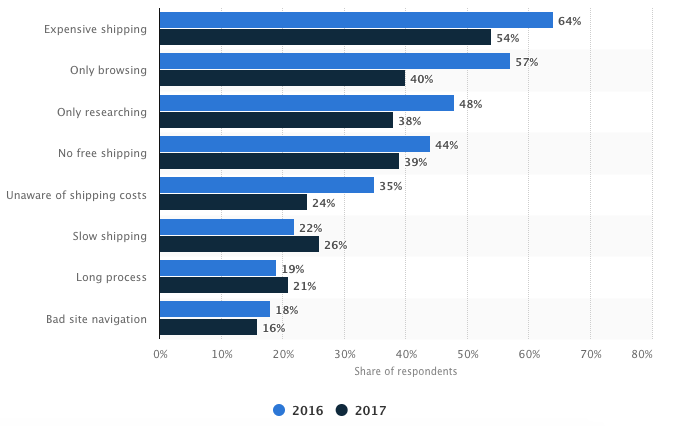
According to Statista, these are the top reasons why consumers abandon carts:

image1 13

Take a look at these figures and see if your existing checkout process has any of these hindering components. Are you encouraging customers to just browse?

It’s clear based on this data that lots of customers may add something to their shopping carts without any intention of buying anything. I know I’m guilty of this myself as well.

You need to find ways to convert these window shoppers into customers. I recommend trying to tastefully implement scarcity tactics:

  • create a sense of urgency
  • use FOMO (fear of missing out)
  • run promotions with short deadlines
  • add popups with promotional offers

These tips will help you reduce abandonment rates and get more conversions.

Shopping cart abandonment is an epidemic that needs to be addressed. You can send your customers an email reminding them they forgot something in their carts as part of fixing the problem.

But looking at your shopping cart abandonment rate is only the first step of optimizing your checkout process.

You should be constantly tracking this number to see whether the changes you’re implementing are making a difference. Keep referring back to it as you go through this guide.

Eliminate unnecessary steps

If your checkout process is long and complicated, it’ll have a negative impact on your conversion rates. Make sure you’re only getting information that’s required to complete the sale.

Consumers are busy. The more steps you make them go through to buy something, the more time they have to realize they really don’t want it.

But if you can simplify your checkout procedure down to a few steps, the customer won’t have time to second-guess their decision.

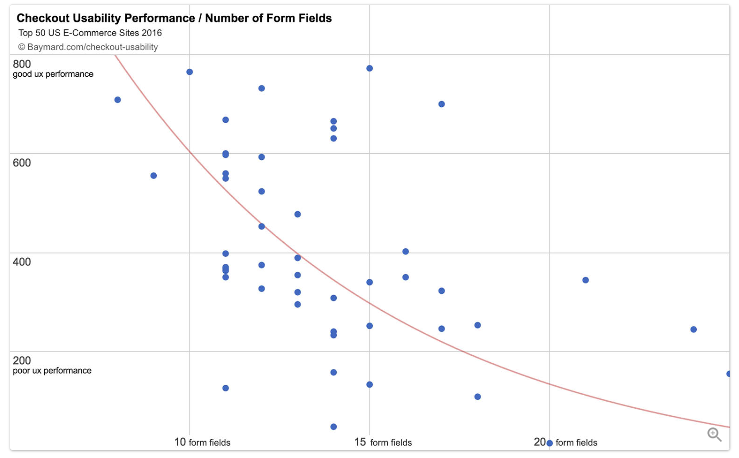
That’s why the number of form fields should be as low as possible.

image3 13

As you can see from the graph above, the fewer form fields, the higher checkout performance and usability. As a result, your checkout process will have better conversion rates.

But look at how quickly those numbers drop when the form fields become too long. Those yield a poor UX performance, which can negatively impact conversions.

Ask yourself this question:

What information do I really need to complete this sale?

  • customer’s name
  • shipping address
  • email address (to send confirmation)
  • billing information

That’s really it. You don’t need to find out their favorite hobby or their mother’s maiden name.

Just stick with the bare minimum, and you’ll see your conversion rates rise.

Encourage customer profiles, but don’t force it

Some ecommerce websites force customers to create profiles before they can buy something. While I can see the reasoning behind this strategy, it’s killing your conversions.

Look, I get it. From a marketing perspective, you want as much information about your customers as possible.

Once they create an account, you’ll have their name, location, and email address to which you can send more promotional info.

That’s all great. But if you had to choose, wouldn’t you rather have their money?

Not everyone wants a customer profile.

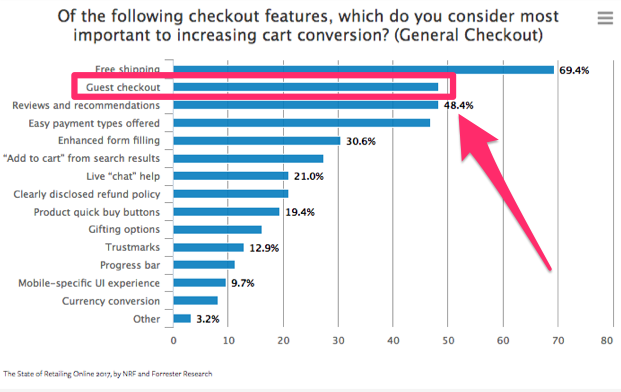
Over 48% of online retailers said a guest checkout was the most important factor to increasing shopping cart conversion rates on their websites.

image2 13

This was the second highest response on the list, trailing only behind free shipping.

Profile creation piggybacks on our last point as well. You want the process to be as quick and simple as possible. Going through a long process will turn customers away.

But you can encourage your customers to create a profile in other, subtle, ways. For example, your “create a profile” CTA button can be larger and more prominent than the “checkout as a guest” button.

Or you can send the customer an email after they complete the checkout process encouraging them to create a profile.

This message can be part of your actionable drip campaign, notifying customers of:

  • their order confirmation
  • their order getting shipped
  • their order being delivered.

You could add a promotion to one of these emails offering a discount off their next purchase if they create a profile.

Just don’t make it a requirement to buy something.

Focus on your top benefits

Besides the product, what else does the customer get when they buy something from your website? There are certain things you can do to add the perceived value of the purchase.

Here’s what I mean.

As I’ve mentioned, not everyone comes to your website with the intention of buying something. But while they are browsing, something might catch their attention.

They may want to buy it, but they want to make sure they aren’t stuck with it if they change their mind later. That’s why you should clearly state your return policy.

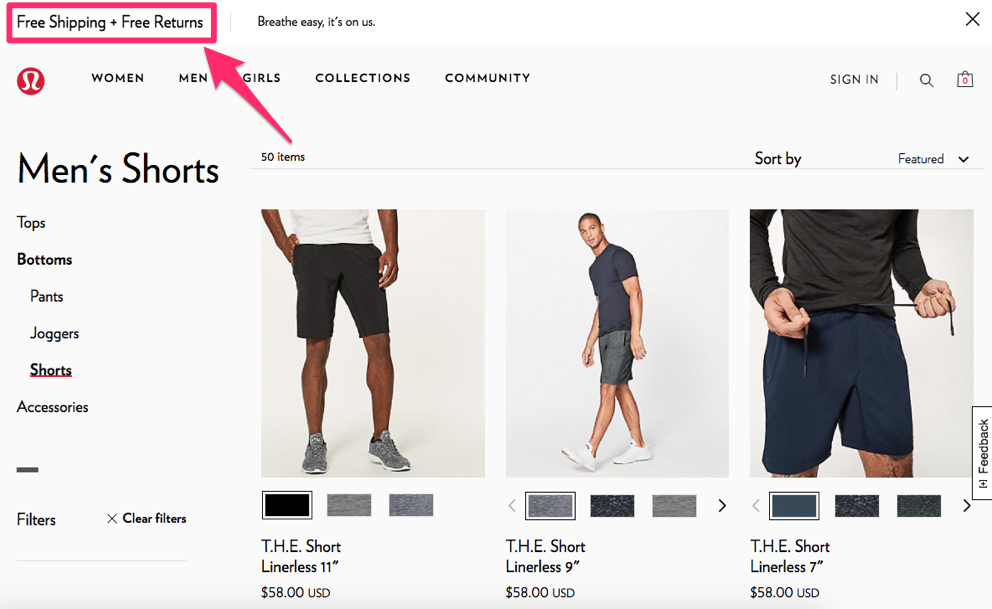
Take a look at this example from Lululemon:

image6 13

When you’re browsing on their website, you can clearly see at all times they offer free shipping and free returns. Their customers know they can get the item delivered free and send it back without any problems.

Obviously, you don’t want items to be returned. Don’t worry, they probably won’t be. In fact, according to the National Retail Federation, about 8% of all purchases get returned.

But just giving your customers the peace of mind can be enough to drive the sale.

In addition to your shipping and return policies, make sure you highlight any other features your company offers. Some things to consider:

  • warranty information
  • secure checkout
  • social proof of the product
  • any differentiating features.

One of these elements can turn a “window shopper” into a paying customer.

Learn how to use images

Believe it or not, pictures can help improve your conversion rates. Instead of just listing your products, show the customer what they’re buying.

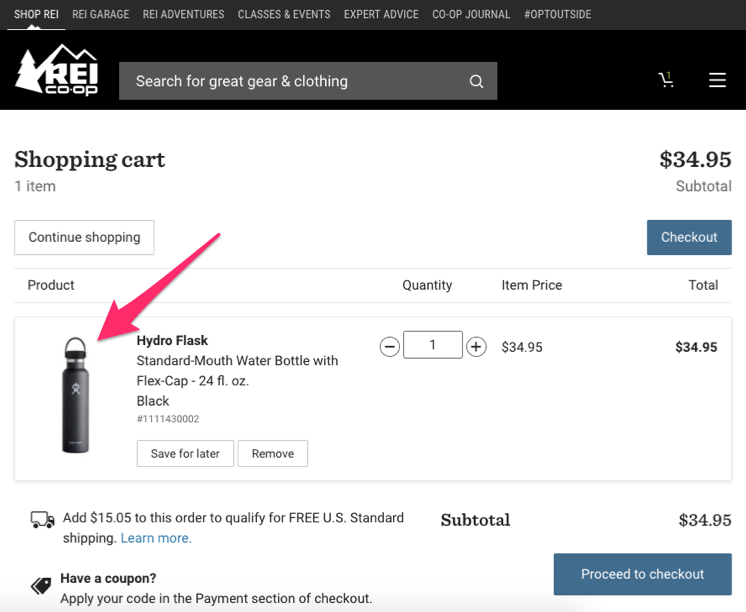
While you may have an image or two of your products on your ecommerce shopping page, make sure that image shows up in the shopping cart.

Why?

This can help remind the consumer what they’re buying and reinforce their decision. Plus, it’s much more appealing than just reading some text on a page.

Here’s an example from the REI website:

image4 13

The consumer gets reminded of exactly what they added to their cart. This could also help avoid any confusion or mix-ups down the road if they selected the wrong color, size, etc.

When they see a visual confirmation of the product they want, psychologically they’ll feel more comfortable about completing the purchase.

Faces also help improve your conversion rates.

According to a recent case study, conversions jumped from 3.7% to 5.5% when an animated picture of a phone was replaced with the face of a customer service representative.

Include images of people on your website. They could be wearing your product, using your product, or be beside your product.

Check out this example from the Macy’s homepage:

image5 13

Notice it shows a person, and that person is looking at the promotional information and the CTA button.

We’ve already established consumers are drawn to faces. In this case, you’d look at the model’s face and then follow his gaze directly toward the text.

This is a great method for increasing conversions.

Simplify the overall design of your website

In addition to simplifying your checkout process, you should also try to clean up your entire website.

If your products are displayed in a cluttered manner, the consumers will feel overwhelmed. They won’t be able to find what they’re looking for, and your conversion rates will suffer.

While you may have hundreds or potentially even thousands of items for sale on your website, you don’t need to cram all of them on to one page.

Less is more.

Let’s look at an example so you can see what I’m talking about. Here is the homepage for Thule:

image9 11

There are only five different places the consumer can click to start navigating through products. On the top header, they can select:

  • racks & carriers
  • active with kids
  • luggage & bags

They’ve also got some options within the main body of the page for:

  • bike racks
  • strollers

That’s it.

Now, as you continue to scroll, you’ll see more options that follow the same format as these two pictures above. But at no time do you ever see more than two pictures and two CTA buttons on the screen at once.

This simple design makes it easy for shoppers to find exactly what they’re looking for.

Give your customers lots of payment options

Some payment options may be more beneficial to your company than others. I completely understand this.

One credit card company may charge higher transaction fees than others, but that doesn’t mean you shouldn’t accept that method of payment.

Recognize your customers have preferences. Certain payment options may give them better reward points or bonus miles over others.

If they want something but can’t buy it with their favorite card, they’ll just buy it from a different retailer instead.

You should accept newer and unconventional types of payment as well. In addition to accepting all major credit cards and debit cards, consider using:

  • PayPal
  • Venmo
  • Apple Pay

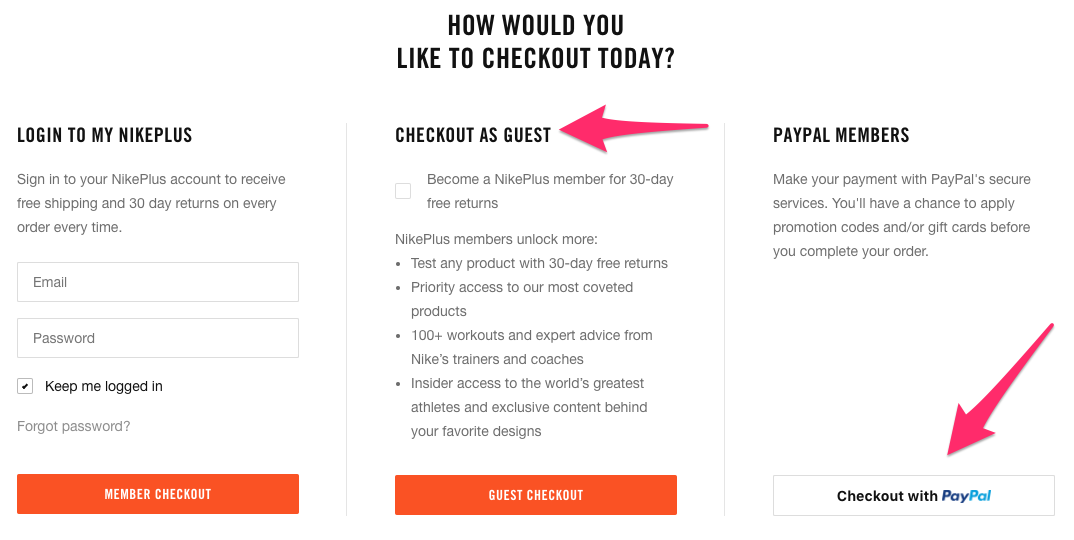
I want to show you an example of this. Here’s a screenshot from the Nike website:

image8 12

If you look at the bottom right corner of the screenshot above, you’ll see they allow their customers to check out using PayPal.

This could appeal to people who have a high PayPal balance and who want to use it for purchases. Accepting PayPal can also help eliminate concerns from customers who may be worried about their credit card information getting stolen.

The reason why I used this example from Nike is because it also highlights another concept I mentioned earlier.

Although they encourage customers to create a profile, they allow them to continue the checkout as guests. Even under the guest checkout area, it shows all the benefits of becoming a member.

To join, all you need to do is check off a box and proceed.

Another quick point about your payment methods. I recommend asking for payment as the last step of the checkout procedure.

By now, the customer has already invested some time into providing other information, so they’ll be more likely to continue. Asking for their payment first could drive them away.

Don’t forget about mobile shoppers

Retailers always need to keep mobile shoppers in mind.

In 2017, 34.5% of ecommerce sales came from mobile devices. That number is projected to reach 54% by 2021.

Your checkout process needs to be optimized for mobile devices. Make sure your site is mobile friendly.

You could even consider creating a mobile app for a checkout process to minimize friction even further.

Touch of Modern is a great example of a successful retail mobile application:

image7 13

You can learn a lot about getting high conversions from their business model.

They get between 150,000 and 200,000 new downloads every month. More than half of their customers are repeat shoppers. Nearly two-thirds of their total sales come from their mobile application.

Those numbers are incredible.

The reason why this app is so successful is because they use daily flash sales and store all their customers’ data on the app, making the checkout process lightning fast.

Customers don’t have to re-input all of their credit card information and shipping addresses every time they want to buy something.

The reduced friction results in high conversions.

Conclusion

Getting higher conversions isn’t that difficult. It just takes some effort.

As you can see from everything I talked about in this article, these methods aren’t really too extreme. They are also fairly easy to implement.

First, analyze your shopping cart abandonment rates.

Next, eliminate any unnecessary steps in your checkout process. Stick to the basics and only ask for information required for a sale.

Encourage shoppers to create a customer profile, but don’t force them to.

Highlight your top benefits. Use images throughout the checkout process to confirm what the customer is buying.

Make sure you offer many different payment options as well.

Don’t forget about mobile customers. Your website needs to be optimized for mobile devices. You may even consider creating a mobile app for your ecommerce store.

If you follow these tips to simplify your checkout process, you’ll get significantly higher conversion rates.

What changes do you need to make to your checkout process to reduce abandonment rates and get more conversions?


Source Quick Sprout http://ift.tt/2swniFt

Here’s What You Need to Know About Flying With Support or Service Animals

Recent reports of the difficulty some airline passengers face when trying to board a plane with service animals highlight how confusing the rules are for traveling with them.

“The Air Carrier Access Act (ACAA) requires airlines to allow service animals and emotional support animals to accompany their handlers in the cabin of the aircraft,” according to the ADA National Network.

The American Disabilities Act defines service animals as “dogs that are individually trained to do work or perform specific tasks for people with disabilities” but acknowledges that its definition does not limit or affect the broader definition of “‘service animal’ under the Air Carrier Access Act.”

Today, many types of animals are recognized as service animals, including ducks, ferrets, snakes and pigs.

But most airlines have strict limits on the size and kind of animals allowed in passenger cabins to ensure everyone on board has a safe and comfortable flight.

For instance, Delta has a long list of animals it doesn’t permit to fly in passenger cabins, including spiders, goats, snakes or anything with hooves, tusks or horns.

When policies on prohibited animals collide with rules allowing people to fly with service or support animals, rules can get murky.

In a story that made international headlines, a woman recently tried to board a United Airlines flight with her emotional support peacock.

United representatives told NBC News the airline turned her away because the peacock, “did not meet guidelines for a number of reasons, including its weight and size.”

A similar situation came up in when a woman tried to take her emotional support hamster on a flight. She was denied travel because Spirit Airlines doesn’t permit rodents on its planes.

If you plan to travel with a service or emotional support animal, it’s important to make accommodation arrangements ahead of time because a missed flight can be expensive.

Detailed information on how to travel with a service or support animal can be found on the website of the airline you’re flying on, or by calling customer service.

Here’s a look at the airline rules and passenger responsibilities at five major airline companies.

1. American Airlines

“Service animals, including emotional support animals, are welcome at no charge if they meet the requirements. They must fit on your lap, at your feet, or under the seat, and cannot block the aisle,” according to the company’s website.

Passengers must provide a letter from their doctor confirming their medical diagnosis or provide an authorization form signed by a physician.

Contact American Airlines for disability assistance online or call reservation services at 800-433-7300 or 800-543-1586 (TDD).

2. Delta

“On a Delta flight, service and support animals are expected to be seated in the floor space below a passenger’s seat, or seated in a passenger’s lap. Service and support animals and their associated items travel for free. The size of the animal must not exceed the “footprint” of the passenger’s seat,” according to the company’s website.

Passengers must fill out a Trained Service Animal or an Emotional Support or Psychiatric Service Animal form and also provide veterinary health information about the animal.

Contact Delta for disability assistance at 404-209-3434.

3. Southwest Airlines

“Service and emotional support animals can be placed on the aircraft floor or on the Customer’s lap (provided the animal is no larger than a child under the age of two). Southwest Airlines does not allow the animals to be placed on an aircraft seat,” according to the company’s website.

Passengers traveling with trained service animals will not be asked to specify their disability, but airline employees may ask some questions about what specific assistance an animal provides.

Passengers traveling with an emotional support animal must provide a letter from their doctor confirming their medical diagnosis.

Contact Southwest Airlines for disability assistance at 1-800-435-9792.

4. Spirit Airlines

“Service and emotional support animals can be placed on the aircraft floor or (provided the animal is no larger than a lap child & there’s no inflatable seat belt) on the customer’s lap. No animals or any part of the animals can be placed on an aircraft seat at any time,” according to the company’s website.

Passengers traveling with trained service animals must provide a service animal identification card, written documentation of medical need, or “reasonable credible verbal assurance” from the person with the disability.

Passengers traveling with an emotional support or psychiatric service animal must provide a letter from their doctor confirming their medical diagnosis.

Contact Spirit Airlines for disability assistance at 801-401-2222.

5.  United Airlines

Trained service animals and emotional support animals “should sit in the floor space in front of the customer’s assigned seat but cannot protrude into the aisles. Customers may elect to use an approved in-cabin kennel for smaller animals,” according to the company’s website.

Trained service animals traveling to international destinations may require documentation.

Passengers traveling with an emotional support or psychiatric service animal must provide a letter from their doctor confirming their medical diagnosis.

Beginning March 1, 2018, passengers must also provide veterinary health information about the animal and confirm the animal has “appropriate behavioral training.”

Contact the United Accessibility Desk at 1-800-228-2744 or email uaaeromed@united.com.

Lisa McGreevy is a staff writer at The Penny Hoarder. She once met a support goat and immediately fell in love.

This was originally published on The Penny Hoarder, which helps millions of readers worldwide earn and save money by sharing unique job opportunities, personal stories, freebies and more. The Inc. 5000 ranked The Penny Hoarder as the fastest-growing private media company in the U.S. in 2017.


source The Penny Hoarder http://ift.tt/2BpmBQT

Questions About Tips, L.L. Bean, Disasters, Diets, and More!

What’s inside? Here are the questions answered in today’s reader mailbag, boiled down to summaries of five or fewer words. Click on the number to jump straight down to the question.
1. Finding a mortgage lender
2. Disaster survival bag
3. Spouse won’t tighten belt
4. Healthy and cheap diet concerns
5. Transforming Debt into Wealth?
6. L.L. Bean options
7. How much to retire?
8. Talk me out of it!
9. Cash tips and taxes
10. Books like The Simple Dollar?
11. Fast food after work routine
12. Dealing with the 10% drop

On Saturday, I went to a place that I expected to be a quiet retreat where I could camp out in a side room and get some work done after a long week that involved lots of snow days and child sickness and other unplanned events.

Of course, an old friend happens to wander in, who immediately insists that I go get a drink and chat for a while. She picked up the tab on both of the drinks, but we found ourselves talking about various things for over three hours, largely deleting the time I had set aside for a project. I am absolutely thrilled that I got to see her and have such a good, long conversation with her.

This led me to a very stressful Sunday, which is when I’m typing this. My to-do list for the next six days is long and incredibly intimidating.

It was great to see an old friend, and I don’t regret it for a second. This to-do list, however, is less than great.

Time to get efficient, Trent. Time to get efficient.

Q1: Finding a mortgage lender

My question for the reader mailbox has to do with searching for a mortgage lender. We’ll be buying our first home in the next couple of months and we just don’t know where to start. We’ll be moving to a small town in the Midwest (where there will probably only be a couple of banks/credit unions in town) and I’m not sure how to go about finding the best rate. Our credit scores are 774 and 734 and we plan on putting 20% down. Is there a way to (a) search for a competitive price without physically being in the area we plan to move to and (b) search for a price without having 20 companies run credit checks (and thus further lower our credit score)?
– Maria

Your best approach is to contact specific lenders rather than doing a big batch search. I would strongly encourage you to spend some time investigating specific lenders, starting with ones that operate in the area you’re considering moving to, and find out about their reputation, their customer service, and whether they just repackage and sell off your mortgages to other bigger banks.

So, your first step should be to get a big list of banks and credit unions operating in the area where you’re considering moving and then start investigating them first. What kind of rates do they offer on mortgages? If you can find reviews of them, are they positive or negative (don’t let one or two negative reviews chase you away, though, as there are lots of reasons for that beyond what the review says)?

Once you find a few that seem to match what you’re looking for, call them up individually and ask about their lending process. Do they do manual underwriting? Do they keep the mortgages themselves or repackage them and sell them off? What are their current rates?

At this point, you’ll probably have one or two standouts. Get pre-approval through them and go with the one that seems like the best fit.

Q2: Disaster survival bag

My family were victims of Hurricane Maria. This awful event got me thinking and I want to create a disaster survival backpack to have in the basement of our home. What do you recommend me to have in our backpack?
– Alex

The checklist offered by Ready.gov, which you can see here, really covers it. I think the “Basics” list is really good, which I’m sharing here along with a few of my own notes:

* Water – one gallon of water per person per day for at least three days, for drinking and sanitation (you probably wouldn’t have this in your backpack, but having a few water bottles in there is smart and having a few gallons of water outside of that is also smart)
* Food – at least a three-day supply of non-perishable food (stuff you don’t have to cook and could subsist off of with ease, like nuts and crackers and tuna packets)
* Battery-powered or hand crank radio and a NOAA Weather Radio with tone alert
* Flashlight
* First aid kit
* Extra batteries for the flashlight and radio
* Whistle to signal for help
* Dust mask to help filter contaminated air and plastic sheeting and duct tape to shelter-in-place
* Moist towelettes, garbage bags and plastic ties for personal sanitation (you don’t want to bathe in flood water, trust me)
* Wrench or pliers to turn off utilities
* Manual can opener for food (if your food supplies contains canned goods)
* Local maps (do not trust GPS)
* Cell phone with chargers and a backup battery (this can be a super-cheap pay-as-you-go phone, but make sure you have numbers that you may want to call available on a printed sheet)

You’ll also probably want a change of clothes for everyone in the family and a few very basic toiletries and sanitizing gel.

Q3: Spouse won’t tighten belt

I am a freelancer and with that comes some pay variability. In 2015-2016 I went on a long run of having more work than I could handle and I was able to charge some pretty high rates to boot. We were flush with cash and splurged a little during that time while also paying off a lot of debt. Right now, I’ve still got some work but not as much as I once had and not at the same rates, so my income is down a lot from that peak but still good. The problem is my wife wants to continue to spend like we did in 2016-2017. She did things like buying a season pass for all of us at a ski resort and giving her sister a $5000 wedding gift without even talking to me. We had a big argument about it the other night and she told me that “there was no point in living” without being able to spend like that. We simply can’t afford it and I don’t know what to do.
– Marcus

Your spouse likely feels that the changes in spending from 2016 to now are an attack on her and her choices. My suggestion is to sit down with her and make a budget based on your actual income. Just make a list together of what’s “required” spending and see what’s left over and figure out where that goes, together.

Honestly, this story sounds less to me like a spouse that refuses to buckle down but one who feels like they have a parent/boss telling them what to do. That rarely works well in a marriage.

You need to sit down together and work out a better solution together, and this has to be centered around both of your inputs, not just one person telling the other what to do. If your spouse won’t sit down at all for this process, then you have a problem, but it doesn’t sound like you’ve even tried yet to sit down together and budget as a team.

Q4: Healthy and cheap diet concerns

You can’t make a healthy diet out of just cheap foods. You can’t just live off of rice and beans!
– Adam

Of course you can’t, but you can fill an awful lot of your plate with rice, beans, pasta, and whatever produce is on sale in your grocery flyer. That can make up the vast, vast majority of your diet.

The goal isn’t to eat nothing but rice and beans and cheap produce, but to make those the backbone of your meals, which you can then supplement with smaller amounts of whatever works.

For example, we prepare a lot of Indian dishes in our home. We serve rice with all of them as rice goes wonderfully with sauces and curries.

We just look for things that happen to center around low cost items rather than deciding on a particular expensive item and then trying to jam inexpensive things in alongside it. Rather than saying “what goes good with this $11 cut of meat,” we start by asking “what goes good with rice or with beans or with these super-cheap carrots” and then move from there. If you let the cheap stuff lead, your meal will be far less expensive on average.

Q5: Transforming Debt into Wealth?

I keep hearing about a “Transforming Debt Into Wealth” system on the radio. Can you tell me about it? Is it worthwhile?
– Tammy

“Transforming Debt Into Wealth” is a program promoted by a man named John Cummuta, often on talk radio stations. At its core, the system is extremely similar to most other debt repayment plans, the basics of which I describe here. In fact, the main difference between Cummuta’s plan and any other one out there is the promotional style and the cost of it – “Transforming Debt Into Wealth” is rather expensive.

All debt repayment plans boil down to the same principles – organizing your debts, cutting back on spending, seeing if you can reduce the interest rates on those debts, and then paying them off rapidly. They all offer their own little tweaks that can help motivate you, but the foundation is just that basic debt repayment plan.

Cummuta talks about paying off mortgages in three years, which is possible if you do some extreme cutting and some hardball negotiations on your debts, but that’s true of any debt repayment system.

There’s nothing wrong with it, per se – it’s just a pretty standard program of debt repayment strategies that you can find in lots of other places for free or for minimal cost (depending on the kind of coaching you want). My only real criticism of it is the relative expense, especially since it’s targeting people who are already struggling financially.

Q6: L.L. Bean options

Is L.L. Bean still a good place to buy clothes not that they have ditched their lifetime guarantee?
– Adam

I received several questions about L.L. Bean this week after they announced that they’re ending their lifetime guarantee after, in their words, “a small, but growing number of customers has been interpreting our guarantee well beyond its original intent. Some view it as a lifetime product replacement program, expecting refunds for heavily worn products used over many years. Others seek refunds for products that have been purchased through third parties, such as at yard sales.”

I can understand that perspective, even if it does mean ending a program that set L.L. Bean apart from other clothing lines. However, their replacement program is somewhat limited. “Customers will have one year after purchasing an item to return it, accompanied by proof of purchase. After one year, we will work with our customers to reach a fair solution if a product is defective in any way.”

I think they could have sought out a middle ground, where they track the original owner of the item and allow that person alone a guarantee with the item, then have that policy start in a year or so. To me, that would have been the best “compromise” solution.

So, should a person no longer buy L.L. Bean clothing? I think some of the value came from their guarantee, so I can’t wholeheartedly recommend them any more. They are now on a similar level with a lot of other relatively high quality clothing manufacturers – it was their guarantee and strong return policy that set them apart for me. That doesn’t mean I’d never buy a L.L. Bean item, but that they no longer stand out above the crowd and are now a part of a large crowd of very solid clothing manufacturers.

Q7: How much to retire?

How much money would it take for you and Sarah to retire? Let’s say you were to inherit big money. How much to just stop working?
– David

I would want us to inherit enough to match our current take-home salaries, plus enough to pay for health care costs, plus enough to pay for taxes, and have that only be 2% of the value of our inheritance. That way, we could just invest all of it, withdraw 2% each year, and live off of that, which would be less than the annual growth of the investments, so we’d stay well ahead of inflation.

I’d have to run some numbers on this, but let’s say that I calculated that out to be $100,000 a year. I’d want that to be 2% of our inheritance, so we’d want about $5 million in inheritance to just quit our jobs.

So, yeah, I think $5 million would do it, at least right now.

Q8: Talk me out of it!

I am really really tempted to buy an iPad. I have one of the very first ones and I used it a lot but not quite as much as I might have because it was pretty heavy, about twice as much as it weighs now. I made the mistake of picking one up and playing with one a month ago and now I’m obsessed over getting a new one! But it’s like $600! Talk me out of it!
– Jane

What exactly would you do with that iPad that you can’t already do with the devices you have? What truly different use case do you have that isn’t already met by your phone or by your computer or by your Kindle (or by whatever other devices you have?)

Does the iPad truly do something distinct? If not, there’s absolutely no reason to buy it.

If it does do something distinct, are those distinct things really worth $600 of your hard earned money? If not, there’s absolutely no reason to buy it.

I’ll be the first to admit that an iPad is a cool device, but it honestly doesn’t fill any use case in my life that isn’t met by other devices. It might do a few uses a little better than what I have – for example, setting it up in the kitchen to show a recipe or something – but I have other devices that can actually do that already. Those minor improvements aren’t worth $600.

Q9: Cash tips and taxes

I started working at a restaurant for 20 hours a week. I get paid a low wage plus tips. My boss says I am supposed to report tips on my taxes but how will anyone know what I make in cash tips that I stick in my pocket? I mean with the credit card tips there is a record but with the cash tips, why would I pay taxes on it?
– Kelly

You’d pay taxes on it because the government considers tips to be taxable income. They just require reporting on what amounts to the honor system because it’s basically impossible to really track it.

So, you can just pocket cash tips and not report them because it’s extremely difficult for the IRS to trace it down, but that doesn’t mean it’s not tax evasion. You’re still earning income and not paying taxes on it.

How might the IRS catch you? Well, if they ever get suspicious, they’ll audit you, and if they can determine you’re spending a lot more than you’re reporting, they’ll keep investigating until they have answers. Now, in reality, they probably won’t go after a part-time waitress who mostly receives credit card tips, but the reality is that they might, and by not reporting, you’re leaving that opening.

You’re legally obligated to pay the taxes on your tips. However, it’s hard to easily prove that you’re not doing it, though it can be done. It’s up to you to decide what to do in response to that knowledge.

Q10: Books like The Simple Dollar?

I love your blog and read it daily. My husband prefers books so I wonder, do you guys have a book out that I could buy for him to read? Preferably NOT an online book.
– Alicia

If you want something similar to The Simple Dollar, I’d perhaps first point to my 2010 book The Simple Dollar. While I think that the book is largely good and is actually my own work, I learned some lessons about the publishing industry from that experience. The book was heavily edited and reorganized in ways that I didn’t fully approve of, but there are pieces that I am quite proud of in that book.

This is probably the right place to “soft announce” that I’m writing a different book that I’m intending to self-publish so I can retain more control over the editing process. I’ve been working on it for about three years now and I hope to talk more about it soon. The focus is more on timeless personal finance approaches, in that it will be a valuable read when it’s published as well as twenty years after it’s published. I have zero interest in discussing the hot new investments or the strategy that works right now and doesn’t mean anything in three years.

The book that inspired me the most in my own journey is Your Money or Your Life by Joe Dominguez and Vicki Robin. It really helped me figure out my relationship with money early on in my financial turnaround, and most of the principles have stuck with me.

Q11: Fast food after work routine

Do you have any suggestions for breaking a fast food addiction? I stop for a box of chicken nuggets after work each night because I’m usually famished after work, and I munch them on the way home. It’s expensive as all get out and not particularly good for my health so I tried to cut it out but now I spend the whole drive home absolutely starving both because I really am hungry and because my head is kind of conditioned to think about the drive home as a time to eat nuggets. Ideas?
– Charlie

Stock your freezer with some protein-rich convenience foods that you can microwave as soon as you get home, whatever it is that you like. This is a really good recipe for making your own nuggets that you can freeze, and they’re pretty cheap and definitely healthier than the fast food ones.

You can also (possibly) take a small bag to work and microwave them just before you leave if you find that you really want them on the way home.

I would also suggest exploring other protein-rich foods for this purpose. You don’t have to stick with just chicken nuggets! Consider keeping some nuts in your car, for example, or some beef jerky. Both options are going to be cheaper than a box of nuggets on the way home (and probably healthier, too).

Q12: Dealing with the 10% drop

So I like to check my retirement accounts once a week just to see how things are going. I looked this morning and I had lost $80,000 in a week. I am sitting here having a hard time processing that. Help.
– John

The key thing to remember is that an investment in the stock market is a long term investment that, over the long term, should go up by an average of about 7% or 8% a year. Over the last decade, it’s exceeded that substantially every year, and this is just a correction back down to that average.

Here’s how I look at a stock market drop. First, I go back over the last ten years or so and look at the annual gains. Are they way over 7% each year? If so, then there should be a losing year at some point, and maybe 2018 is that year. It’s hard to predict, but it will eventually happen.

Second, I recognize that the contributions I’m making now are now buying 10% more shares than they were a week ago. A share that cost $100 a week ago now costs $90, so if I invest $1,000, I will now have 11.1 shares, whereas if I bought them a week ago, I would have only bought 10 shares. Shares are on sale right now!

Together, those two thoughts usually undo any negative feelings that I have. In truth, I very rarely check my balances at all. There’s no benefit I can find in doing so, because it’s not really going to cause me to take any action whatsoever. It just causes me to worry with no reason.

Got any questions? The best way to ask is to follow me on Facebook and ask questions directly there. I’ll attempt to answer them in a future mailbag (which, by way of full disclosure, may also get re-posted on other websites that pick up my blog). However, I do receive many, many questions per week, so I may not necessarily be able to answer yours.

The post Questions About Tips, L.L. Bean, Disasters, Diets, and More! appeared first on The Simple Dollar.


Source The Simple Dollar http://ift.tt/2ElUXqT

How This Mom Ditched the Cube and Launched a Home Business From Scratch

Becky Flansburg is WAHM, Influencer, Blogger, and Freelance Writer. Her veteran blog Franticmommy.com shares her unique and humorous perspective on children’s books, parenthood, and women in business. She is also the project manager for the non-profit children’s literacy event, Multicultural Children’s Book Day and is one half of the dynamic mommy-duo at UpNorthParent.com. She is […]

The post How This Mom Ditched the Cube and Launched a Home Business From Scratch appeared first on The Work at Home Woman.


Source The Work at Home Woman http://ift.tt/2ElobpI

More Than Free Eggs: How One Family’s Backyard Chickens Keep On Giving

Stroudsburg updated on street projects

STROUDSBURG —The Borough Council reviewed updates on a list of various improvement projects on its local streets Tuesday.Engineering contractor RKR Hess of East Stroudsburg is offering to help the borough apply for funding to upgrade the sanitary sewer line running beneath Ann Street, between Eighth and Broad streets, according to a recent letter to the borough."The options we are investigating focus on... pipe bursting or slip lining to essentially rehabilitate the [...]

Source Business - poconorecord.com http://ift.tt/2sonQge

How to Start Investing on a Tight Budget

If you’re living paycheck-to-paycheck, without much wiggle room in your budget, you might assume that investing just isn’t something you can do right now.

And in some cases you may be right. Sometimes you really do just need to focus on paying your bills, keeping food on the table, and getting your budget in order.

But you don’t need to have a lot of money to start investing. There are a number of ways to get started on a tight budget, and every little bit you can save and invest now will make things easier on you down the line.

Here are a few ways to get started.

Focus on What Matters

Most of the news you hear about investing focuses on the ups and downs of the stock market. And while that can certainly be entertaining, the truth is that those ups and downs are largely irrelevant when you’re just starting out.

There are two things that do matter though, and both your wallet and your anxiety level will thank you for focusing on them instead:

  1. Your savings rate: No other factor is even remotely important as your savings rate. Investing even a little bit now will help, and finding small ways to increase that savings over time go a lot further than trying to study or time the stock market.
  2. Costs: Cost is the single best predictor of future investment returns, with lower costs leading to better returns. And minimizing your costs is especially crucial when you’re on a tight budget, since even small fees can take a huge bite out of your savings.

Build an Emergency Fund

An emergency fund is simply money you keep in a savings account for those unexpected expenses life always seems to throw your way.

And while this isn’t technically an investment in the sense that you’re not putting money into mutual funds, stocks, or bonds, there are a few reasons why it’s a great first step:

  1. It’s an investment in your financial security, and a secure financial foundation makes it easier to invest in your financial future.
  2. Good savings accounts come without any minimum balance or contribution requirements, so you can get started with any dollar amount.
  3. Given that your savings rate is far more important than your investment return, you’re not sacrificing as much as you might think by keeping your money out of the market.
  4. The skills needed to build an emergency fund – namely making regular contributions and letting the money grow without touching it – are skills that will also help you build your investments. Honing them now will help you later.

Invest in Your 401(k)

Here’s where we get into the traditional long-term investments.

Your 401(k) – or your 403(b) or 457 in some cases – is a retirement plan offered by your employer. You typically contribute a set percentage of every paycheck and choose from a collection of mutual funds in which you can invest. Your contributions are usually tax-deductible and the money grows tax-free until you withdraw it in retirement.

There are a few reasons why your 401(k) is a great place to start investing when you’re on a tight budget:

  • It’s easy to setup. All you have to do is choose how much you’d like to contribute and you’re good to go.
  • There are no minimum contribution requirements. You can start by contributing as little as you’d like.
  • You may get an employer match, which could as much as double the impact of every dollar you contribute.
  • Your contributions are tax-deductible, which means that the hit to your take-home pay is smaller than your actual contribution. You may even be eligible for the saver’s credit, which would put even more money back in your wallet.

Contributing to your 401(k) up to the point where you’re maxing out your employer match is a no-brainer as a starting point. Especially when you’re on a tight budget, those extra dollars can make a big difference.

Beyond that, it’s worth noting that some 401(k)s are burdened by high-cost investment options, which might make other accounts more attractive as a next step. Which brings us to…

Start an IRA

If you don’t have a retirement plan at work, or if your employer doesn’t match contributions, you could consider starting with an IRA instead.

An IRA is simply a retirement account that you open on your own instead of through an employer. And it comes in two different flavors:

  • Traditional IRA: Your contributions are tax-deductible and your money grows tax-free, but your withdrawals in retirement are taxed.
  • Roth IRA: Your contributions are not tax-deductible, but your money grows tax-free and you can withdraw it tax-free in retirement.

While there are often reasons to prefer one or the other, for our purposes here all that matters is that they are both great ways to save and invest. The trick is finding one that one that doesn’t charge a lot of fees and that doesn’t have minimum account balance or contribution requirements.

Betterment could be a good choice if you’re looking for an easy, low-cost way to open an IRA without any account minimums. You can review other IRA providers here.

Pay Off Debt

Like building an emergency fund, paying off debt is not an investment in the way that we typically think about investments.

But if your objective is simply to make the most out of the few dollars you have available to save, paying off debt might be your best option.

Think about it this way: Experts seem to agree that 7% to 7.5% is a reasonable estimate for long-term stock market returns. But those returns are not guaranteed, there will be lots of ups and downs along the way, and a more balanced portfolio that includes bonds may reduce that estimate to 6% to 6.5%.

On the other hand, every extra dollar you put towards debt earns you a guaranteed return at the rate of your interest charges. Putting an extra dollar towards your credit card that charges you 15% in interest earns you a 15% return. An extra dollar towards your student loan with 6% interest earns you a 6% return.

Put simply, paying off high-interest debt often allows you to get stock market-like returns without all of the uncertainty. If that’s not a smart investment, I don’t know what is.

Invest in Yourself

Learn new skills. Negotiate a raise at work. Find ways to earn some income on the side.

These investments in yourself generally only cost some of your time, but can pay off in the form of more income — which means you’ll have more money available to save and invest.

And given that your savings rate is the most important part of your investment plan, this may be the single best move you can make.

Matt Becker, CFP® is a fee-only financial planner and the founder of Mom and Dad Money, where he helps new parents take control of their money so they can take care of their families.

Related Articles:

The post How to Start Investing on a Tight Budget appeared first on The Simple Dollar.


Source The Simple Dollar http://ift.tt/2sogn0Z

7 Simple Steps to Take This Week to Improve Your Finances

One week. Seven days. It’s not such a long time.

But if you commit to the seven-day plan we’re laying out here, you can fix your finances in just a week. Then you can flex your arms and say, YES, I AM MR./MRS. FIXIT.

At the very least, you can take steps to improve your financial situation in some tangible ways.

C’mon, seven days. Give it 15 minutes a day. Get out your calendar, and let’s give it a go.

Day 1: Take Steps to Raise Your Credit Score

How about a better, more strategic look at your finances — particularly your debts? Credit Sesame can help you figure it out.

Credit Sesame gives you a “credit report card” that shows you a free credit score, plus lays out your credit history so you can see exactly how much money you owe and to whom.

It even tells you your monthly payments and interest rate, as well as which debts are in collections.

The app lets you keep track of your credit score and recommends ways to improve it. Also, signing up for it won’t hurt your credit score.

For example, it might recommend a mortgage lender, credit card or debt refinancing company, based on your needs and chances of being approved.

Small business owner Kenneth Bain raised his credit score 234 points using Credit Sesame. He said it became like a game, and he wanted to achieve the high score.

“I literally checked my credit every day, two to three times a day,” he told us. “I remember the day I logged on and saw 721… and [I thought], ‘Yes, finally! My hard work paid off.’”

You can sign up for Credit Sesame and get your free credit report card here.

Day 2: Start Stashing Some Cash Away

It’s no brilliant secret that investing can be a smart way to grow your money.

Sometimes, though, it feels restricted to a few wealthy elite.

Stash is different. This app lets you start investing with as little as $5 and for just a $1 monthly fee for balances under $5,000. (The first month is fee-free.)

Stash curates investments from professional fund managers and investors and lets you choose where to put your money.

It leaves the complicated investment terms out of it. You just choose from a set of simple portfolios reflecting your beliefs, interests and goals.

Bonus: Right now, The Penny Hoarder is teaming up with Stash to fund your first investment — so you’ll get a $5 bonus to get started!

Day 3: Consolidate Your Debt

Consolidating your debt could substantially reduce payments you’re already making on your debt and help you save more money each month.

A lot of us are being crushed by credit card interest rates north of 20%. If you’re in the same boat, it might be worth seeing if you can consolidate and refinance your debt.

A good resource is consumer financial technology platform Even Financial, which can help match you with the right personal loan to meet your needs. Because you’re not applying for the loan, checking out your options won’t ping your credit report.

Even searches the top online lenders to match you with a personalized loan offer in three steps. Even’s platform can help you borrow up to $100,000 (no collateral needed) with fixed rates starting at 4.99% and terms from 24 to 84 months.

Day 4: Have a Robot Negotiate for You

The price of internet — and cable, if you’re still into that kind of thing — certainly isn’t decreasing. If anything, prices are steadily climbing.

And if you’ve had to chat with a representative from your internet or cable company recently, you know how long you can sit on hold.

That’s why it’s time to call in a robot. A negotiation bot like Trim will negotiate your cable or internet bills down for you.

It works with Comcast, Time Warner, Charter and other major providers. You can sign up simply with Facebook. Then upload a PDF of your most recent bill, and Trim’s AI-powered system gets to work. If at first it doesn’t succeed, it’ll keep negotiating until it can save you some money.

Also, if you have any outages, Trim believes you deserve a credit, and it’ll handle that for you.

Trim keeps 25% of the savings tab, and you get the rest.

Day 5: Seriously Rethink Your Student Loans

For some, lowering your interest rates could be one of the best ways to pay off student loans.

Try getting a lower interest rate on your federal and private loans by refinancing with a company like Credible. There are others that offer similar services, but we like that the average Credible user saves about two interest points on their current federal loans — or an average of $18,886.

Refinancing will generally mean replacing your laundry list of loans with one (or a few) loans that bring all your student debt under one umbrella.

This could simplify your life with one monthly payment, instead of several. It might also reduce your monthly payment, improve your interest rate and/or give you more time to pay.

It might seem like a small difference, but a lower interest rate can mean a lot of savings over time. It’s helping grad Ashley Williams save more than $18,000 in interest over the life of her loan!

Enter your info at Credible to find out what your new interest rate could be (without pinging your credit).

Day 6: Start Keeping Your Receipts

Can’t hold off on that purchase for a big sale? Do the next best thing: Buy it now and get a refund next time the price drops.

Your secret weapon here is an app called Earny. It scans your emails for receipts, looking for online purchases from participating retailers like Amazon and Target.

Earny takes advantage of retailers’ price-match policies to negotiate a refund on your behalf. So you don’t have to do anything — just wait for a notification that you’ve earned cash back.

You’ll get a refund via your original payment method, store credit or a check in the mail, and Earny keeps a 25% fee only when it saves you money.

Day 7: Maximize Your 401(k)

Got a 401(k)? You’re on the right track.

Now you just need to make sure it’s doing what you need it to. However, tapping into that account and deciphering the information — or lack thereof — can be hard.

There’s a robo-advisor for that. Blooom, an SEC-registered investment advisory firm, will optimize and monitor your 401(k) for you.

A few of us Penny Hoarders use the service. It gives you an initial 401(k) checkup for free, and you’ll get to know your account a little more intimately. Find out if you’re paying too many hidden fees, have the appropriate amount invested in stocks versus bonds, that kind of fun stuff.

After that, the tool is $10 a month to use to continue to monitor your retirement account. Let Blooom know your target retirement age, and it can help you get there by investing more or less aggressively.

And that’s it. One week.

Seven days.

Mike Brassfield (mike@thepennyhoarder.com) is a senior writer at The Penny Hoarder. He’s going to need more than seven days to fix his finances.

This was originally published on The Penny Hoarder, which helps millions of readers worldwide earn and save money by sharing unique job opportunities, personal stories, freebies and more. The Inc. 5000 ranked The Penny Hoarder as the fastest-growing private media company in the U.S. in 2017.


source The Penny Hoarder http://ift.tt/2CerfxR