Thousands of courses for $10 728x90

الاثنين، 1 يوليو 2019

Questions About AirPods, Telecommuting, Military Retirement, Gold Coins, and More!

What’s inside? Here are the questions answered in today’s reader mailbag, boiled down to summaries of five or fewer words. Click on the number to jump straight down to the question.
1. Telecommuting in the country?
2. Military retirement question
3. Cheap alternatives to AirPods
4. Stuff now, money later?
5. Youtube or Spotify?
6. Bad luck with scholarships
7. Choosing car insurance
8. Son getting into Magic cards
9. Gold coins in bank box?
10. Retirement fluctuations feel abstract
11. Why I love the library
12. My summer reading list

One of the toughest parts of the reader mailbag is editing the questions.

Most of the questions I receive need a little bit of editing, usually because there are elements to the question that could reveal the identity of the person writing the question. They’ll mention a specific employer or give specific dates or timeframes or dollar amounts or name specific people. I’ve learned in the past that it can be very bad for people if their identity is clear or suspected from mailbag questions (for example, if a person is considering a divorce or retirement or something like that and hasn’t discussed it with their partner or employer), even seemingly innocuous ones, so I want to “blur” those elements as much as possible without disrupting the value of the answer to the question. Mostly, I’m trying to keep out their specific identity while retaining as much of their actual question as possible.

Sometimes, that forms a very fine line. How much “blurring” is too much? In the end, if I’m in doubt at all, I err on behalf of keeping identifying details out of the mailbag. Sometimes that verges on changing the nature of the question a little bit, but it still remains useful to the thousands and thousands of people who read the mailbag column each week.

My aim is to help people, and part of that is to never disrupt lives.

On with the questions.

Q1: Telecommuting in the country?

I got a new job in the Boston area that allows people to work remotely as long as you go to a quarterly retreat in the Boston area. I’m burned out living in cities and want to live in a rural area or small town. It’s cheaper and a lot less crowded.

My main concern is quality of internet service. Some rural areas apparently still use dial-up which is a non-starter for my work. Is there a way to screen for rural areas with good internet access?
– Adam

I live on the edge of a pretty small Iowa town and I have internet service that never seems to go lower than about 150 Mbps and is usually around 400 Mbps, which is near the upper limit of 802.11n wireless.

My advice is to look for small towns that are within 20-30 miles of a college town (or perhaps actually a college town) and start filtering from there. Most small towns near college towns tend to be bedroom communities for people who want to live in small town areas, but they also typically demand good internet service, so in many such areas internet cooperatives have emerged or else the providers in the college towns have extended out to the surrounding towns.

If you’re looking to stick in New England, I’d look at the areas around Hanover, NH; New Haven, CT; and Burlington, VT. Those would be an easy drive from the Boston area and would be quite rural.

If you’re wanting to go further away, the country really is your oyster.

Q2: Military retirement question

Next May I will be eligible to retire from the military with 21 years of service, meaning I am eligible for High 36 retirement and will receive 52.5% of my annual salary for life if I retire at that point. My CO is strongly encouraging me to reenlist but I haven’t made up my mind. Reenlistment would keep me in for several more years and bump up my retirement percentage to around 65%, enough that I could probably live off of it if I wanted to. Not sure I’d want to make it off of 52.5%. I enjoy the work and routine and I’m not sure what I would do if I leave but I also don’t want to be one of the old guys hobbling around. I have been very careful with my pay and have about $45K in savings. What would you do in my situation?
– Gary

First of all, thank you for your service. I have had several family members serve and I know it has a lot of challenges, personally and professionally.

In your situation, the one question on my mind would be what exactly I would do if I didn’t reenlist.

I’m estimating from this story that you’re in your very late thirties to mid forties. Your writing makes you appear well spoken, which is a good sign. I don’t know what your service has provided you with in terms of employable skills and experience, so the first thing I’d do is figure out what your skills translate to in civilian life. Are those things you would be happy doing? Are those fields in demand enough that you could get a good job in those fields (I’m sure your service record, if it’s good enough that your CO wants you to reenlist, is a positive)?

At this point, your finances are in great shape, so if I were you, I’d simply choose the path that seems like it would give you the most fulfilling daily life. A military pension is a rock solid one, and with the additional money you have saved, you’ll be in good financial shape no matter which way you choose. So, choose the one that you feel will give you the best life throughout your forties and fifties, until you choose to fully retire.

Q3: Cheap alternatives to AirPods

My daughter wants Air Pods for her birthday but it seems ridiculous to me to spend $160 for ear buds. Is there a less expensive alternative to wireless ear buds that work just as well without the Apple markup?
– Kevin

The cheapest wireless ear buds that I know of that supposedly do a good job are these JBuds for $50. The biggest difference I’ve seen between them and AirPods are the color/design, the distance you can hold them from your phone without losing signal (it’s a little less for these), and there’s a fraction of a second latency that’s barely noticeable when watching videos (it doesn’t matter when just listening to music or podcasts). They’re probably the bargain ones I’d get.

If your daughter is an athlete and runs a lot, you may want to also look at these Jabra Elite Sport wireless earbuds. They’re similar to AirPods, but they also function as a heart rate monitor and have other useful functions for runners. The MSRP on these is similar to AirPods, but these pop up on sale pretty frequently.

If you decide to go the AirPods route, you can find them fairly regularly below MSRP on eBay, but pay careful attention to the seller when buying.

Q4: Stuff now, money later?

I’ve been struggling a lot with your suggestion to think about whether you’d rather have stuff now or money later. Almost always I’d rather have the stuff now so your suggestion isn’t helping.
– Chris

It didn’t help me either, at first.

For me, that question is a reminder of the things I want in life beyond that thing I happen to hold in my hand at the moment. I have spent a lot of time thinking carefully about what it is I want from my future, and I recognize that what I want more than anything else is financial freedom. I want to be able to wake up in the morning and have only responsibilities I’ve chosen because they’re important to me, not responsibilities I have to take on because I need to make money. That’s my dream, and it’s a strong one.

When I look at an object in my hand and I ask myself whether it’s worth putting off that dream for a day or a week or whatever, I become quickly hesitant to buy it. After that, I ask myself whether this item is really going to add anything meaningful to my life, and almost always, by that point, the object is back on the shelf.

Both of those realizations took time to actually work. They didn’t work well at first. They both required some reflection on what I want from the future and, frankly, what I want from right now. Temptation is a tricky thing, but once you start to see past it, it loses a lot of strength.

Q5: Youtube or Spotify?

If I can just listen to music all day from Youtube for free, why should I ever pay for Spotify? I don’t get the point.
– Jenna

I’m not trying to sway you one way or another with this; I’m just attempting to clarify what you get with Spotify.

First of all, a paid Spotify account doesn’t have ads in it. Whenever I find myself listening to Youtube and having songs auto-load, there’s almost always an ad between each song.

Second, Spotify works really well on mobile and allows you to download the music so that you don’t have to use data to listen to it when you’re out and about. It works far better than just listening to Youtube videos if you have a limited data plan and aren’t always in LTE range.

Third, Spotify does a really good job with playlists, which helps a lot with discovering new music and listening to batches of music you want to listen to.

I’m not saying people should subscribe to it, but if you listen to music for a large portion of your day, particularly when out and about, Spotify might be a worthwhile expense for you.

Q6: Bad luck with scholarships

My son just graduated high school and is entering college in the fall. He spent a ton of time applying for scholarships all through the school year and managed to get a whopping $500. He would have been better off working at Subway. What a rip.
– Alice

Most scholarships that are well-promoted, particularly ones with a wide range of eligibility, tend to be utterly inundated with responses. They’re offering four scholarships and get a thousand entries. Often, they barely have the staff to even look at all of the entries, so they do a very quick filter on the entries and narrow it down fast, often eliminating good candidates out of expediency.

So, what can a person looking for scholarships do?

My best advice is to look locally for scholarships. Try to find ones that mostly apply to students in your area. My experience has been that if the parents or the family is involved in a community group and that community group offers any sort of scholarship, those kids have a very very strong chance of getting one.

So, my advice for parents with kids that may be angling for scholarships in the near future is to get involved with the community. Find some organizations that you can get involved with in a meaningful way and dive in, but don’t just do it for the scholarship. Do it for the purpose, and for the personal experience and growth. Do that and opportunities are much more likely to reveal themselves.

Q7: Choosing car insurance

Shopping around for car insurance. How do you choose between policies that have similar prices? I mean which one is better? I have four quotes that are basically identical.
– Erin

My advice would be to check out the Consumer Reports car insurance buying guide. They do a really thorough job of comparing insurers. Unfortunately, their full comparison of insurers is behind a paywall.

So, what can you do? If I were you, I’d hit the library and look through their back issues of Consumer Reports – it’s a magazine that most libraries carry. It looks like the most recent issue that had side-by-side comparisons of auto insurance providers was the March 2017 issue. I would expect that another comparison will be forthcoming in the near future, so I’d look at very recent issues, too.

My experience has been that most of the really big car insurance providers were all bunched up together with fairly similar ratings, but I’m not sure which four insurers you have quotes from. In general, if they seem really similar, go with the one that has good customer service scores and has a high satisfaction rating from customers, which you’ll find in that Consumer Reports article.

Q8: Son getting into Magic cards

My 13 year old son and a few of his friends are getting into Magic: the Gathering. A local shop gave them some free decks and a bunch of cards and they seem to be happily building decks to play with each other at lunch. However, it seems to be a really expensive hobby to get into. Do you have any suggestions for keeping it low cost?
– Adam

Magic really only gets expensive if you want to play in tournaments, which almost require you to spend quite a lot to build competitive decks. The nature of the free market is that when certain cards prove themselves to be very strong on the tournament scene, they become expensive to buy as individual cards, and opening packs is very random.

My suggestion would be to encourage your son to avoid the popular constructed tournament formats and instead stick to casual formats. If he really wants to play in an occasional tournament, the least expensive format is draft, which has an entry fee of around $10 to play, requires no cards of your own, and you get cards while playing to keep. Sealed tournaments and prereleases would be largely okay, too.

As for buying packs, let him decide if he wants to spend his own money on them or not. They do make an easy small gift for people who are into the game.

As some readers know, I played Magic when the game was first introduced back in the 1990s and I have a binder full of old cards and a few decks from those days. My son went through a Magic phase recently and I let him play with a few of my old decks, but he was mostly interested in playing with a lot of commons given to him by a local shop, much as your son, and the fad seems to have passed for him.

Q9: Gold coins in bank box?

My father in law has a whole bunch of gold coins stored in his safe deposit box at his bank. He does not trust 401(k) or the stock market so this is his retirement plan of sorts. He is 59 and he buys a gold coin really regularly and puts it in there. He says that he will sell them as needed when he retires. He plans on working until full Social Security and then retiring. My worry is that this won’t actually sustain him and he’s going to wind up being our financial responsibility. What do you think?
– Jane

It depends on how full that safe deposit box is.

However, in general, I think this is a very unstable idea for retirement. For one, gold is an extremely volatile investment. It routinely fluctuates in value as much as 30% within a single year. Recently, it doubled in value from mid-2009 to mid-2011, then lost almost all of those gains by mid-2013. The long term history of gold shows routine wide fluctuations in value like this.

Now, if gold maintains its value or even spikes in value, this will work out fine for him. However, if the price of gold drops rapidly, as it has in the past, he will need a lot of gold to make ends meet.

I would strongly encourage your father-in-law to assess the cash value of his gold coins and make sure that it not only accounts for enough to meet his retirement needs, but has a nice buffer to handle some significant fluctuation in value.

Q10: Retirement fluctuations feel abstract

When I first started reading The Simple Dollar several years ago, one of the things I read that you wrote seemed like crazy talk to me. You said something to the effect that you were able to just not pay any attention to big changes in your retirement accounts. It was after some 5% or 10% market drop and a reader was kind of panicking about losing $50K in retirement and your response was “Well, stop looking at it.” That struck me as weird and nonchalant.

Fast forward to now. I just realized that I now feel exactly this way. I’ve been contributing to my workplace 401(k) a lot over the past seven or eight years and the balance is somewhere between $150K and $200K. The thing is I don’t even look at the balance any more other than a rare check to make sure things are okay. If the stock market drops 5%, I barely even notice it even though that represents a loss of $10K or $15K. I think that I’ll feel this exact same way until I get close to retirement age.

I think it’s because these losses don’t impact my daily life in any way and because I know such losses are temporary. The market will rebound and I won’t need the money for a very long time, so what difference does it make that the market drops 5%? They just feel abstract. Funny how old comments that stick in your head because they didn’t make sense suddenly make sense after a while.
– Dan

This is exactly how I feel about changes in my retirement savings balance due to market fluctuations. There’s really no need for me to look at them because the market is pretty volatile. It’ll go up and it’ll go down and it really doesn’t make one iota of difference to me in terms of my life right now. I’m far enough away from needing to use that money that such fluctuations really don’t matter.

Now, there will come a time when I care, and when that happens, I will start dialing investments back into more secure investments with less day to day volatility, but the truth is that if I’m not touching that stock market money for more than ten years, I honestly do not care what it does on a daily basis. It just does not impact me.

I like the word “abstract.” I mean, I’m aware that the market is going up and down and it does mean the value of my accounts are going up and down along with it, but it really doesn’t impact me at all. It’s my money, sure, but I’m not touching it for a good decade at the very least, so it just has no impact.

Q11: Why I love the library

I just wanted to share that the biggest reason I love the library is the feeling I get of leaving the library with a bag full of books I’m excited to read. I didn’t pay a dime for those books (other than indirectly through library funding and so on) but I still get to take them home with me and get lost in them and hold them in my hands and learn from them. I get to have stacks of books I’m excited to read on my bedside table. It’s just a great feeling and it’s a free feeling!
– Tara

I feel the exact same way! After a library visit, when I go strolling out the door with those new books in my hand, it’s kind of a blissful feeling. It’s almost the same as leaving a bookstore with books in hand, but without that twinge of guilt of having spent a bunch of money on books that I’m not sure I’ll read more than once.

I’ll often end up checking out more books than I’ll probably be able to read before they’re all due to be returned, but the simple joy of having more books to read on my bedside table than I have time for is a real pleasure, and the fact that they’re all free adds to that sensibility.

And if you’re looking to grab some stuff from the library…

Q12: My summer reading list

So what’s on your summer reading list? You used to mention them in your mailbag every year.
– Amy

Well, now’s as good a time as any! I have five books I intend to get through by the end of summer.

Why Buddhism Is True by Robert Wright is a book about how neuroscience and biochemistry provide scientific evidence for many of the tenets of secular Buddhism that I’m looking forward to rereading with fresh eyes. I wrote in depth about secular Buddhism and its value several months back and I’m eager to dig into the topic again.

Return of a King by William Dalrymple was recommended to me by a friend who said that it brought a period not well known in the West to beautiful, vibrant life. That period is 19th century Afghanistan, where the area was beset by British and Indian influence from the east and south and by Russian influence from the north.

Liberty or Death: The French Revolution by Peter McPhee was recommended to me by a historian as a great one-volume look at the French Revolution, a subject that’s always interested me but I’ve never dove into head-first, always looking at it from adjacent subjects.

Inspired by Rachel Held Evans is a re-read due to the untimely death of the author at age 37 earlier this year. She was a great voice and I (like many others) will miss her.

Atomic Habits by James Clear is actually a re-read of a book I’m likely to talk about soon on The Simple Dollar. The focus of this book is on developing very small habits that are a natural part of your day that gradually nudge your life in the direction you want it to go.

Beyond that, I’ll get some light fun reading in sometimes in the evenings, mostly fantasy and sci-fi novels. I’m currently reading Children of Time by Adrian Tchaikovsky.

Got any questions? The best way to ask is to follow me on Facebook and ask questions directly there. I’ll attempt to answer them in a future mailbag (which, by way of full disclosure, may also get re-posted on other websites that pick up my blog). However, I do receive many, many questions per week, so I may not necessarily be able to answer yours.

The post Questions About AirPods, Telecommuting, Military Retirement, Gold Coins, and More! appeared first on The Simple Dollar.


Source The Simple Dollar https://ift.tt/2RMQ4KX

Can You Cash In on Any of July’s Major Class-Action Settlements?

Global Shares Rise on Hopes for US-China Trade Negotiations

Global markets took heart Monday from revived hopes for progress in trade negotiations between the U.S. and China after President Donald Trump met with China’s Xi Jinping at the Group of 20 Summit in Japan.

Source CBNNews.com https://ift.tt/2xkBTTF

الأحد، 30 يونيو 2019

Remote Facebook Jobs and Money Making Opportunities

My guess is that you're on Facebook a lot. I know I'm on it daily, both for business and for personal usage. In fact, according to this article on The Motley Fool, the average daily user spends 41 minutes a day on the platform. If you enjoy spending time on Facebook and would like to […]

The post Remote Facebook Jobs and Money Making Opportunities appeared first on The Work at Home Woman.


Source The Work at Home Woman https://ift.tt/2Ys2IRW

HostGator Cloud Web Hosting Review (2019)

If you’re in the market for a new web hosting service, HostGator is certainly an option that will come on your radar. It’s a reputable company within the web hosting industry.

Like most web hosts, HostGator has a wide range of plans, options, and hosting types to accommodate the needs of different websites.

Today, I want to put more emphasis on the HostGator Cloud.

Cloud hosting is new compared to other types of web hosting. Rather than your website being hosted on a local server, it’s hosted on multiple remote servers.

One of the biggest benefits of cloud hosting is the ability to scale on-demand. So it’s a great option for fast-growing websites with high volatility in their site traffic.

For those of you who are interested in using the cloud to host your website, I strongly recommend that you review my analysis of HostGator Cloud. I’ll cover their plans, pricing, benefits, and everything else that you need to know before finalizing your decision.

HostGator Cloud Web Hosting Plans

HostGator Cloud Hosting

There are three cloud plans offered by HostGator. The cloud uses premium hardware, low-density servers, and multiple layers for caching. As a result, this speeds up your page loading times.

As your traffic increases, HostGator Cloud plans make it possible for you to increase your resources with a click on-demand. All of this happens without any downtime, reboots, or data migrations.

Regardless of the plan you choose, you’ll have access to HostGator’s intuitive dashboard. From here, you’ll be able to monitor all of the metrics related to your website’s performance.

That’s what you’ll use to allocate any additional resources accordingly. Basically, you have complete control of your usage with the HostGator Cloud.

Let’s take a closer look at each individual cloud hosting plan.

Hatchling Cloud

The Hatchling Cloud is the entry-level cloud hosting plan from HostGator. It’s made for hosting one domain and has 2 GB of RAM.

Like all cloud plans, the Hatchling comes with a free SSL certificate.

Pricing for this plan starts at $4.95 per month as an introductory offer. Your contract will renew at $8.95 per month.

You can add on SiteLock monitoring, CodeGuard site backups, professional email, and HostGator SEO tools for additional annual fees.

This plan is best for new websites that want to be hosted on the cloud. Even though you can allocate new resources on demand, you’ll likely want to upgrade as your total monthly traffic increases.

Baby Cloud

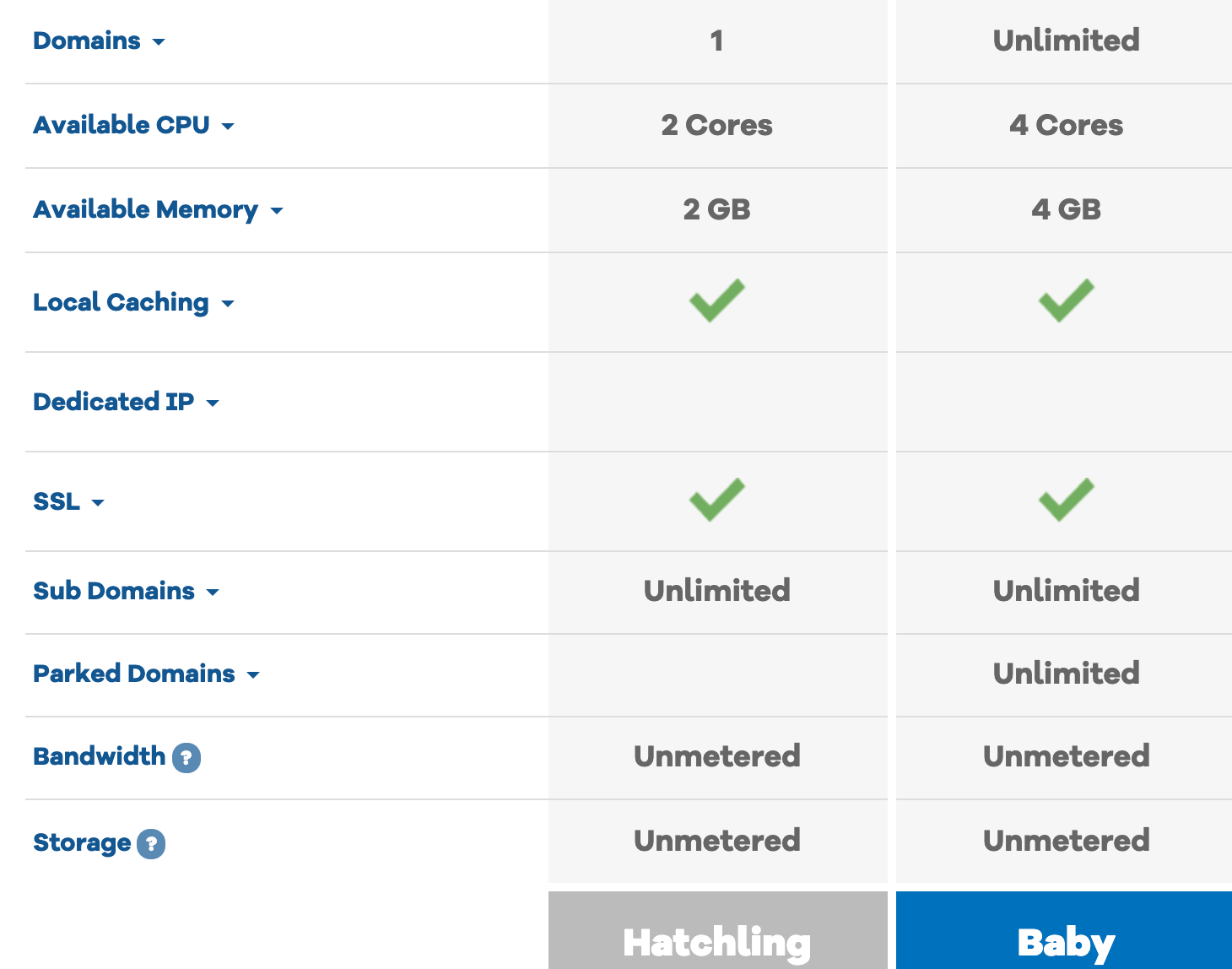
Here’s a quick glance at what the Baby Cloud offers compared to the Hatchling.

Baby Cloud

As you can see, the Baby Cloud can host unlimited domains, and has twice as much available CPU space, and double the memory.

The rate for new cloud customers is $7.95 per month, before renewing at $11.95 per month. Right now they’re running a deal where you can actually get the introductory rate reduced down to $6.57 per month, which is a great value.

All you need to do is sign up and the discount will automatically be applied at the checkout.

This is the most popular cloud hosting plan offered by HostGator. I’d say it will likely be the option that’s the most suitable for the majority of you.

Business Cloud

The Business Cloud is HostGator’s top-tier cloud hosting plan. Like the Baby Cloud, it also hosts an unlimited number of domains on a single plan.

However, the Business plan comes with access to 6 cores, as opposed to just 2 or 4 cores on the Hatchling and Baby plans. Your HostGator Business Cloud also has access to 6 GB of RAM.

It’s the only cloud hosting plan that comes standard with a dedicated IP address. This feature is not available on the Hatchling plan and it costs an additional $4 per month on the Baby Cloud plan.

Considering that the Business Cloud starts at $9.95 per month, that extra feature is a great value. However, it’s worth noting that renewals jump up to $17.95 per month once your initial contract expires.

Alternative Hostgator hosting options

While the primary focus of this review is on the HostGator Cloud, I would be doing you a disservice if I didn’t mention the other hosting options offered by this provider.

Cloud hosting isn’t for everyone. So if you’re in the market for a more traditional type of web hosting plan, you may want to consider one of these options as an alternative.

Dedicated server hosting

HostGator Dedicated Server

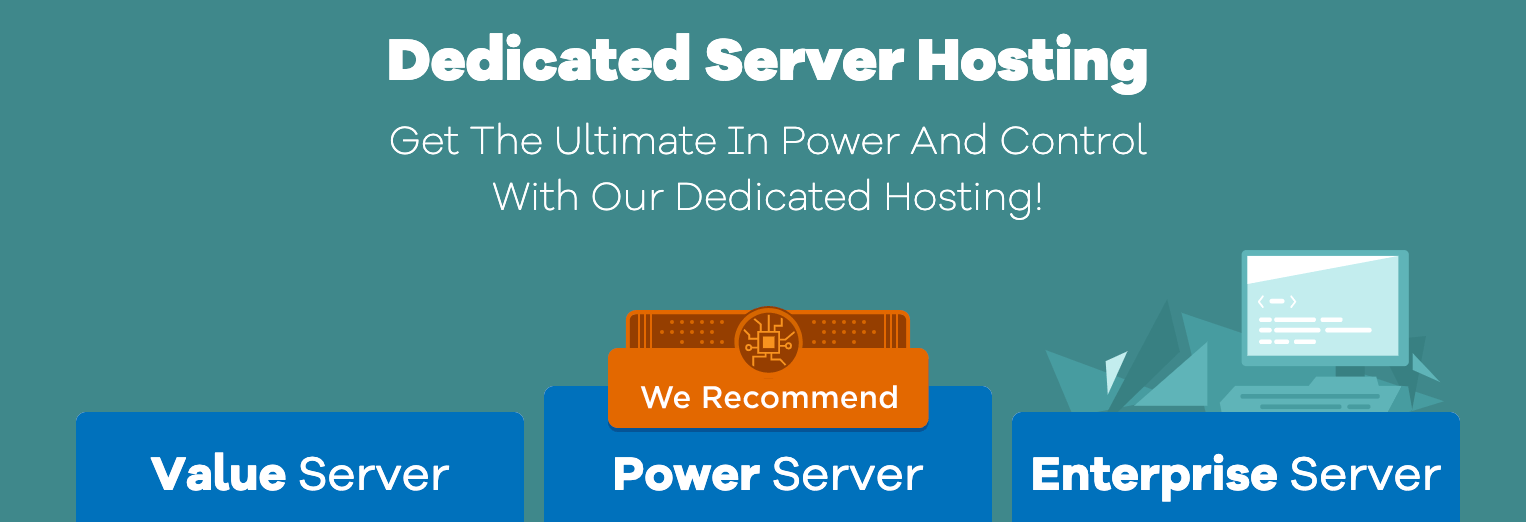
With a dedicated server, your website will be renting a physical server from HostGator. This server will only be used for your site.

It’s a faster option than shared or VPS hosting since you won’t be sharing any resources, storage, or bandwidth with other websites.

Dedicated servers are ideal for those of you who are a bit more tech-savvy. If you want complete control over your server in terms of security and flexibility, this is your best bet.

Pricing for HostGator dedicated servers starts at:

  • $118.99 per month for the Value Server
  • $138.99 per month for the Power Server
  • $148.98 per month for the Enterprise Server

Compared to the cloud hosting plans, these dedicated servers are priced significantly higher.

VPS hosting

Virtual private servers from HostGator give you flexible software options. You’ll gain full root access, which gives you added control in your environment.

The VPS plans are a step up from shared hosting, but not quite as in-depth or expensive as the dedicated servers. For comparison purposes, let’s take a look at how these VPS plans are priced, so you can weigh them as an option against cloud hosting.

  • Snappy 2000 — $29.95 per month
  • Snappy 4000 — $39.95 per month
  • Snappy 8000 — $49.95 per month

If you’re already using cPannel for web hosting, SiteGround will migrate you to VPS hosting for free.

Shared hosting

If you’re on a budget and don’t want to use the cloud, shared hosting is the bottom-tier plan offered by HostGator.

Plans start at $2.75 per month, $3.95 per month, and $5.95 per month, respectively.

The problem with this option is that you’re going to be sharing resources with other websites. So if those sites have traffic spikes or higher volumes of visitors, it will impact the metrics on your site as well.

So if you want to save some money, but don’t want to sacrifice performance, cloud hosting will be a better option for you. Shared hosting doesn’t give you the flexibility to manage your resources the way that cloud hosting does.

Benefits of HostGator Cloud for web hosting

Now that you’ve had a chance to see some of the other types of web hosting offered by HostGator, let’s get back to focusing on the HostGator Cloud.

The following benefits refer specifically to the cloud plans. So for those of you who are considering one of those alternative options, I can’t guarantee the same advantages.

High uptimes and fast load times

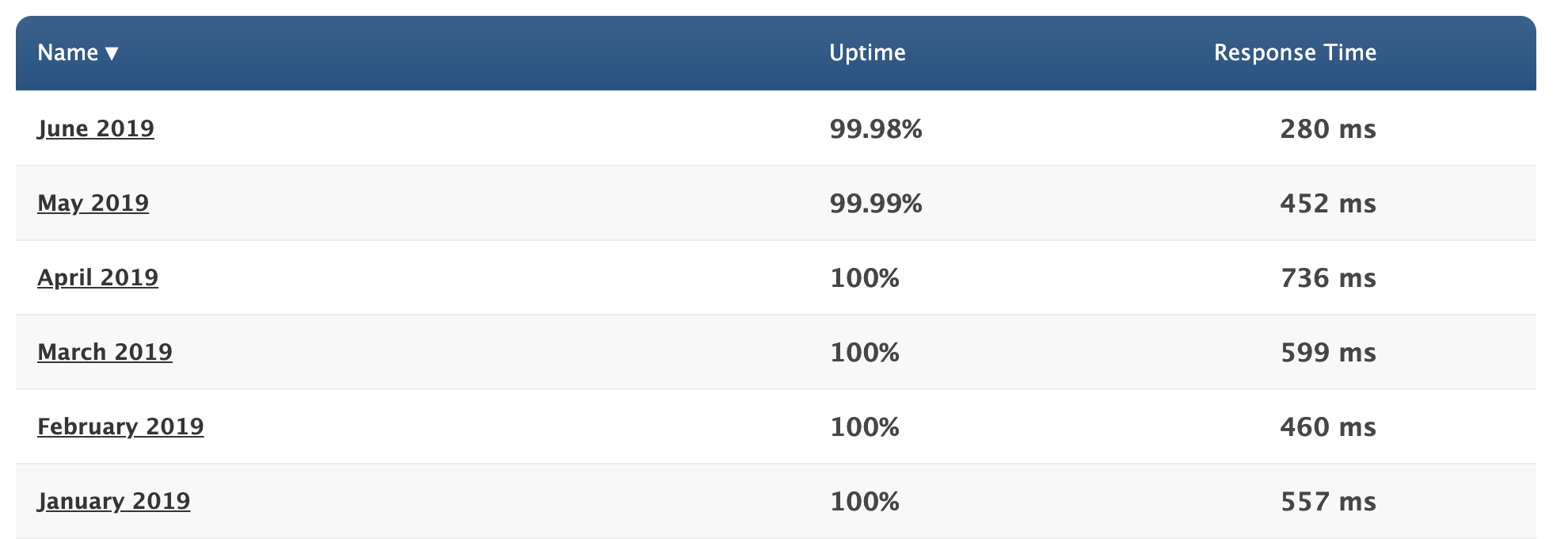
When measuring the performance of a web hosting service, uptime and page loading speeds are two of the most important metrics to consider. Let’s take a look at how a HostGator Cloud test website performed so far this year.

HostGator Uptimes

Over the past six months, HostGator Cloud had a 99.995% average uptime rate. That’s about as exceptional as it gets.

As you can see from the table above, the page loading speed fluctuates quite a bit so far this year. The fastest average monthly response time was 280 ms, while the slowest was 736 ms. But on average, the response time in 2019 is 514 ms.

Truthfully, it’s definitely not the fastest loading time we’ve seen. But with that said, it’s still very fast, and far from the slowest.

Based on these numbers, I can’t say that you’ll be disappointed with your uptimes or loading speed if you decide to go with a cloud hosting plan from HostGator.

User-friendly

HostGator Cloud is very easy to use. It’s a great option for beginners, as well as users who have more experience with web hosting.

The cloud plans make it possible for you to allocate your resources as needed whenever you’re experiencing traffic spikes. That’s not the case with their other plans, which would require you to upgrade as you reached limitations on resources.

Even if you’ve never done this before, the interface is very easy to manage.

Another reason why HostGator Cloud is so user-friendly is because you won’t have to worry about outrageous pricing. These plans don’t surprise you with monthly overage fees when you exceed your plan limits. That’s a major downside of other web hosting plans.

Lots of freebies

The reason why cloud hosting from HostGator is so fast is because it doesn’t rely on typical servers. Instead, the servers from remote data centers work in unison with a person’s web browser to limit the number of resources required to host the website.

Things like managed cloud resources, data mirroring, and integrated caching make this possible, which comes free with your cloud hosting plan.

Furthermore, you’ll get free server monitoring to alert you if there are any hardware problems.

When you sign up for HostGator cloud, you’ll have access to cPannel as well. As I said before, you’ll get a free migration if you’ve been using cPannel with your current web host.

Easy access to customer support

HostGator Cloud comes with 24/7/365 customer support, which is crucial for web hosting. My favorite part about this is their support portal.

Rather than having to pick up the phone or chat online, there’s a good chance you can find the answer to your question here.

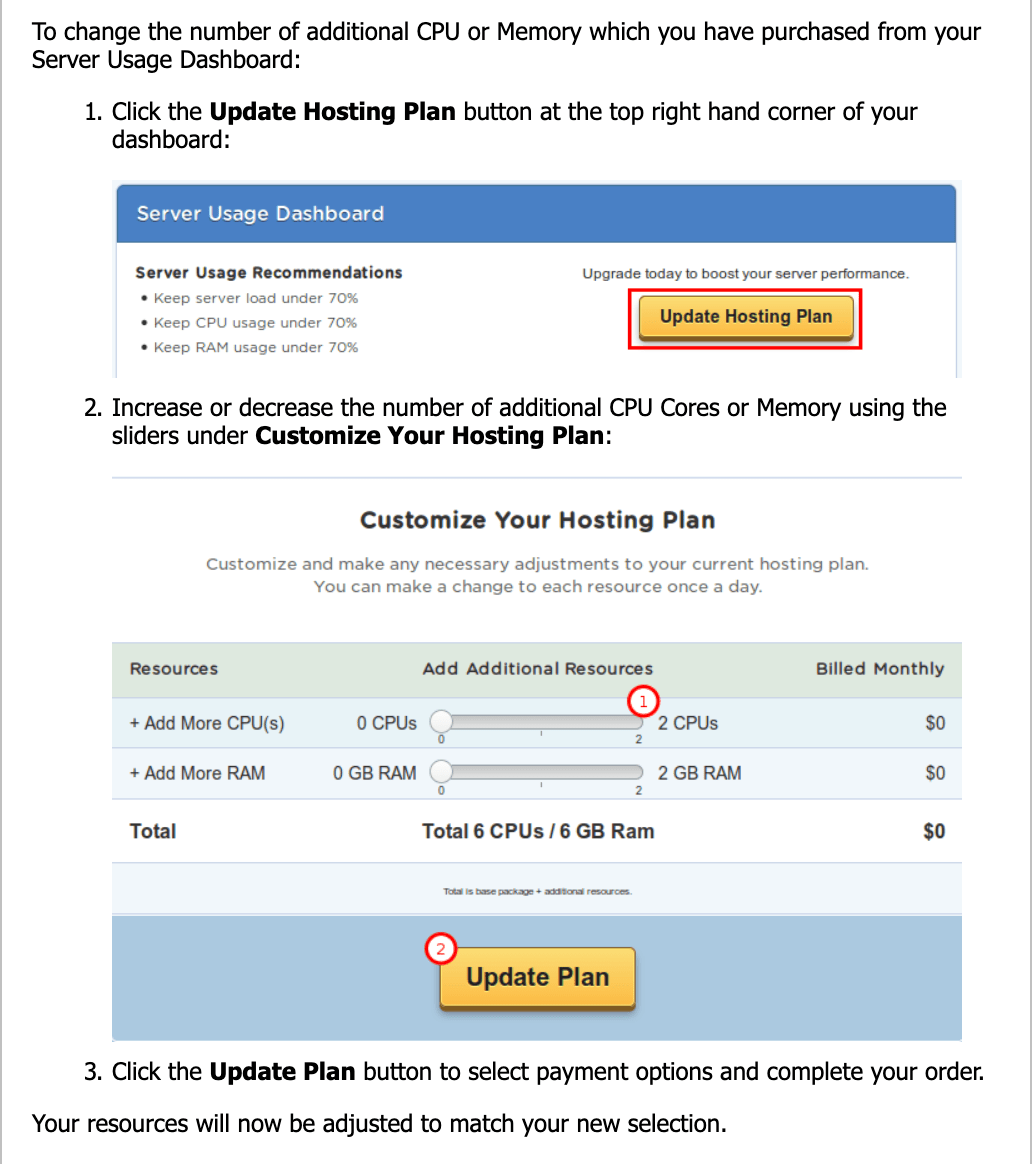
Here’s an example of a tutorial that explains the step-by-step process of how to add resources to your cloud hosting plan.

Hostgator Update Plan

HostGator has tons of these for nearly every aspect of cloud hosting. It’s a quick way to find a solution to your problem.

With that said, phone support and live chat is always available as well. Personally, I prefer live chat as opposed to picking up the phone. But you’ll have both options depending on your personal preference.

Other considerations

Based on the benefits that we just discussed, I think we’ve established that HostGator Cloud is a top choice to consider if you want to use cloud hosting. But with that said, there are a couple of things that you need to keep in mind before you make that decision.

I briefly touched on this earlier when we discussed the cloud hosting plans, but the initial rates are just introductory offers. When your contract renews, you’ll be paying more.

Depending on your plan, you can expect prices to increase by roughly 80%.

While HostGator has its fair share of freebies, there are also some upsells along the way as well. Some of these are automatically checked off in your shopping cart, so make sure you review that page thoroughly before you commit to anything.

Conclusion

Overall, HostGator is a reputable name in the web hosting space. Their cloud hosting service is a great option for those of you who want to take advantage of cloud website hosting.

If you compare those plans to their standard shared hosting options, the cloud is the superior choice in my opinion.

However, if you don’t think cloud hosting is for you then you could always consider VPS or dedicated server hosting from HostGator as well.

For those of you who still aren’t convinced on the HostGator Cloud, you can check out my list of the best web hosting services for some other viable options.


Source Quick Sprout https://ift.tt/2YnuU8B

Prepare for Your Next Job Interview With Answers to 10 Common Questions

السبت، 29 يونيو 2019

Stroudsburg's NYC Street Grill brings taste of Big Apple

STROUDSBURG — A few doors up the street from the Sherman Theater, Ali and Sheeri Khaja do whatever it takes to turn a small storefront at 534 Main St. into a slice of the Big Apple.In the high risk restaurant business where success is measured in years, their NYC Street Grill is in its infancy after opening just eight months ago."It's a long road ahead," said Sheeri. "We are glad we are on this road."The couple's story is a common one in the Poconos. Tired of the [...]

Source Business - poconorecord.com https://ift.tt/320gnlf

Books with Impact: You Need a Budget

The “Books with Impact” series takes a deeper look at specific books that have had a profound impact on my financial, professional, and personal growth by extracting specific points of advice from those books and looking at how I’ve applied them in my life with successful results. The previous entry in this series covered Triggers by Marshall Goldsmith.

You Need a Budget was the first personal finance software package I really fell in love with. I dabbled with Microsoft Money (RIP) and Quicken when I was first turning my finances around, but it was You Need a Budget that really clicked with me when I started using a spreadsheet-based version of the software many years ago, and I still use You Need a Budget 4 (the last standalone version of the software) on occasion when trying to get a clear picture of my finances because I simply love how it handles and displays my financial information.

What drew me to the software more than anything, however, was the philosophy behind it. YNAB wasn’t just a piece of software for tracking your finances; it was designed to help you follow a rather in depth philosophy and program for improving your financial state, something that other major personal finance software packages never really had (and still don’t, for the most part). That philosophy, encapsulated in four simple rules, was the really valuable part of the whole system.

That brings me around to this book. You Need a Budget by Jesse Mecham (the founder of YNAB) is basically the philosophy behind YNAB expanded with details into a short but quite powerful book, a book that I want to dig deep into because of the all-around solid personal finance philosophy and system it contains.

Let’s dive right in.

A New Way to Look at Your Money

The book starts off with an insightful criticism of the traditional form of budgeting, budgeting in which you merely list a lot of categories, come up with spending targets for each category, and then aim for those targets in those categories.

What’s wrong with it? It’s inflexible. You can’t prioritize one budget category over another. It’s inherently predictive, meaning you’re trying to guess what the future holds every time you make a spending target.

The big shift that the YNAB philosophy makes is that it focuses on spending what you have right now, rather than what you project you’ll have going forward, with a particular emphasis on how that money can get you to your goals. In other words, it chops the concept of projecting future income out of budgeting entirely.

The interesting part of this method as opposed to traditional budgeting is that it highlights the scarcity of money, as is nicely described on page 20:

[T]his feeling of scarcity is a good thing. It means you’re seeing your money for what it truly is: a finite resource – and this is a huge part of that mindset shift I talked about. It doesn’t actually matter how much money we have or don’t have. Scarcity is simply that feeling of wishing their were more. This is an important moment. The feeling of scarcity might tempt us to quit, but when we step back and embrace scarcity, we make good decisions.

I found this really interesting because it seems to fly in the face of the idea of an abundance mindset. In many aspects of life, it’s much better to have an “abundance” mindset, meaning that you perceive that the pie is infinite in size so it’s not a big deal to share with others because you’ll still have more than enough for yourself. YNAB centers around the opposite idea, at least for your finances: all you have is this little pool of money.

The argument is that, in terms of your money, the future is abundant and thus very difficult to reasonably budget. The present of your financial situation, however, is scarce – there’s only a limited amount of money and you have to make the most of it that you can.

The advantage of applying a scarcity mindset to your financial state is that it shows you that each dollar is important and everything in your life is vying for each and every dollar because there’s only so much to go around. Much of the justification for splurging comes from an abundance mindset about money – there will always be more money, so why not just spend it now on something unimportant? When you walk away from that mindset and adopt a scarcity mindset for your money, splurging becomes just another competitor alongside things that are likely more important to you.

Because you’re treating every expense and financial goal as a hungry mouth wanting to devour part of that relatively small pool of money you have right now, you have to prioritize. Which of these expenses is the most important right now? If I give $200 to this, what other possible expense has to go without money for now? You begin to feel those little frivolous nickel and dime expenses actually ripping money away from things you know are more important, and that forces you to start thinking about every dollar with seriousness.

Another interesting aspect to this perspective is that it forces you to start taking responsibility for your future now. If you want to have things in the future, you have to put money aside for them now. Taking money away from future savings goals and giving it to something else is effectively saying no to your future goals. If you want that future goal, you have to put your money where your mouth is now. There is no “someday” that will take care of it.

This leads directly into the first “rule” of the YNAB philosophy.

Rule One – Give Every Dollar a Job

It’s simple. From page 33:

Just check your bank account balance and assign a job to every dollar you own. You’re officially budgeting the moment you start doing this, and with every “job” you assign, you’re answering the question: What do I want my money to do for me?

Of course, this starts with figuring out what needs to get done with your money along with what your big goals are. What are the urgent things that have to be covered soon, like your current bills, the rent, your food needs in the next week or so, and so on? What long term things do you want to happen in your life? What fun things do you want to do in the near future – or even a little way down the road? What big bills are coming up?

You want to start with survival. What do you need to make it through the next few weeks with your basic well being intact? You need food, water, shelter, hygiene, and clothes on your back, basically. After that, move onto obligations – electricity, debt payments, garbage removal, and so on. Those are the basics. Those are the needs. Those are the things that, if you don’t handle them, your short term life gets bad quickly. It is vital to separate these things from non-essential habits that you’re treating as necessities. Coffee isn’t a necessity – it’s a non-essential habit. Non-basic foods aren’t a necessity – they’re just something you want because it’s tasty or healthy or whatever. Alcohol? Not a necessity. Filter those things out for now.

You’ll also need to consider longer-term obligations, like upcoming expenses that you know are coming. It’s time to cover a fraction of those things – and cover another fraction each time you get an influx of cash.

After that, it really comes down to your personal priorities, and that’s where you need to start thinking. What is actually a real priority in my life? The nice part about this philosophy is that it’s literally about putting your money where your mouth is. Once you’ve covered survival and obligations, the things you do with your money are up to your personal priorities, and there’s no hiding them here. What you do with your money is your true priority, regardless of what you tell yourself.

The use of each and every dollar you have is an expression of either the basic needs of your life or what your life’s priorities are. Each and every dollar has a “job,” in other words. It’s doing something for you.

My experience has been that the more in line your personal priorities are with the “job” you assign to every dollar in your life, the more peaceful you feel. It’s when you’re not taking care of something that you’re theoretically prioritizing so that you can spend money on something that has a lower priority for you that you run into financial trouble, every time. It’s all about carefully considering what your priorities are.

This does not mean having no fun. However, what it does mean is that things that you spend money that have a comparatively low return in terms of the pleasure they give you should be pretty low on the priority list, below a lot of your long term goals. It’s okay to prioritize a few pleasures that bring you a lot of joy in the short term, but you have to be discerning about it. Some things simply aren’t as big of a deal as others, and those lesser things need to fall rapidly down the priority list.

This becomes very real when you’re looking at the money sitting in your checking account right now and assigning each and every dollar in there a job. Where does each of those dollars go? Doing it well requires some real thought and introspection, and that’s the real value of this system.

Rule Two – Embrace Your True Expenses

The “true expenses” that this chapter is talking about is alluded to a little bit in the previous chapter, but this chapter brings it into focus. It’s not just about making sure the bills are covered each month, but making sure that you’re also taking care of the irregular expenses in your life.

For example, let’s say you know you have an insurance bill for $700 coming due in 7 months, and you get paid twice a month. That means you should probably put $50 out of your current pile of cash aside toward that insurance bill and then do it again every time you have a cash influx so that the insurance bill is easily paid when it comes due.

Those are your true expenses – not just the daily ones or the monthly ones, but the irregular ones that come around once every six months or once a year or whatever. In the YNAB system, those required but infrequent expenses should always be directly gobbling up a little piece of the pool of money you have right now, as well as a piece of every influx of money that comes in (like a paycheck).

There are also things that are unexpected and inevitable, like needing to replace parts on your car or having to repair appliances in your home. It can be very hard to estimate these kinds of things, but following routine maintenance on a 15,000 mile per year car is about $50 per month, and a good annual budget for unexpected home costs is about 1% of your home’s value, so you can break that down, too. Those are pieces that need to come out of the pool of cash you have.

Beyond that, this is how you plan ahead for your big life goals. What slice of the current cash you have available is going to retirement? What about college savings for your kids? Your house down payment?

This obviously requires some planning, and that’s where software can help. The YNAB software is designed to do this very naturally, and it’s why I fell in love with it years ago. You can actually do all of this on a spreadsheet, too, if you’re familiar with Excel or Google Sheets.

Rule Three – Roll with the Punches

Just as it’s impossible to micromanage every second of your time because unexpected events always happen, it’s impossible to micromanage your money because of the unexpected events life deals us. We can have the best money plan in the world, but when something like a job loss or an unexpected family illness or a hailstorm occurs, the best laid plans are torn to shreds.

Unexpected expenses can often mean changing your budget, and changing your budget can feel like failure. It can feel like you didn’t plan for everything and now all of your planning is worthless.

It’s not.

Part of the value of this type of financial planning is that, once it gets going, it becomes very possible to roll with the punches. If a sudden high priority event comes along, you simply take cash designated for lower priority events to handle it. In other words, once you’ve been doing this for a while, your budget becomes something of a living thing, capable of changing and morphing around the unexpected moments of your life.

How does this work? Let’s say you decided you wanted to buy a new television for your family for Christmas and budgeted $1,000 for it. Using the YNAB system, you decide to put aside $50 per paycheck for it starting in February. September rolls around and suddenly the unexpected happens – you have a sudden $500 expense. Guess what? You can handle it. You have the cash set aside to do so.

But what happens to that television plan? Once the urgent thing is paid for, you reprioritize. Do you want to put aside $100 per paycheck until Christmas to cover it, or are there other priorities that you should deal with first? You get to make that choice because of the freedom that YNAB offers you.

The system really centers around prioritizing your expenses, and when an urgent expense comes in with a higher priority, then you can take away money put aside for lower priority expenses (like a $1,000 television for the holidays) to handle it. The key is understanding that you’re really only worried about the pool of money that you actually have in hand and how to use every dollar most effectively. You don’t worry about the next influx of cash until it arrives.

Rule Four – Age Your Money

The real power of this system is that, over time, it moves you to a situation where you don’t need your next paycheck, and given a long enough timeframe, it moves you to a situation where you don’t need any paycheck.

It’s actually quite simple. All you really have to do is over prepare a little for each of those expenses you know are coming so that eventually you’re covering next month’s rent out of this month’s pool of cash because the next rent payment is already covered. Then you’re covering two months in advance, then three.

Let’s say that you’re paid twice a month and your rent is $1,000 a month. If you say that out of every incoming pool of cash, you set aside $600 for rent, you will have next month’s rent covered at the end of the month with $200 left over. Do that again next month and there’s $400 left over. Three months later and you actually have a full month of rent already in the can in advance and you can start preparing for subsequent months.

Mecham refers to this as “aging your money.” You’re effectively using money you brought in two or three months ago to pay your rent now.

If you do that for every bill, a lot of good things start to happen.

For one, you can survive for a while without any influxes of cash. You roll right through a job change without skipping a beat. You get fired? No problem, as long as you can find a job in the next month or two. You have a sudden life emergency? No problem – you can just nibble a bit from the money you have put aside for rent two months from now.

For another, you can start feeling confident investing for really long term stuff. If you have two months of rent checks already covered, you can tone down your $600 twice a month put aside for rent down to $550 or $525, then apply that $50 or $75 twice a month to, say, retirement savings or an extra payment toward paying off a student loan. Think of it this way: you have the money set aside to cover all of your survival needs and obligations for the next two months, so you can start working on covering a month’s worth of survival needs and obligations for yourself when you’re old by contributing to retirement savings. It’s the same thing, just very long term.

For yet another, your money starts to earn money for itself as it is aging. When you only age it for a month or two in savings, it only earns a little bit of interest, but when you age money for 30 years in a retirement account, it earns a ton of return on your money.

For yet another, the more you age your money, the larger your pool of money that you have available to make decisions with. Remember, the YNAB philosophy orients itself around making decisions regarding only the money you have in hand. Thus, the more money you have on hand, the richer your decision making palette and the easier it seems to make room for big long term goals.

So, how do you get there? The book suggests setting a simple goal (page 110):

Set a goal to save what you spend in a typical month. When you hit your goal, budget out the new month with that money. Now your next paycheck can go to the following month. Your money is officially thirty days old.

And how do you get there?

Embrace the sprint. Go on a no-spending spree for as long as you can. Also hustle to bring in extra cash in creative (and legal) ways. Anything you save or earn goes straight to your savings for the next month.

The more you age your money, the better. It not only gives you breathing room, but it also grows your money.

The rest of the book consists of a series of short chapters talking about specific applications of these four rules to specific life situations.

Budgeting as a Couple

Here, Mecham essentially reiterates the core advice that almost everyone gives for couples dealing with money issues, because it’s hands-down the best advice and the one thing that works: communicate. You’ve got to talk about your money situation together, openly, with minimal emotion, and with a genuine intent to put you both in the best life possible.

The main focus of the chapter is on the idea of a monthly “money date,” where you sit down with your partner and fully go through your finances and budget, setting priorities together for the next month. Together is important here; there’s almost no better way for this to fall apart than for one partner to just dictate the financial rules to the other one.

One important part of “couples budgeting” is to recognize that you both need a bit of personal fun money. There has to be some breathing room in the budget for each of you to pursue your own interests or else there will be backlash against the whole idea, especially from the person less committed to the concept, so this should be a fairly high priority item. Now, if that person decides to use that personal fun money of theirs buying soft drinks at the convenience store, that’s their call.

Slaying Debt, Whatever Your Situation

How does debt repayment work into all of this?

First of all, accruing more debt should be pretty much entirely off the table if you’re using this philosophy. That includes credit card debt. The only time you might consider debt once you get this whole strategy rolling is something like a home loan or possibly a student loan, but consumer debt should be almost entirely avoided because you’re planning ahead for expenses now and sticking with just the pool of money you actually have in hand for your spending.

As for repayment of the debt you already have, the best strategy is to treat your basic payment as an obligation and treat an extra payment as a fairly high priority but non-essential item that you want to throw some money to each time money comes into your accounts. So, you make sure your minimum is covered, and then you put some significant priority to allotting some cash for an extra payment on that debt.

Teaching Your Kids to Budget

Mecham advocates giving children an allowance and using that as a basis for teaching basic money management skills when they reach middle and upper elementary and middle school. He advocates giving them one or two required commitments for portions of their allowance and then complete freedom in terms of the rest of it.

The one or two required commitments for a portion of their allowance – things like saving for college or giving to charity – are basically a microcosm of YNAB. If you talk about the philosophy behind this a little and then talk about how they can use the idea to take a portion of their weekly allowance and put it aside for bigger goals (like, say, a new game for their Nintendo Switch or a bunch of new canvases for painting), they’ll often come around to it on their own.

Even better, if you establish this kind of pattern early on in their life, they’re more likely to draw on that type of thinking later in life to build their own path to financial independence from you and financial success on their own.

When You Feel Like Quitting

This last section discusses a lot of reasons why people quit budgeting: they don’t leave themselves any breathing room, they set unrealistically low spending targets for things like household supplies or food, they assume that they can rapidly and permanently change a lot of their routines and habits, they demand too much too soon, and so on.

The key to sticking with a financial change, no matter what it is, is to accept that things won’t always go perfectly and it’s okay to be imperfect. What you’re looking for more than anything is to be a little better today than you were yesterday and to gradually move towards where you want to be while recognizing that steps backward are normal and aren’t a terrible sign of failure.

If you feel like quitting or feel like a failure, look at the progress you’ve made so far and feel good about it, then refactor your plans. What parts work well? Keep those. Which parts don’t work well? Ditch them or try new versions of them. No one has a perfect plan the first time they try.

A Brief Note About the Software

Although my focus here was writing about the book You Need a Budget, I felt it appropriate to make some references to the software package You Need a Budget a few times, and rather than reiterating my thoughts on the software package, I thought I’d summarize my thoughts in one place near the end.

Several years ago, YNAB version 4 was hands down my favorite piece of personal finance software. In fact, I still use that exact version at home because of how well it embodies the philosophy spelled out in this book, a philosophy I strongly agree with in most ways.

However, several years ago, YNAB chose to discontinue their standalone version 4 software and instead moved to a subscription-based software package. While I have no objection to the concept of software as service, I didn’t migrate to the subscription based version because, well, I still use my old version 4 software. I did do a trial of the subscription-based version, but I was pretty happy with my old software for a number of reasons (it does what I want, for one, and it also keeps all of my data local rather than in the cloud) and I’ll stick with it as long as it still runs.

So, if it seemed like I often stopped short of a full-throated endorsement of the software in its current form, that’s why. I don’t actually use the current form. Having said that, the current form of the software is a really well executed embodiment of the principles described in that book and cloud software is mature enough that I would feel safe putting information into the software that didn’t directly reveal my identity. It is the best budgeting software around today.

Final Thoughts

This book is a great readable explanation of the You Need a Budget philosophy and how to apply it to one’s own finances. This philosophy – and the accompanying software – was a vital part of my own financial turnaround, particularly during the period when we were finishing up paying off our consumer debt and considering buying a home and then figuring out how to handle expenses with multiple children. I still use the principles of the system, and I still occasionally use the software, though much of our financial organization is automated at this point. (In fact, the automation itself is a lot like You Need a Budget, as the automation just moves a lot of our income off to various pools and accounts for specific purposes.)

If you know of someone just trying to get a grip on managing their own money and getting a little ahead of the paycheck to paycheck life while building a foundation of money principles that can really grow with them as they get more and more ahead financially, this is a great book for them. The material might seem overly straightforward for someone who is already in a great financial place, but roughly 80% of Americans live paycheck to paycheck and quite a few of them want a path out of that life, and this book’s a great starting point for them.

The post Books with Impact: You Need a Budget appeared first on The Simple Dollar.


Source The Simple Dollar https://ift.tt/2YmJYmP

These Companies Pay for College for Employees – Even Part-Timers

الجمعة، 28 يونيو 2019

Business briefs

Ruffino Real Estate names top agentWeichert, Realtors — Ruffino Real Estate in Milford has announced that Realtor Angela Williams has been named the top agent in the office for May.Williams was named the Top Agent of the Month after generating the most sales production in May – including six buyer transactions, one new listing agreement and a successful open house event.Weichert, Realtors — Ruffino Real Estate is an [...]

Source Business - poconorecord.com https://ift.tt/2xgUEaz

What Are Polarized Sunglasses, and Are They Really Worth the Cost?

The Ten Year Old Test

A few years ago, when my oldest had freshly turned ten years old, he began to ask a lot of questions about our family’s financial state. He wanted to know if we saved money, how much we saved, and where we saved it. He wanted to know how we spent our money and where it went and how we kept track of that.

For a two or three month period, he kept asking these questions until, I guess, his curiosity was sated and he moved onto something else.

Unsurprisingly, those conversations gave rise to a lot of articles on The Simple Dollar. I’d start talking about something with him and realize before long that there was something in this conversation that could easily grow into an article for the site. Many articles that I wrote two to three years ago were outgrowths of those conversations.

One thing I found very interesting during those conversations with him is that there were at least a few areas he’d delve into where I would get upset or frustrated with having to talk about that issue. I kept my cool – I didn’t blow up at him or get angry or angsty or anything – but inside, I felt annoyed or frustrated or I simply wanted to avoid talking about that subject.

It took me a while to really put together what was happening, but after some reflection, it became clear: anything that I was doing financially that I couldn’t or didn’t want to explain to a ten year old was probably a bad move.

In short, if I couldn’t justify it to my ten year old son, then it probably didn’t deserve to be justified.

Similarly, if I couldn’t explain it to my ten year old son, then I didn’t understand it myself and shouldn’t be financially involved with it.

As I began to realize this, I also began to realize that the “ten year old test” was actually a pretty simple way to quickly figure out if something was an acceptable move or not. If it was something I could reasonably justify or could easily explain, that idea at least passed a basic sniff test. If I couldn’t justify it or explain it, that idea was almost certainly bad.

Over the last few years, without really thinking about it, I’ve adopted that “ten year old test” to a lot of my financial moves and to a lot of my choices in other areas of life.

It’s actually really easy to use. I just try to imagine, as accurately as possible, how my ten year old would respond if I suggest a course of action. I’d try to explain it to my ten year old as clearly as I could and then, to the best of my ability, try to imagine how he’d respond (I usually visualize my oldest son when doing this, as he was the ten year old that originated the idea).

One of four things typically happens.

One, I have trouble explaining it at all. This either means I’m trying to pitch something that I don’t even really understand myself (because of the complexity) or because I’m considering a course of action that’s really hard to justify.

For example, I’ve often thought about trying out more complex investment arrangements for our retirement, but whenever I sit down and try to explain them in simple terms, it sounds like a mishmashed mess.

Two, I can explain it simply, but it rings hollow as I’m explaining it. This happens quite often when I’m trying to justify unnecessary spending or some kind of unhealthy choice.

For example, if I try to explain why I really need to spend $40 on this game, the explanation usually rings hollow pretty quickly, so I put it back on the shelf. If I try to justify stopping at a drive-thru, the explanation usually sounds comically shortsighted, so I drive on by.

Three, I can explain it simply, but it leads to a really obvious question that I can’t easily answer – either I can’t actually explain the answer to that obvious question or else it rings hollow. In this case, again, it’s a bad idea, but there’s usually a better idea buried somewhere nearby. If I can explain the core idea well but a simple question makes it much less clear or justifiable, the core idea is probably okay, but I just need to think about the implementation of it.

For example, I might suggest that it’s a good idea to stop at a drive-thru because it’s dinner time and everyone in the car is hungry. The obvious question in response would be, “Don’t we have a bunch of good leftovers in the fridge that we could eat as soon as we get home?” The core idea of eating soon because we’re hungry is good, but the course of action is flawed – there’s a cheaper alternative that’s obvious at just a glance.

A similar thing pops up at the grocery store. I know I need some laundry detergent and I’m looking at the options, but that ten year old voice asks, “Why buy that expensive one when that store brand will do the job you want?” If I can’t really answer that sensible follow-up with a good reason, the store brand goes in the cart.

Finally, I can explain it simply and answer any follow-up questions simply. If this happens, then I know the plan is pretty good and at least somewhat sensible, and when I need a quick plan or decision, the first thing that works here is usually what I do.

This usually happens when I’m making good spending choices and focusing on actual needs and keeping costs low. It happens when I’m making good long term choices.

In fact, almost every “bad” decision I might make in any area of my life is silenced by the ten year old test.

It’s pretty hard to justify eating a bunch of junk food when there are grapes in the fridge or an apple in the fruit bowl.

It’s pretty hard to convince myself that wasting time doing something unfulfilling is ever a great idea.

It’s pretty hard to see why I would say bad things about someone else or let a friendship wither or let a friend down.

The question you’re probably asking yourself is, “Great, but I don’t have a ten year old asking these questions!”

Here’s the thing: the ten year old test works just as well when you cultivate that voice of a questioning ten year old in your head rather than relying on an actual curious ten year old. Let it be your conscience. Run your plans through that voice and see whether or not it passes muster.

What you’re really doing here is cultivating a better sense of what makes for a good financial move. If your internal ten year old is balking at a purchase, then you likely shouldn’t be making that purchase. If your internal ten year old doesn’t understand your financial plan, then you don’t understand it, either, and you shouldn’t be doing it.

That ten year old voice can keep you away from unnecessary purchases, network marketing schemes, and bad investment choices. That ten year old voice can nudge you toward saving for retirement, building an emergency fund, and making sensible buying choices.

Listen to it. Use it.

If you can’t explain what you’re about to do with your money to a ten year old, or you can’t do so without feeling angry or ashamed, you probably shouldn’t be doing it. It’s that simple.

As I write this, my nine year old is just starting to ask questions along those same lines. Why are you buying that? What are you doing with the money you make? Why are you saving for retirement? What happens if our house gets hit by a tornado?

Can I answer those questions truthfully in a way he can understand? If so, I’m probably on the right path. If I can’t, maybe I need to rethink things.

When he gets past that phase, I’ll have to go back to relying on my internal ten year old test. It might not be as loud, but it’s certainly good at separating out good ideas and truth from bad ideas and nonsense.

Cultivate your own ten year old voice. You’ll be glad you did.

The post The Ten Year Old Test appeared first on The Simple Dollar.


Source The Simple Dollar https://ift.tt/2xi89Hl

The 11 Top WordPress Landing Page Templates in 2019

Anyone can create a website. Just because you own or manage a website, it doesn’t automatically mean that you’re a natural born designer.

But the design and layout of your website will have a huge impact on its success.

In fact, 48% of people say that the design of a website is the top factor they use when it comes to determining how credible a business is. 38% of people will stop using websites with unattractive layouts.

So if you want to create unique and beautiful landing pages without having to design them from scratch, you’re going to want to use pre-designed templates. WordPress is the best place to find these.

That’s because WordPress is the most popular CMS platform in the world, and has been for the past seven years in a row.

It controls nearly 60% of the entire CMS market across the globe. With more than 500 new sites launching on WordPress each day, it’s also the fastest growing CMS worldwide. 34% of the whole internet is run via WordPress.

So if you were on the fence about using WordPress to manage your site, hopefully now you’re convinced.

For those of you who are already using WordPress, you’re ahead of the game. Now it’s time to design the best landing pages for your WordPress site.

With so many options to choose from, I’ve narrowed down the top 11 WordPress landing page templates to make the decision much easier for you.

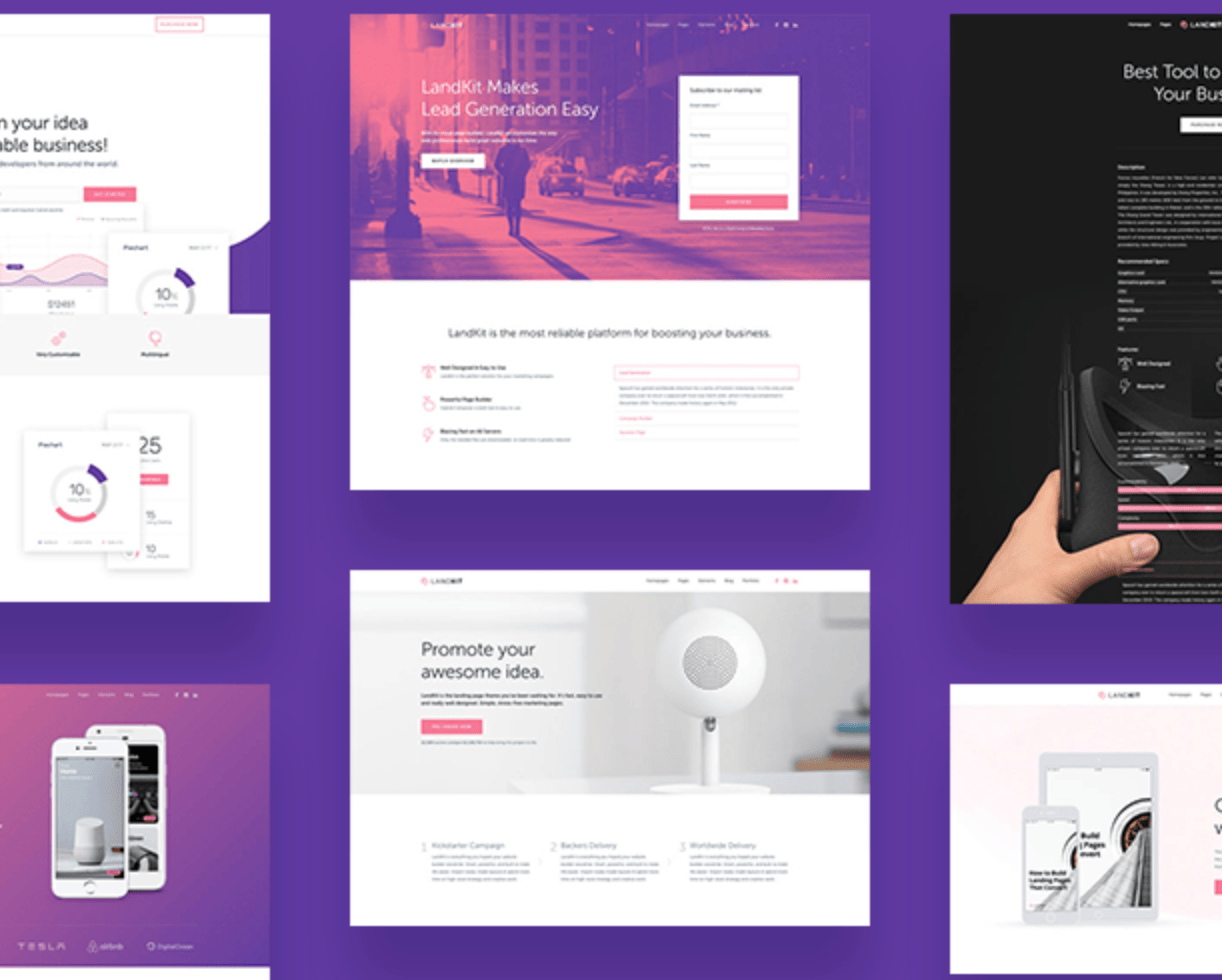
1. Landkit

Landkit

Landkit is extremely easy to use, yet it’s designed for high performance. The hybrid composer page builder makes it possible for you to design your website without having to write any code.

It doesn’t use many server resources, which makes it perfect for websites with high volumes of traffic. You can use the Landkit template to functionally present information in a way that’s attractive to your website visitors.

Another reason why I recommend Landkit is because the landing page templates are so versatile. They can be used for pages related to things like:

  • Lead generation
  • Ebook downloads
  • Webinar registrations
  • Online services
  • Free trial page
  • Mobile app showcase
  • Contest details
  • Crowdfunding
  • New product launch
  • Coupons

The list goes on and on. Landkit makes it easy for you to change the colors to match your website color schemes. It’s also compatible with the WooCommerce plugin, for those of you who are using WordPress for your ecommerce site.

Landkit has more than 70 page elements for complete customization. You can choose from 12 header styles, and add use the built-in WordPress mega menu. This landing page theme can be purchased for $49.

2. Landing

Landing

The Landing template from Themify is another versatile option for you to consider. It comes with a drag and drop page builder, making it easier than ever before to customize all of the page elements to your liking.

Landing has more than 25 builder layouts for you to choose from, based on the type of page that you want to create.

There are options specifically created for products, portfolios, marketers, events, ebooks, weddings, agencies, restaurants, mobile apps, personal pages, and more.

I like this template because it has a responsive design on all devices, and it’s retina ready as well. Landing has cool header options such as:

  • Default header
  • Transparent with text
  • Transparent
  • Transparent with no logo
  • No header

These choices are ideal for those of you who want to draw more attention to background images and CTAs on your landing page. Another benefit of Landing is the fact that it has MailChimp integration, so you can use this landing page to collect email addresses.

The standard Landing WordPress template costs $59. Developers can buy it for $69.

3. BeOnePage Lite

BeOnePage Lite

BeOnePage Lite is meant to portray a futuristic and interactive design. This template can be customized to be colorful as well. It comes with a full-screen layout and slider that can be used to display things like images, videos, icons, and other graphics.

Another benefit of this template is that it can support several different media files. The parallax effect of BeOnePage Lite ensures that all scrolling will be very smooth on the user’s end.

It has a responsive design, with lots of customizable options for you to consider. BeOnePage Lite is a retina ready template that can be used as a landing page for virtually any website.

So if you’re looking for a modern WordPress template that’s free to install, BeOnePage Lite should be taken into consideration.

4. Foton

Foton

Foton was developed with software and mobile app promotion in mind. So for those of you who are creating a landing page to drive mobile app downloads or sell software, this template should be at the top of your list.

You can import this template into WordPress with just one click. To customize your page settings, you can take advantage of the drag and drop page builder, which is extremely easy for anyone to use.

No coding is required to use Foton. It has WooCommerce integration, slider revolution, and excellent support. It’s also fully responsive and easy to change color themes.

Foton comes with free plugins and is optimized for SEO purposes. It has shortcodes designed for portfolios as well, such as lists, projects, sliders, galleries, masonry, and hover layouts.

Transitions from page to page are very smooth. The font sets and icons are attractive and easy to change as well. Shortcodes for videos and call-to-actions are definitely ones that you’ll want to take advantage of.

The Foton WordPress landing page template is priced at $59.

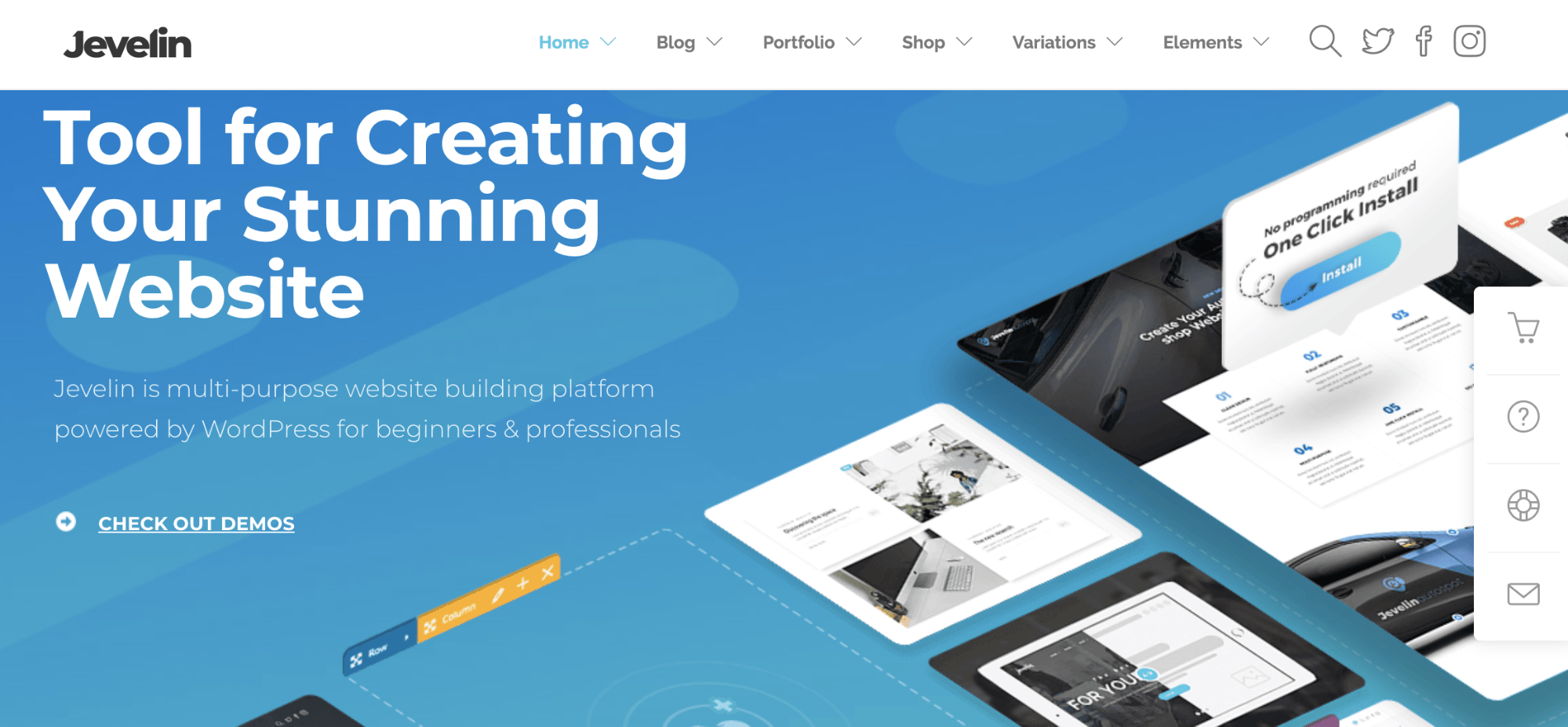
5. Jevelin

Jevelin

Jevelin is another multi-purpose WordPress landing page template. Some of the top features of this theme include:

  • WooCommerce integration
  • Mobile ready
  • Contact Form 7
  • One click installation
  • SEO friendly
  • RTL optimized
  • 40+ customizable shortcodes

There is a great video installation guide, making it possible for anyone to install Jevelin, even if you don’t have experience adding landing page templates to your WordPress site. The fact that it has built-in capabilities with one of the best WordPress form plugins is another added bonus.

Jevelin has great reviews from website owners who are using this template on their sites.

The drag and drop builder paired with mega menus, custom widgets, social sharing functionality, and ecommerce support make it a popular option. This WordPress landing page template can be bought for just $59.

6. Launchkit

Launchkit

Launchkit is definitely a one size fits all landing page template, which I’m not saying in a negative way by any stretch. I like Launchkit because it can be used for virtually any landing page for any business type.

They offer versatile headers with all different types of media in mind. You can customize headers, CTAs, and forms in a way that positions them for high conversions.

Launchkit has simple colors, so your website always looks good, regardless of the screen size or type that it’s being viewed on.

Top features of Launchkit include:

  • Three header layouts
  • Seven footer layouts
  • Custom logos
  • One click data installer
  • Multilingual support
  • Gravity Forms
  • Contact Form 7

This template comes with more than 600 Google Fonts as well. With that in mind, you should check out my guide on the best Google Fonts that go together on your website.

For the reasonable price of $59, Launchkit is definitely one of the best landing page templates you can find for your WordPress site.

7. The Gem

Gem

If you’re looking for a multi-purpose landing page that is optimized for high performance, look no further than The Gem. This template offers a creative design that’s modern and suitable for all different types of websites.

There are more than 70 built-in concepts. So you can find a landing page that fits your needs.

  • Agencies
  • Business and finance
  • Ecommerce shops
  • Portfolios
  • Blogs
  • Mobile apps
  • Cryptocurrencies
  • Real estate
  • Restaurants
  • Gyms
  • Beauty salons
  • Law firms
  • Hotels
  • Nonprofit organizations

These are just some of the many options that showcase the versatility of this WordPress landing page template. It’s fully responsive and looks great on both desktop devices and mobile screens.

The Gem is compatible with WooCommerce, making it a top choice for those of you who have an ecommerce shop.

With the visual composer, you can easily change elements on your landing pages with the drag and drop builder. The template is compatible with plugins and also comes with premium sliders.

You can buy this landing page template for $59.

8. Kallyas

Kallyas

More than 35,000 websites are using Kallyas for landing page templates. They have more than 65 live demos, with new ones coming out each month.

I always like it when landing page templates offer lots of live demos because it makes it easier to give you inspiration for designing your own website. Top benefits of Kallyas include:

  • Fast loading times
  • Quick setup
  • Video tutorials
  • Written tutorials
  • Reliable customer support
  • Visual page builder
  • Free updates for life

The one-click installation makes it easy for you to start editing your website in minutes. They have demos for things like weddings, makeup artists, bloggers, kids websites, membership sites, news, medical, sports, and dozens more.

Kallyas has more than 100 pre-built elements into the template. This gives you seemingly unlimited options when it comes to customizing your landing pages. Kallyas is priced at $69.

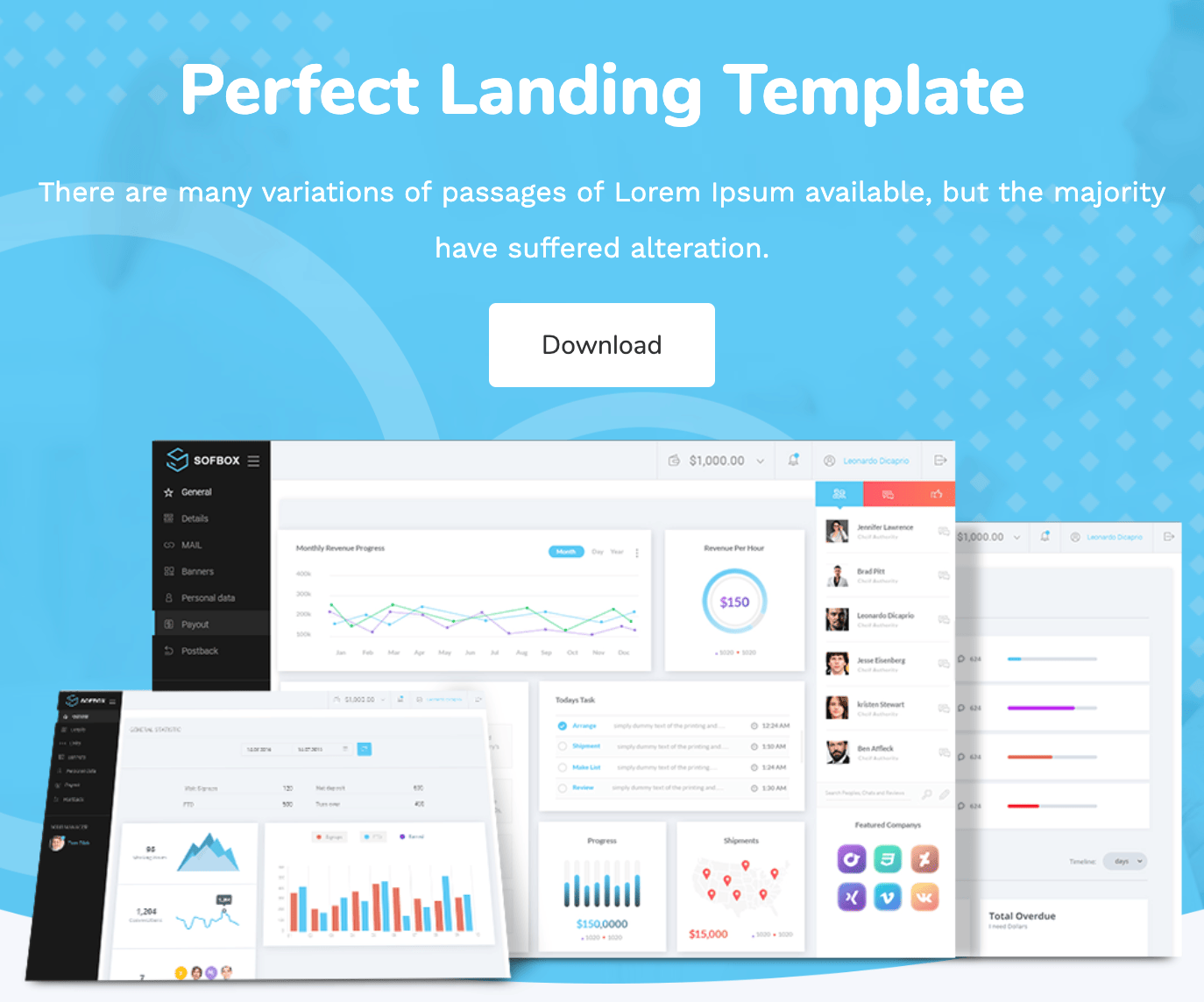
9. Softbox

Softbox

Softbox is perfect for those of you who want a clean and professional design for landing pages on your website. It’s easy to choose your layout and customize the elements with some of their pre-built options.

It works on all major web browsers, screens, and devices. Softbox is retina ready and fully responsive. They have templates designed specifically for home pages, blogs, and interior landing pages as well.

In a word, Softbox can be described as simple. But when it comes to your website, simple designs have higher conversion rates.

Compared to some of the other WordPress landing pages on our list, Softbox is offered at a lower price point. This template can be yours for just $39.

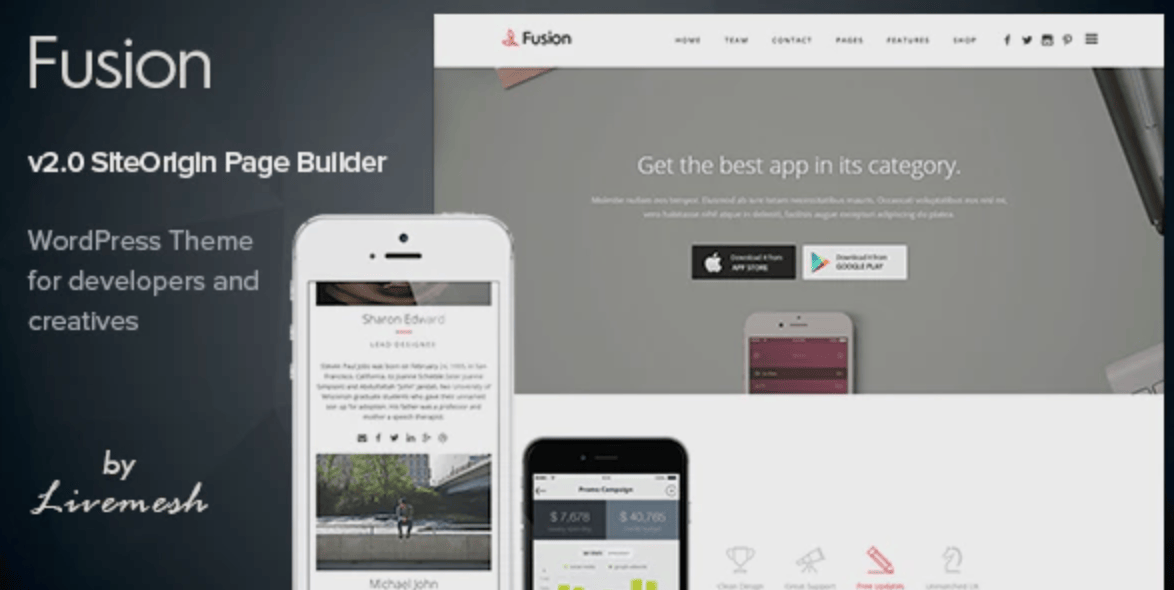
10. Fusion

Fusion

The Fusion WordPress template is designed with mobile app landing pages and portfolio landing pages in mind. So if you’re looking to showcase one or both of these things on your website, you should take a closer look at this option.

It’s an ideal solution for agencies and developers. The pages can be set up so that creatives can showcase their products. This holds true for both firms or individuals as well.

The typography is super clean. All of the design elements and whitespace is managed perfectly with this template, so the eyes of your website visitors are always drawn to the right spot on the page.

Fusion has a simple shortcode builder and easy customization. Everything integrates seamlessly into WordPress for you to manage.

This template has more than 1,500 retina icons, a revolution slider, and the ability to create a gallery with captions. It comes with over 500 Google Fonts, Contact Form 7, and an Ajax loading gallery as well.

Fusion costs $49 to install.

11. Leadinjection

Leadinjection

Last, but certainly not least, on our list is Leadinjection. As the name implies, this template is designed especially for generating leads.

They have pre-built layouts for things like:

  • Online courses
  • Mobile apps
  • eBooks
  • Services
  • Medical websites
  • Insurance companies
  • Landscaping businesses
  • Diets and health
  • Cryptocurrencies

As you can see, these lead generation templates are extremely versatile and can fit the needs of nearly any website.

The template comes with a Lead Modal plugin, that’s basically a popup on your site that can be used to generate leads. This can be based on timing, exit intent, or other trigger options.

Leadinjection has all different types of opt-in forms for your landing pages as well. You can fully customize your CTA, and even add a click to call button for your mobile site. If this sounds like the landing page template that you want, it can be purchased for $39.

Conclusion

If you need help designing a landing page for your WordPress website, I’m confident that you can find what you’re looking for somewhere in these options that I’ve listed above.

I tried to include something for everyone on here. Some of these templates are made for multiple purposes, while others are made specifically for things like mobile apps, ecommerce, or lead generation.

Price is another factor that you can take into consideration when making this decision. While there are some free WordPress landing page templates, the rest tend to be priced between the $39 and $69 range.

So keep this list in mind when you’re on the search for the perfect WordPress landing page template.


Source Quick Sprout https://ift.tt/2RPXxZL