Thousands of courses for $10 728x90

الأربعاء، 28 أغسطس 2019

How to Create a Website

Creating a website used to be a massive project.

And expensive too.

Everything had to be built by hand and businesses needed to work with an online marketing agency that would charge them tens of thousands of dollars to build the site. If you wanted a professional-looking site, that was your only option.

Things have gotten a lot cheaper over the years.

Now it’s possible to get a polished site for less than $100. About $10 to buy the domain, $30–60 for a good template, and $5–10/month to host it. It’ll look so good that people won’t even realize that you built it yourself. It’ll look like some high-flying marketing agency built it for you.

Not only has it gotten cheaper, it’s also gotten a lot easier.

I’ve broken down the 9 simple steps to create your website from scratch. You’ll easily be able to run through these steps over the next 120 minutes.

Step 1: Pick a name and find a domain for your website

These are not two separate steps, unfortunately.

I really wish I could sit down, pick any name that I want for my business, and be able to create the site that I want around that name. Now that the internet is a couple of decades old, we all have to face the reality that most of the good domains have been taken.

Here’s how a naming session always seems to go for me:

  1. In a moment of inspiration, we think of an amazing name.
  2. We hold on to this name for months, maybe even years.
  3. It’s time to start the business, so we go to purchase the domain.
  4. The domain is taken.
  5. We try a dozen small variations of our original idea, all taken.
  6. No biggie, we thought of one brilliant name, we’ll think of another one.
  7. Backup idea #2 = taken.
  8. Backup idea #3 = taken.
  9. Backup idea #4 = taken.
  10. Despair sets in.
  11. We start considering names that we don’t actually like, hoping that anything is available.
  12. We come up with 2 or 3 options that we don’t like at all.
  13. Then we spend a week trying to come up with a name that’s both available and a name that we can live with.
  14. Finally, we find one.

Websites have also become so embedded in our day-to-day lives that it’s better to change the name of the business to match an available domain than it is to pick a poor quality domain. Through this process, I almost always end up with a completely different name than I originally intended.

This is why I consider the “naming my business” and “buying the domain” steps for creating a business to be the same step. I try to only lock myself into a name once I have the domain.

We put together an in-depth guide on buying domains here.

The good news is that the rest of these steps are a breeze once you have your domain purchased. It’s the first and hardest step to create your website.

Step 2: Register your domain name

Real quick, let’s sort out the difference between a domain registrar and a web host.

A domain registrar is a company that specializes in buying (registering) domains.

A web host, on the other hand, specializes in running servers that host websites.

Every web host will desperately try to get you to also registrar a domain through them. The reason is that it’s a great upsell for them. They’ve spent most of their resources building out a hosting service, then they offer domain registration as a convenience, increase the price a bit, and collect a nice chunk of extra profit from you.

My philosophy is to buy things from businesses that specialize in that exact thing. Prices will be better and so will quality. That’s why I also use a domain registrar for buying domains and a web host for hosting. I never mix up the two.

The best domain registrar is NameCheap. That’s where I have all of my domain names.

We put together a detailed review of domain registrars here.

Step 3: Decide what kind of site you are creating

Most guides on creating a website will push you into using WordPress. It’s the most popular and flexible website builder. And that’s usually a good recommendation.

But there are a few situations where I recommend different options.

Simple Portfolio or “Business Card” Sites

Many businesses need a simple website that tells people a few things:

  • Who the business is for
  • What the business does
  • Sometimes a portfolio that shows off some work
  • Contact info

This kind of site gives the basic info for the business, nothing more. If this is what you need, Squarespace is your best option for creating your website. It’s incredibly simple to use and will give you a professional site at a very low price. It’s perfect for small businesses.

Squarespace will try to convince you that they can handle everything. That’s not true.

They’ve created the simplest and easiest website builder out there. Truly, it’s a joy to use.

However, they completely lack all the advanced features that an online business needs. The ecommerce functionality is extremely limited, and I don’t know any serious online marketer that uses Squarespace for a content site. If your business an online business, Squarespace isn’t a legitimate option. You’ll hit the limits of its features too fast.

If you know that you want an ecommerce store from the beginning, start on Shopify and skip Squarespace. And if you know you want a blog or are planning on doing lots of content, start on WordPress. The majority of this guide is around building a wordpress website.

Squarespace makes the most sense when you just need a clean, professional-looking site that gives some basic info on your business. It’s perfect for small businesses, freelancers, and artists.

Here’s another way to think about it: If you’re building a business that doesn’t live and die on its website, it just needs a website in case anyone looks for it, like a digital business card, then go with Squarespace. But if you’re website is your business, use one of the more tailored platforms.

Ecommerce Sites

If you’re planning on building an ecommerce store for your site, don’t use WordPress. We have an entire post here on when to use WordPress for ecommerce and when not to. The short story: it rarely makes sense to use WordPress for ecommerce.

The best option, by far, is Shopify. There used to be more competition in the ecommerce tool space but Shopify got too far ahead. Now they’re really the only option and they have an incredible reputation. You won’t regret using them for an ecommerce site.

If you’re going this route, we have a 9-step guide on how to create an ecommerce website. We also have a guide on how to start a store that drives real sales. Both of those guides will get you pointed in the right direction.

Blog Sites

If you want to create a blog with a bunch of content, you need to use WordPress. We have a detailed guide on starting blogs here. Most websites are really just blogs. Some of the biggest, and most well known websites on the Internet are blogs.

WordPress powers over 30% of the entire internet. So it’s the only real option for starting a blog these days.

What about Joomla or Drupal? Or Typepad?

WordPress left all those other platforms in the dust about a decade ago. They’re not even legitimate options at this point. Pick WordPress — there isn’t a single situation where you’ll regret it.

When I originally started with this online thing, Drupal sites were still pretty common. I partnered up with an engineer friend of mine and we did a lot of freelance work migrating sites from Drupal to WordPress. Even back then, WordPress was a clear winner.

Now when I come across a site on any of these other tools, it’s kind of exciting. It’s like finding an ancient artifact. “This still exists!? How fascinating!”

Don’t use any of these other tools, stick to WordPress.

Everything Else

If you’re not sure or have another vision for your site outside the categories above, use WordPress. It’s the most flexible platform out there. It will do ecommerce, it’ll do simple portfolios, it’ll do massive content sites, it’ll do Fortune 500 marketing sites, it’ll do it all.

You might have to customize it more than other platforms in some situations but you can make WordPress do whatever you want it to. And just about anyone in online marketing knows their way around WordPress so you’ll be able to find plenty of people to help you when the time comes.

Whether you want to build your site by hand or you have an online marketing agency to do it for you, you should still build on top of WordPress. It’ll shortcut a lot of the programming work and give you the ability to edit basic items on your site without having to edit any code. I’ve managed marketing sites of venture-backed tech startups that employed dozens of engineers — we still had our marketing site built on top of WordPress. It’s the standard choice.

Step 4: Get a host for your website

For the rest of this guide, I’m going to assume that you’ve picked WordPress to create your site. If you want an ecommerce site, skip the rest of this guide and follow our guide on creating an ecommerce site.

WordPress is the tool that you’ll use to build your website. But you also need a host that will store your site and make it available to anyone who visits.

The best place to go for most people is Siteground.

We have an entire guide here that goes through all the best web hosts.

Hosting plans usually start around $5/month.

Step 5: Install WordPress

Just about every website host has a 1-click install of WordPress. Siteground, the hosting provider I recommend the most has this feature. It’s usually under a section called Tools, Website, Software, or Content Management Systems (CMS). It’ll look something like this:
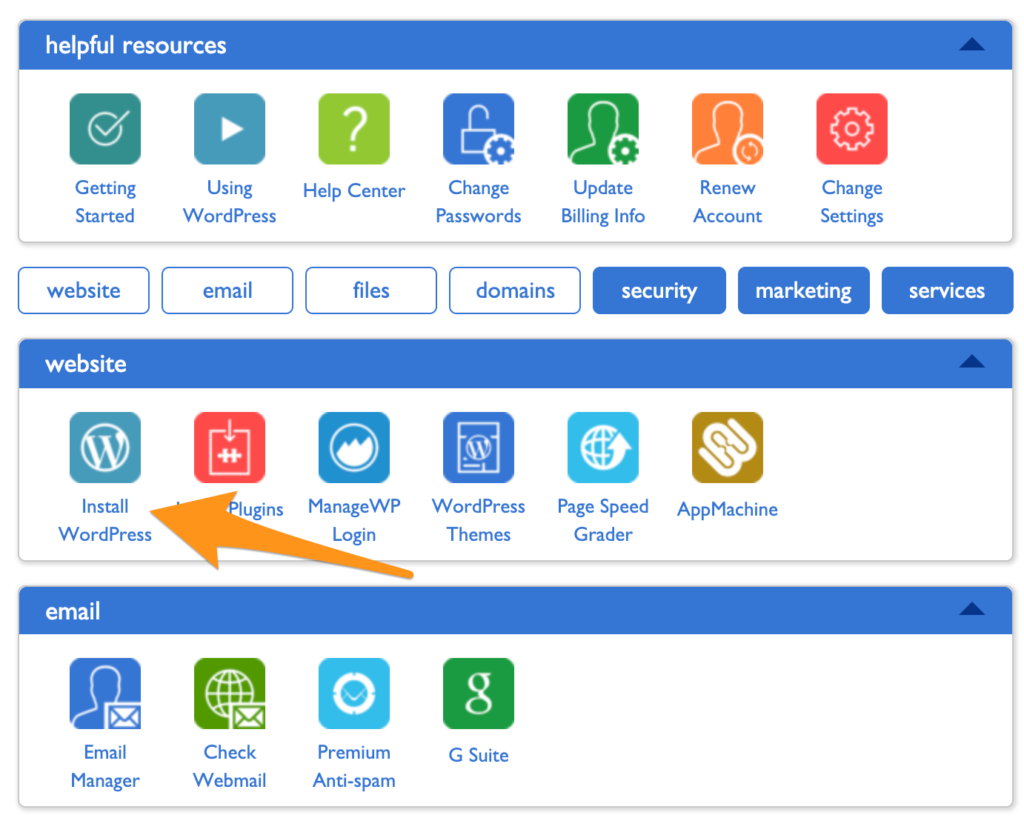
Install WordPress

If you have trouble finding it, contact support at your host and they’ll be able to walk you through it.

Step 6: Point your domain to your host

Let’s do a quick recap.

  • You bought your domain using a domain registrar.
  • You signed up for a hosting plan.
  • You installed WordPress on your host.

Now you’re going to connect all that stuff together by pointing your domain to your host. Then when people go to your domain, they’ll end up on your website.

There are a few technical settings you need to apply. This involves configuring a few nameserver settings on your domain registrar for your domain. Your host will give you the correct settings; you’re looking for their nameserver settings.

If you get stuck, contact your host and they’ll give you all the info you need.

Once you have the nameserver info from your host, go into your domain registrar and configure those settings for the domain that you want to point at your site. Once you’re done, it’ll look something like this:

Create a Website Name Servers

Step 7: Install a WordPress theme

Think of WordPress as the guts of your site, it’s all the pumping that makes your site work.

WordPress uses themes to determine how your website looks. This makes it really easy to change how your site looks without having to rebuild your site from scratch. Swap out your old theme for a new one and ta-da! Your design will look completely different.

These days, I purchase all my themes from StudioPress.

Heads up, WP Engine bought StudioPress and now includes all the StudioPress themes in its hosting plans. WP Engine is more expensive but it’s perfect for serious bloggers. It’s a great way to save money on your theme if you are planning on building a large site to begin with. WP Engine is another one of our recommended hosts if you’re looking for the best. The downside is that WP Engine tends to be more expensive than other hosts. It’s probably overkill if you are just starting out, or creating your first website.

Back to themes, are there other options?

You betcha. ThemeForest has a marketplace of WordPress themes. There are literally tens of thousands of themes to pick from. They’re usually in the $30–60 price range. When looking for theme, I rank them by the most popular or the highest rating. Then I pick one I personally like.

After you’ve purchased a theme, go to the WordPress Theme settings and upload your theme. The Theme settings are under Appearance in the WordPress sidebar menu. You’ll have to click through “Add new” and “Upload Theme” in order to see this option to upload:
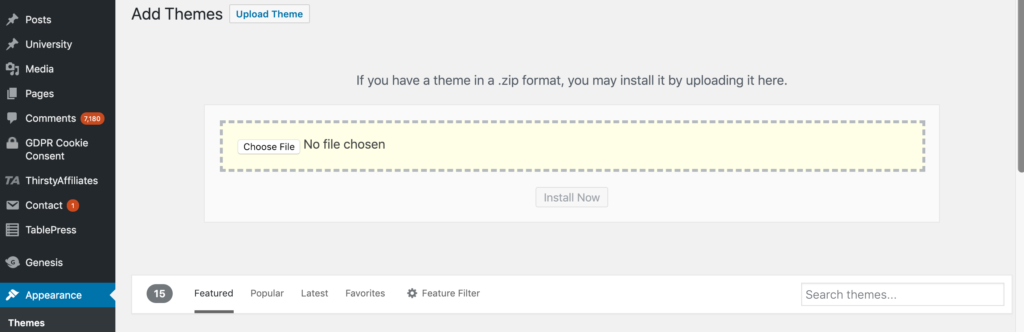
Upload WordPress Theme

Go ahead and upload the .zip file you received when you purchased your theme.

After it’s uploaded, you’ll also have to click “activate” on the theme in WordPress to make it go live.

Step 8: Add content to your website

Now the fun part — it’s time to create the individual pages of your site.

You’ll do this within WordPress.

WordPress has two types of content: pages and posts.

Think of posts as blog posts that are published under a “blog” section of a site. If you’re not planning on having a blog, then you can skip posts entirely.

Pages are the more permanent pages on your website. Like your About or Contact Us pages. When you’re first creating your website, you want to get a batch of pages live so your site feels real.

Every website has a few standard pages you should create:

  • Homepage – Your WordPress theme usually has settings for this page.
  • Contact Page – Create a new page and install a WordPress form plugin so you can add a form to the page.
  • About page – Tell your story and why you’ve started your business.
  • Product or services pages – For the main services or products that you’re offering, it’s a good idea to create a dedicated page for each.
  • Blog – If you’re building a blog, make sure all your posts get listed here.

This list will get you started. You can always add more later.

Step 9: Continue evolving your website

At this point, you have a fully functioning site that looks great.

I’m not going to lie, there’s a lot of extra configuration you can do to your site: you can add WordPress plugins that upgrade your site, build out a blog, add an email list, grow traffic, the list is endless.

You don’t have to do any of this extra stuff — it’s all optional. It depends on your priorities and goals.

A website is an ever evolving thing. The way it looks after you first create it, won’t be how it looks a couple months later. At least that is the case if you are actively working and growing your website.

When you’re ready, these guides will walk you through the extra stuff that’s worth considering:


Source Quick Sprout https://ift.tt/2Xnliua

Prefer the Night Shift? Check Out the 21 Best Jobs for Night Owls

Highlight Your Gig Experience on the Job Hunt, Experts Say

Today is State Pension shortfall day

The Parable of the Fruit Tree

Imagine two farmers – we’ll call them Adam and Betty – living a couple hundred years ago. Toiling the land was hard work and it took all they had to work their forty acres of land.

Adam used all of his forty acres for wheat, and he was able to get 5 bushels of wheat per acre and he saved ten bushels for his own family’s food, so he would take 190 bushes to the market each year.

Betty did the same at first, but one year she saw someone selling apples at the market and thought to herself, “You know, if I gave over one of my acres of land and built an apple orchard, I could have many bushels of apples, for myself and for my family.” That fall, she bought minimal supplies at the market and saved some of her money.

The next spring, Betty planted one of her acres with apple trees using the money she had saved the previous fall. This was a bunch of additional work on top of the other acres, so Betty worked even harder and even later many nights. That fall, she only brought 185 bushels to the market, where Adam brought 190. Betty felt a bit foolish – she worked harder, but Adam came home with more money from the market? How unfair.

The next few years were a repeat of the same thing: Betty worked extra hours getting her apple orchard going with no production, while Adam actually earned a little more at the market each year.

Betty’s orchard slowly matured and required less work each year, until finally, one year, the orchard began to produce an abundance of apples. Betty took bushel after bushel of apples to the market that fall in addition to her wheat and brought home quite a lot more money than Adam, even though she had actually worked less that year.

Suddenly, it was Adam looking on with jealousy. Betty worked less than him this year and made more money because of her apples? How was that fair?

While Adam could certainly plant an apple orchard of his own, it would take him several years to start producing, during which he’d be working far more than Betty while earning significantly less.

What’s the lesson here? Invest in yourself, and do it sooner rather than later. Plant lots and lots and lots of apple trees in your own life. Invest a little time and energy and money now so that it will produce big returns later.

Don’t have any idea how to do this? Here are a bunch of ways to invest some of the resources you have right now – time, money, energy – to pay even bigger dividends in the future. It is well worth your time to spend an hour or so each day and some portion of your money in these endeavors.

Save for retirement. This is a big one, and it’s a perfect example of the idea. Contribute a little to retirement each paycheck and when you reach retirement age you’ll have a lot more resources at your disposal than you would have if you hadn’t saved. Social Security alone will lead to a very threadbare existence unless you continue to work in your old age, and even having a little put away will make a huge difference in your quality of life.

Help someone out in a meaningful way without expecting anything in return. This doesn’t mean doing someone’s job for them or continually doing someone else’s work without appreciation. It means things like showing up a little early so someone else can leave a little early, or helping someone move, or giving someone’s paper a look-over to see if you notice any issues and actually giving them good feedback, or giving someone a ride somewhere, or showing up with a meal in hand for someone who’s sick or for the family of someone who recently passed. Do these kinds of things consistently without expecting anything in return.

Build your professional network. Simply find people who are in your field and share advice and swap stories with them. You can do this online by seeking out groups on social media related to your career field on sites like LinkedIn, Twitter, or StackOverflow, depending on your field. Even better, seek out groups in your community. Get involved in your union. Seek out meetups or professional organizations related to your field and start going to them. If you ever have an opportunity to present your work, take it and, if possible, share the materials you present far and wide. Make sure to put as much polish on it as you can, too. Keep business cards on you with all times, with multiple avenues for contacting you, and try to accumulate cards as well from people actually in your field, then follow up with those people and keep the connection alive.

Build a skill that has professional application in your field. I used to spend an hour out of each workday simply working on learning a skill that I knew would be useful down the road. I’d learn a new programming API or a new data mining technique or very carefully study something related to the types of data I was digging into. You can do the same type of thing in almost any career path. Try to devote some time in each workday solely to develop a skill that you currently find useful or that you will find useful in the next step in your career path. This can be a technical skill, or it can be something like a people skill or a presentation skill.

Build a skill that makes you less reliant on paying others for services (and perhaps could build into others paying you). Pretty much any home improvement project falls into this category, as do things like cooking, baking, basic auto maintenance, basic carpentry, basic plumbing, and so on. Those are skills that many people pay others for that, if you can do them yourself, you can just pocket that money, and if you build them enough, you may be in a position to easily jump to a situation where others pay you for those skills. Practicing these skills for yourself is about more than just the immediate benefit (the meal or the fixed toilet). It’s about the skill you build and the confidence to apply it in the future.

Put effort into maintaining a relationship. Give your parents a call and have a meaningful, lengthy conversation with them. Call up a friend you haven’t spoken to in a while. Send someone in your life a handwritten note or a card – do you know how much a simple handwritten note stands out in a good way in today’s internet age? Send someone a text that you haven’t communicated with recently, just asking what’s up and letting them know they’re in your thoughts. Don’t make it about you – just ask about them, and listen.

Put a little extra polish into a project you’re working on. If you’re writing computer code, put in the effort to use sensible variable names and include good (but not excessive) comments. If you’re writing a report, let it sit for a day before turning it in, then carefully re-read it and edit it with fresh eyes. If you’re stocking shelves, look at the shelves again when you’re finished and take a moment to make them look neat and attractive. Putting in that little extra effort to polish your work is something that people subtly notice over time, and that usually builds into opportunity if you sustain that effort.

Show genuine and consistent appreciation to your partner. A good relationship is the result of a lot of thoughtful investment of time and energy. If you don’t pay attention to your partner, figure out what he/she/they needs in a partner, and then do your best to fulfill those needs, then you’re not going to have the strong long-term relationship that you want. Put in the time to figure out what your partner needs, then consistently put in the effort to be what they need.

Spend consistent quality time with your children. The same thing is true for the parent-child relationship: it’s going to be far warmer and far more open and far more supportive if you put in the time to really understand your child and support them in the way that they need. This involves time and attention in terms of keeping up with them and figuring out what they need, then time and effort applying that.

Listen! This is the single best seed you can plant in terms of human relationships. Authentically listen to people and respond to what they’re saying. Don’t make up your mind without hearing them out. Don’t use the time when they’re talking to formulate what you’re going to say next. You’re always better off listening meaningfully, asking questions when you want clarity, and then pausing for a bit to respond appropriately. That type of behavior is the foundation of truly strong relationships, whether familial, romantic, friendship, or professional.

All of these things boil down to being the proverbial Johnny Appleseed for your own future. The more time you spend planting seeds, the more likely it is that many of them will flower and grow. Not all of them will – you’ll give your time and effort to people who turn away from you and things that end up not helping you – but the value you get from those trees that do grow will far outshine the lost time.

Plant a few trees today, and tomorrow, and the day after that, and then keep it up.

Good luck.

The post The Parable of the Fruit Tree appeared first on The Simple Dollar.


Source The Simple Dollar https://ift.tt/2HtcAnY

5 Best Banks for High School and College Students in 2019

Meet the forgotten fund managers ...and discover how they’re working behind the scenes for investors

Meet the forgotten fund managers ...and discover how they’re working behind the scenes for investors Rachel Rickard… Wed, 08/28/2019 - 12:48


Source Moneywise - 29 years of helping you with your finances https://ift.tt/2zp2QXu

Some investors will happily pay to lend

Should I save my money in one place or spread it across investments?

Should I save my money in one place or spread it across investments?

I’m 24 and I’d like to start saving £400 a month. Where should I put the money? Should it be all in the same place or should I split it across different investments?

Ray Black Wed, 08/28/2019 - 12:47
From
FR/London

The correct answer to your question relies entirely on your current financial position and what you hope might happen in your life over the next 10 years.

The first step is to make sure you have enough money held in an easy access cash account for emergencies.

As a general rule, ensure that you keep at least three months’ living expenses and enough capital to cover any known larger expenses (such as upcoming car or holiday expenses) in an easily accessible deposit account. A high-interest paying current account like the one from TSB’s Classic Plus account (which pays 3% per annum gross interest on up to £1,500) might work well for this. For any surplus capital funds, I’d suggest taking a look at the online Marcus deposit account, which is paying 1.5% gross.

Once that’s in hand, if you are yet to buy your first home (but intend to be a property owner in due course) consider opening up a Lifetime Isa, (Lisa). You can save up to £4,000 per tax year into a Lisa and if you do, the HMRC will add another £1,000 (25%) to your account.

If you decide to save the maximum £333.33 per month into a Lisa, you could add the remaining £66.67 per month to your emergency fund.

Alternatively, if you are happy investing in the stock market for five years or more, you could put that extra money into an Investment Isa with a different provider. You can contribute up to an extra £16,000 (2019/2020) into an additional Investment Isa that can be used for long-term growth, but you can also get access to the funds should you need it.


Source Moneywise - 29 years of helping you with your finances https://ift.tt/2znLkD4

Government plans shake up of shared ownership schemes to get more people on housing ladder

How to Get Companies to Purchase Advertising Space on Your Blog

Recently, I ran a survey asking readers what types of topics they wanted more information on and “how to make money with your blog” came up over and over again. It seems like it would be easy enough – place some ads on your site and watch the money roll in, right? Unfortunately, securing advertisers […]

The post How to Get Companies to Purchase Advertising Space on Your Blog appeared first on The Work at Home Woman.


Source The Work at Home Woman https://ift.tt/2U9Q2hi

الثلاثاء، 27 أغسطس 2019

How to Become a Virtual Assistant

Metro Credit Union Mortgage Rates Reviews: Today’s Best Analysis

Metro Credit Union was founded in 1926 as a small member-owned banking institution with less than 35 members.

Over its 93 years in business, Metro has grown into the largest state-chartered credit union in Massachusetts, with over $1 billion in assets and more than 200,000 active members.

This lender’s commitment to low-fee services, competitive loan rates, and community outreach have contributed significantly to its positive reputation and long-term success.

Metro Credit Union Quick Facts

  • Only operates within the state of Massachusetts
  • Formal credit union membership is required
  • Offers an incredibly diverse selection of mortgage options, including adjustable and conventional fixed-rate, FHA, VA, HomeReady, Home Possible, and more
  • FHA loans can be secured with as little as 3.5 percent down
  • Supports low- to moderate-income borrowers by providing a variety of home loans with flexible qualification requirements
  • Members can apply for a mortgage in person or online
  • The website does not contain a rate quote process

Overview

metro credti union mortgage rates reviewMetro Credit Union was founded in 1926 as a small member-owned banking institution with less than 35 members. Over its 93 years in business, Metro has grown into the largest state-chartered credit union in Massachusetts, with over $1 billion in assets and more than 200,000 active members.

This lender’s commitment to low-fee services, competitive loan rates, and community outreach have contributed significantly to its positive reputation and long-term success.

Metro Credit Union has provided Massachusetts residents with affordable home financing solutions for over 90 years and has earned a reputation as one the state’s most reliable lenders.

The credit union’s massive catalog of government-backed and conventional mortgage products eclipses many of its regional and nationwide competitors, though formal membership is a strict prerequisite.

This lender offers a variety of specialty programs aimed at low- to moderate-income borrowers and those unable to make a sizeable down payment, including Fannie Mae’s HomeReady mortgages and Freddie Mac’s Home Possible loans.

Both of these programs feature down payment minimums of just 3 percent, along with flexible credit requirements.

Almost all of Metro’s mortgages are tailored to borrowers who may face difficulties qualifying for a conventional loan from other lenders, which has helped the credit union distinguish itself as a community-focused lending institution.

Metro’s main branch earned an A+ rating from the Better Business Bureau, though it does hold a one-star customer review score. This credit union determines program eligibility by reviewing a wide range of financial information, including debt-to-income ratios, credit scores and histories, and household income, yet it is markedly flexible compared to other lenders.

Current Metro Credit Union Mortgage Rates

—–

Metro Credit Union Loan Specifics

Compared with most regional and nationwide lenders, Metro Credit Union offers a staggering variety of mortgage options to choose from.

The credit union’s website lists more than ten unique home loan programs, including conventional fixed- and adjustable-rate, FHA, VA, HomeReady, Home Possible, MassHousing, and a whole lot more.

Fixed-rate Loans

This popular mortgage type benefits from set interest rates that will not fluctuate over the full life of the loan, making it a solid choice for home buyers that plan to settle down for more than seven years.

Metro provides a variety of loan terms to choose from, including 10, 15, 20, and 30 years, though longer repayment terms often mean higher interest rates and monthly payments.

Adjustable-rate Loans

Unlike fixed-rate mortgages, this home financing option features variable rates that may fluctuate over the repayment period. Borrowers can negotiate an initial fixed-rate period of 5, 7, 10, or 15 years, after which their interest rates and monthly payments will automatically adjust to the market index.

This mortgage type is well-suited to home buyers who are unsure about their long-term plans, as it typically offers lower starting rates than traditional alternatives.

Jumbo Loans

Borrowers who plan to purchase or refinance an expensive home can take advantage of this specialty mortgage program, which provides loan amounts of up to $2.5 million.

Metro’s jumbo loans are available as either fixed- or adjustable-rate and feature markedly flexible loan terms. This home financing option was designed to support purchases that exceed the maximum conforming limits set by the Federal Housing Finance Agency, which currently stands at $484,350 in Massachusetts.

FHA Loans

This government-backed program was created by The Federal Housing Administration to support first-time home buyers and borrowers who are unable to make a sizeable down payment. FHA loans are available for 1-4 unit properties and do not possess income limitations, but some credit score restrictions do apply.

Qualified borrowers can secure an affordable rate with as little as 3.5 percent down, though mortgage insurance is required for down payments below 20 percent.

VA Loans

Eligible veterans and active-duty military personnel may want to consider this flexible home loan program, as it features 100 percent financing options for borrowers with credit scores as low as 620.

VA loans are federally insured by the U.S. Department of Veterans Affairs and have some of the lowest available interest rates and monthly payments. Additionally, mortgage insurance is not required to qualify, even for borrowers who put no money down upfront.

Operation Welcome Home Loans

This unique home financing option extends the closing cost and down payment assistance to members of the National Guard, active-duty military personnel, and veterans who are purchasing their first home.

The program is sponsored by MassHousing and features competitive rates that will not fluctuate over the repayment period, though certain income and loan limits do apply. Eligible borrowers can secure a closing cost credit of up to $2,500, along with discounted mortgage insurance premiums.

HomeReady Loans

This specialty mortgage was created by Fannie Mae to help creditworthy low- to moderate-income borrowers secure affordable rates and monthly payments.

Qualified home buyers with credit scores of 620 or higher can land a HomeReady loan with just 3 percent down, though some income restrictions do apply. These mortgages can be negotiated as either a fixed- or adjustable-rate loan, and possess a variety of repayment term options.

Home Possible Loans

Much like HomeReady mortgages, this financing program is designed to support low- to moderate-income borrowers in their search for affordable interest rates and flexible loan terms.

Eligible home buyers with credit scores of 660 and above can qualify with as little as 3 percent down and may submit non-traditional credit information alongside their mortgage application.

Metro Credit Union, in partnership with Freddie Mac, offers its members a choice between fixed or variable interest rates with a wide array of loan terms to choose from.

MassHousing Loans

This fixed-rate mortgage option features flexible underwriting and down payment requirements for Massachusetts borrowers looking to purchase a single-family home or condo.

While MassHousing has somewhat strict loan and income limits for this program, they do offer qualified borrowers the choice to opt-out of mortgage insurance.

At Home Mortgage Loans

Metro Credit Union offers this specialty mortgage program for low- to moderate-income home buyers who are interested in moving to specific Massachusetts gateway cities.

The credit union works with MassHousing and other community development partners to supply affordable interest rates and flexible repayment terms on homes located in Chelsea, Everett, Revere, and Lawrence.

Additionally, this mortgage option can be used to finance a home in need of rehabilitation, as it will help cover the cost of repairing and restoring the property.

Metro Credit Union Mortgage Customer Experience

Metro Credit Union provides conventional lending services tailored to the specific needs of Massachusetts residents and is particularly committed to supporting low- to moderate-income home buyers.

While this lender only operates 15 physical branches throughout the Greater Boston area, it allows members to apply for a home loan directly through its website. Metro also supplies its members with a variety of useful online resources, including FAQ pages, rate calculators, and a dense collection of educational articles.

The credit union’s website does not feature a rate quote or pre-qualification process, though interested borrowers can contact a lending agent by filling out a webform, reaching out by phone, or by visiting one of its branches in person.

On the downside, Metro’s website lacks specific information about many of its conventional mortgage programs, which may make comparative shopping a bit difficult.

Additional information about the credit union’s government-backed programs can be easily obtained by visiting one of its partners’ websites.

Despite its shortcomings, the credit union’s overwhelming selection of home financing options ensures that every one of its members has access to an affordable mortgage that suits their unique financial needs.

Metro Credit Union Lender Reputation

Metro Credit Union has been in operation for over 95 years and is considered a reliable and member-focused lending institution. The credit union’s main branch, located in Chelsea, Massachusetts, was awarded an A+ rating by the Better Business Bureau, yet it has not earned formal accreditation from the agency.

While Metro’s profile currently features a one-star customer review score, only ten complaints have been filed with the BBB over the past three years. Metro Credit Union is federally insured by NCUA and is a Member MSIC.

  • Information collected on March 1, 2019

Metro Credit Union Mortgage Qualifications

Loan Type

Rate Type

Down Payment Requirements

Fixed-rate Loans

Fixed

5 – 10%

Adjustable-rate Loans

Variable

5 – 10%

Jumbo Loans

Fixed or Variable

10 – 20%

FHA Loans

Fixed or Variable

3.5%

VA Loans

Fixed

0%

Operation Welcome Home Loans

Fixed

3%

HomeReady Loans

Fixed or Variable

3%

Home Possible Loans

Fixed or Variable

3%

MassHousing Loans

Fixed

0 – 5%

At Home Mortgage Loans

Fixed

3 – 5%

Each of Metro Credit Union’s mortgage products has different qualification guidelines, though formal membership is a universal requirement.

A vast majority of this lender’s home financing options feature low down payment minimums, making it a solid choice for first-time homebuyers and low- to moderate-income earners.

For example, an FHA loan can be secured with just 3.5 percent down, while its HomeReady and Home Possible mortgages require down payments of 3 percent.

Although Metro’s website does not list concrete down payment guidelines for its conventional fixed- and adjustable-rate loans, most lenders ask for at least 5 percent of the total purchase price.

Typically, the higher your down payment, the lower your interest rate will be, though some restrictions do apply.

Many of Metro’s mortgage programs benefit from flexible credit score conditions, which can help borrowers with less-than-perfect credit obtain affordable interest rates. HomeReady loans are available to members with scores as low as 620, but a robust credit history may be required.

Home buyers with limited credit histories should look into Freddie Mac’s Home Possible mortgage program, as it allows applicants to submit non-traditional credit histories alongside their applications.

One limitation is that Metro does not list any information about its median income requirements, debt-to-income guidelines, or its loan-to-value expectations, which may complicate the comparative shopping process.

Metro Credit Union Phone Number & Additional Details

  • Homepage URL: https://www.metrocu.org/
  • Company Phone: 1-877-696-3876
  • Headquarters Address: 200 Revere Beach Parkway, Chelsea, MA 02150

The post Metro Credit Union Mortgage Rates Reviews: Today’s Best Analysis appeared first on Good Financial Cents®.


Source Good Financial Cents® https://ift.tt/2KYfjYQ

Rent vs. Buy a Home: Which is Better for You?

The rent vs. buy a home debate is an ongoing one, that seems to rise and fall with property values.

With house prices now sitting at record levels, the debate is relevant than eve.

This is especially true in high-priced markets, where house prices have reached nosebleed levels, and will require a massive financial investment – if that’s even possible.

First Things First: Where You Live Figures into the Rent vs. Buy Decision

It shouldn’t come as a surprise that geography plays a major role in the rent vs. buy a home decision.

In some markets, with either very high house prices or an abundance of rental housing, renting will be the better choice. But in others, where rents are higher than a typical house payment, buying stands out as the preferred strategy.

A CNBC report late last year, It’s better to rent than to buy in today’s housing market, disclosed that buying a home is now cheaper than renting in only 35% of US counties. They report that renting is a better investment than buying in 16 of 23 major metropolitan markets.

Metropolitan areas where it’s better to rent include Atlanta, Dallas, Denver, Houston, Los Angeles, Miami, San Francisco and Seattle. However, buying outperforms renting in much of the Midwest and Northeast, with Chicago and Cleveland being the best places to buy.

San Francisco is a classic case in point. As of the middle of this year, the median sale price of a single-family home reached an incredible $1.7 million dollars, and $1.3 million for condos. Buying at those price levels may be out of the question for the great majority of households.

By contrast, the median price of a house in Buffalo is $115,750, versus an average monthly rent of $1,100. Numbers like that make owning a better investment than renting, since the monthly payment for the median priced home will be below the average monthly rent.

If You Don’t Qualify for a Mortgage Then It Doesn’t Matter

This is another fundamental fact of life when it comes the homebuying.

Simply put, the rent vs. buy a home question doesn’t apply if you can’t qualify with a mortgage lender for the financing.

This can include several factors, including:

  • Insufficient or unstable income.
  • Bad credit history.
  • Excessive non-housing debts and obligations.
  • Lack of funds for a down payment.

If you hope to buy a home in the future, the good news is that each of these issues can be fixed in going forward. It’ll take time, but it’s certainly doable.

In the meantime though, we’re going to focus this debate on the rent vs. buy question with the assumption that you do have the financial resources to buy.

Rent vs. Buy a Home: Which is Better for You?

There are a lot of factors that go into the rent vs. buy a home decision. Not all have to do with money either.

Below, we’ll break down each factor individually, discuss the details of how it affects renting or owning, then attempt to declare a winner in each category.

Monthly Payment vs. Actual Cost

This one may be the most complicated of all. If you purchase a house for $300,000, with a $60,000 down payment (20%), you’ll need a mortgage of $240,000. At 4% for a 30-year loan, the monthly mortgage payment will be $1,145. Property taxes, at $3,000 per year, will add another $250 to your monthly payment. You should also figure an additional $100 for homeowner’s insurance.

That will bring the total monthly cost to buy to $1,395.

If the cost to rent the same house is $1,800 per month, buying will certainly be the better choice.

But let’s say instead of making a 20% down payment, you go in with only 5%. That will increase your mortgage to $285,000. At 4% for a 30-year loan, the mortgage payment itself will be $1,360. You’ll also need to add $350 for property taxes and homeowner’s insurance, bringing the total to $1,710.

But that’s not the end of the story. By putting 5% down, you’ll be required to pay private mortgage insurance. The monthly premium on a $285,000 that represents 95% of the value of the house will add about $185 to the payment.

That will bring the total monthly cost to buy up to $1,895.

But there’s one more variable for owners: repair and maintenance costs.

HGTV reports that average annual repair and maintenance costs for homeowners is between 1% and 3% of of the home’s purchase price. For a house bought for $300,000, using the midpoint of 2%, the repair and maintenance costs comes to $6,000 per year. That will add about $500 to your monthly payment, whether you put down 5% or 20%.

With a 20% down payment, the monthly payment then rises to $1,895. With a 5% down payment, it rises to $2,395.

Winner: Renting

Job Stability

This is an often under-appreciated rent vs. buy criteria. If you have a very stable job, or you work in a very stable career field, buying can make more sense. But if, like many occupations today, future employment is uncertain, you may be better off renting.

Part of the problem with unstable employment is income reliability. If you change jobs frequently, there’s a real possibility that at some point you’ll be earning less than you did when you first bought your home. If that even potentially describes your situation, renting is the better course.

Winner: Buying for those with stable employment, renting for all others.

Mobility

This is looking at the job stability situation from a different angle. If you live in a small city or rural area, and jobs in your field are scarce, you may need to relocate if you lose your job.

Another example is where you may be getting married in the near future, requiring relocation. Still another possibility is an ailing loved one in another city, that may require you to make a move at some point.

In any of the above situations, renting will give you the needed mobility to make a move with the fewest hassles. You can get out of a lease at the end of the term at the latest, and some will allow you to break the lease at minimal cost. But trying to sell a home to make a move is not only more time-consuming, but if you need to move quickly, you may lose money on the sale.

Winner: Renting

Tax Implications

There was a time when the tax code was extremely homeowner friendly. But the tax code changes implemented at the end of 2017 changed that equation for millions of homeowners.

First and foremost, the standard deduction increased dramatically. For 2019, it’s $24,400 for married filing jointly, and $12,200 for single filers.

Continuing our example from above, if you have a $240,000 mortgage at 4%, you’ll pay mortgage interest of something under $9,600 in the first year of the loan. Even if you add in $3,000 for real estate taxes, you’re only up to $12,600 in tax-deductible expenses related to your home.

That may give you a slight deduction – $200 – if you’re single. But it’ll barely exceed 50% of the standard deduction for a married couple.

There’s another limitation in the new tax code as well. State and local tax (“SALT”) deductions are now limited to $10,000 per year. If you live in a high tax state, your real estate tax deduction will be capped, denying you the full benefit of the expense deduction.

The renter will get the standard deduction, which may be all the homeowner gets as well.

Winner: Buying, as long as you have large itemized deductions apart from your home. Otherwise, the win goes to renting.

Liquidity & “Trapped Capital”

Money invested in the down payment on a house is effectively trapped capital. That’s because it can’t be accessed, apart from selling the home or taking out a home equity loan. One is entirely inconvenient, and the other adds to the cost of owning. The take-away however is that down payment money is not liquid. It’s there, but it’s really not.

Let’s take an example of two people, each of whom has $60,000 in savings. The first takes the entire amount and uses it as a 20% down payment on a $300,000 house. The second keeps it in savings and rents her home.

By investing his savings and a house, the buyer has lost liquidity. But by retaining $60,000 in savings, the renter remains completely liquid. Because of that liquidity, the renter has more options in life, as well as a generous cushion against financial uncertainty.

Winner: Renting, if liquidity is important to you – and it should be.

Building Wealth

There are a lot of variables with this factor, but let’s take renting and buying individually.

Person A puts the $60,000 down payment on a $300,000 house and faithfully makes the mortgage payments for 30 years. At the end of that time, not only is the mortgage paid in full, but the house has doubled in value. Person A has grown is wealth from $60,000 to $600,000 in 30 years.

Person B also has $60,000, but instead of buying a house, she invests it in a blended portfolio of stocks and bonds, with an average annual rate of return of 7%. After 30 years, her $60,000 portfolio has grown to $456,735.

Person A nets an advantage of more than $153,000 as a result of buying rather than renting. However, if his house doesn’t rise in value, his net worth will be only $300,000 after 30 years. That will put him behind by more than $156,000.

Winner: It could go either way, depending on the price-performance of the homeowner’s house, versus the savings and investment commitment of the renter.

Opportunity Cost

We just did an example of how a person can choose to invest money in a portfolio of stocks and bonds that would otherwise go toward the purchase of a home. That’s one form of opportunity cost that could go either for or against the homeowner.

But there are less certain opportunity costs. For example, if rather than buying a house, you chose to invest the money in your career or in buying a business, the increase in income – as well as the potential resale value of the business – could put you well ahead of the investment return on owning a house.

Self-made millionaire real estate investor Grant Cardone has stated many times that you shouldn’t buy a house to live in, but instead rent, then invest your money in yourself. (He rents his home while owning a portfolio of income producing rental properties.) Using the money to buy a business or improving your career skills is largely what he was referring to.

Winner: Renting

Personal Preference

This covers a wide range of potential topics, that depend on your individual circumstances. For example, some people just feel better emotionally owning. They prefer the permanence of ownership – as well as the ability to customize their home – to any benefits that may be provided by renting. As well, if you have children, it’s likely you’ll strongly prefer owning to provide them with a greater sense of security.

On the other hand, if you have a very demanding career, you like to travel, or you have hobbies and passions that don’t see you spending much time at home, renting may be preferred. It’s also the better choice for anyone who doesn’t want to get involved in the hands-on maintenance that owning a home requires.

Winner: It’s a certified toss-up.

Should YOU Rent or Buy a Home?

As you can see from the various factors we’ve evaluated in the rent vs. buy a home decision, it’s really a complicated choice.

It starts with the big picture factors, like the market you live in. If the area has particularly high housing costs, owning may not be an option, no matter how desirable it may be from an emotional standpoint.

There are also financial considerations, which tend to dominate the debate. First and foremost is the long-term financial advantage of owning versus renting. That really hangs mostly on the likelihood house prices in your area will rise substantially in the future. That is, of course, a variable, since it involves the use of a crystal ball that none of us have.

Then there are personal factors. First in that category is whether you can even afford to buy a house. That will depend on the strength of your finances, against levels of affordability in your area. You’ll also need to determine if owning will be a benefit from a tax standpoint, as well as the impact of variable costs, like repairs and maintenance.

Finally, there are issues of personal preference. As much as you may want to own a home, renting may better accommodate your lifestyle. If your occupation, hobbies, or traveling frequently keep you away from home, renting may be the better choice, even if other factors favor owning.

If you’re facing the rent vs. buy decision right now, carefully consider the choice against all the factors listed above. You may be surprised at your final conclusion.

The post Rent vs. Buy a Home: Which is Better for You? appeared first on Good Financial Cents®.


Source Good Financial Cents® https://ift.tt/2ZpMkGk

First Federal of Lakewood Mortgage Rates Review: Today’s Best Analysis

Founded in 1935, First Federal of Lakewood is the largest independent depositor-owned bank with a headquarters in Ohio.

Today, First Federal has 18 branches to serve Ohio residents in the Lakewood area. First Federal mortgage options include fixed and adjustable-rate mortgages, Federal Housing Administration (FHA), Veterans Affairs (VA), United States Department of Agriculture (USDA), jumbo, construction, bridge, and many other options.

First Federal of Lakewood Mortgage Facts

  • Offers mortgages in Ohio
  • Largest independent depositor-owned bank with a headquarters in Ohio state
  • A large variety of alternative loan options for borrowers
  • Fixed and adjustable-rate, jumbo, Freddie Mac Home Possible, Fannie Mae HomeReady, and other mortgage options
  • Online application available
  • Request information online, find current rates, and connect with a quote

Overview

first federal lakewood mortgage rates reviewFirst Federal was founded in 1935 in Lakewood, Ohio and continues to serve the Lakewood area today. As the largest independent depositor-owned bank with a headquarters in Ohio, the bank offers a wide range of loan options, with a special emphasis on local grants and state-supported lending programs.

Borrowers can apply online or speak with a mortgage specialist at a local branch. Educational information about mortgages and guidance on the many programs offered by First Federal is available on their website.

The bank’s reputation appears to be positive, although very little news could be found online.

Currently, First Federal is not on Trustpilot. The bank has an A- rating from the Better Business Bureau (BBB), with a one-star average based on two customer reviews.

Current First Federal of Lakewood Mortgage Rates

First Federal of Lakewood Loan Specifics

First Federal of Lakewood offers a wide variety of loan options, that can benefit many different home buyers. They help those looking to purchase for the first time to doctors, service members, those looking to buy land and build, and more.

Fixed-Rate Loans

With a fixed-rate mortgage loan from First Federal of Lakewood, borrowers can get a consistent rate and monthly mortgage cost that will stay consistent throughout the lifetime of the loan, even if market rates change later. This is a household budget item that can consistently be accounted for every month.

For homeowners who plan to stay in their homes or own their property for several years, having a fixed-rate mortgage may make the most sense. It’s also true, however, that fixed-rate payments stay the same later even if market rates decrease. This means buyers could also end up paying more overall than they have to if rates go down. First Federal of Lakewood offers 10, 15, 20 and 30-year loans.

Adjustable-Rate Loans

An adjustable-rate mortgage (ARM) from First Federal of Lakewood can go up or down based on market conditions. This means that borrowers planning to sell their homes soon may benefit from what they save with an ARM loan. ARM rates usually start low and are fixed for a specific period. For example, a 5/1 ARM stays at a single rate for the first five years of the loan and becomes subject to change every year after.

Jumbo Loans

For financing more than $484,350 in a mortgage, a jumbo loan from First Federal of Lakewood provides special terms and can make the purchase more affordable. These loans are structured for high-value homes and can have higher balances than what conventional loans usually cover. Borrowers must be able to qualify. A lower minimum down payment option may be available through First Federal.

Construction Loans

Interest-only loans for financing the cost of new construction. This makes it less challenging for buyers to cover their mortgage costs while also paying for their current housing expenses.

Doctor and Resident Loans

Special financing is available to make purchasing a home more affordable for healthcare professionals such as medical doctors, residents, podiatrists, veterinarians, ophthalmologists, and residents training to enter a medical profession.

Due to the realities of financing professional training, many healthcare professionals have student loans, but a doctor and resident loan from First Federal can provide up to 100 percent financing and special rates for qualifying applicants. Borrowers may be able to apply without student loan amounts counting against them during the loan qualification process.

Bridge Loans

Designed for home buyers who are also selling their current residence, bridge loans make it possible to transition from one mortgage into another, so buyers don’t have to worry as much about coordinating closing dates.

Community Programs and Grant Loans

First Federal has several community programs and local grants available for applicants who are looking to make their mortgages more affordable. These programs may ask borrowers to meet specific requirements. Ohio Financing Housing Agency (OHFA) loans, for instance, are generally for first-time home buyers, recent grads, and others who meet the qualifications.

Family Loans

Special financing programs for family members to assist with mortgages.

Fannie Mae HomeReady Loans

With this program through First Federal, buyers with low incomes can qualify for more affordable mortgages.

Fannie Mae HomeStyle Loans

A HomeStyle loan includes additional funding to cover repairs and updates to a home during the purchase process.

FHA Loans

With insurance backing FHA loans, more affordable options are available for buyers, bringing down payments as low as 3.5 percent.

USDA Rural Housing Loans

Backed by the USDA, these loans offer affordable home financing for buyers purchasing homes in rural areas of the United States. Low and no down payment options are available for those who meet the qualifications.

VA Loans

With backing by the VA, these loans for veterans, service members, and spouses provide an affordable mortgage option for applicants connected to the military.

Lot Loans

To help with the land purchase before construction, lot loans can provide flexible financing. Construction can begin later, enabling future homeowners to determine construction plans and design their dream homes after buying the perfect lot.

First Federal of Lakewood Mortgage Customer Experience

First Federal has a wide variety of mortgage options for borrowers. This bank has a particularly great selection of loans for first-time home buyers, low-income buyers, and others who may benefit from affordable and flexible lending options. Those applicants with credit challenges may find more favorable options through First Federal, also.

To get started, borrowers should request a free consultation with a First Federal loan specialist or start an online application. The bank provides a decent amount of information and mortgage education through their website for buyers hoping to learn more about the process and how to make the most of the experience of shopping around for a loan.

To get the most accurate estimate and information, buyers should prepare to provide detailed information about assets, income, and personal credit profiles. Self-employed applicants and others may be asked to provide additional documentation, depending on their finances and situation.

Borrowers may be required to pay private mortgage insurance (PMI) if they do not have enough of a down payment, which is traditionally 25 percent down at closing. First Federal of Lakewood seems to have a positive reputation with customers. Very little information or news is available. The bank is currently not listed on Trustpilot, although it has an A- rating with the BBB.

First Federal does not have a Trustpilot score and has an A- rating from the BBB.

  • Information collected February 25th, 2019

First Federal of Lakewood Lender Reputation

Credit score

Quality

Ease of approval

760+

Excellent

Very easy

700-759

Good

Easy

621-699

Fair

Somewhat easy

620 and below

Poor

Somewhat difficult

n/a

No credit score

Somewhat difficult

Prospective borrowers with credit scores at or above 760 have the best opportunities with First Federal and can access the best rates and down payment options. Borrowers with scores that are between 700 and 759, however, typically don’t have as many choices available to them, but usually, have a couple of options at the very least to choose from.

Applicants with scores in the 621 to 699 range may find it somewhat easy to get a favorable offer from First Federal if they are eligible for a grant-based or government-backed program. Applying with a score below 620 or with no credit score may make it more challenging to qualify for a mortgage.

The bank does have a wide range of alternative loan options, so this may be an ideal lender for applicants with less-than-perfect credit histories. As is often the case, bringing plenty of documentation with you or including additional supporting information in your application can help improve your approval odds and opportunities with First Federal.

Debt-to-income ratio

Quality

Likelihood to get approved by a lender

35% or less

Manageable

Likely

36-49%

Needs improvement

Possible

50% or more

Poor

Less likely

Applicants with debt-to-income (DTI) ratios that are at or under 30 percent are the most likely to get great offers from First Federal. This bank has plenty of alternative loan options, so applicants with higher ratios may find an option that fits them, although higher debt levels do generally decrease your opportunities.

Phone Number & Additional Details

Homepage URL: http://www.ffl.net/

Company Phone: 1-800-966-7300

Headquarters Address: 14806 Detroit Ave, Lakewood, OH 44107

The post First Federal of Lakewood Mortgage Rates Review: Today’s Best Analysis appeared first on Good Financial Cents®.


Source Good Financial Cents® https://ift.tt/2ZqBR8F

Commerce Home Mortgage Rates Review: Today’s Best Analysis

Commerce Bank was founded in 1865 under the name Kansas City Savings Association and has significantly expanded over its 154 years of business.

While the bank is headquartered in Kansas City, Missouri, it operates branches in several neighboring states, including Colorado, Kansas, Illinois, and Oklahoma.

This lender is owned and operated by Commerce Bancshares, Inc., which was listed as the 63rd largest U.S. bank holding company in 2018, as reported by the Federal Reserve.

Commerce Home Mortgage Facts

  • Founded in 1865
  • Offers a standard variety of mortgage products, including conventional fixed- and adjustable-rate, FHA, USDA, VA, and construction loans
  • Only works with borrowers looking to finance a home in MO, KA, IL, OK, and CO
  • The website lacks specific information on down payment minimums and credit score requirements
  • Fixed-rate FHA loans can be secured with as little as 3.5 percent down
  • Most branches have earned an A+ rating from the BBB

Overall

commerce home mortgage rates reviewCommerce Bank has helped its customers obtain mortgages with competitive interest rates and flexible terms for over 150 years. The bank offers a diverse selection of home loans that are well suited to a wide range of financial needs.

This includes first-time homebuyers, moderate-to-low income applicants and borrowers interested in moving to a rural or suburban community.

This lender’s customer-focused approach earned it a spot on Forbes’ 2019 list of America’s best banks, due, in part, to its long-standing commitment to affordable home financing solutions. Commerce Bank is an excellent example of a strong “all-around” lender, with over 150 branches available to homebuyers looking for a traditional face-to-face banking experience.

Online applicants can benefit from the bank’s extensive digital resources, which include educational articles, loan and rate calculators, and a simple rate quote process.

One advantage of working with Commerce Bank is its robust mortgage catalog. This lender offers conventional fixed- and adjustable-rate loans, along with several government-backed options, including FHA, USDA, and VA mortgages.

Borrowers who plan to build their own home may benefit from Commerce’s construction loan program. The program simplifies the financing process and provides up to $2 million toward labor, materials, and land costs.

On the downside, this lender does not list specific qualification guidelines for most of its mortgage products. Online users may have trouble locating down payment minimums, credit score requirements, and information on debt-to-income ratios.

This will likely complicate the comparative shopping process for homebuyers that want an online lending experience, though you can apply for a mortgage directly through Commerce Bank’s website.

Current Commerce Mortgage Rates

Commerce Loan Specifics

Commerce Bank provides a standard selection of mortgage products to its customers, including conventional fixed and adjustable-rate, Federal Housing Administration (FHA), U.S. Department of Agriculture (USDA), Veterans Affairs (VA), and construction loans.

The bank’s relatively small service area allows it to offer home financing solutions that are uniquely tailored to the needs of Midwestern homebuyers. While Commerce does operate a large number of physical branches across several states, it only supplies mortgages to residents in Missouri, Kansas, Illinois, Oklahoma, and Colorado.

Fixed-Rate Loans

This conventional mortgage option is great for borrowers that plan to settle down long term. It features consistent interest rates and monthly payment amounts over the full life of the loan.

Home buyers can select a loan term of 10, 15, 20, or 30 years for their mortgage, though longer repayment periods typically come with higher rates. Down payments of less than 20 percent require mortgage insurance, which is standard for home loans of this type.

Adjustable-Rate Loans

Home buyers that are unsure of their plans may prefer this variable financing option, as it benefits more from lower interest rates than its fixed-rate counterpart.

This mortgage type starts with an initial fixed-rate period, after which interest rates and monthly payment amounts will automatically adjust to the market index. Borrowers can select from several flexible loan term options, including 5/1, 7/1, or 10/1 ARMs.

FHA Loans

This government-backed financing program is well suited to first-time home buyers and those who are unable to qualify for traditional home loans. Commerce Bank offers fixed-rate FHA mortgages with terms of 15 or 30 years, which are insured by the Federal Housing Administration for added security.

Home buyers can secure a competitive interest rate with as little as 3.5 percent down, even if their credit score is below the industry average.

VA Loans

Eligible military veterans and active duty service members can take advantage of this specialty mortgage type, which is fully backed by the U.S. Department of Veterans Affairs. Unlike most home loans, a VA mortgage can be obtained with 0 percent down and does not require private mortgage insurance.

Qualified borrowers with credit scores as low as 620 may be eligible, though certain restrictions do apply. VA loans can be negotiated either fixed- or adjustable-rate mortgages with loan terms of 15 or 30 years.

USDA Loans

This home loan option was created to support moderate-to-low income borrowers and those looking to move to designated rural and suburban areas. USDA loans provide 100 percent financing solutions to qualified applicants and feature some of the most competitive rates available on the market.

There are several important eligibility guidelines for this program, including household income restrictions and geographical limitations, which can be reviewed on USDA’s website.

Construction Loans

Borrowers planning to build their own home may be eligible for this specialty program. It separates the financing process into two parts: a loan for construction and an end loan (or mortgage). Commerce

Bank extends up to $2 million to cover labor, materials, and land costs during the first phase of the program, with a loan term of 12 months and options to extend the repayment period. Once construction is complete, the bank works with borrowers to negotiate a standard mortgage with flexible terms and competitive rates.

Commerce Mortgage Customer Experience

Commerce Bank provides lending services tailored to the specific needs of Midwestern homebuyers and takes a customer-focused approach to mortgage origination and support. This lender ranked 17th on Forbes’ list of America’s Best Banks in 2019, with $25.1 billion in assets and 9.4 percent revenue growth.

The bank operates 169 physical branches across its service region, but only facilitates mortgages for borrowers in Missouri, Kansas, Illinois, Oklahoma, and Colorado. Interested homebuyers can learn more by visiting a local branch in person, contacting a lending agent by phone, or by visiting the lender’s website.

Online customers can access a wide array of educational resources through the bank’s website, which discusses the mortgage application and origination process in detail.

Commerce’s website houses a rich store of information and digital tools that can help applicants understand the nuances of home financing, including loan calculators, topical articles, tip sheets, and FAQ pages.

Borrowers can request a personalized rate quote by submitting their information online, but entering your Social Security number is required. Homebuyers looking for an online lending experience can apply through the bank’s website by filling out a standard mortgage application.

This lender’s website is markedly easy to use and chock-full of useful information that can help you land the best available interest rate on your next mortgage.

Commerce Lender Reputation

Commerce Bank has been in business for over 150 years and has earned the reputation as a trusted lender with a long history of success. Many of the bank’s physical branches have secured an A+ rating from the BBB, though the agency has formally accredited only a few.

Commerce Bank of St. Louis, however, earned its official BBB accreditation in 1961 and currently stands as one of the organization’s largest branches. To date, this location has only had 33 customer complaints filed through the BBB’s website, though it does hold a one-star rating.

  • Information collected on Feb. 26, 2019

Commerce Mortgage Qualifications

Loan Type

Rate Type

Loan Terms

Fixed-Rate Loans

Fixed

10, 15, 20, or 30 years

Adjustable-Rate Loans

Variable

5/1, 7/1 or 10/1 ARMs

FHA Loans

Fixed

15 or 30 years

VA Loans

Fixed or Variable

15 or 30 years

USDA Loans

Fixed

30 years

Construction Loans

N/A

N/A

Each of Commerce Bank’s mortgage offerings has unique qualification guidelines, but there is some overlap between its conventional fixed and adjustable-rate loans.

Unfortunately, the bank does not list any specific information about down payment minimums for these standard home financing products, which may make it difficult to compare your options. Most lenders require down payments of at least 5 percent for conventional mortgages.

The more money you’re able to put down up front, the better rate you’re likely to receive. Borrowers who are unable to make a sizable down payment can take advantage of Commerce’s government-backed programs. For example, FHA loans can be secured with just 3.5 percent down, while the USDA program requires no down payment at all.

A credit score is another important metric that lenders use to determine eligibility and calculate interest rates. Commerce Bank does not list its credit score requirements online, though many of its government-backed programs feature standardized guidelines.

Borrowers can obtain an FHA loan with scores as low as 580, making it a strong option for first-time home buyers and those with less-than-perfect credit. USDA and VA mortgages are available to home buyers with scores of 620 and above, but feature strict qualification standards compared to other home financing programs.

Home buyers who lack robust credit histories may also face some difficulty qualifying for a conventional mortgage, as it is unclear whether Commerce Bank considers non-traditional credit information.

The best way to learn more about this lender’s eligibility guidelines is to contact a lending agent directly by phone, email, or by visiting one of its physical branches in person.

Commerce Phone Number & Additional Details

  • Homepage URL: https://www.commercebank.com/
  • Company Phone: 1-816-760-3663
  • Headquarters Address: 1000 Walnut Street, Kansas City, Missouri 64106

The post Commerce Home Mortgage Rates Review: Today’s Best Analysis appeared first on Good Financial Cents®.


Source Good Financial Cents® https://ift.tt/2ZuKRO3

Camden National Bank Mortgage Rates Review: Today’s Best Analysis

Are you looking for a home loan in Maine?

Camden National Bank mortgage rates will be among your first options, as the bank is the largest such institution with headquarters in The Pine Tree State. A self-styled community bank with 60 locations spread across Maine, it is also publicly traded on the Nasdaq. The company has 650 employees plus lending offices in New Hampshire and Massachusetts, to meet home loan demand in Maine and greater New England.

Camden National focuses on providing an easy mortgage or refinance experience for borrowers. They accomplish this with an online portal that allows users to complete an application in minutes, plus link tax and other personal accounts for streamlined personal finances.

In addition to mortgage, refinance, and home equity products, it also offers personal and business banking, commercial banking, and wealth management services.

Camden National Bank Mortgage Facts

●     The largest bank headquartered in Maine has 60 banking centers throughout the state

●     Founded in 1875: a publicly-traded community bank with more than $4 billion in assets under management

●     Has received various local and national recognition for customer service

●     Offers a number of checking, savings, and lending services to consumers and businesses alike

●     Promises borrowers a no-hassle experience with MortgageTouch, an online portal for streamlined applications

●     Supports the home buying experience with helpful articles, mortgage calculators, and local loan officers

Overview

camden national bank mortgage rates reviewServing primarily Maine customers for over 140 years, Camden National Bank has not only 60 locations across the state but also has a lending presence across New England. Promoting itself as a community bank, its personal and business customers benefit from a wide range of competitive checking, savings, and lending services and products.

The borrower experience is a focus for the company, which supports customers with locally-based loan officers, informative resources, online tools, and various other resources. Camden National Bank mortgage rates are partially viewable on its online site, but information on specific products, including refinances and home equity, must be requested.

While not accredited by the Better Business Bureau (BBB), Camden National Bank earns an A+ rating from the organization. A file has been open on the business since 1995.

Current Camden National Bank Mortgage Rates

Camden National Bank Loan Specifics

It’s essential borrowers pick the best mortgage for them. Each product will vary depending on several factors, including interest rate, value, down payment, term, private mortgage insurance, and qualification standards. Each borrower will have different needs and financial means. They could be a first-time homebuyer with less-than-stellar credit, or an existing homeowner looking to refinance and pay off their loan quicker in exchange for an adjustable rate. Camden National Bank customers can inquire with a loan officer on specific loan options it has; in general, borrowers should be familiar with:

Fixed-rate mortgages

This type of mortgage features one interest rate over the lifetime of the loan. This fixed nature of the interest rate is ideal for customers looking for a consistent monthly payment. Fixed-rate mortgages usually come in lengthier terms, often presented as a 30-year or 15-year loan, which is another benefit for borrowers who want a mortgage that can be easily budgeted for.

A hugely popular style of loan in America, fixed-rate mortgages can be the best fit for homeowners who wish to settle down. The other side of the equation is that the interest rate is comparatively higher to other options, given the lengthier conditions of the loan, which increases the risk to the lender.

Adjustable-rate mortgages (ARM)

Want to pay off a loan quickly or not sure you’re going to stay in one place long? An adjustable-rate mortgage is attractive to such borrowers because it usually comes with a shorter term and lower interest rate. ARMs come with a fixed introductory rate, which then is adjusted on a periodic basis to the prevailing market.

For instance, a 5/1 ARM would come with a fixed rate for one year, then readjust for the five years at pre-established intervals, like annually, or biannually. This means borrowers can save with a rate that trends down, yet they may also be exposed to higher rates. Protections against volatile swings are sometimes offered.

Jumbo mortgages

Borrowers in high-priced markets or who want a high-value loan can opt for a jumbo mortgage. The Federal Housing Finance Authority sets limits for mortgages that can be insured by Fannie Mae and Freddie Mac, see here for 2019. Loans above the threshold are called jumbo loans and have different conditions, like qualifying credit scores or loan-to-value ratios.

FHA, USDA, and VA mortgages

Government-backed loans are an ideal option for first-time homebuyers or borrowers with low credit. These mortgages are made through approved lenders but supported by federal agencies. Each can offer different benefits for those who qualify.

Federal Housing Authority (FHA) loans can come with down payment requirements as low as 3.5 percent, while the U.S. Department of Agriculture (USDA) mortgages can offer no money down and less-strict credit standards. Certain active-duty members of the armed forces, veterans, and widowed spouses can apply for a mortgage from the Department of Veterans Affairs (VA).

These loans feature no insurance requirements, low interest rates, and no prepayment fees.

Cash-out refinance

Homeowners who have built up equity in their property by making timely mortgage payments can potentially get a lower rate if they refinance their loan.

A cash-out refinance refers to when homeowners take out a second mortgage for more than what they owe on the house, and pocket the cash difference between the new and original mortgage. Proceeds are often reinvested back into the house through renovations or other improvements that increase its value.

Camden National Bank Mortgage Customer Experience

The online tools and resources that Camden National Bank makes available to customers is a big piece to its mortgage experience. MortgageTouch is the solution the bank touts to customers as a one-stop-shop for managing their mortgage application, payments, and other finances.

Borrowers can complete an application in minutes and link tax records and other accounts to streamline their finances and mortgage banking. Dedicated personal support is a companion ideal to the efficiency of technology, as the bank assigns local loan officers and has 24/7 customer service.

Borrowers can better understand what mortgage is best for them by browsing through the library of articles the bank has built up. First-time homebuyers can increase their knowledge, while others can get information about how to calculate home affordability. A mortgage glossary and application checklist are also helpful items that borrowers can access from the bank’s site.

Camden National Bank Lender Reputation

Camden National Bank emphasizes its community ties, local investment, and significant Maine presence as attesting to its reputation as a high-quality and trustworthy lender. The bank has an A+ rating from the BBB. While it does not have accreditation, the file on the business has been open since 1995 and received only four registered complaints in the last three years.

The bank is FDIC insured, and Equal Housing Lender and has the NMLS identification number of #486887.

●       Information collected on Feb. 26, 2019

Camden National Bank Mortgage Qualifications

Customers can inquire about Camden National Bank’s specific qualification standards, but in general, should be aware of the factors that will affect what mortgage they can be approved for and at what rate. Borrowers should become familiar with how their debt-to-income ratio can influence qualification and offered rates.

A higher DTI may lead to a higher interest rate because of perceived risk to the lender. The credit score is perhaps the most important concept to study when researching and comparing mortgage products. A measure of your overall history of making payments and credit profile, this score is often a litmus test for mortgage approval.

Credit score

Category

Likelihood of Approval

760 or higher

Excellent

Very likely

700-759

Good

Likely

621-699

Fair

Somewhat likely

0-620

Poor

Somewhat unlikely

None

N/A

Unlikely

Camden National Bank Number and Additional Details


The post Camden National Bank Mortgage Rates Review: Today’s Best Analysis appeared first on Good Financial Cents®.


Source Good Financial Cents® https://ift.tt/320HbB8