Thousands of courses for $10 728x90

الخميس، 19 سبتمبر 2019

The Minimal Day: Rethinking the Little Things You Do Every Day

As I see it, there are two different modes of frugality. One mode is the big action, the one where you do one thing and it saves you a lot of money going forward. I’m talking about things like cancelling a bill or moving to a more cost-effective place to live or making a big energy improvement to your home or switching to a far more fuel efficient car or ditching a car entirely. Those moves are great things to do and they can make a huge and immediate difference to your finances going forward.

In the end, though, there are really only so many of those big things you can do. You either have to start looking at progressively smaller and smaller “big moves” or just say that it’s good enough and move on with life.

A much different approach is to optimize those repeated little things you do that have financial impact. Rather than doing one big thing that will save $200 this year, you focus on modifying something that will save you $0.50 each time you do it, but you do that thing every day, so that it adds up to about $200 a year in savings.

I use an approach that I like to call the “minimal day.” The “minimal day” simply means that on an ordinary day, I try to keep my expenses and resource consumption as low as possible.

This serves a couple of purposes.

One, it means that most days, I’m not spending much money at all. My “minimal days,” which are most days, are quite inexpensive in terms of how much money I’m spending and how many resources I’m using.

Two, it means that on days where I am doing something out of the ordinary, it feels genuinely special, even when it’s something that might feel ordinary to others. I eat a really simple lunch at home most days, for example, so when I actually go out for lunch, it’s usually with someone and it feels like something special, even if it’s just a fast casual lunch with a friend.

One big part of making this “minimal day” idea work is that I look very carefully at things that I do every day, or almost every day, and then I try to figure out ways to make that element as inexpensive and smooth as I possibly can. I take very ordinary life routines, things that I do over and over and over again, and I try to hone them down to make them as cost-efficient and time-efficient and resource-efficient as possible.

For me, it is well worth investing an hour or two now in deeply investigating a normal routine and finding everything I can tweak about it in order to shave 30 seconds off of the task and $0.50 off of the cost of the task every time I do it forever afterwards. I will take that trade every time, because if I can do that across all of the ordinary things that I do in my life, then I’m going to wind up saving a bunch of money and a bunch of time in my ordinary life compared to how I used to do things.

What kinds of normal routines am I talking about? I’m referring to things like doing a load of laundry, doing a load of dishes, my morning routine with my kids before school, my workday routine, the lunches I eat, the family dinners we have, taking kids to activities, taking a shower and doing basic hygiene, cleaning a room, doing a “meal prep” (where I make a meal and then make three or so extra copies of it to freeze for the future), go grocery shopping, and so on. I could make a very long list of these routines. Ideally, if I can squeeze 10% of the time and 10% of the money out of each of those routines, it’ll make a profound change in my everyday life.

I actually rather enjoy doing this as a project when I have a couple of spare hours. First, I break that routine down into the tiniest baby steps I possibly can. I go through the routine step by step, taking note of every little thing I do. What buttons do I push? Where do I do sorting? What modes do I select? I try to spell all of it out in detail.

Then, I do some research into each of those things. I look into things like the effectiveness of cold water versus warm water versus hot water, and the cost of each. I look at the manual for any appliances I’m using to see what they recommend as the most efficient use of the machine. I make sure I’m following the maintenance routine for each of those appliances, too, and I do it if I haven’t done it lately. I look at all of the materials I’m using for this, particularly anything that gets used up (like soap or water or heat), and I make sure I’m using the right amount of that material.

In the end, I usually end up finding ways to shave off a few steps from each routine, which saves time, and also how to use fewer resources in doing so, which saves money. I might have burnt two hours really looking at the details of how I do some mundane daily task, but now I’m doing it in significantly less time and spending significantly fewer resources in doing it, so going forward, that routine is going to be cheaper and more efficient forever.

If I do that with every routine in my life, then I’m making my “minimal day” require less resources and money and time, and since most of my days are “minimal days,” that adds up to a real impact on my finances and my life. I spend less time doing mundane tasks, spend less money doing them, and thus have more time for the things I want to do and more money with which to build my financial future. Even if it’s just a minute or two and $0.25 or $0.50 for each routine I evaluate, that routine is repeated each and every day, adding up to several hours and a couple hundred bucks over the course of a year, and if I can do the same with every routine, that’s a life-changing difference.

Let me give you a few examples of the kind of analysis I do of ordinary routines at home.

Washing a Load of Laundry

The basics of this routine are simple. I bring a basket of laundry down to the laundry room, dump it in the washer, add a bit of soap, start a load, and wait forty minutes, then move it to the dryer and let it tumble dry for an hour, then I carry the basket upstairs and fold the clothes and put them away. Easy enough, right? That’s a normal routine.

Yet, in that routine, there are lots of little steps that can be tweaked.

The size of the load What’s the most efficient size of a load of laundry in our washer that makes sure it all gets properly clean? For this, I need to look at the manual for the washer, which gives clear recommendations. Our manual actually gives diagrams for the optimal amount of clothes for each setting and suggests that if you have a lot of clothes, you should use one specific setting and put in clothes that fill the basin up to a certain height to get the most clean clothes for the amount of water and energy used. We use the “large load” setting and fill the basin with clothes up to a particular level.

The temperature of the water Is there any reason to use warm or hot water for the wash or warm water for the rinse? Those choices cost money – you have to heat up that water, after all. Is there any reason not to use cold-cold for the water setting? In general, there are only three reasons not to just use cold-cold for everything: when clothes or other items are deeply dirty, when a particular clothing item requires a particular temperature, or when the weather is well below freezing. Outside of that, use cold-cold and you’ll be just fine, saving you a little money on every load.

The type of soap The choice you make here can make a difference of as much as $0.25 per load. For most of our laundry, we use a homemade mix that’s equal portions of washing soda, borax, and soap flakes, mixed together in a small tub with a tablespoon-sized measuring spoon. On occasion, we use store-brand laundry detergent, but the homemade powder is significantly cheaper. The only side effect we’ve noticed with the homemade soap is that

Drying the clothes The most cost-efficient thing to do is to hang clothes up to dry, but that only works if you have space to do so and some extra free time to hang them. We sometimes hang lines across our laundry room to hang some garments, but we often just use the dryer. It turns out from studying our manual that for most clothes, it’s most efficient to use the permanent press setting, which gets clothes dry but doesn’t leave them overly warm when you pull them out of the dryer. It balances the actual purpose of the dryer – getting them dry – with the energy cost, shaving off about 20% of the cost of a tumbled load.

The fabric softener We simply don’t use it. The benefits of it compared to using nothing or using a few wool dryer balls is small enough that we simply don’t bother with any form of fabric softener. Part of this may be due to the water quality in our area, but you should experiment with not using fabric softener or dryer sheets and decide for yourself.

The efficiency of the appliances Both the washer and the dryer have suggestions for maintenance and efficient running in their manuals, so it’s worthwhile to take the time to actually follow those instructions. Tasks like getting behind the dryer to make sure that the blower outtake is completely free of lint are not only going to extend the life of the dryer, but also make each load more energy efficient and water efficient. I keep these kinds of maintenance tasks on a schedule in my calendar, reminding me regularly to do them.

The efficiency of folding I actually worked quite a bit to become super-efficient at folding clothes. I do things like using the two second technique for folding t-shirts, which takes some practice to pick up but makes it a breeze to fold a big pile of t-shirts once you have it down, and I basically just tuck pairs of socks together. To make my laundry as efficient as possible, virtually all of my socks and underwear and jeans are identical, so making pairs and folding clothes is about as efficient as can be. Most other clothing is simply put on inexpensive hangers and hung in the closet. I learned that doing this on the large table near our laundry room is about the easiest place in the house to do the folding, and simply having a good technique down has cut the clothes folding time down to a fraction of what it was years ago.

These tweaks, all added together, have shaved significant time and significant money off of the normal routine of a load of laundry, and most days at our house involve at least one load of laundry (yeah, that’s part of having two adults, three children, and a messy puppy in one house together).

I may have spent several hours of my life optimizing that routine (research, maintenance, and so on), but it now saves me a good 5-10 minutes per day and probably $0.75 per load compared to the methods I used to use. If I repeat that daily for ten years, the time and money savings are tremendous, and I haven’t reduced my quality of living in any way.

Doing a Load of Dishes

In many ways, the efficiency of doing dishes has a lot in common with the efficiency of doing laundry. Many of the same specific elements come into play.

Keeping the dishwasher running efficiently This means doing basic maintenance on your dishwasher, as per the owner’s manual. This means occasionally running an empty load with two cups of white vinegar, making sure any food traps are empty, and making sure that the holes on the sprayer aren’t clogged (and unclogging them as needed with a toothpick or pin). Your manual will tell you what to do. Doing this will ensure your dishwasher lasts a lot longer and also will ensure that when you run it, it runs well.

Optimizing the modes used Your dishwasher likely comes with an array of different cycles. Again, simply knowing what those cycles are and figuring out which ones to use depending on what’s in the dishwasher is worthwhile. Do you need things like a heated drying mode? Maybe, but probably not.

Loading the dishes effectively In most dishwashers, knowing how to load the dishes efficiently and directing them so that they’re going to get clean is going to save you time and effort in terms of re-washing and also enable you to run the dishwasher fewer times.

Using cost-effective dish soap As I mentioned before, I like using homemade dish soap tabs when I have a few minutes to make them. They’re far cheaper than the ones at the store and do a great job. Here’s what I wrote:

Mix a cup of baking soda and a quarter of a cup of salt. Add two teaspoons of liquid dish soap, then a teaspoon of lemon juice. This should form a thick slush that you can easily mold – if it’s too dry, add a bit more lemon juice, but if it’s too wet, add a bit more baking soda. Push this mix into the wells of an ice cube tray, then let it dry for 48 hours. After that, just pop out a “cube” and use that to wash your dishes.

They’re dirt cheap, and using them regularly eliminates the need to run a “cleaning mode” in your dishwasher because of the lemon juice. However, it does take a bit of time to mix up a batch and you do need a place to store them that won’t get wet.

If I don’t have time for those, I honestly don’t see much difference between the different types of dishwashing detergents at the store, so I just buy the cheap store brand detergent. As long as the dishwasher remains clean and there’s no soap residue buildup (meaning I either use homemade soap sometimes or I do an occasional “vinegar load”), they work great.

Having efficient places to store dishes Unloading the dishwasher is a lot faster if most of the items you unload are close to the dishwasher. Things that you wash in the dishwasher frequently should be stored close to the dishwasher, with other items stored further away. A few quick changes in kitchen cabinet arrangement can cut a surprising amount of time off of dishwasher unloading.

Again, little tweaks like reading the manual for proper operation and efficiency, performing maintenance on the item, using inexpensive soap options and keeping the cost of the water and the heating low, and practicing efficient methods for loading and unloading make every load of dishes more cost efficient and time efficient, meaning you have more time and money for other things. If you can shave a minute off of each dishwasher load and $0.20 off of the total cost (by optimizing soap and heat and water usage), that adds up to six hours and $70 over the course of a year and 60 hours and $700 over a decade (not including extending the life of your dishwasher). That’s worth an hour or two of figuring out best practices.

Buying Groceries

The number of tweaks you can do to make grocery shopping more efficient is almost infinite, and they add up to a huge impact on your food costs.

For example, my old routine of going to the grocery store would involve stopping at an upscale grocer after work with a vague notion of two or three meals I might want to make, loading up the cart with a bunch of things bought on more or less the spur of the moment, grabbing a lot of unplanned snack items along the way, and spending a bunch of extra time in the store.

That can be tweaked all over the place.

Do I have a meal plan?

Did I use a grocery flyer and the bulk items in my cupboard when putting together that meal plan?

Am I planning meals that can be efficiently prepared in the time I have available for them?

Am I shopping at a discount grocer where the average prices are low? Am I sure the store I use is the one with the best average prices in the area? (Aldi and Fareway are two discount grocers near me and they’re the two I use most of the time.)

Did I make a grocery list from that meal plan with only the stuff I actually need on it?

Am I stocking up on nonperishable staples that are on sale at the discount grocer?

Do I have a list of things that I’ll buy at the warehouse club the next time I go there?

Is my list organized to match the layout of the discount grocer that I always use and am familiar with?

Am I synergizing my shopping trip with other errands that need to be run outside the house?

Am I using the ten second rule when putting anything in the cart that’s not on the list? (The ten second rule just means I pause for ten seconds and think about why I shouldn’t make an unplanned purchase.)

When I put stuff in the cupboards and refrigerator and freezer, do I group items by meal so the stuff is easy to grab when I need it for food preparation? Spending a few seconds here can save minutes in a few days.

Stepping back and looking at your grocery shopping routine like this not only makes the whole process much more efficient in terms of time and money, it actually improves the efficiency of your meal preparations later in the week.

Final Thoughts

When you look at optimizing the routines of your “minimal day” with things like optimizing your laundry washing routine or your dishwashing routine or your home temperature or your grocery routine or your morning routine or your lunch routine or any of the other routines that make up an ordinary day, it can seem like you’re worrying about a minor detail. And the truth is, you are.

What makes the difference here is that the little detail you’re worried about is repeated countless times, far more than you probably realize, and figuring out how to tweak that little detail just a little bit can make a huge difference over the longer scale of your life.

I genuinely believe that part of the reason I’m able to spend big blocks of time on my hobbies most weekends is because I made my normal routines more efficient in terms of time. The elements of my “minimal day” take up far less time than they used to, which means I can take on more things in a typical day, which means I have less things clogging up my weekends, which means a nice leisure block on Sunday afternoons.

In terms of cost, I don’t see the savings directly. Rather, what I notice is that over a long period of time, my energy bill and water bill and food bill are lower than they used to be and that shows up with a gradually larger surplus in our checking account. It’s not a miraculous sudden change, but rather a gradual thing, one that leads us to the ability to automatically contribute to a Roth IRA when we were just unable to do so before.

The thing is, those positive changes really have no negative impact on my quality of life. Getting six daily chores done in two hours rather than just getting five done in two hours doesn’t change the fact that I’m spending two hours on chores – it just means that I now have one fewer chore to worry about this weekend, which gives me more free time.

Doing the laundry in a way where the cost of water, soap, and heat costs $0.25 less but it doesn’t impact the results or the time spent just means that we spend $5 less a month on household supplies and our energy bill is $2 less each month. Over a year, that means about $100 more in our checking account, quietly building up over a year, and that money makes it easier to make a nice end-of-the-year contribution to a Roth IRA or a 529 plan that wouldn’t have otherwise happened.

It’s all about making the minimal day as efficient as possible in terms of resources used, and that requires breaking down all of the things you do in an ordinary day and asking yourself what it is you’re trying to achieve and how you can get that thing done as efficiently as you can. Sometimes you’ll save money, sometimes you’ll save time, often you’ll save both.

Make your default day into a minimal day. Not only will you save a lot of time and money, you’ll also find yourself greatly appreciating the trappings of the days that aren’t so ordinary.

Good luck!

The post The Minimal Day: Rethinking the Little Things You Do Every Day appeared first on The Simple Dollar.


Source The Simple Dollar https://ift.tt/307Vtmq

5 of the Best Checking Accounts for Business Owners in 2019

This App Showed a Busy Mom How to Save $44K on Her Mortgage

A busy working mom, Molly Moorhead spends every hour of the day juggling her job and her family. She doesn’t have a lot of spare time to explore all of her financial options. Seriously, who has time for that?

“Life can get pretty crazy. Kids get sick all the time. They have a lot of needs,” said the mother of two young boys. “In the meantime, I want to come to work every day and do a great job.”

It’s a lot.

That’s why she downloaded LendingTree’s new app.

“It asked for my income, it asked for my monthly expenses, and then it spun its magic,” said Moorhead, a senior editor at The Penny Hoarder.

In one window on her phone, the app shows Moorhead her credit score, cash flow and potential financial future.

How the LendingTree App Can Boost Your Financial Future

Through the free LendingTree app, you can:

  • Monitor your credit score and find places to improve it.
  • Keep an eye on savings, investments and home equity to see how you’re keeping up with your goals.
  • Be alerted of opportunities to spend less on big expenses, like your mortgage, insurance and student loans.
  • Shop around and compare financial products, including loans, insurance and credit cards, to get the best rates and save money.

It paid off quickly for Moorhead: In no time at all, the app found a way for her to save $44,000 by refinancing her mortgage. She was floored.

“I was thrilled,” she said. “There’s a lot I can do with that much money,” like save it for retirement or her two sons’ college educations.

“When I get home at the end of the day, my kids want my attention,” Moorhead concluded. “This app has been great for me because it’s done so much of the work that I don’t have time to do — and that’s time that I can spend on my family.”

You can download LendingTree’s app here.

This represents one person’s experience. Results may vary.

This was originally published on The Penny Hoarder, which helps millions of readers worldwide earn and save money by sharing unique job opportunities, personal stories, freebies and more. The Inc. 5000 ranked The Penny Hoarder as the fastest-growing private media company in the U.S. in 2017.


source The Penny Hoarder https://ift.tt/31JU6Id

Should you be Corbyn-proofing your investment portfolio?

Should you be Corbyn-proofing your investment portfolio?

The prospect of a Corbyn government has long spooked investors, private and institutional alike

Tom Bailey Thu, 09/19/2019 - 10:45

With Brexit still stuck at an impasse and the government now unable to command a majority, a general election at some point soon looks likely.

While the Conservative Party is currently leading in the polls, the prospect of a Labour government led by Jeremy Corbyn is not totally out of the question.

This possibility has long spooked investors - private and institutional alike.

Below, we run through some of the strategies and threats of a Corbyn-led Labour government, identified by Kames Capital’s investment team.

One of the biggest threats to bond and equity holders in UK utilities, according to Colin Dryburgh, investment manager in Kames’ multi-asset team.

Members of Labour’s shadow cabinet have repeatedly warned that they plan to bring certain utility firms back under state ownership.  

Dryburgh notes: “Corbyn’s nationalisation policies pose an obvious threat to several parts of the UK equity and corporate bond markets, such as water, energy supply and Private Finance Initiative (PFI) related investments.”

Meanwhile, Adrian Hull, head of fixed income at Kames, says: “Corbyn’s higher tax takes and dilution of share register to give away to employees isn’t the stuff of higher share prices.”

When it comes to bonds, however, the picture is less clear. It is now widely expected that yields would rise in the event of a Corbyn government on the back of expected large increases in public spending.

However, says Hull, there are reasons to believe that bonds valuations may hold up. First of all, he argues that gilts already look cheap compared to the European counterparts.

At the same time, he argues: “Increased fiscal spending may be done quantitative easing style in conjunction with the Bank and may not pull the rug on valuations. Mainstream concerns around the flight of capital from the UK and a subsequent weakness in the economy could also actually support gilts.”

What might do well

“Finding potential investment beneficiaries from a Corbyn government is harder than identifying assets that could suffer,” notes Dryburgh.

However, there are still some sectors which could see some uplift. Dryburgh says: “One area would be construction and civil engineering related investments that would likely benefit from higher levels of public spending.”

At the same time, both Dryburgh and Hull note the potential for a run on the pound to benefit global facing companies.

Dryburgh notes: “A weaker sterling would likely benefit large companies with a high proportion of overseas earnings.”

As has been widely covered since the Brexit referendum initially sunk the pound, weak sterling is good for the FTSE 100, which derives roughly 70% of its earnings from abroad.  

This article first appeared on our sister website Money Observer


Source Moneywise - 29 years of helping you with your finances https://ift.tt/2LCAuQj

الأربعاء، 18 سبتمبر 2019

3 Ways to Invest in The Stock Market and What We Recommend for Beginners

Some of the links in this post are from our sponsors. We provide you with accurate, reliable information. Learn more about how we make money and select our advertising partners.

Investing might be one of those topics you’ve shied away from because it’s all too intimidating. Heck, finding the definition of “stock” is enough to send you into a fit of sweat.

But investing doesn’t have to be that complicated, especially when you’re just starting out. Plus, you’ll learn as you go.

If you’re looking for just the essentials, here’s our quick and easy guide to investing in the stock market.

3 Ways to Invest in the Stock Market

We told you we’re going to make this painless, so we’ll show you exactly how to invest in the stock market.

1. Beginner: Exchange-Traded Funds (ETFs)

What it is: A basket of investments (such as stocks and bonds) that trades on the stock exchange.

Main perks:

  • The ability to invest in big names without buying whole stocks — honestly, who can afford an $1,800 share of Amazon stock?!
  • Tend to hold less risk, since you’re not investing in whole stocks (you’re not putting all your eggs in one basket, so to say).

Heads up: Won’t necessarily help you retire early, but a great option for beginners.

How to start investing: Look for apps that allow you to invest in ETFs at low to no cost, like Acorns, which will round up your purchases and invest the spare change into the stock market for you. The app is $1 a month for balances under $1 million, and you’ll get a $5 bonus when you sign up.

2. Intermediate: Mutual Funds

What it is: A combination of stocks, bonds and other investments. Basically, your money gets pooled with other people’s money, which goes toward buying larger company shares. If you have a 401(k), there’s a chance you invest in mutual funds already.

Main Perks

  • A way to diversify your investments. If a particular stock crashes, you’re not totally out of luck.
  • Experts manage mutual funds, though that means you can’t control your portfolio.

Heads up: Typically require higher minimum investments; cannot be traded like ETFs and stocks; be aware of fees and expenses.

How to start investing: Purchase mutual funds through a mutual fund company, bank or brokerage firm (like Ally Invest and Fidelity Investments).

3. Expert: Individual Stocks

What it is: An investment that indicates you own a share of a company (e.g. Apple, Netflix or Amazon).

Main Perks

  • Potential to earn big money. Think: If I’d only bought Apple stock for $22 a share back in 1980… it’s now worth nearly $220 a share… 

Heads up: This is the riskiest option on this list. The value of stock hinges on a company’s performance. If everyone boycotts Apple tomorrow, your stock could drop in value, causing you to lose a lot of money. Not recommended for beginners.

How to start investing: Consult with a brokerage firm or online brokerage.

Got the basics down? Go ahead and start dabbling. Investing in ETFs through an app like Acorns is a great, gentle way to launch your investing career. Then you’ll be off!

This was originally published on The Penny Hoarder, which helps millions of readers worldwide earn and save money by sharing unique job opportunities, personal stories, freebies and more. The Inc. 5000 ranked The Penny Hoarder as the fastest-growing private media company in the U.S. in 2017.


source The Penny Hoarder https://ift.tt/2V0d8aC

A DACA Recipient’s Guide to Overcoming Financial Barriers

If you’re a Deferred Action for Childhood Arrivals (DACA) recipient, also known as a DREAMer, you might face some unique financial barriers. Getting approved for a personal loan, buying a home, or paying for college can be trickier when banks and lenders don’t classify you as a permanent resident. But DREAMers still have plenty of options if you know where to look and what to ask. Here are the six most common financial issues DREAMers are likely to face, along with tips and resources that can help.

Paying for College

Unfortunately, DREAMers aren’t eligible for most federal or state financial aid for college, so you won’t be able to file a Free Application for Federal Student Aid (FAFSA) for grants, scholarships, or loans. However, DREAMers can apply for financial aid from private sources, including private loans, and a few states do provide financial aid and/or in-state tuition rates to undocumented residents.

The following states offer in-state tuition rates to undocumented students:

  • California
  • Colorado
  • Connecticut
  • Florida
  • Illinois
  • Kansas
  • Maryland
  • Minnesota
  • Nebraska
  • New Jersey
  • New Mexico
  • New York
  • Oregon
  • Texas
  • Utah
  • Washington

Of these states, New York, Connecticut, and New Jersey allow eligible undocumented students to access state financial aid. Oklahoma and Rhode Island allow in-state tuition rates to undocumented students through Board of Regents decisions, according to the National Conference of State Legislatures. Check out the institution you’d like to attend for more information about in-state tuition rates.

You can apply for a private student loan from a lender like Stilt, Discover, or Citizens Bank in lieu of federal student loans. Most require a cosigner who has a Social Security number. Check the interest rate, repayment terms, and all of the requirements in detail before you sign a contract for a private student loan.

You can also look into a more general personal loan from a bank, credit union, or online lender. An “unsecured” personal loan lets you pay in installments over time without collateral to back your loan. In other words, the bank can’t seize your home or car if you don’t pay a personal loan back. Unlike other types of loans (such as student loans or auto loans), you can use a personal loan for almost anything you want, including school. Some common service charges you might see include origination fees, underwriting fees, credit check fees, and repayment fees. Choose a lender that offers low or no fees and limited charges.

Applying for Scholarships

A scholarship is like a loan for college you never have to pay back. “Many individuals believe DACA is an obstacle to receiving aid directly from the school, which is incorrect,” says Renata Castro, an immigration attorney in Pompano Beach, Florida. “Institutions are free to award scholarships as long as permanent immigrant status is not a requirement to obtaining the funds.”

Here are a few scholarship options for DREAMers:

Paying Renewal, Application and Legal Fees

DACA is no longer accepting new applicants, but if you’ve had DACA at some point in the past, you can submit a renewal application, according to the National Immigration Law Center. “DACA is currently in limbo and what DACA holders should really be doing is seeking legal advice on whether they may be able to pursue alternative relief,” says Castro. “For example, individuals who obtained DACA prior to 18 years old have not accumulated unlawful presence, and as such, may be able to obtain a green card through an employment-based green card application. Seeking competent legal advice is essential to navigating the uncertain waters of immigration law at this time.”

Castro says current DACA holders should save at least $1,000 for legal fees and immigration fees for every renewal period. Fees exclusively for DACA renewal are $495 and can be made online using a credit or debit card, sent through the mail via a credit card number, or check. You can also make a payment in person at a USCIS field office.

In certain situations, you may be exempt from having to pay the renewal fee. If you have to pay the $495 fee but can’t afford it out-of-pocket, you can apply for the following:

Paying for a Financial Emergency

As a DREAMer, it may be difficult for you to get cash in an emergency. But no matter what, taking out a payday loan should be your last resort. Payday loans usually accumulate interest at a predatory rate (as high as 400% per year), not to mention hidden fees. Instead, consider an online lender that provides personal loans with fast funding (sometimes within 24 hours), or better yet, applying for a credit card now and keeping it open for a future emergency. Not all credit card companies will accept your DACA social security number on an application, but many will, including Capital One.

Buying a Home

If you’re no longer a student, your next big financial goal might be buying a home. “Many of the normal avenues are closed to the DACA client,” says Mike Scott, senior mortgage loan originator for Independent Bank. “They cannot qualify for any loan in which the government is the backer. As a result, FHA loans, VA loans and USDA loans are automatically out. Fannie Mae, however, did recognize that the DACA recipient, for all intents and purposes, has a work permit, and allows the clients to qualify for any Fannie Mae product.”

Fannie Mae, or the Federal National Mortgage Association, is a leader in providing housing finance for homebuyers and renters in the United States. The Fannie Mae HomeReady loan, which allows for as little as 3% down, is ideal for DACA recipients. DREAMers must have:

      • Low income
      • Be first-time or repeat homebuyers
      • Limited cash down payment
      • A credit score greater than 620

“Now, keep in mind that just because Fannie Mae accepts the loan to a DACA recipient, not every lender out there will follow up with a loan to a DACA client,” says Scott. “Our current political uncertainty has caused many of the larger banks to turn the client away because of the government’s stance as to the legal residency status of the DACA client.”

Scott recommends looking into several lenders before deciding on the right one — and that includes confirming ahead of time whether a particular banking institution will allow you to pursue a loan. “In the case of larger institutions, they may find that they won’t even open any accounts for the DACA recipient, not even a checking/savings account. DACA recipients should find out if their financial institution will issue a mortgage loan to a DACA recipient. If the answer is ‘no,’ then why do they have their checking and savings accounts with that institution? They should take their money to one that accepts them.”

Building Credit

Your credit score can help you get the loans (and the better interest rates) you want in the future. Your credit score is a three-digit number that ranges from 300 to 850 and indicates to a lender how likely you are to make payments in full and on time. According to FICO, the average credit score is 704.

One of the quickest ways to start building credit is to get a credit card and make payments on time. If you don’t qualify for a “regular” credit card, try applying for a secured card to prove your creditworthiness. A secured credit card requires cash collateral in order to get one. The cash collateral that you put on the card is the credit line, or the amount you can charge. For example, you can put $400 on the card and you can charge up to $400. However, don’t apply for multiple cards within a short timeframe. When a credit card company processes your application, they pull a “hard credit check,” and too many of those in a short timeframe can negatively affect your credit score.

Organizations That Can Help

      • Hispanic Federation (New York): The Hispanic Federation supports Hispanic families and strengthens Latino institutions through education, health, immigration, civic engagement, economic empowerment and the environment.
      • Immigrants Rising (California): Helps young people get the education and career they want through personal, institutional and policy transformation.
      • National Immigration Law Center: The National Immigration Law Center (NILC) defends and advances the rights of immigrants with low income.

The post A DACA Recipient’s Guide to Overcoming Financial Barriers appeared first on The Simple Dollar.


Source The Simple Dollar https://ift.tt/2LA9SQ7

How to Get Cell Phone Service for $5/Mo and Save More Than $1,800/Year

Some of the links in this post are from our sponsors. We provide you with accurate, reliable information. Learn more about how we make money and select our advertising partners.

Have you got money to burn? Just all kinds of extra cash lying around? Heck no.

So here’s a reality check: You’re almost certainly paying too much for cell phone service. The average cell phone bill has climbed to $157 a month, according to a J.D. Power study. Holy cow, that’s nearly $1,900 per year!

It doesn’t have to be that way. We’ve found a cool discount wireless carrier where you can pay a lot less, and you can even build yourself a custom plan that fits your needs to a T.

Best of all, Tello makes it super easy. It’s quick and simple to choose a wireless plan based on how many minutes and how much data you want. Monthly rates range from $5 to $39. 

That’s right, it’s impossible to choose a Tello plan that costs more than $40 a month. Most plans cost less than $30 per month.

At the low end, a bare-bones plan costs $5. That gets you 100 minutes of talk per month, unlimited texting and no data. This might be a good fit if you typically have access to WiFi, or if you only use your phone for talking and texting.

On the high end, Tello’s most deluxe plan costs $39. That gets you unlimited data on Sprint’s network and unlimited talk.

Between those two extremes, you can choose from among 24 other combinations of talk and data. Or, for simplicity’s sake, you can choose one of Tello’s four standard plans. The most affordable one starts at only $10 per month and includes 1GB of data with unlimited talk and text.

All of Tello’s plans include unlimited texting, mobile hotspot (so you can have internet access for other devices anywhere you have phone service) and tethering for no additional charge. You can also use your minutes to make international calls to Canada, Mexico and China for no extra charge.

If your phone usage habits change, you can alter your plan at any time.

Check to See How It’ll Work for You

Tello is a relative newcomer to the world of discount wireless carriers and prepaid, no-contract cell phone service. 

It operates on Sprint’s nationwide network, which covers more than 282 million people in the U.S. Tello provides state-of-the-art, full-speed 4G LTE data everywhere that Sprint does.

If you use up all your data for the month, your access to data doesn’t disappear. But your data speed gets slowed down considerably.

Before signing up, it’s easy to check on how good Tello’s coverage is in your area. Use Tello’s coverage tool to see how strong its network is where you live.

It’s also easy to see if your phone will work with Tello. Just use its compatibility checker. Tello works with any Sprint-compatible phone, including iPhones from 5S to SE; Nexus 5 to 6P; or any unlocked CDMA phone.

You can supply your own phone or buy one of about 20 new or refurbished phones that Tello sells. Prices range from $25 to $429, with several phones on sale for less than $100.

Signing up is a breeze, and transferring your current phone number isn’t a problem either.

No Fees, No Contracts, No Risk

Here’s why trying Tello is risk-free. There are no early termination fees or activation fees or any of that garbage. There are no contracts, no lock-ins, no phone-exclusive plans, no fine print, no trap doors, no quicksand, no tricks of any kind. 

If you decide you don’t like it, you can always just change your mind. You’re not going to get stuck with something you don’t want.

And Tello wants to make sure you won’t be sorry for switching. The company offers 24/7 customer support via phone, email or the My Tello app, which is available for iOS or Android. You can also use the app to see how much data you have left for the month, among other things.

Low cost doesn’t have to mean low quality. As proof, Tello points to its more than 5,000 mostly positive customer reviews on Trustpilot.

The Bottom Line 

Ultimately, Tello’s calling cards are its affordability and flexibility. 

In an age of rising costs, Tello has actually lowered its rates. This most recently happened on June 11, 2019, when it unveiled lower prices. On that day, 85% of Tello’s existing customers automatically got a plan upgrade. For the price they were already paying, they suddenly got more minutes, more data or both.

Parents, if you’ve got kids who are asking for phones, Tello is an astonishingly affordable way to get them cellular service.  

And you can make your own wireless plan. Whether you choose to pay $5 per month, $39 per month or somewhere in between, it’s way, way less expensive than what you’re probably paying now.

Mike Brassfield (mike@thepennyhoarder.com) is a senior writer at The Penny Hoarder. He’s got little kids who want their own cell phones.

This was originally published on The Penny Hoarder, which helps millions of readers worldwide earn and save money by sharing unique job opportunities, personal stories, freebies and more. The Inc. 5000 ranked The Penny Hoarder as the fastest-growing private media company in the U.S. in 2017.


source The Penny Hoarder https://ift.tt/2IdDssz

Scared to Invest? This App Has Experts Who Manage Your Investments For You

Investing in the stock market sounds intimidating. 

You’re not exactly a Wall Street expert, and this is your hard-earned money on the line. Knowing what stocks to pick, when to buy, when to sell — it can be downright scary.

But a new iOS app called Round has expert fund managers who actively manage your investments. 

It works by connecting your money with world-class investment experts who collectively manage more than $500 billion. This means you invest with big-time asset management firms with names like Guggenheim, DoubleLine and Highland Capital. These are world-class managers who are equipped to navigate the most complex markets for you.

But you probably need a lot of money for something like this, right? 

With Round, you can get started in minutes with only $5 — for now. That low minimum investment will probably go up later on as Round keeps building its clientele. It’s also easy to set up small weekly contributions to grow your nest egg over time.

While a traditional wealth manager might charge over 1%, Round charges only a 0.5% annual fee. Here’s a sweetener: If you don’t make money, Round waives its fee.* What other company is willing to do that?

Get Experts to Manage Your Investments 

A lot of investing apps are robo-investors. They automate your investments by using software to rebalance and trade for you. 

The catch is, they have a really generic, bare-bones investment strategy. They simply funnel your money into low-cost index funds that track the stock and bond markets as a whole. They don’t provide any management or oversight. 

They just passively follow the markets. As the markets go, they go. It’s like investing with training wheels.

Do you really want to put a robot in charge of your financial future? Do you really want to trust your precious nest egg with the likes of WALL-E, Ultron and C-3PO?

With Round, you get real-life humans managing your investments. Expert management means safer, more stable returns. It could even add 3% more in annual returns.* These world-class investment pros use more sophisticated strategies, invest in alternative areas, and they make moves that robots can’t.

Get a Customized Investment Strategy

Here’s what Round will do for you that the robos won’t:

  • Investment managers will actively steer your portfolio as conditions change, instead of passively following the markets.
  • They can diversify your investments more, because they have a wider range of options to choose from. Instead of just stocks and bonds, they can also invest in alternative assets — a strategy of the ultra-wealthy. 
  • Round will ask you questions to assess your financial situation. Based largely on that, you’ll get a custom-built portfolio with different experts managing each part. For example, a fixed-income specialist might manage 10% of your portfolio, while a growth stock manager guides 20% of it, and other experts oversee the rest.

The bottom line: With Round, your money gets managed by real experts — not robots — at a fraction of the typical cost.

Mike Brassfield (mike@thepennyhoarder.com) is a senior writer at The Penny Hoarder.

*Terms and conditions apply. Visit Investround.com for further information.

Disclosure: We have a financial relationship with Round Investments LLC and will be compensated if consumers apply for an account and/or fund an account with Round through links in our content. However, the analysis and opinions expressed here are our own.

This was originally published on The Penny Hoarder, which helps millions of readers worldwide earn and save money by sharing unique job opportunities, personal stories, freebies and more. The Inc. 5000 ranked The Penny Hoarder as the fastest-growing private media company in the U.S. in 2017.


source The Penny Hoarder https://ift.tt/2M2tHhM

The Best Shared Hosting Plans

Shared hosting is the most cost-effective way to host your website. So if you’re looking for the cheapest web hosting plans, look no further than shared hosting.

The problem is that so many hosting providers out there offer shared web hosting services.

Trying to find the best shared hosting service can be like looking for a needle in a haystack. That is, if you don’t know where to look.

I’ve seen so many website owners just pick the first or the cheapest option they find. Then down the road, they end up running into problems with their website. You don’t want this to happen to you.

That’s why I’ve taken the time to research and identify the best shared hosting plans on the market today.

Whether you’re launching a new site from scratch or looking to change hosting providers, you can use this guide to find the best option for your new website.

Here’s a preview of the 8 best shared hosting plans on my list:

  • Bluehost — Best “unlimited” plans.
  • SiteGround — Best for scaling your shared hosting plan.
  • DreamHost — Best cheap shared hosting provider.
  • InMotion — Best support.
  • HostGator — Cost-effective with great support.
  • GoDaddy — Biggest variety of plan options.
  • A2 Hosting — Best for speed and site migrations.
  • iPage — Most straightforward and cheap pricing.

Now lets begin!

What is shared web hosting?

Since the majority of you are probably new website owners, let me take a moment to explain exactly what shared hosting is and how it works.

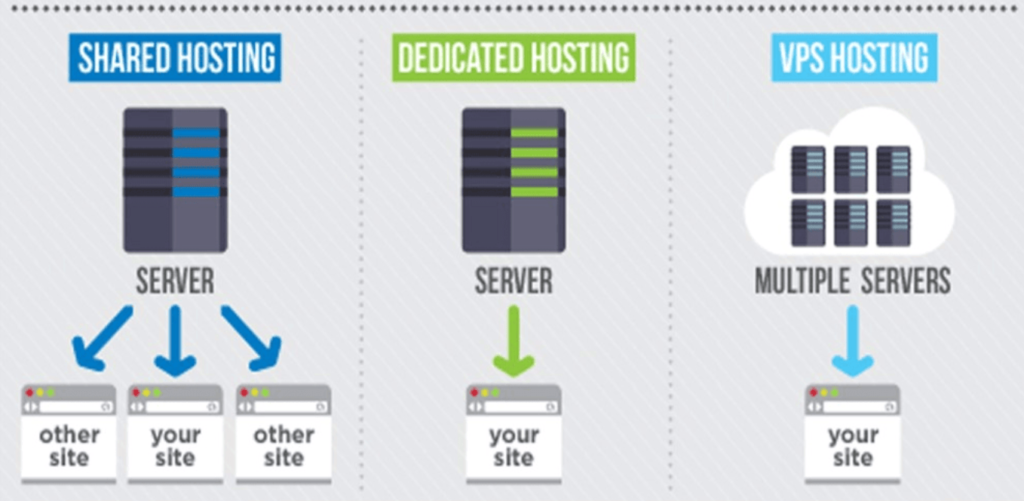
With a shared hosting plan, your website will be hosted on the same server as other websites. This means that you’ll be sharing (hence the name) server resources with those other sites as well.

Shared Hosting

That’s the reason why shared hosting is so cost-effective compared to VPS hosting or dedicated hosting plans.

Shared hosting is like renting a bedroom in a house with other roommates. You have your own room, but you’re sharing supplies and resources in the house. If one of your roommates has a bunch of friends over and they eat all of the food or use all of the soap, there won’t be anything left for you.

This is the major downside of shared hosting. If another site on the same server has tons of traffic, it can slow down the loading speed on your website.

Shared hosting is an entry-level service offered by most web hosting providers.

Who is shared hosting for?

Shared hosting is best for new websites, small websites, bloggers, and small businesses. If your website is just a few pages and doesn’t require lots of on-site interaction, then shared hosting is the best option for you.

It’s an ideal choice for websites that aren’t expecting large volumes of site traffic.

Shared hosting is not scalable. So if you plan on doubling your traffic every month for the next six months until you reach 200,000 monthly visitors, you’ll need to find a VPS, dedicated server, or cloud hosting plan instead.

While I mentioned the downsides associated with shared hosting, it’s not something that new or smaller sites should worry about.

A small website can handle a little bit of downtime or slightly slower loading speeds once in a while in order to keep their web hostings costs down.

Best shared hosting providers and plans

There are literally hundreds of different shared hosting plans available today. If you’ve already done a quick Google search, then I’m sure you’re aware of this.

All of those plans are not created equally. Some are significantly better than others.

If you need a shared hosting plan for your website, these are the providers you should be considering.

Bluehost

BlueHost

Bluehost stands out for its performance compared to other web hosting companies. They definitely don’t fall short of the competition in terms of uptimes and speed.

Like most hosting providers, Bluehost offers a variety of plans, each with different features and price points. Although unlike most of the providers we’ve seen that offer just two or three plan options, Bluehost has four.

Basic

  • Starts at $2.95 per month (renews at $7.99)
  • 1 website
  • Unmetered bandwidth
  • 50 GB of SSD storage
  • 1 domain included
  • 25 sub domains

Plus

  • Starts at $5.45 per month (renews at $10.99)
  • Unlimited websites
  • Unmetered bandwidth
  • Unlimited SSD storage
  • Unlimited domains
  • Spam experts
  • Office 365 Mailbox (free for 30 days)

Choice Plus

  • Starts at $5.45 per month (renews at $14.99)
  • Unlimited websites
  • Unmetered bandwidth
  • Unlimited SSD storage
  • Unlimited domains
  • Spam experts
  • Domain privacy
  • Site backup

Pro

  • Starts at $13.95 per month (renews at $23.99)
  • Unlimited websites
  • Unmetered bandwidth
  • Unlimited SSD storage
  • Unlimited domains
  • 2 spam experts
  • Domain privacy
  • Site backup
  • Dedicated IP

Overall, the Choice Plus plan is my best overall pick from these options. With a starting price point the same as Plus plan, it’s worth paying a few extra bucks per month when it comes time to renew.

I can’t really justify the price jump for the Pro plan. You get extra spam protection and a dedicated IP. But if those are a priority for you, then you could get an upgraded plan elsewhere.

Bluehost is a top choice for new or beginner websites that plan on scaling in the near future. They provide you with the ability to upgrade your plan as needed, with just a few clicks.

So if your site is brand new and you’re not planning to prioritize traffic for a couple of years, then you can definitely get away with the Basic plan for the time being.

Bluehost pricing is straightforward, but they will charge you for add-ons.

To get the best possible rate, then you need to lock in your plan for 36 months. That’s another reason why I lean toward Choice Plus over the Plus and Basic packages. Even if you’re paying a little extra for resources that are going unused right now, it’s worth it for when your site eventually scales.

It will only end up costing you an extra $30 per year to go with Choice Plus over Basic for the first three years. That’s a great price for a reliable shared hosting service.

SiteGround

siteground

While shared hosting is typically for new or smaller websites, SiteGround is a great choice because it gives you room to scale. They offer three different shared plans, each offering more web space and the capacity to handle more monthly visitors.

So you could start with their entry-level plan, and eventually upgrade as your site gains popularity.

Here’s a brief overview of SiteGround’s three shared hosting plans:

StartUp

  • Starting at $3.95 per month (renews at $11.95)
  • Hosting for 1 website
  • 10 GB of web space
  • Suitable for roughly 10,000 monthly visitors

GrowBig

  • Starting at $5.95 per month (renews at $19.95)
  • Hosting for unlimited sites
  • 20 GB of web space
  • Suitable for roughly 25,000 monthly visitors


GoGeek

  • Starting at $11.95 per month (renews at $34.95)
  • Hosting for unlimited sites
  • 30 GB of web space
  • Suitable for roughly 100,000 monthly visitors

If your website is brand new, you probably won’t be getting 10,000 monthly visitors for quite some time. But with that said, I’d still recommend the GrowBig plan over the StartUp option.

The introductory rate is only $2 more per month, and it can accommodate more than double the monthly traffic for when your site eventually scales.

Plus, the GrowBig plan comes with on-demand backups and a free site transfer. That’s an important feature for those of you who are switching from another hosting provider.

The GoGeek plan is for small, simple websites that are expecting tons of website site traffic. I’m sure the majority of you won’t fall into this category, but I know there are a handful of you out there.

GoGeek comes with three levels of super-caching, advanced priority support, white-label and client management services, and pre-installed Git.

DreamHost

dreamhost

Some of you are just looking for a cheap web hosting plan. DreamHost has cost-effective shared hosting, without sacrificing performance.

DreamHost is shared hosting made simple. They only offer two plans that are both very straightforward.

Shared Starter

  • Starting at $2.59 per month
  • Hosting for 1 website
  • 5 subdomains
  • Email starting at $1.67 per month
  • 50 GB of site storage

Shared Unlimited

  • Starting at $5.95 per month
  • Hosting for unlimited websites
  • Unlimited subdomains
  • Email included
  • Unlimited site storage

The Shared Starter plan is the best option for brand new websites. There is plenty of site storage and it comes with five subdomains. The biggest downside is that email accounts from your domain aren’t included, but you can add-on that option.

I’d recommend the Shared Unlimited plan because it comes with added benefits like email, unlimited subdomains, and unlimited storage.

Both plans come with WordPress pre-installed, a WP site builder, SSD storage, and a free SSL certificate.

Bluehost guarantees a 100% uptime rate. If they fail to meet that promise, you’ll receive compensation for every hour of downtime, which is up to 10% of your next pre-paid renewal fee.

They also offer a 97-day money-back guarantee. In my experience, 30 days seems to be the industry standard. So Bluehost really stands behind their product by tripling that period.

For those of you who already have a WordPress site, the Bluehost experts will migrate the site to your new account for a $99 fee. If you fall into this category, I strongly recommend taking advantage of this service.

InMotion

inmotion

For those of you who prioritize customer support, InMotion Hosting will be a top option for you.

Their rates fall in-between SiteGround and Dreamhost. However, the price jumps for InMotion’s renewal rates aren’t as drastic as the competition. So you won’t have to worry about paying triple price when it’s time to renew your plan.

InMotion has three shared hosting plans for you to choose from.

Launch

  • $6.39 per month (renews at $7.99)
  • 2 websites
  • Unlimited disk space
  • Unlimited bandwidth
  • Unlimited email
  • Free SSL

Power

  • $8.49 per month (renews at $9.99)
  • 6 websites
  • Unlimited disk space
  • Unlimited bandwidth
  • Unlimited email
  • Free SSL

Pro

  • $14.71 per month (renews at $15.99)
  • Unlimited websites
  • Unlimited disk space
  • Unlimited bandwidth
  • Unlimited email
  • Free SSL

All shared hosting plans also come with a free domain, marketing tools, and security suite.

Unlike other plans we’ve seen so far, InMotion’s entry-level plan offers hosting for more than one website, unlimited disk space, and unlimited email. This is a great value for the price.

The Launch plan is the best option for beginners. Power is made for small business websites, and the Pro plan is made for developers and growing businesses.

Compared to some of the other providers on our list, InMotion really stands out when it comes to their customer support. This is definitely something to keep in mind as a new website owner.

If you’re having trouble and neep help, it’s nice to know that their team is available for you 24/7.

For those of you who decide to go with the Pro plan, you’ll get a 99.9% uptime guarantee. If InMotion fails to deliver on that promise, you’ll get credits toward free hosting.

Speaking of credits, all InMotion shared hosting plans come with $150 in free advertising credits, which can be very useful for a new website. It’s a great way to gain some exposure through popular search engines.

HostGator

hostgator

HostGator is another cheap shared hosting option. But for a cost-effective hosting solution, they still offer great support.

All HostGator shared plans come with unmetered bandwidth, unmetered storage, a free SSL certificate, and free domain. Pricing for each is:

  • Hatchling Plan — Starting at $2.75 per month (renews at $6.95)
  • Baby Plan — Starting at $3.95 per month (renews at $9.95)
  • Business Plan — Starting at $5.95 per month (renews at $14.95)

Both the Baby and Business plan come with unlimited domains, while the Hatchling plan is for a single domain.

The Business Plan comes with added benefits like a free dedicated IP, free SEO tools, and a free upgrade to Positive SSL.

Overall, HostGator is a great value. The new customer rates are definitely on the lower end of the spectrum, but the renewal rates aren’t too expensive. Plus, you can lock in the introductory rate for three years.

HostGator offers a $100 Google AdWords credit and a $100 Bing Ads credit for all shared hosting plans.

If you’re considering HostGator, I’d recommend the Business Plan, even for beginners.

It’s not often that I pick the top-tier pricing as the go-to plan for everyone. But with HostGator, I think that the value for that plan is the best. The add-ons that come with the Business Plan are worth the higher pricing. Ultimately, it’s still less than $15 per month, even after you renew.

In addition to 24/7 server monitoring, 24/7 live chat and phone support, HostGator also has more than 500 video tutorials and nearly 700 help articles if you want to learn how to do things on your own.

GoDaddy

Godaddy

GoDaddy is another well-known name in the web hosting industry. They offer quality shared hosting plans at competitive rates.

If you decide to go with GoDaddy for shared web hosting, your site will benefit from high uptime rates and fast loading times. Both of which are crucial components of web hosting.

GoDaddy offers four shared hosting plans. Each one is made for different types of websites.

  • Economy — Best for basic starter websites. Starts at $5.99 per month (renews at $8.99).
  • Deluxe — Offers more space for multiple sites. Starts at $7.99 per month (renews at $11.99).
  • Ultimate — Best for sites with lots of traffic. Starts at $12.99 per month (renews at $16.99).
  • Maximum — Best for complex sites with lots of high-resolution images and videos. Starts at $19.99 (renews at $24.99).

As you can see, all of the GoDaddy plans are affordable. There’s something for everyone on this list, and it’s very straightforward.

If you’re starting a simple blog from scratch, you can get away with the Economy plan.

For those of you who have a small business and expect heavy site traffic, you’ll be better off with the Ultimate plan.

You always have the option to level-up if you need more resources. GoDaddy will actually send you an alert if you’re getting close to exceeding things like your memory or CPU. That way you can stay on top of things.

A2 Hosting

A2

A2 is another top option for shared hosting. They offer one of the fastest shared hosting services available on the market today.

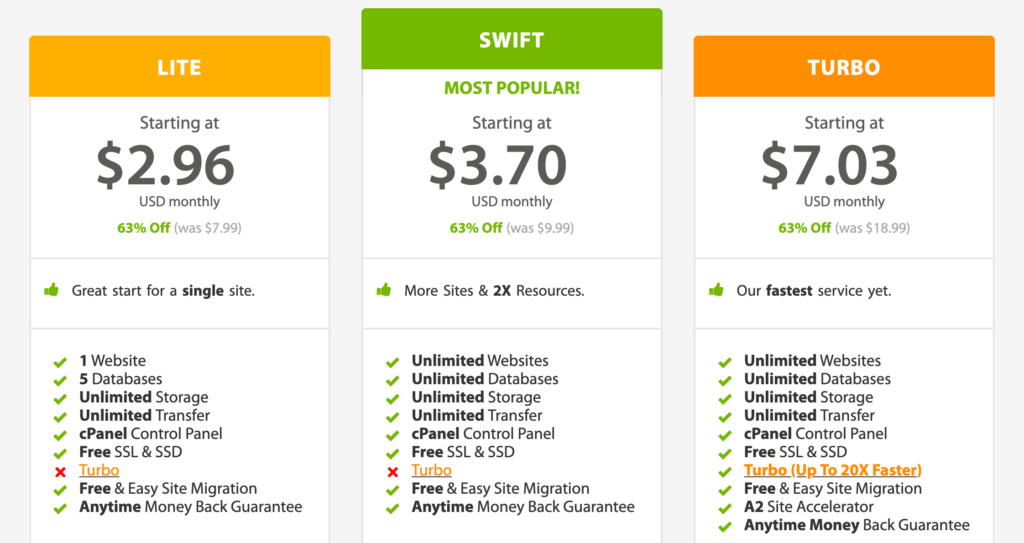
Here’s a side-by-side comparison of their three shared hosting plans.

A2 Hosting offers affordable pricing for all of their plans. The introductory rates rival some of the lowest we’ve seen in this guide.

With that said, I’d go with the Swift plan at a minimum.

While the Lite plan is the cheapest, you might as well upgrade to get unlimited databases, even if you’re not planning to take advantage of unlimited websites.

Swift is less than $1 more per month when you first sign up, and only $2 more per month when you renew. That extra $24 per year is worth double the resources.

For those of you who have a need for speed, the Turbo plan will be best for you. It’s probably the fastest shared hosting plan offered by any provider on our list. A2 is already known for its speed, and Turbo is their top of the line shared plan.

While it ends up being $18.99 when you renew, it’s still cheaper than some of the other high-end plans we’ve looked at so far. Overall, A2 hosting is priced in the middle range compared to the competition.

Furthermore, A2 Hosting offers free site migrations for their shared plans. If you recall, other providers charge an added fee for this service.

They have excellent customer support as well, which is always a nice bonus. Overall, I can’t find much of anything bad to say about A2’s shared hosting plans.

iPage

ipage

Unlike other providers on our list that have multiple plan options, iPage offers just one plan for shared web hosting.

It’s about as straightforward as it gets. Their plan costs $1.99 per month when you sign up, and $7.99 per month when you renew. Overall, this definitely puts them in the best cheap web hosting category.

Even though they offer low prices, iPage has great features like:

  • Unlimited disk space
  • Scalable bandwidth
  • Unlimited domains
  • Free SSL certificate
  • Free domain for one year
  • Free ecommerce integration
  • 24/7 phone and live chat support

That’s a lot of “frees” and “unlimiteds” for such a low-cost plan. Even though iPage advertises a free online store, PayPal integration, and other ecommerce features, I wouldn’t use them if you have an ecommerce site.

Overall, iPage is best for smaller websites. Be aware, they do charge extras for things like site transfers, but that’s expected for a low-cost web host.

Conclusion

Shared web hosting is the most popular option for new websites, blogs, and smaller websites. The vast majority of you will be more than satisfied with this type of web hosting.

With that said, there are lots of plans out there to choose from. There are definitely options you can eliminate right away based on your needs, while others should jump out at you as a suitable choice.

Here’s a recap of the best shared hosting plans on my list:

  • Bluehost — Best “unlimited” plans.
  • SiteGround — Best for scaling your shared hosting plan.
  • DreamHost — Best cheap shared hosting provider.
  • InMotion — Best support.
  • HostGator — Cost-effective with great support.
  • GoDaddy — Biggest variety of plan options.
  • A2 Hosting — Best for speed and site migrations.
  • iPage — Most straightforward and cheap pricing.

No matter what type of website you’re creating, I’m confident that you’ll find a the best hosting plan for your needs in this guide.


Source Quick Sprout https://ift.tt/2NmFfjo

Calculating the Real Annual Savings of Our Warehouse Club Membership

Sarah and I have been longtime members of Sam’s Club, the only warehouse club within reasonable distance of our home. Since our membership renewal last September, I’ve been keeping careful track of how much money the membership has actually saved us with a pocket notebook devoted to this purpose that I keep in our van, and here are the results, broken down by category. Note that an annual membership at Sam’s Club is $45.

Please note that this only includes things where I could actually verify the savings. It does not include a number of additional purchases where I instinctually was very confident about savings, but could not immediately verify it, and it does not include any purchases Sarah made separately at the club near her workplace.

We generally buy household supply store brands at a local Target as their store brands on household supplies work well and at least sometimes beat Sam’s Club prices. We buy many food items at Fareway and Aldi, which are local discount grocers convenient to us, and we usually stick to store brands there. So, basically, our comparison points are the store brands at Target, Fareway, and Aldi, not name brand items, and that’s largely because those are the shopping options available for us for food and household items.

Gasoline I have stopped at Sam’s Club 14 times in the last year for a gasoline fill-up. During each of those visits, I compared Sam’s Club gas prices to the gas offerings close to the club and also close to our house. On each visit, the gas price saved us between $0.05 and $0.11 per gallon. On each visit, the amount of gas purchased varied between 10 and 16 gallons. Thus, the range of savings per stop was $0.50 to $1.76 per visit, over 14 visits. Our actual total savings for gas was $12.74.

Trash bags We have been buying Member’s Mark boxes of tall trash bags, which come with 200 trash bags in them, which cost $12.98 per box. For comparison’s sake, the store brand trash bags that we would normally buy from our regular store come in a box of 120 for $15.99. In this case, the cost of the Sam’s Club bags are $0.0649 per bag and the store brand bags are $0.13325, for a savings of $0.06835 per bag. My estimate is that we used about 200 bags per year, so our savings is $13.67 per year.

We also have a box of tall brown bags for yard waste, of which we perhaps use 40 per year (conservatively, as it seems like we use a ton during the spring and they still get used occasionally throughout the year). The Member’s Mark 33 gallon bags we use come in boxes of 90 for $13.48, giving a cost per bag of $0.1498 per bag. The equivalent store brand 30 gallon bags come in a 72 count box for $15.99, giving a cost of $0.22208 per bag. Thus, we save about $0.07228 per bag, and over 40 bags that adds up to $2.89 per year.

Dish soap We buy the Member’s Mark 100 ounce liquid dish soap for the dishes we hand-wash, and it does a pretty good job. We keep it under the sink and use it to re-fill a smaller and more convenient bottle, as this is quite a jug. It costs $6.98 for 100 ounces, or $0.0698 per ounce. The best deal for store brand dish soap we’ve found elsewhere are these 10 ounce bottles for $0.79, or $0.079 per ounce. We go through about three of the big jugs per year (about 300 ounces) and each ounce saves us $0.0092, so the total savings is $2.76.

Steel cut oats They offer this in a 25 pound bag for $32.98, or $1.3192 per pound, whereas the cheapest price I can find elsewhere is a 30 ounce canister for $2.79, or $1.488 per pound. That’s a savings of $0.1688 per pound. My estimate is that we go through about 30 pounds of oatmeal per year, so we save about $5.06 annually buying the oatmeal in bulk.

Dishwashing detergent Our kids do the majority of the dishwasher loads here and we’ve found that individual packets tend to work much better than a nine year old dumping dishwashing detergent out of a jug, so we buy individual packets when we’re not experimenting with our homemade ones. We’ve found that these packets at $9.98 for 105 of them (or $0.0950 per load) work just as well as the store brand packs elsewhere, which come in around $8.59 for 43 of them or $0.1998 per load. This means that the Sam’s Club jumbo box saves us $0.1048 per load, and over the course of 350 loads per year (yes, we have five people, we run the dishwasher roughly daily), that saves us $36.66 annually. That’s one of the best bargains there for us.

Spiced rum We use this in cooking (you haven’t lived until you’ve tried rum-soaked walnuts in cookies) and in occasional mixed drinks. We go through a large 1.75 L bottle of this per year and buy it at the warehouse for $28.39, whereas the cheapest we’ve been able to find it elsewhere was for $31.99 for the same exact bottle. Thus, we save $3.60 per year on this specific purchase.

What don’t we buy there? Some products that we do not buy at Sam’s Club because the store brand is cheaper elsewhere include toilet paper (this store brand is notably cheaper per sheet), brown rice (I can get it for about $0.60 a pound to $0.75 a pound, and it’s never less than a dollar a pound at Sam’s Club), condiments (store brand condiments elsewhere are cheaper than the usual Heinz options at Sam’s Club), sugar (store brands are cheaper elsewhere), and fresh produce unless I’m absolutely positive I’m going to use it all in the next day or two.

So, in the end, I can verify $77.38 in annual savings from our membership over the past year. This does not include additional savings that my wife incurred or that I wasn’t able to directly verify (like when she gets her own gas there). If I buy nothing but gas, trash bags, dish soap, steel cut oats, dishwashing soap, and spiced rum there, I’ve more than paid for the annual membership. Any other savings are just icing on the cake. Obviously, these savings will vary a bit as prices change over time, but there’s more than enough breathing room here to continue to make the membership worthwhile for us.

What about Costco? What about BJ’s? I would actually quite happily shop at both of those stores if they were easily available to us. However, there are three Sam’s Clubs closer to our home than the nearest Costco (it’s far enough away that I wouldn’t realistically shop there), and there doesn’t appear to be a BJ’s within several states of us. I would love to shop at a Costco as I’ve found their store brand stuff to be stellar when I’ve had a chance to use it and their prices seem quite good, but I simply don’t have access for comparison.

All I can say is this: for our family’s buying habits, a Sam’s Club membership saves us money compared to buying gas and store brand products elsewhere, even with the cost of membership included. I can absolutely verify the savings over the course of a year, and I know which products actually save us money there.

In terms of routine, I often know which handful of items we need at Sam’s Club and I pick them up when I’m there. I remind myself of a needed item at Sam’s Club by using a location-aware reminder on my phone. Whenever I notice we need something from Sam’s Club – one of the items on that list, such as dish soap or trash bags – I check the levels of a few other things that we buy there, then put a reminder on my phone that sends me a loud notification whenever I go near the place. It dings whenever I pull in there to get gas, which is my routine. Then I just pop across the parking lot and pick up the stuff I need.

For us, this ends up saving us at least $25 per year. That’s just the money I can dead-on verify – it doesn’t include things like my wife’s routine of getting gas at the Sam’s Club near her workplace, which I don’t have accurate numbers on, or moments when I’ll buy a ton of fresh produce for a make-ahead meal or something like that, because those are irregular. In short, the membership more than pays for itself for our family.

The post Calculating the Real Annual Savings of Our Warehouse Club Membership appeared first on The Simple Dollar.


Source The Simple Dollar https://ift.tt/2LYpMTl

Paying for Your Kids’ Loans? Here Are 4 Ways to Wipe Out Parent Plus Loans

British workers now receiving 2.3% real-terms pay rises as inflation drops

From Side Hustle to Full-Time Freelance Writer and Podcast Host

Sarah Li-Cain is a finance writer whose work has appeared in places like Bankrate, Business Insider, Redbook, Financial Planning Association, Stacking Benjamins, and Her Money podcast with Jean Chatzky (of NBC Today). Her work blends practical tips and mindset strategies so that those trying to change their financial life can see themselves in the starring […]

The post From Side Hustle to Full-Time Freelance Writer and Podcast Host appeared first on The Work at Home Woman.


Source The Work at Home Woman https://ift.tt/2IdUbfr

I deferred my state pension: how much will I get if I take it now?

I deferred my state pension: how much will I get if I take it now?

I was able to draw my state pension in March 2016, but decided to defer it.

As I come under the old pension rules, I understand that by deferring my state pension by a year my pension is uplifted by 10.4%. However, I am not sure whether after each year the 10.4% is added after the interest increase or whether the 10.4% uplift is only ever on my original state pension. I presume I also accrue the yearly state pension increases?

I am now considering whether to draw my state pension on a monthly basis and pay the 40% on the income (as I work too) and invest the state pension. I would like to know how much my state pension has increased by after deferring since 2016, and whether to carry on deferring.

I have tried writing for a pension forecast based on my deferment history, but I have not received a reply. Could you advise me?

Michelle Cracknell Wed, 09/18/2019 - 10:58
From
CR/Camberley

As you reached state pension age before April 2016, your state pension increases by 10.4% a year. This is a 1% increase for every five weeks that you defer. When you claim your state pension, the increase will be applied as a ‘simple interest’ rate to whatever is the state pension at that time.  For example, if you defer your state pension for 200 weeks, the state pension at the time you draw will be increased by 40%.

As your state pension was due before April 2016, you have the option of taking the deferred payment as a lump sum or as extra income. 

As you rightly say, the state pension counts as income when working out if any income tax is payable. This means you will have to pay tax on your combined income (your earnings from work and the enhanced state pension) that is above your personal tax allowance. This may take you into the higher-rate tax bracket.

The amount of tax you may have to pay on a lump sum payment is worked out differently. The lump sum is not added to the rest of your income to work out your total income for tax. Instead, the rate of tax due on your lump sum will usually be the highest main rate of tax that you pay on your other income including any state pension you get once you have started to claim it.

In other words, if your combined income (your earnings from work and the basic state pension) is below the 40% tax band, you will only pay basic-rate tax on the lump sum. It may therefore be beneficial to take the lump sum rather than the enhanced pension – especially if you take the lump sum in a year when you are a basic-rate taxpayer.

It is often only possible to determine whether it was worthwhile with hindsight. The deferral rate of 10.4% a year that applies to you is considered to be generous and generally pays off if you live nine to 10 years after you start drawing your state pension.

The factors that determine whether it makes sense to defer include how long you expect to live, your total income in retirement and the tax rates that may apply to you during deferral and after and other state benefits that you may have been eligible to receive.

If you die before drawing your state pension, your beneficiaries would receive the lump sum that you would have received if you had opted to draw your state pension the day before you died.


Source Moneywise - 29 years of helping you with your finances https://ift.tt/307Sgny

Free cash machines are disappearing fastest in poorer areas

Plastic-free investing

7 tell-tale signs it’s time to sell an investment- and how to do it

7 tell-tale signs it’s time to sell an investment- and how to do it Ruth Jackson Tue, 09/17/2019 - 15:38


Source Moneywise - 29 years of helping you with your finances https://ift.tt/2O9isai