Thousands of courses for $10 728x90

الأحد، 13 مايو 2018

Saving Money as a Serial Wedding Guest

Being invited to a wedding or asked to be a member of a wedding party is an honor, but a costly one. No one knows this better than the serial wedding guest.

There are points when the frequency of weddings and wedding-related obligations in life increases due to factors largely beyond a serial wedding guest’s control. In my 20s, it was simply a matter of timing: Friends had finished school, met people, and opted to get hitched. Some wedding required flights and/or hotels (Las Vegas and West Palm Beach come to mind), some just required hotels and a train or bus ticket (Salem, Mass., and Long Island), and some just fell well beyond my budget (Honolulu, where I sent an off-registry garage door opener instead).

Years later, I find myself heading to multiple weddings for different reasons. A friend’s second wedding close to home and a cousin’s first at age 40 have me feeling a bit wistful, but also have also made me remember that these are events that require some budgeting. The latter is 3,000 miles away and includes me in the wedding party, which requires not only a flight and hotels, but some additional time for events, photos, and the like.

I’m grateful for the invitations and grateful that I have the means to accept them, but weddings are becoming a serious financial consideration resulting in both monetary and emotional debt. An 30-year-old account manager in England recently moved back to her parents’ house after amassing nearly $2,900 in debt attending 20 weddings and 12 bachelorette parties in four years.

Joe O’Boyle, a financial adviser and retirement coach with Voya Financial Advisors in Beverly Hills, Calif., starts financial conversations with clients by asking three questions: “What is your monthly take-home income, what are your monthly expenses, and how much are you saving each month?” After breaking down fixed costs, he points out three expenses that can be reduced. The first is restaurants and eating out. The second is clothing and accessories.

“The third is one that they almost never plan for, which is travel for weddings and bachelor or bachelorette parties,” O’Boyle says. “We have some clients who go to two, three, or four of these events a year, and it can cost a couple thousand dollars once everything is factored in. They never plan for that.”

Boston Globe “Love Letters” columnist Meredith Goldstein, author of “Can’t Help Myself,” estimates that she spent close to $15,000 on weddings during her seven years of peak wedding attendance. That sum includes bridal showers, dresses, and bridal-party salon visits where “You’re going to get a blow dry you’d never get in real life.” She warns serial wedding guests not to underestimate the costs of their popularity.

“If only one person got married a year, it would be an annual expense that you could anticipate, but it never works that way,” Goldstein says. “It’s easier said than done, but you’re allowed to say no to things and explain your financial situation to people. Sometimes it means saying no to being a bridesmaid and being maid of honor.”

Kimberly Fusaro, longtime weddings editor for Glamour magazine, suggests weighing every wedding invitation and every wedding-party invitation as you receive it. Think about your relationship with the bride and groom, your finances, and your calendar. If you have a bunch of close friends getting married within the same year, it may be a scenario where you swallow the costs for a year and go.

But a distant cousin, a neglected college roommate, or that coworker who invited you to their wedding likely aren’t going to miss you. And Fusaro notes that the rule of thumb is that roughly 20% of the people invited to a wedding will decline. That percentage only gets higher for a destination wedding.

“It’s a wedding invitation, not a subpoena,” Fusaro says.

While it’s hard to turn down an invitation from a member of the immediate family, Fusaro warns that if you don’t support your sister’s marriage or don’t want to watch your dad say “I do” for the fourth time, don’t go. She notes that you can always just send a gift, if you can bear it.

It’s similarly difficult to make it to destination weddings. While couples will sometimes hold weddings far from home just to thin the guest list, Fusaro notes that those who plan on actually attending shouldn’t feel the need to splurge. Fly on off days, check out hotels or home rentals that aren’t recommended by the couple, and consider staying a bit further from the wedding venue and taking a cab or ride-share from the festivities.

Meanwhile, Goldstein notes that couples who plan destination weddings may learn that their relationships aren’t as strong as they may believe. Goldstein remembers being invited to a friend’s wedding several thousand miles out of her way that would’ve required her to go alone, rent or split a room, and buy various presents. When she offered to come to the friend’s shower instead, the friend wasn’t happy.

“In that particular situation, if anything, it revealed that she didn’t know much about my life at that point,” Goldstein says. “She was asking for things that reflected a friendship that had not been as close because of distance, which is fine, but I couldn’t deliver on something that she just assumed I could deliver on.”

Goldstein was willing to go into debt for weddings, but acknowledged that some required debt she didn’t think she could recover from. This is a particularly acute concern for members of the wedding party. Fusaro recommends cutting costs by checking out less expensive shops (like David’s Bridal, Men’s Wearhouse, or The Black Tux) or even bridesmaid dress rental site (Weddington Way, Union Station, and Vow to Be Chic are options, as is Rent the Runway).

Fusaro also notes that the only time you’re obligated to attend an engagement party, bachelor/ette parties, or showers is when you live in the city where the event is being hosted. When you agree to be in the wedding party, you’re committing to the wedding day and the night before, maybe brunch the day after. Bridesmaids are somewhat stuck with the salon visit unless they’re able to style their hair and nails on their own, Fusaro says, but they should remember that it’s more about the camaraderie than the expense. Meanwhile, it’s always fine to send a gift to a shower or party instead.

As for gifts, Fusaro points out that the old rule is that the guest should cover the cost of his or her plate at the reception. However, with most couples reluctant to talk about the cost of the wedding, Goldstein says you shouldn’t spend any amount that makes you uncomfortable, and you shouldn’t feel too badly about small gifts. Goldstein says she’s gone off of a couple’s registry if there’s nothing left, but she’s also failed to get couples a gift in general because she ended up “thinking so hard about what I could get them that would be creative.” Her solutions have included dinners, pub crawls made of gift certificates, and meaningful books and journals, but she admits that even a small item on a couple’s registry is worth getting.

“It’s OK to get that one fork,” Goldstein says. “Weddings are practical at the end of the day: They are about setting up a life with someone and, if they’re a young couple, they don’t have anything and they are going to end up using that fork.”

However, the costs of being serial wedding guest aren’t bankable. Goldstein warns that brides and grooms who spend absurd amounts of money at other people’s weddings shouldn’t expect it all back at their own wedding.

It’s a vicious cycle often built on payback, and it makes little sense at a time when people are sharing money with friends on apps like Venmo and trying to keep spending as equitable as possible. The serial wedding guest can stop the cycle by saying no every so often and keeping spending within reason, but couples sending out invitations may want to consider curtailing some of that wedding-to-wedding resentment themselves.

“It shouldn’t just fall to the people being asked,” Goldstein says. “I wish that the the people having the wedding would allow the people in their lives to know that nothing is mandatory. I want it to be on the brides and grooms to say, ‘I’m asking you to do this, but none of this is required. Please let me know if this is a hardship.’”

Related Articles: 

The post Saving Money as a Serial Wedding Guest appeared first on The Simple Dollar.


Source The Simple Dollar https://ift.tt/2jSbBl5

She’s a Whisk-Taker: Advice From a Homebaker Who Turned Passion Into Profit

السبت، 12 مايو 2018

10 Things That Shaped My Frugality and Financial Outlook

In my day to day life, I naturally gravitate toward frugal options. I prefer to make a meal at home rather than eating out. I prefer to buy store brand options for most things. I love hitting sales in the produce section. My idea of a great family vacation involves camping in a national park, particularly when we have a free national parks pass. I love digging for bargains. I love the lack of stress that comes from not having any debt and earning more than we spend and having some money in the bank.

But what made me have that mindset? What kinds of things shifted my thinking in that direction? Obviously, at other points in my life, I was much more of a big spender. What brought about that shift?

I started making a list of the factors that made me frugal. I realized pretty quickly that some of the elements really did pre-date my turnaround – the foundations for the change were in place even as I was spending big. However, it took a few more elements for everything to really click into place.

So, without further ado, here are ten things that shaped my sense of frugality and my overall financial outlook, in roughly chronological order.

My parents

This story really has to start with them.

My father was a “jack of all trades” kind of person. He worked most of the time in a factory making construction equipment, but he was often laid off from his job, particularly when I was younger. To keep things afloat for our family, he seemed to constantly have all kinds of side gigs going on. He was an avid gardener, with gardens on an incredible scale for an individual person. He was a small scale commercial fisherman. He raised small amounts of livestock – pigs, chickens, goats, and rabbits. He did all kinds of odd jobs, from small car repairs to welding to foraging for things like fungi and wild ginseng. He always made sure that there was food on the table, a roof over our head, and clothes on our backs.

My mother was a stay-at-home mom and a frugal powerhouse. Her goal was to seemingly spend as little as possible in a given week so that we’d have money available when bigger moments came around. She did this by constantly doing things to cut our spending. She would do laundry and hang it out on the line in any and all weather short of a downpour or freezing temperature. We virtually never ate out and often had meals centered around what came out of the garden or the deep freezer or what was on sale at the grocery store. She was an avid reader, but we didn’t go to the book store for books, we always went to the library.

They each set financial examples for me, but in different ways. My father showed me the value of having a lot of skills and a lot of different income streams. If one faltered, you could always pick up another if you had a wide range of skills. My mother showed me the value of frugality and watching where pennies went.

Those values were embedded deep in me. In some ways, my years of “big spending” were something of a rebellion against them and an attempt to explore other avenues, but the underlying values were still there.

Growing up lower middle class

As you might guess from the above story, we didn’t have a lot of money when I was growing up. I think lower middle class is a decent description of our average financial state, though it varied a bit (both upwards and downwards) during my childhood and teen years.

Most of the people I went to school with had substantially more family income than my own family did. They always had things that I wished I could have. They went on trips and participated in things that were simply not things we could afford.

Even given that, I still had a really good childhood. My memories of childhood are almost entirely good ones. We didn’t travel much, but I remember a lot of camping trips and a lot of evenings doing things together as a family. We didn’t have lots of stuff, but we always had what we needed and we often had at least some of the things we wanted. We didn’t have an amazing fancy house and it didn’t have a ton of space, but it kept the rain and the cold out.

If my childhood taught me anything, it’s that you don’t really need to have a lot of money to have a good life. All you really need is enough clothes to keep you warm, a roof over your head, food and water in your belly, something to engage your mind and body, and good people in your life for friendship and guidance. That’s all children really need. That’s all people really need. Everything else is just extras.

The Tightwad Gazette by Amy Dacyczyn

My aunt subscribed to this newsletter after hearing about it on the Donahue show that she watched faithfully. She received it in the mail on a monthly basis when I was in high school and she’d leave the newsletters out on her side table for anyone to read in a nice neat stack.

I remember leafing through them at the time and finding some of the ideas pretty creative, and I remember thinking to myself that it was interesting that people who had the financial means to buy pretty much whatever they wanted would actively choose to do these things. Some of the articles in the Gazette touched on that idea, linking the idea of frugality to having minimal money worries and a lot of freedom in terms of lifestyle choices.

Those articles came into my life when I was first really beginning to understand that people might not necessarily choose to invest their lives in chasing the standard American dream and might want to chase other dreams that might center around other life ambitions. At that time, I secretly dreamed of becoming a novelist, and The Tightwad Gazette really planted the idea in my mind that a person could actually pursue such goals without falling entirely into the “starving artist” trap.

I didn’t see frugality as a tool with which to build the life you wanted until I spent a few afternoons reading a pile of those newsletters. Before that, I perceived frugality as something one did out of necessity, not out of choice. It’s actually a useful tool no matter what your life situation.

My best friend, girlfriend, and eventual wife Sarah

Sarah and I were friends in high school, but we didn’t start actually dating until we ended up attending the same college. Neither one of us knew anyone when we started – there were no pre-existing social networks for either one of us aside from each other – so that gradually pushed us closer and closer together.

Sarah is the one person in my life that I’ve never felt that I had to impress. I could completely be myself with her and never feel like I had to be something else. Most of my best memories of our years as friends and our later years when we were dating were of incredibly simple things, like just watching movies or going on walks or things like that.

When you couple that sentiment with her natural inclination to enjoy the simpler things in life and my own upbringing, we often found ourselves enjoying simple things, and we still do.

My first forays into frugality and fixing our finances were strongly supported by her, and it was through that process that we rediscovered a lot of the things that we enjoyed doing together that we had replaced due to having money. We started making meals together again. We started going on a lot of walks together again.

It was because of that shared history and our shared comfort level and our open conversation that we were able to make that financial turnaround happen.

Titan by Ron Chernow

For a long period in my life – most of the 2000s, actually – I devoured biography after biography. Politicians. Artists. Businesspeople. Religious leaders. Cultural icons. I was hungry to learn about the lives of those who had accomplished big things.

My big goal with each biography I read was to intentionally pull out one or two things that meaningfully applied to my life and then spend some time trying to meaningfully apply it.

During that period in my life when I was just starting to be more open about turning my financial ship around, I happened to be reading Titan by Ron Chernow. Titan is a biography of John D. Rockefeller Sr., the founder of Standard Oil. He pulled himself up from nearly nothing to build one of the largest companies in the world.

The big element I took away from this book was Rockefeller’s insistence on keeping track of every single penny in not only his personal life, but in his businesses. He kept a ledger of every expense and every dollar brought in. His success was in no small part built upon careful tracking and careful consideration of every single dime.

I attempted this practice for a while. It was really my first attempt at keeping track of every dime that I spent. What did I learn from it? Well, when I actually went through those expenses at the time, I couldn’t help but conclude that I was spending way too much.

One might think that this experience alone would have shaken my financial path of destruction that I followed in my early adult years. It didn’t, but it certainly unsettled things and it likely helped set the stage for things to come. Plus, I think it’s somewhat responsible for my continued use of spreadsheets and You Need a Budget for tracking my expenses, even to this day.

Camping and hiking

When Sarah and I were first married, our vacations were elaborate. In the first few years of our marriage, we traveled to London, to Edinburgh, to Vegas, to Seattle, to Mexico City. We stayed in nice hotels and enjoyed ourselves.

However, one vacation in particular really stood out as memorable. For a good week, we camped on Mount Rainier and in Olympic National Forest. The two of us just stayed in a tent and did a ton of hiking and talking and exploring.

After that trip, we both realized how much we loved camping and hiking. They’re really inexpensive hobbies (once you have some basic gear) and they provide the backbone for really inexpensive getaways. Plus, there’s a certain DIY element to those kinds of experiences.

Since then, our travel has been more and more directed towards camping and hiking. In the past decade, we’ve spent our summers in countless state and national parks, exploring trails and building campfires and just enjoying nature. I’ve come to enjoy camping and hiking as incredibly relaxing and renewing experiences.

Camping and hiking, more than anything else, taught me that I don’t need to spend thousands of dollars to feel relaxed. I can find it anywhere if I just open my mind and heart to it.

Benjamin Franklin by Walter Isaacson

I read this biography of Benjamin Franklin while my wife was pregnant with our first child, and as with the many other biographies I read, I tried to take something out of it that I could use in my life.

Here, the lesson I took away is that a person could consciously work on their virtues and actually practice being a better person. There was a section of Isaacson’s biography covering Franklin’s years as a printer in Philadelphia that discussed how Franklin used a little pocket notebook to work on the virtues he desired for himself that he felt he was weak on. I actually wrote about this process not long ago on The Simple Dollar.

I tried doing this for a while as I finished up Isaacson’s biography and tackled Franklin’s own autobiography and found it to be pretty challenging, but in a good way, one that makes you feel like you’ve actually pushed yourself in a better direction. I’ve revisited this practice over the years in various ways.

So, what does that have to do with shaping my frugality? Well, frugality was literally one of Franklin’s thirteen virtues. I remember finding the practice of that virtue to be easier and more meaningful than I expected at the time, which I believe really set the stage for the financial direction that was to come.

Becoming a parent

In late 2005, Sarah and I became parents for the first time. For the first time in my life, I felt wholly responsible for the well being and safety of another life. My son’s life was completely in my hands. His well being and growth was in my hands. What was I going to do?

I was absolutely scared to death by the prospect of parenthood. I felt like I could barely manage my own life, let alone take on the responsibility of raising a child. This shift in perspective largely occurred during Sarah’s pregnancy – prior to that, I thought I was ready to be a parent, but as those months passed, it became clear to me that I wasn’t ready and that I could barely manage myself.

Those first few months of parenthood were a major adjustment. I began to really feel the weight of how the things I was doing during his infancy were going to shape him. He needed to be held and loved. He needed to be fed. He needed to be warm and safe. He needed to hear my calm and happy speaking voice.

Along with that, I needed to consider his future. What was his childhood going to look like? His teen years? What about growing up and leaving home, something I had done myself not too long before that? I was now going to be the parent in those roles, not the kid. How would I ever be ready?

That experience of parenthood gave me a lot of food for thought that weighed heavily on my heart and eventually led right to the doorstep of my financial epiphany.

Julius Rock from Everybody Hates Chris

At the time when our first child was a baby, one of the better sitcoms on television was Everybody Hates Chris, a sitcom based on the troubled teenage experiences of comedian Chris Rock. It was one of those shows that manages to bridge the gap between funny and genuinely thoughtful and I found myself watching it regularly.

The character that stood out to me on the show was Julius Rock, the father of the main character. Julius was a solid, level headed, and reliable father and husband, portrayed with a lot more respect than many sitcom fathers, at least in my eyes. He worried a lot about his family and made a conscientious effort to be involved in their lives.

One of his biggest quirks, however, was his strong frugality. He was extremely, extremely careful with his money and his family’s money. He carried it over the line to “cheapness” sometimes, but quite often, it was clear that he was trying to be careful with his money so that his family could always be sure to have a roof over their head and have what they needed.

Julius Rock had a profound impact on my consideration of what it meant to be a father and a husband, in the sense that part of that responsibility was to make sure that my family always had what they needed, even if it were sometimes at the expense of what I wanted.

Your Money or Your Life by Joe Dominguez and Vicki Robin

When I finally hit financial rock bottom, I already had most of the pieces in place to carve out a better direction for my own life, but it was Your Money or Your Life that truly kicked it into high gear.

My initial move when I realized that I needed to turn my finances around was the same as it always was when I hit a problem in life or a subject I didn’t fully understand: I started reading. I went to the library and checked out tons of books on personal finance.

Your Money or Your Life clicked like no other book did. It drew upon all of those pieces that were already in place in my life and gave those pieces a shape and a worldview that I didn’t quite have before I opened that cover. It really was a framework for a lot of elements already present in my life and it pointed me in a new direction, one that eventually led to The Simple Dollar and debt freedom and potential financial independence from work in the reasonably near future.

I really encourage you to read my series on the book, where I dig deeply into the impact this book had on me.

Final Thoughts

As I look back over my life, I realize that I spent most of it assembling the pieces of my frugality and financial outlook, but I didn’t put them all together in a sensible way until after I had been married for a few years and had a child. Before that, I stumbled through life without any real financial direction; it took those life changes and the ability to put all of those ideas in a real framework for things to change for us.

What are the pieces that make up the puzzle of your financial foundations? What brought you to the point where you’re reading this article and thinking seriously about your finances? Perhaps most importantly, how can those things keep you moving forward?

Good luck.

The post 10 Things That Shaped My Frugality and Financial Outlook appeared first on The Simple Dollar.


Source The Simple Dollar https://ift.tt/2Ih5JfY

How Single People Afford Homes: New Study Shows Difficulties of Single Homebuyers

The typical single American requires almost eleven years to save up a down payment for a home purchase. Discover how to buy a home as a single person.

Source CBNNews.com https://ift.tt/2jSTE60

Take a Deep Breath: Here’s How to Tame Your Financial Stress


I never thought much about how I reacted to money stress until recently, when I realized I had negative equity on my car.

I’d been living at home and hacking away at my debt, trying to position myself so that I could move out again.

I finally got to a financial place where, as long as I sold my car, I could live closer to work. But then something happened that threw me into panic mode.

My car was appraised at less than I owed on it. About $2,000 less. And then the meltdown began.

It wasn’t so much that I owed the money. It was the fact that the longer I drove the car, the bigger the financial grave I was digging.

I had less than the amount owed in my savings and had no idea how I was going to make up the difference. I started experiencing cold sweats, reduced appetite and racing thoughts for an entire week.

Financial Issues: A Stress for Many

For many, money is a common cause of stress, panic and worry. In 2015, a survey conducted by the American Psychological Association revealed that 72 percent of survey respondents felt stressed about money at least some of the time, and 26 percent felt stressed about money all of the time.

And, let’s face it: Cash really is king. Money doesn’t necessarily buy happiness, but it brings stability –– like a roof over your head and food to eat.

When you’re stressed over financials, you might end up having knee-jerk reactions –– and could make decisions that are okay in the short term, but terrible in the long run.

Our reactions to financial stress are buried deep in our brains. And for those of us who experience the panic, it can be hard to realize it.

The so-called “great solution” my brain came up with after the car fiasco? Get rid of the car as soon as possible, move into a cheap apartment in a not-so-great area near work with zero belongings except for my clothes and dog, and “figure it out.” Whatever that means.

Thankfully, I avoided that disaster, thanks to my parents rationalizing the situation for me –– but they won’t always be around.

It was time to learn how to deal with these problems on my own.

Why We Start to Panic

Whether you’re just learning how to make it on your own or are feeling the burn of struggling financially for most of your life, panicking does no good.

I reached out to Dr. Audrey Ervin, PhD, a psychology faculty member at Delaware Valley University in Pennsylvania, for her thoughts on why we seem to make knee-jerk reactions when we’re faced with difficult financial situations.

Ervin broke it down:

Anxiety that involves leaning into the future and the past.

When it comes to financial stress, people often conflate future events with past ones. In my case, all I could think about was, “If I never bought this stupid car in the first place, I wouldn’t be dealing with this right now.” This isn’t necessarily true, though. Something else could have happened to keep me from moving.

We’re afraid of the unknown.

Thinking things like, “Will I have enough money to pay my student loans? Will I be able to pay the electric bill?” are all thoughts that help feed the panic within. When you have a tight budget or worry about job security, these thoughts add stress to your life. My biggest unknown was how much my car would be worth by the time I saved up a couple of grand to sell it: “Will I ever have enough to get rid of it?”

We think of the worst-case scenario.

Ervin explains that some people create fear-based narratives and negative self-talk with doom- and-gloom scenarios. Probably not the best thing to do when you’re stressed –– it only adds to the problem. Ervin recommends asking yourself, “How likely is this scenario to happen on a scale of 1 to 100?” My worst-case scenario was living at home for the rest of my life because of a car –– probably a minus-1,000 on a scale of 1 to 100, but it felt real in my overloaded brain.

Tips to Overcome Financial Stress or Panic

The good news is there’s a way to identify and manage stress and panic, regardless of whether they’re because of money or not.

Ervin shared five tips:

  1. Stop, take a breath and come into the moment. This will take your focus away from the panic and back to the present.
  2. Pay attention to your thoughts, feelings and physical sensations in the body. How are you feeling? Why do you feel that way? I thought I had a headache and wasn’t sleeping well because I was getting a cold, but the more I thought about it, the more I realized it was my financial situation affecting my health. Sometimes we experience emotions we aren’t fully aware of.
  3. Focus on the here and now and being in your body. Ervin says that mindfully coming into the moment can be a strong antidote to panic. It forces you to take a step back instead of just reacting.
  4. Engage in self-soothing thoughts. Ervin suggests changing your internal thoughts to focus on what you have control over right now, in the moment. In doing so, you’ll be able to detach from things you can’t control and will be able to focus your energy on the things you can actually change. She also recommends asking yourself, “What are some realistic short-term solutions?” And as always, remain positive. By reflecting on your successes and internal strengths, you can affirm that you can handle the current situation. Changing your narrative from “this is absolutely horrible” to “this is not preferable, but I can handle it,” can reduce panic.
  5. Develop a short-term and long-term financial goal list. Know the difference between a genuine immediate financial need and a long-term desire or goal. Allocate your emotional resources proportionally.

After using some of Ervin’s tips, I took a step back from my situation and was able to see it from a much clearer, objective perspective.

Instead of quickly making a poor financial decision to move while still having my car, I took a step back. I wrote down all of pros and cons of my situation and then formatted a plan based on it.

The end result? I was able to come up with a plan to borrow the money and sell my car. I even signed a lease on an apartment in a nicer neighborhood –– and I can still afford to keep hacking away at my debt while living there, even with the new loan payment.

Sometimes taking a breath is all it takes.

Kelly Anne Smith is an email content specialist at The Penny Hoarder. Catch her on Twitter at @keywordkelly.

This was originally published on The Penny Hoarder, which helps millions of readers worldwide earn and save money by sharing unique job opportunities, personal stories, freebies and more. The Inc. 5000 ranked The Penny Hoarder as the fastest-growing private media company in the U.S. in 2017.


source The Penny Hoarder https://ift.tt/2KWQ3zZ

الجمعة، 11 مايو 2018

This Call Center Is Hiring Work-From-Home Representatives in 4 States


Hey there, Chatty Cathy.

Put your social skills to work with Windy City Call Center, which posted these remote call center jobs available to residents of Georgia, Illinois, Texas and Florida.

The company is looking for multitaskers with excellent telephone etiquette, even amid a flurry of calls. Previous interviewing and scheduling experience is strongly preferred, and you’ll be expected to meet sales targets.

Two options are available for full-time schedules: 9 a.m. to 6 p.m. CST or 10 a.m. to 7 p.m. CST. Both schedules are Monday through Friday. Part-time schedules also come in two varieties: 10 a.m. to 3 p.m. CST or 3 p.m. to 7 p.m. CST. Both are also Monday through Friday.

You’ll be paid to attend the virtual training period, which lasts for five consecutive days from 9 a.m. to 5 p.m. CST.

Prefer to breeze past this job? Check out our Jobs page on Facebook. We post new opportunities there all the time.

Virtual Inbound Call Center Representative at Windy City Call Center

Pay: $9 per hour for the first 90 days, then $10 per hour

Responsibilities include:

  • Processing inbound calls and helping job applicants complete the final step in the application process
  • Meeting or exceeding sales goals and quality-of-work metrics

Applicants for this position must have:

  • Ability to deal with a fast-paced call center work environment, answering calls while working with multiple computer programs
  • Minimum typing speed of 35 words per minute
  • High-speed and wired internet connection — your computer must plug directly into the modem
  • Computer with at least 4GB of RAM, 2GHz processor and one of the following browsers installed: Google Chrome, Firefox or Safari
  • MS Office or OpenOffice — the job posting says the company will provide technical help if you need to assistance downloading either of these free programs

Benefits include:

  • Health insurance with company contributions
  • Company-matched 401(k) retirement plan
  • Paid time off after 90 days of employment for both full- and part-time employees

Apply here for the virtual inbound call center representative job at Windy City Call Center.

Tiffany Wendeln Connors is a staff writer at The Penny Hoarder.

This was originally published on The Penny Hoarder, which helps millions of readers worldwide earn and save money by sharing unique job opportunities, personal stories, freebies and more. The Inc. 5000 ranked The Penny Hoarder as the fastest-growing private media company in the U.S. in 2017.


source The Penny Hoarder https://ift.tt/2jNGFCu

Grab Some Popcorn: These Companies Will Pay You to Watch Movie Previews

Amazon Will Give You $15 Just for Putting Cash (Yes, Cash) in Your Account


There are two types of people: those who credit, debit and Venmo their way through money exchanges, and those who still like the feel of a crisp $20 bill.

For people of the first type, receiving any amount of cash is roughly the equivalent of getting a handful of baby snakes. The sooner it’s gone, the better. Grandma gave you $50? Quick! Give it to a friend who can Venmo the money back! (That’s right. You even use Venmo as a verb.)

But believe it or not, there are a lot of people who still like cash, or simply don’t have access to a bank account or credit card. But like everybody else, they still want to buy stuff on Amazon.

Cash may be king, but Amazon rules.

Now there is a way for you to use cash to buy your stuff on Amazon and get a little bit of free money in the process. Cha-ching! (That’s the sound of an old-timey cash register.)

And if you add cash to your account before June 30, you can score some bonus credits in your Amazon account.

  • Deposit $60 cash, and Amazon will toss in a bonus $15, making your new total $75.
  • Or, go to a participating 7-Eleven store and deposit $30 to receive a bonus of (you guessed it) $7.11, for a total of $37.11.

That’s free Amazon money, folks.

How to Deposit Cash Into Your Amazon Account

Amazon Cash allows you to turn your cash into Amazon credit.

How? It’s actually pretty easy. Log in to your Amazon account on your computer or phone app, and search “Amazon Cash.” Then, click on the “Get Your Barcode” link. You can print off the bar code or access it on your phone for the next step.

Now that you have your bar code, head to a participating store location, such as 7-Eleven, CVS or for my peeps back in the Midwest, Kwik Trip. Ask the cashier to scan the bar code, and then hand them your cash.

Like magic, your cash is turned into Amazon credits on your account in seconds.

Confused? Scroll to the bottom of this page for a quick video to walk you through the process.

Don’t Wait to Spend Your Bonus Money

Your cash deposit does not expire in your Amazon account, and you can use it on anything you want on the site. However, your bonus money does expire on July 31, so you’ll want to use that up fairly fast. I recommend this fun and stylish squid hat for just $14.99. It’s perfect for those summer get-togethers with relatives.

If you have cash burning a hole in your pocket or sitting idly in a drawer somewhere, breathe a sigh of relief, because now you can use it on Amazon.

Tyler Omoth is a senior writer at The Penny Hoarder who loves soaking up the sun and finding creative ways to help others. He finds the crisp crinkle of cash to be a soothing sound when it comes from his pocket. Catch him on Twitter at @Tyomoth.

This was originally published on The Penny Hoarder, which helps millions of readers worldwide earn and save money by sharing unique job opportunities, personal stories, freebies and more. The Inc. 5000 ranked The Penny Hoarder as the fastest-growing private media company in the U.S. in 2017.


source The Penny Hoarder https://ift.tt/2I7VMFz

Turn Your Gaming Talents Into Dollars as a Freelance Writer for GameSkinny


When I was a kid, it was always a great day when one of my video game magazines arrived in the mail. I’d spend afternoons reading about all the upcoming releases and reviews of new titles.

Back then, the idea of being able to get paid to play and write about video games sounded like the best thing ever. Fast forward to today: The internet provides gamers with the opportunity to write about their favorite pastime.

If you have some writing experience and want to get paid to write about video games, now is your chance. GameSkinny is looking for remote freelance writers to join its team. The website, a subsidiary of the Launch Media Network, features content written for gamers, by gamers. It includes reviews, news, game guides, gaming trends and more.

Writers will be expected to follow Google Trends and research topics for story ideas that they think GameSkinny readers will enjoy.

If you’re not a gamer but are still interested in work-from-home jobs, don’t forget to check out our Jobs page on Facebook. We post new opportunities there all the time.

Freelance Writer at GameSkinny

Pay: Based on Your Submitted Pay Rate for a 600- to 1,200-Word Post

Responsibilities include:

  • Researching current trends and keywords
  • Writing quality content based on research and anticipating what the gaming community needs
  • Using self-promotion and content marketing to attract new audiences to your posts (bonuses for content that scores big)
  • Pitching a set number of story ideas per week/month

Applicants for this position must have:

  • At least one year of experience as a freelance gaming writer

To apply for the freelance writer position at GameSkinny, email WriteforUs@GameSkinny.com with “Freelance Writer” written on the subject line.

Include the following credentials in the email:

  • Links to published work, including samples of reviews, game guides or any content related to gaming
  • Three or four sample headlines you think would work for GameSkinny
  • Your per-article pay rate based on a 600- to 1,200-word post
  • A list of games you are currently playing

Click here to see all the details for this gig.

Matt Reinstetle is a staff writer at The Penny Hoarder.

This was originally published on The Penny Hoarder, which helps millions of readers worldwide earn and save money by sharing unique job opportunities, personal stories, freebies and more. The Inc. 5000 ranked The Penny Hoarder as the fastest-growing private media company in the U.S. in 2017.


source The Penny Hoarder https://ift.tt/2jTufZH

How to Leverage Your Brand’s Story to Drive Sales

Everyone has a story, what’s yours?

I’m not referring to your life story, although there are times when that can be intriguing as well. Instead, I’m talking about things like how you started your business.

What was your motivation?

Sure, everyone gets into business to make money, but there has to be more to it than that. Stories are a powerful way to connect with your audience.

That’s because they can entice all different types of emotions. The key is finding a way to drive sales by guiding these emotions.

One of my favorite ways to do this is by using your brand’s story.

I know what you’re thinking. Your brand’s story isn’t that interesting or worth sharing. Or maybe you’ve got a good story, but you just don’t know how to tell it.

But if you learn how to master the art of storytelling, it can help you increase sales revenue.

Not sure how to approach this? Don’t worry. I’ll teach you how to leverage your brand’s story to make more money. Here’s what you need to know.

Your story needs to simple

For starters, it’s important for you to keep things simple.

We’re not trying to write a Martin Scorsese film here. Stay away from plot twists, mysteries, or thought-provoking endings with an open-ended interpretation.

Your story needs to have a clear beginning, middle, and end. So before you can share this story, you’ve got to take the time to figure these components out.

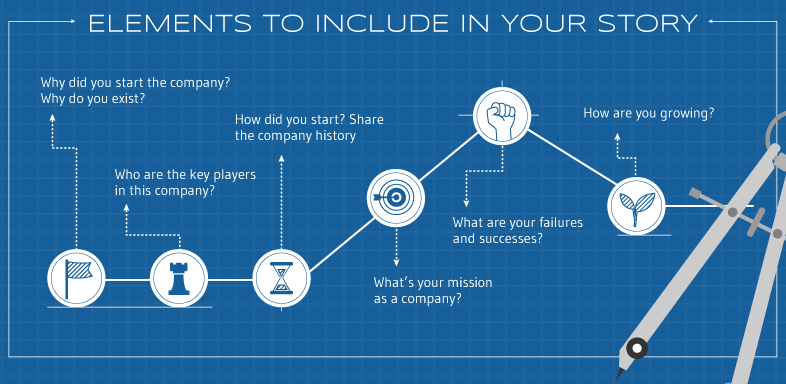
Here are some of the most common elements that should be included in your brand’s story.

image1

While you’ll want to include as much information as possible, you also need to make sure that it’s going to be easy for people to understand.

The easiest way to do this is by starting your story with some sort of problem that you’ve identified. This will be something that your audience will recognize as your reason for going into business.

Shortly after sharing the problem that your brand acknowledged, you need to talk about your solution.

Did you invent something? How did you make improvements to an already existing product?

This part of your story will help show what makes your brand different from competing companies in this market segment. So now is your chance to really shine.

Finally, the story should end with your success. Coming up with a solution is much different than finding a method that’s successful.

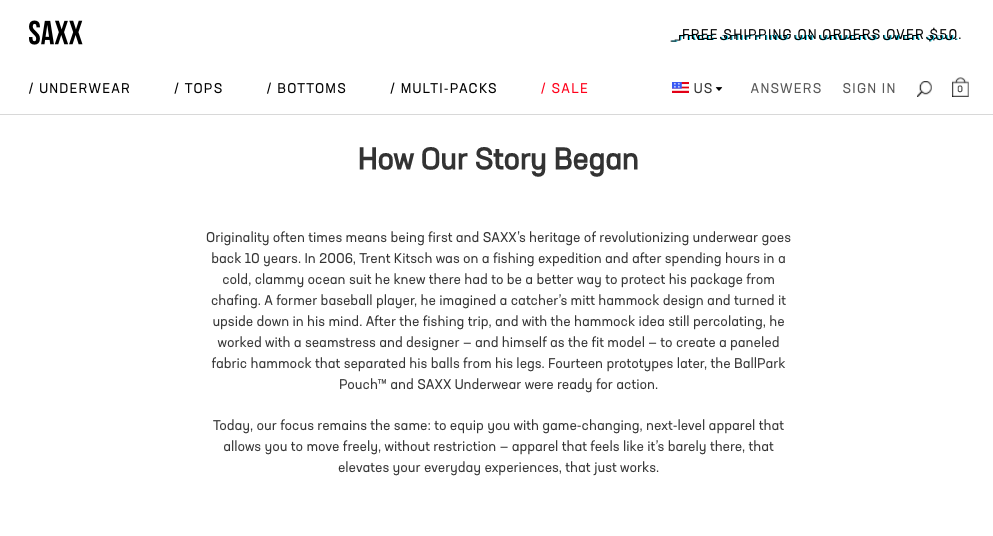
Here’s a great example from this from SAXX Underwear.

image2

SAXX manufactures and sells men’s underwear with a unique support pouch. Their story talks about how they landed on this design.

It explains how their founder was on a fishing trip and experiencing discomfort with what he was currently wearing. That’s the problem.

His solution was to create a hammock-like pouch that’s designed to keep men comfortable and dry. That’s the solution.

But he’s not quite at the success portion of the story yet. They continue explaining that it took 14 prototypes to finalize their first product. That’s the success story.

It’s also important that the ending of your story doesn’t make it sound like it’s over. You’ve got to make it clear that your business is still in operation. You’re trying to grow, prosper, and continue along the path of success.

SAXX does this well. They end the story by reinforcing that all of these years later, their focus is still the same.

So try to use this example as a template for how to tell your brand’s unique story.

Tell a story that your customers can relate to

Depending on where your company currently stands at the moment, you may not think that it’s easy for your customers to relate to.

Your company could be in a position where you are grossing hundreds of thousands of dollars annually, which the average person just can’t seem to wrap their mind around.

This is a perfect opportunity for you to refer back to where you got started. Was it difficult for you to become successful?

The struggle for success is definitely something that people can relate to. It’s something that most people deal with on a daily basis. But just make sure that you relate to our last point about keeping things simple if you’re going this route.

It’s imperative that you stick to the important details. For example, nobody cares about your negotiations with the banker as you were trying to secure a startup loan.

If you want to share a rags to riches story, you could just say something like, “We had $100 in the bank,” and it will paint a picture that’s relatable without boring your audience with minor details.

Take a look at how Mush Oatmeal shares their brand story.

image3

Rather than writing it, which is a more traditional route, they used a video to explain the motivation behind their brand. It’s a great idea because video marketing tactics increase sales.

In fact, 43% of consumers say that they want marketers to provide more video marketing content.

But in addition to being a creative way to share their journey, one of the best parts about this story from Mush is that it’s relatable.

They talk about how families walk into stores like Costco to buy big variety packs of oatmeal that contain added sugar and preservatives.

The co-founders of this brand both had a passion for health and wellness. They felt like big corporations were only motivated by making money, but Mush was motivated by providing consumers with nutrition.

That’s when they came up with the idea to provide fresh and cold oatmeal, which is different than what most people expect from a traditional hot bowl of oatmeal.

They identified a problem that people can relate to and came up with a unique solution. These are the components of a great brand story that will entice consumers to buy your products.

Relatable stories can show the human side of your company. You’re not just a brand without a face.

Show your customers that you have more in common with them than they might think, which can ultimately make them want to support you.

Establish trust and credibility

What makes you qualified to do whatever it is that you do?

Here is where your story can really help you add credibility to your brand name.

For example, let’s say that your company sells surfboards. Well, if you’ve been a professional surfer for 20 years, you’re probably qualified in this space.

So you could talk about your transition from surfing to building your own boards.

Do you have a degree in a field that’s related to your business? What did you study? Talk about some of your past jobs and experiences that made you qualified to create and run your current company.

If you can effectively answer these questions and position yourself as a credible source, then customers will be more likely to buy your products based on your differentiation from the competition.

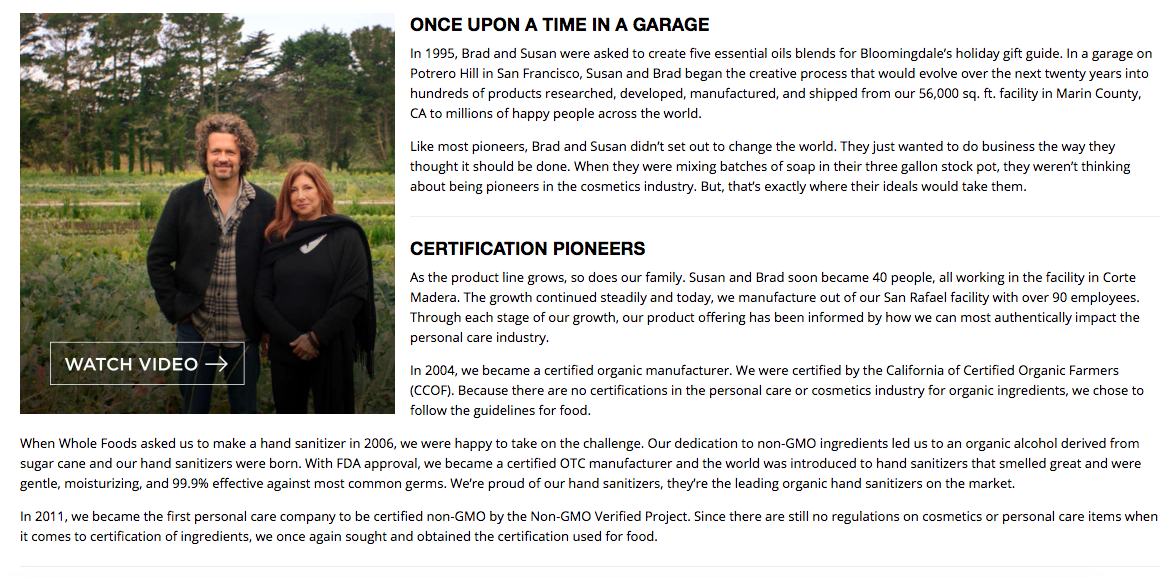
Here’s a great example of this strategy from EO Products.

image6

The story talks about their humble beginnings of making soap in a three-gallon pot in their garage. But it then turns into a tale of two pioneers in the cosmetics industry.

EO Products was tasked to create a hand sanitizer with non-GMO ingredients. So they figured out a way to use organic alcohol from sugar cane.

This brand received FDA approval as a certified OTC manufacturer of these products.

They also were the first personal care brand that was certified by the Non-GMO Verified Project.

Once their brand established trust and credibility, EO Products launched a product extension called Love Everyone. These products were designed for people and families who wanted high-quality and natural products at a budget price.

Stories like this make it enticing for consumers to buy from this brand.

Entice an emotional response

The best stories are emotional.

You may not have a story that your customers can relate to, but that doesn’t mean that you can’t get them to feel a certain type of way.

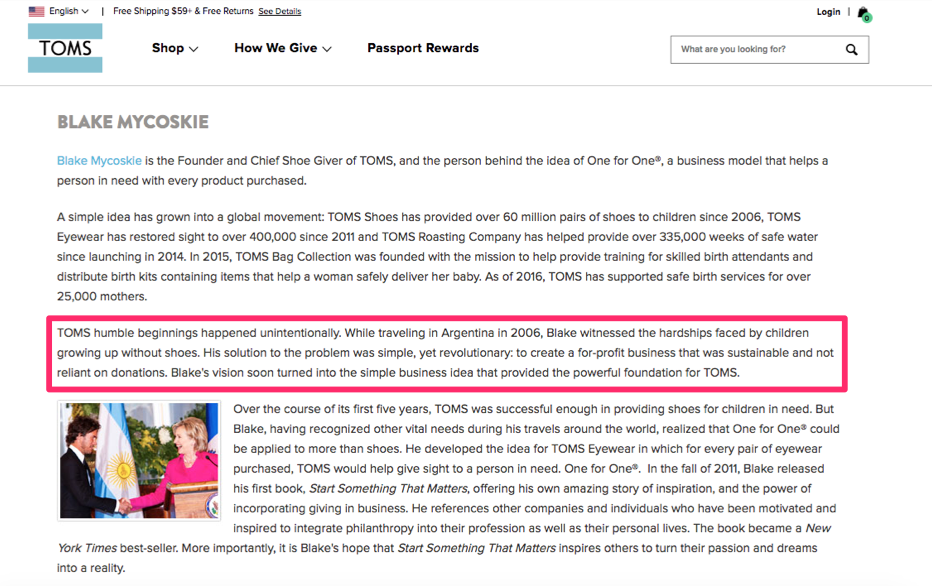
One of the best examples of this kind of brand story is used by TOMS Shoes.

image4

Their founder, Blake Mycoskie, built a brand to help people in need.

While he was traveling to Argentina, he was overwhelmed by how many children were living without shoes. This was the inspiration behind the creation of his company.

His business model is simple. For every pair of shoes purchased, another pair of shoes is donated to someone who needs help.

While prospective customers may not have a similar or relatable story, they will still be willing to buy products to help this cause based on their emotional response.

This type of story stimulates a response that drives sales. These emotions can vary based on the person.

For example, someone may feel sympathy for the people in need, while other people could feel praise for the brand that is helping. Other customers may even feel joy and self-gratitude for making a purchase, knowing that their money is going to help a greater cause.

Regardless of the reason or the emotion attached to it, you can use a similar strategy in your story to help increase your sales.

Encourage customers to tell their own story

Your story is important to your brand.

But with that said, not everyone will have the same story. Your products and services may have a unique impact on your customers.

Allow them to share it with others and create user-generated content. Stories provided by your customers can ultimately help shape and form your overall brand story.

How did your product change their lives or make things easier for them?

Your customer had a problem, and your product solved it. Let them share this story. One of the best ways to do this is by staying active on social media.

Run contests or promotions that encourage people to share their stories.

You can even share them on your website. Try to create a specific section of your site that’s dedicated to user stories.

Here is a great example of how Tesla uses this strategy on their website.

image5

Tesla builds and sells electric cars, which is revolutionary in the motor vehicle industry.

The stories shared by their customers explain how these electric cars helped improve their lives. As you can see from the examples above, there is a wide range of diversity on this page.

One story explains how two guys were able to fit eight beer kegs in an SUV, while another story talks about how a mother uses her Tesla for her family of five.

Be authentic

You don’t want to appear fake or phony when you’re telling your brand’s story.

Make sure that you aren’t making things up or embellishing the truth to make yourself sound better. If you get caught in a lie, it could backfire and potentially destroy your company.

That’s definitely not something you want to go through. We just finished talking about how important it is for you to establish trust and credibility, so don’t ruin that.

But with that said, being authentic involves much more than just telling the truth.

Let your personality shine. If you’re funny, then be funny in your story.

If you were emotional when you were creating your company, then share those emotions with your audience.

Just make sure that everything you say is an accurate representation of both you and your company.

Sell your story

When a customer buys something, they should feel like they are purchasing more than just a product.

If you market your brand properly, then customers can seemingly buy a portion of your story and make it part of their own.

This may sound complicated, but it can be done. FFTOB is a perfect example of how to properly leverage this strategy.

image7

After a certain amount of time, firefighters need to retire their suits.

But rather than having those old suits go to waste, this company turns them into unique handmade bags.

People who buy these bags are purchasing more than just the brand’s story. They are buying the story of a real-life hero.

These uniforms were worn by brave men and women who risked their lives on a daily basis to keep their communities safe. The idea of turning those uniforms into bags is so creative and just hard for customers to resist.

Everywhere they go with their bags, their story goes with them.

Some of the bags even have distorted coloring on them because they were exposed to a fire. If you’ve got a story that’s this unique, you’ve got to get out there and share it with the world.

Conclusion

If you’re looking for a new way to get more sales, look no further than yourself.

Think about how your brand got started and what inspired you to go into business. It’s been a long journey and it’s worth sharing.

You’ve just gotta make sure that your story is simple and easy to follow.

Find a way for your customers to relate with your brand’s story. Use this to help you establish trust and credibility within your industry.

A great story will stimulate emotions from your audience. Use these powerful emotions to guide customers into a buying decision.

You should also encourage your customers to tell their own stories. These unique pieces of user-generated content will help shape your overall brand story.

Sell your story in addition to your products. But no matter what you do, it’s imperative that you remain authentic at all times.

Follow these tips if you want to drive sales by leveraging your brand’s unique story.

How are you using your brand’s story to establish trust and credibility with your customers?


Source Quick Sprout https://ift.tt/2rzLgwj

A Kitchen Full of Projects

As you walk through our kitchen, one thing you can’t help but notice is that there are usually a lot of food-related projects that are almost always ongoing.

In just a cursory glance at our kitchen right now, one would find a small batch of homemade peach cider in the process of fermenting, a batch of homemade kombucha that’s also in the middle of fermenting, a jar of homemade preserved lemons, a bunch of home-canned items in the pantry, a ton of little jars of various seasoning mixes in the pantry, several full meals made in advance in the freezer, and some homemade bread dough rising in a bowl. This isn’t an unusual state of affairs.

Why do this? Why not just buy these items at the store? Doesn’t it take a lot of time and energy?

There are several reasons why we spend time and energy on food related projects, actually.

First of all, the homemade version of anything is almost always substantially less expensive than the same item in the store, often enough to produce a pretty impressive savings per hour of effort. I can make $15 worth of kombucha (at the cost at which it’s sold in stores around here) for about $1 worth of tea and sugar. The cost of a loaf of bread from scratch is about a quarter of the cost of a similar quality loaf of bread at the store. Preserved lemons consist of a few lemons, some salt, and a jar left in the fridge for a while – literally a few pennies for an amazing condiment, compared to the dollars that a smaller jar of preserved lemons costs at the store. Homemade cider consists of chopping up and boiling fruit for a while, then letting it cool, adding yeast, and waiting – a dollar or so for what would cost quite a bit in the store. All of this stuff saves money compared to the cost of buying a comparable item at the store.

Second, most of these tasks boil down to mixing together a few ingredients and waiting, so the time commitment is minimal. I’ll often make a batch of bread dough while doing dishes, since most of it is dumping four ingredients in our stand mixer bowl and letting the kneading hook knead it, which happens while I’m loading the dishwasher. I then just sit that bowl out with a towel over it to rise, come back a while later, shape it into a loaf and put it in a loaf pan (takes about 30 second), come back a while later, and pop it in the oven. It’s not hard.

Preserved lemons? I cut up some lemons. I added some salt. I pushed them down in the jar and latched it. I put them in the fridge. Now I have preserved lemons for the next year, perfect for things like marinades and potato salads.

Cider? I cut up some fruit (usually just cutting up extras when I’m making a fruit salad or slicing apples for dinner or something), add enough water to cover the fruit pieces, and let them all sit in a slow cooker for eight hours until the fruit is complete mush. I strain off the solids, add a bit of additional sugar and some yeast, and let it sit for several days in a jar with an air lock while it ferments. When it’s done, I pour it into a bottle and stick it in the fridge until we want to drink it.

Extra meals in the freezer? I just make two or three or four simultaneous batches of the supper I’m making anyway, get them all to the point where they’re ready for final cooking, and freeze the extras. Two days before we’re going to use one of the extras, I move it to the bottom of the fridge. That’s literally it.

Most of these tasks take a minute or two, then you just leave things sit for a while, then take another minute or two. Some of the others are just done in parallel with other things I’m already doing. I usually just add those tasks to the list of things that ordinarily need to be done in the kitchen, like meal prep or doing dishes.

Third, the homemade version is often better in most regards than the store-bought version. For starters, I have far more control over the ingredients. If I want a stronger ginger flavor in my cider, I add more ginger. If I want more peach flavor, I use more peaches; if it’s overwhelming, I’ll add a bit of water to cut it down next time. If I want it less salty, I add less salt. Like garlic? Add more garlic to your seasoning mix. You get the idea.

The homemade version is usually healthier without sacrificing flavor, too, because you don’t really have to worry about something being “shelf stable” for a long period of time and you don’t have to include unhealthy ingredients if you don’t wish to do so. For example, I don’t care if my homemade canned pickles slightly discolor over time – they still taste the same – so I don’t have to add a bunch of funky ingredients to make them look appropriately “pickle green” on the shelf. I don’t have to add preservatives to my bread that I just made because it’ll likely be eaten in a day or two.

Third, the more frequently I do things in the kitchen, the easier it becomes to do pretty much anything in the kitchen. I’m no longer intimidated by anything I might do in the kitchen, and part of that is the result of simply doing lots of things in the kitchen.

The first time I made a loaf of bread on my own, it seemed like a ton of work and I made a huge mess. The next time was almost as bad. The time after that? Pretty bad, too. But by the time I got to loaf 100, it was easy – I can do it quickly with minimal mess. I often make bread while I’m waiting for water to boil for tea or something like that, with all cleanup handled except for the dough hook and the bowl before the water boils. Not only that, I’m way more confident about things like making pizza dough or making breadsticks or making rolls.

This is pretty much true with the first time I made anything in my kitchen. The first time I made a seasoning mix, I had stuff all over the place. I eventually learned a few simple tricks for making it easy and now there’s not even a speck left behind. The first time I made homemade beer, our kitchen looked like a war zone. Now I can have the fermenter put away and the kitchen spotless in minutes.

Things just get easier the more you do them, and eventually the savings and the higher quality makes the process of trying to make something at home seem like a better deal than buying it at the store because the time and energy investment gets so small. It just takes practice.

Finally, I let it become a hobby. At first, I really pressed into the kitchen because the idea that I could save a lot of money through home food preparation was so prevalent in the things I was reading at the time, but as time went on, I actually grew to appreciate it.

For me, the turning point was the first time I prepared a really really good meal, one that felt like it was at least as good as what I would have had at a restaurant and paid several times as much for it. I wanted to recapture that feeling as often as possible. It became a goal for me.

As I got better and better at it, through sheer practice, I began to turn out good meals faster and faster, and I began to desire to experiment a little. I could buy some craft beer… but maybe I could just make it, and make a raspberry chocolate stout that focuses on the dark chocolate flavor. I could buy some preserved lemons for this salad… but maybe I could just make them and add just a bit of heat by putting a pepper in there. This seasoning is good, but it could use a bit more garlic… maybe I could just make a batch of seasoning just as I like it.

The end result of all of this is a kitchen full of projects, a surprisingly small food bill for the relative quality of our diet, and a surprisingly little amount of time spent in the kitchen that isn’t purely fun.

How can you get started down this path? You can do it by making simple meals and food items that you like on your own from basic ingredients. Do you like coffee? Figure out how to make your own cold brew – you need almost no equipment to make good coffee. Do you like scrambled eggs? Make scrambled eggs frequently. Look at these tasks not only as a food preparation task, but as a way to build skills so that every time you do this in the future is easier.

After you start feeling more confident in the kitchen, start making more and more things. You can move from buying burritos at Taco Bell to making a simple burrito at home with canned beans to making grilled burritos at home with beans you cooked yourself, sour cream, cheese, a bit of guacamole, and a bit of oil in a skillet. Follow recipes, figure out what seasonings you like for your regular meals, then make seasoning mixes that match exactly the flavors you want.

Just keep trying stuff. It’ll seem hard at first, with a lot of work and some likelihood of messing it up. That’s okay. Once you build the needed skills, everything gets easier and the realm of possibility gets wider. You’re making better/healthier/tastier things and you’re making them faster with less cleanup. You’ll also find that an awful lot of food tasks involve simply starting something and leaving it for a long time while you go off and do other things, so it doesn’t eat up nearly the time you imagine that it does.

The best thing you can do is get out there and try. Try making a meal. Don’t grumble about it being hard or how big the cleanup is. The thing is, each time you do it, it gets easier and the cleanup gets easier and the result gets better. The challenge is to keep going back until it becomes the easy, tasty, healthy, cheap, and obvious choice most of the time. Before you know it, you’ll have a kitchen full of projects, too.

Good luck.

The post A Kitchen Full of Projects appeared first on The Simple Dollar.


Source The Simple Dollar https://ift.tt/2Id2ryo

Postal Service: More Financial Loss as Mail Delivery Slumps

The U.S. Postal Service is reporting another quarterly loss. That's because strong gains in package deliveries were outweighed by an unrelenting decline in mail volume and the costs of its health care and pension obligations.

Source CBNNews.com https://ift.tt/2G7VNDj

Retirement Confidence Is Increasing – But Should It Be?

The 2018 EBRI survey shows nearly 2 in 3 workers are confident they will have enough money for retirement. See more findings from the 28th Annual Retirement Confidence Survey.

Source CBNNews.com https://ift.tt/2IbTiWz

How Much Money Do You Really Make Selling Stuff Like Rodan + Fields?

Ever had a friend try to get you to sell Mary Kay, Rodan & Fields, Pampered Chef, jewelry, oils or some other product from home? How much can you really expect to earn doing these?

Source Business & Money | HowStuffWorks https://ift.tt/2G9XZdS

How Much Money Do You Really Make Selling Stuff Like Rodan + Fields?

Ever had a friend try to get you to sell Mary Kay, Rodan & Fields, Pampered Chef, jewelry, oils or some other product from home? How much can you really expect to earn doing these?

Source Business & Money | HowStuffWorks https://ift.tt/2G9XZdS

My Husband Is Bleeding Us Dry to Pay for His Grown Daughter’s Lavish Tastes


Hello Penny,

I got married last October. My husband and his first wife have one daughter, now in her late 20s. The ex-wife has been very successful financially and has raised this daughter to have luxurious tastes and surroundings, emphasizing materialism. We cannot keep up with them financially.

A few weeks ago, he told me he borrowed $100,000 on a second house he owns for Daughter’s college expenses before I was with him, and it is coming due. The townhouse we live in is not fully paid for.

He raided his retirement to put up $40,000 of what was likely a $150,000 to $200,000 wedding for Daughter for a marriage that didn’t last.

He’s 67 and doesn’t want to retire, but his employer is making overtures that they want him to retire. I keep trying to get us better organized re: personal documentation, the future, etc., but I don’t want to get stuck with debt that isn’t mine when no one has ever said no to Daughter, and she will bleed all of us financially dry for her unmet emotional needs.

How do I deal with this tricky situation?

Thanks!

It seems like you’re upset with your stepdaughter for her expensive taste, when that’s not exactly her fault. She has simply responded to the dynamic set up by her mother and your new husband.

The person who is going to bleed you financially dry is actually your husband. He’s the one who keeps writing checks, apparently putting his own finances at risk by doing so.

If he did not disclose this debt and its purpose before you tied the knot, you may need to have a difficult conversation about financial honesty and how to move forward.

It sounds like you’re mad at everyone — your new husband, his ex and his daughter. It sounds like you don’t want any part of any of their financial problems. I cannot blame you.   

It’s possible to have a postnuptial agreement drawn up and notarized, barring any peculiar rules in your state. Doing so would determine what happens to his and your property in the event of death, and in theory could determine the fate of your individual debts in a worst-case scenario.

But unless you’re planning to separate, that won’t excuse you from working together to figure out how to handle finances as your husband approaches retirement.

He and your stepdaughter are long overdue for another conversation about the loan he took out to pay her college bills. Whether he intended on requiring her to pay him back or not, it’s probably time to shift the burden.

Have an awkward money dilemma? Send it to dearpenny@thepennyhoarder.com.

Disclaimer: Chosen questions and featured answers will appear in The Penny Hoarder’s “Dear Penny” column. I won’t be able to answer every single letter (I can only type so fast!). We reserve the right to edit and publish your questions. Don’t worry — your identity will remain anonymous. I don’t have a psychology, accounting, finance or legal degree, so my advice is for informational purposes only. I do, however, promise to give you honest advice based on my own insights and real-life experiences.

This was originally published on The Penny Hoarder, which helps millions of readers worldwide earn and save money by sharing unique job opportunities, personal stories, freebies and more. The Inc. 5000 ranked The Penny Hoarder as the fastest-growing private media company in the U.S. in 2017.


source The Penny Hoarder https://ift.tt/2rziP1t

Yep, Graduation Gift Registries Are Now a Thing. Here Are 4 Good Ones

الخميس، 10 مايو 2018

Just in Time for Summer: 5 Affordable Ways to Get Screened for Skin Cancer


Summer's coming. That means picnics, pool parties and a whole lot of fun in the sun.

It’s also a good time to start stocking up on sunscreen.

I know it’s gloppy, smelly and a hassle to put on every couple of hours, but it’s worth it to protect yourself against skin cancer.

According to the American Academy of Dermatology, skin cancer is the most common form of the disease  in the U.S.

In fact, around 9,500 people are diagnosed with skin cancer every day.

May is Skin Cancer Awareness Month and the Skin Cancer Foundation is encouraging people to take measures to prevent what it calls “mainly a lifestyle disease.”

Melanoma, the most serious form of skin cancer, is more likely to occur in older people but a number of other risk factors could cause it to develop in people of any age.

The Skin Cancer Foundation and the American Academy of Dermatology offer free educational materials that parents and teachers can use to teach children about the importance of protecting themselves from harmful sun rays.

Even babies aren’t immune from sun damage. New guidelines from the U.S. Preventive Services Task Force recommend physicians begin counseling parents on skin-cancer prevention for children as young 6 months old.

Skin cancer is easier to treat when detected early, so regular screenings are important.

Where to Find Affordable Skin Cancer Screenings

There are a variety of ways to find affordable skin care screenings near you.

  • SPOTme, the American Academy of Dermatology’s skin cancer prevention program, offers an online database of locations throughout the country to get a free skin cancer screening.

If there aren’t currently any locations in your area, be sure to sign up for email alerts from SPOTme to be notified when screenings are scheduled within 50 miles of you.

  • The American Society for Dermatologic Surgery also has an online database of screening locations in your area.
  • The nonprofit organization Skin Cancer Free assists people who can’t afford the full cost of a complete skin cancer screening.
  • Physician groups, dermatologists and hospital systems across the country are offering free skin cancer screenings in May for Skin Cancer Awareness Month. Contact your local hospital for more information.
  • Medicare does not cover screenings in people who aren’t showing symptoms of skin cancer. However, it does cover screening when a patient or physician is concerned about new skin growth or changes to existing moles.

One of the best ways to combat skin cancer is using a broad spectrum (UVA/UVB) sunscreen with an SPF of 15 or higher every day.

But the cost of sunscreen can really add up. Try these six tips to save a few bucks.

Lisa McGreevy is a staff writer at The Penny Hoarder. She lives in Florida so she bathes in sunscreen year-round.

This was originally published on The Penny Hoarder, which helps millions of readers worldwide earn and save money by sharing unique job opportunities, personal stories, freebies and more. The Inc. 5000 ranked The Penny Hoarder as the fastest-growing private media company in the U.S. in 2017.


source The Penny Hoarder https://ift.tt/2wqibs6

11 Mother’s Day Deals You Need to Share With Any Amazing Mom You Know

Want to Raise a Healthier Child? Use These Nutrition Tips From the CDC


The first couple years of a child’s life can be anxiety-inducing for even the most chill parents.That’s because there are a million little things to figure out.

How do I know if she’s too warm or too cold?

How should I lay him in the crib?

Should I pick her up or let her cry it out?

How long before he reaches his next growth and development milestone?

Infant and toddler nutrition is its own bundle of confusion. Well-meaning grandparents, friends and strangers throw tons of advice your way, but how do you sort out the good information from stuff that’s, to put it nicely, not so great?

The medical professionals at the Centers for Disease Control and Prevention have you covered.

The CDC unveiled a new section of its website recently that’s filled with guidance and recommendations on infant and toddler nutrition.

The website already had loads of advice on breastfeeding, formula feeding and general nutrition for tots, but this new section consolidates it all in one place for easy access. It covers everything from the types of vitamins and minerals young children need to what foods and drinks to give six-to-24-month-olds.

For a deeper dive that goes beyond nutrition advice, you’ll also find resources to learn more about oral health and food safety, and pick up general parenting tips.

The older children get, the harder it is to break bad eating habits that could lead to health and cognitive development problems, so start building a solid nutritional foundation while they’re young.

Who knows? They may even grow up liking broccoli.

Lisa McGreevy is a staff writer at The Penny Hoarder. She enjoys telling readers about affordable ways to stay healthy, so look her up on Twitter (@lisah) if you’ve got a tip to share.

This was originally published on The Penny Hoarder, which helps millions of readers worldwide earn and save money by sharing unique job opportunities, personal stories, freebies and more. The Inc. 5000 ranked The Penny Hoarder as the fastest-growing private media company in the U.S. in 2017.


source The Penny Hoarder https://ift.tt/2rzRVXm