Thousands of courses for $10 728x90

الاثنين، 12 نوفمبر 2018

Vote with your feet: Does boycotting work?

Baby Milk Action UK demonstrates outside Nestlé's HQ in 2007

If a company is getting away with poor customer service, unethical practices or tax evasion, one thing you can do is vote with your feet. But does a boycott work? We explore some recent cases to see if we can really make a difference

What do you do if you receive bad customer service? You can complain and fight for your consumer rights. But what if that still doesn’t work or it doesn’t go far enough? Perhaps your treatment was so unjust or the company does something wrong that goes beyond your own experience and you want to let it know. What’s left? You can boycott it.

Why do people boycott?

Boycotting is a way of voting with your feet, of telling a company you’re not happy by withdrawing your business. But it can go beyond that. While taking away your custom is unlikely to hit a company’s bottom line, if done in unison with others it can start to make a difference. It can also start to affect a company’s reputation by drawing attention to what it is doing wrong.

When a few money bloggers were asked if they boycotted companies or services, this is what they said.


Hollie from Thrifty Mum battled shop snobbery


Hollie from ThriftyMum says “There’s an independent handbag shop in my village where I had a Pretty Woman moment. I’d gone in and was browsing. When asked what I was looking for, I explained I was after a tan leather satchel. The assistant pointed at a few in the window (neither tan nor leather). Then I spotted THE bag in a glass cabinet by the checkout. I asked her if I could see it and she stood up, walked in front of it, blocking it from my sight, and said: “Oh, you won’t want that. It’s REAL leather, so very expensive.” I bought the bag to prove I could afford it and loved it, but I vowed never to go back due to her rudeness.”

Victoria Sully from Lylia Rose recognises that she made little impact on New Look when she boycotted it for a year for its poor customer service after querying a voucher code. However, she felt that at least she had made a stand.

“I bought the bag to prove I could afford it and loved it, but I vowed never to go back due to her rudeness”

Elle Finlay, who writes the blog E.L. Feelsgood Vintage, is among those who boycott Starbucks and Google. She goes one further refusing to use ‘Google’ as a verb for good measure too.

The problem with boycotting is that sometimes it is a little harder to keep to your principles even when you try. Perry Wilson, who writes the blog Stupidisthenorm, boycotted Sports Direct because of chief executive Mike Ashley’s behaviour as owner of Newcastle United. But a few months later, he caved in when he needed a cheap pair of socks. “Money over principles,” he sighs. He adds that, a year on, he is comfortable with his decision – but the socks disintegrated after six months.

When Sky tried to increase the subscription for Joseph Seager of Thrifty Chap, he took action. He had been with Sky for eight years, while his brother-in-law who had been with the firm for three years was getting a better deal. Joseph cancelled and didn’t budge when Sky offered him a 70%, discount a couple of days before the cut-off. He says he doesn’t miss the Sky channels either.

How can you boycott?

For a company to sit up and notice, it generally takes more than just taking your custom elsewhere.

One way is to join a large campaign of boycotting, making your voice louder by speaking up together.

Sometimes it’s not just about affecting a company’s bottomline, it’s about doing what you think is right – or finding another way to make your voice heard.

People have been posting empty crisp packets back to Walkers to show their displeasure

On a BBC Radio Scotland phone-in on boycotting this year, one man called to say he had had a run-in with the supermarket he used regularly, due to its poor service. For the next six months, he went to a rival supermarket and kept the receipts.

He then totalled up all the receipts and wrote to the chief executive of his former supermarket with the receipts and the total loss to the business.

He may have been working alone, but it really turbo-boosted his chances of his boycott being noticed.

There are times when it can seem almost impossible to boycott something because it is so integral to our daily lives.


Perry's dislike of Mike Ashley led to a failed boycott of Sports Direct


For example, there are some people who have concerns about the low level of tax paid by online retailing giant Amazon and the impact its prevalence is having on small UK businesses. Others have similar fears about Google’s tax record and dominance. However, a boycott on such ubiquitous and useful companies can seem all but impossible – and the inconvenience of losing them far greater than the realistic impact that one individual’s actions could have.

Sometimes campaigners find ways of showing their displeasure without having to give up something they like.

Postal workers have been baffled in recent weeks by a steady stream of empty crisp packets finding their way into the postal system.

It’s due to a campaign, instigated by petition website 38 Degrees, in protest against Walkers crisps use of non-recyclable packets.

Walkers announced earlier this year it would only make recyclable bags by 2025. In response, people have been posting empty packets back to Walkers to let it know they’re unhappy.

Do boycotts work?

Whether boycotts work depends on the desired outcome. Is it to raise awareness of an issue? Is it to hit a company’s sales figures? Or is it to damage reputation?

One of the first reported boycotts in England dates back to 1791. When Parliament rejected the abolition of slavery, campaigner William Fox published an anti-sugar pamphlet selling 70,000 copies in four months. Profits from sugar used in tea and cakes helped fund the slave trade. By 1792, 400,000 British people were boycotting slave-grown sugar. It wasn’t until 1807 that Parliament outlawed the slave trade, by which time sales of sugar had dropped by between a third and a half.

One of the most high-profile boycotts of recent times is that of Nestlé. Campaign groups, such as Baby Milk Action UK, have encouraged people to boycott the global brand over concerns about how it advertises baby food. The campaign, which aims to give executives a financial reason to act on criticisms of its marketing practices, says it has prompted Nestlé to modify its behaviour over the years.

Emily Rowley from ThriftyFox joined the Nestlé boycott, as she felt it was important, even though she says she misses her Smarties.

A Nestlé spokesperson says: ‘We understand that people feel strongly about a whole range of issues, such as baby health, because we do too. We have continuously evolved our policies, based on listening to the needs of families, governments, civil society and consumers, as well as our own experience. Our policy to market breastmilk substitutes responsibly is driven by five key principles: compliance, good governance, transparency, constructive engagement and continuous improvement.”

Dr Kristian Niemietz , head of health and welfare at right-wing think tank the Institute of Economic Affairs, is sceptical about boycotters’ aims. But he adds: “It’s generally a good thing that companies are so responsive to public demands, and sensitive about their image. It shows that the consumer, not big corporations, runs the show.”


Emily Rowley joined the Nestlé boycott


For a boycott to work, the target usually has to be high profile and visible. A quick search of #boycott on Twitter shows people boycotting extensively. But frequently it is a sole person encouraging others to join in their own personal cause. It is easy to just get lost in the Twitter noise. As for Facebook, you name it and there is probably a page or group to boycott it. Finding one that has achieved its aims is more difficult although raising awareness is hard to evaluate.

Earlier this year, cosmetics chain Lush launched a campaign called SpyCops, which was intended to highlight the government-backed probe into alleged instances of undercover police overstepping the mark to infiltrate the lives of activists. However, many thought it was unfairly critical of the police and insulting to police officers, the vast majority of whom have nothing to do with the allegations.

Many people supported the campaign and others publicly stated their intention to boycott Lush, with the #flushlush campaign trending on social media. However, many of these were people who didn’t buy Lush products anyway and others showed their support. According to social media monitoring firm Brandwatch, Lush sales went up by 13% over this period.

People often like to join a campaign of boycotting, feeling that it makes more of a difference when a large number of people join forces to support a particular cause. Undertaken on a large scale, it is possible to hit the profit and/or reputation of a business.

But people are also prepared to take an individual stand too. Often this boils down to good old customer service, so companies would do well to heed this.

Helen Dewdney is a print, TV and radio journalist and the author of consumer rights website The Complaining Cow

Section

Free Tag

Twitter


Source Moneywise https://ift.tt/2Dg8fTM

The Big Picture: How Two Muralists Make a Living With Their Art

These Grocery Stores Will Give You a Free Thanksgiving Turkey


Now that November is in full swing, one thing is on everyone’s mind.

It starts with a “t” and ends with a “y” — or maybe a “Why… did I let myself eat so freaking much?” as you slump over on the couch.

But while turkey might be the time-honored centerpiece of most Thanksgiving Day meals, it sure ain’t cheap.

Unless your bird’s pretty small (and you’re willing to forgo leftovers), you’re still likely pay $20 or more.

And that’s just one element of your Thanksgiving dinner.

How to Get a Free Turkey This Year

To help offset this major holiday cost — and to bring more hungry holiday shoppers into their stores — many grocery chains run specials that allow you to get a free turkey (or other holiday centerpiece) through their rewards programs.

It’s not worth it to buy $100 of random items just to score a bird you could get for $20. But if you’re going to spend that money anyway, why not get the turkey on the house?

One word of warning: All of these offers vary by store, so you’ll want to call ahead and make sure your favorite location is participating.

Here’s where to go to get a free turkey this year.

1. Fareway

Stop by your local Fareway before Nov. 22 and spend $50 or more at the meat counter to receive a 14-pound Fareway Basted Turkey for free.

The offer is limited to one per order and is not valid with any other offer.

2. Giant/Martin’s

After a two-year hiatus, Giant/Martin’s has brought back its free turkey promotion.

According to a recent press release, customers expressed how much they’ve missed the free turkey promotion and Giant couldn’t think of a better time than its 95th anniversary to bring it back.

Once again, reward members can earn extra reward points toward a free turkey every time they use their BonusCard through Nov. 22. Once you reach 400 rewards points, you get a certificate for a free turkey.

Free turkey certificates can be redeemed from Nov. 9 through Nov. 22.

3. ShopRite

Earn points on purchases through Nov. 22 — Thanksgiving Day — with your (free!) Price Plus club card.

Once you spend a certain amount, you can present your Price Plus club card to the cashier to receive a free turkey, ham, turkey breast, kosher chicken, lasagna or tofurky.

You can pick up your free item any day up to and including Thanksgiving Day. (Note that the turkey is frozen, so you’ll want to pick it up well ahead of time if you plan to make it for the big meal!)

4. Weis Market

If you’re part of Weis’s rewards program, your reward points could get you a Thanksgiving turkey for free.

It’s pretty simple: You earn one point for every dollar you spend, and it takes 400 points to receive a free turkey.

That might seem like a lot — and it is! — but it includes purchases from Oct. 4. to now.  If you spend $50 per week on groceries and have been shopping at Weis each week since then, you’ll be more than covered by Thanksgiving.

And even if you don’t earn 400 points in time, you can use 100 points toward these holiday rewards:

  • 25 cents per pound off Weis frozen turkey.
  • 25 cents per pound off smoked ham portions.
  • 49 cents per pound off Butterball frozen turkey or frozen turkey breast.
  • 99 cents per pound off John F. Martin Boneless Ham or Weis Quality Spiral Ham.
  • 99 cents per pound off Stouffer’s Party Lasagna, 90 oz. or 96 oz.
  • $1 per pound off fresh turkeys and roasting chicken.

It’s important to note that your points do have an expiration date, which is printed on the bottom of your receipts.

And in case you’re hosting dinner on a different day, you can redeem Weis’ holiday rewards anytime through Nov. 22.

Free Thanksgiving Turkey and Meals for Families in Need

If you simply can’t afford to spend the money to get a free turkey from the grocery stores above, you can look to your community for help.

Food Banks

Food banks are hard at work hosting turkey drives and fundraising events to help put Thanksgiving meals on the tables of those in need. Food bank turkey distributions are usually held during the weekend before and days leading up to Thanksgiving. If you’re not sure where to find your local food bank, you can search by state or ZIP code here.

United Way

United Way chapters also host turkey drives to help families in need. For example, the Heart of Florida United Way hosted its Thanksgiving Project Food Drive to help provide Florida families with all of the ingredients need to enjoy a Thanksgiving meal. You can search for your local United Way chapter here.

Churches and Charities

Local churches and charities have also been collecting donated items to provide low-income families in their communities with Thanksgiving meals. This church in North Carolina has been collecting items to give the first 1,000 people to visit the church on Nov. 20 a box that feeds up to five people and includes a frozen turkey, potatoes, green beans, an apple pie and other fixings.

Be sure to check with your church or local charities if you need help providing your family with a Thanksgiving meal, or if you would like to contribute to this wonderful cause.

Jamie Cattanach (@jamiecattanach) has written for SELF, Ms. Magazine, Roads & Kingdoms, VinePair, The Write Life, Barclaycard’s Travel Blog, Santander Bank’s Prosper and Thrive and other outlets. Her writing focuses on food, wine, travel and frugality.

Jessica Gray is an editorial assistant at The Penny Hoarder. She updated this post for 2018.

This was originally published on The Penny Hoarder, which helps millions of readers worldwide earn and save money by sharing unique job opportunities, personal stories, freebies and more. The Inc. 5000 ranked The Penny Hoarder as the fastest-growing private media company in the U.S. in 2017.

The Penny Hoarder Promise: We provide accurate, reliable information. Here’s why you can trust us and how we make money.


source The Penny Hoarder https://ift.tt/2DAF2nM

Create a Clever Resume of Your Favorite Character to Win a $1K Scholarship


If Homer Simpson had a resume, it might look something like this:

Homer Simpson

742 Evergreen Terrace

Springfield, United States

Summary:

Active community servant with experience as mayor, mall Santa Claus and police chief, plus more than 20 years’ experience as nuclear safety inspector.

Skills:

Making beef jerky, sales, garbage collection, chiropractic adjustments, visual arts, public speaking, sports, farming, hair styling, mountain climbing and opera singing.

What do you think other resumes of fictional and nonfictional characters might look like?

Create a spoof resume based on the life of characters from TV, literature, history or mythology to win a $1,000 scholarship from Resume Genius.

Resume Genius Scholarship Details

Good news: There’s no minimum GPA or essay required to enter.

Domestic, international, graduate and undergraduate students can apply as long as they are enrolled or planning to be enrolled full time at a university for the the spring 2019 semester.

The fake resume shouldn’t be longer than two pages or include anything about your experiences or personal information. It needs to be entirely about your fictional or nonfictional character of choice.

Resumes can be creative and humorous as long as they are well-written.

To submit your resume, attach it in a Microsoft Word, PDF or infographic format in an email to scholarship@resumegenius.com.

Include your name, the university you’ll be attending (or plan to attend) and a brief intro about yourself in the body of the email.

Only one submission per student, per semester.

An email will be sent to confirm receipt of your submission.

The deadline to enter is Dec. 15, 2018.

The winner will be announced on the Resume Genius Twitter account. For more details, visit the Resume Genius Scholarship page.

Also check out our list of 100 scholarships that will help you pay for college, or you can like The Penny Hoarder Life on Facebook to discover other scholarship opportunities.

Stephanie Bolling is a staff writer at The Penny Hoarder. She’d write a depressing but funny resume for Sisyphus.

This was originally published on The Penny Hoarder, which helps millions of readers worldwide earn and save money by sharing unique job opportunities, personal stories, freebies and more. The Inc. 5000 ranked The Penny Hoarder as the fastest-growing private media company in the U.S. in 2017.

The Penny Hoarder Promise: We provide accurate, reliable information. Here’s why you can trust us and how we make money.


source The Penny Hoarder https://ift.tt/2ODwj5a

Chiropractors Make About $100K Per Year. Here’s How to Get Crackin’

The Art of the Pitch: How to Land Your First Bylines as a Freelance Writer

Questions About Checking Luggage, Funeral Expenses, Altruism, Roth IRAs, and More!

What’s inside? Here are the questions answered in today’s reader mailbag, boiled down to summaries of five or fewer words. Click on the number to jump straight down to the question.
1. What is wealth?
2. Logistics of multiple savings goals
3. Cost of unexpected funeral
4. Changing goals
5. Shipping items verus checking luggage
6. “Get what you pay for”?
7. Retire early for altruism?
8. Can’t reduce debt
9. Emptied out 401(k)…
10. “Mega backdoor Roth”
11. Summer things on sale
12. Holiday gifts without reciprocation

My youngest son is quite skilled at chess and carries around a pocket chess set with him. While he’s not a chess prodigy by any means, he’s quite skilled at the game and can give me a run for my money – and I played chess fairly seriously for years.

It’s been fun watching him inch through the stages of it, from learning the rules to learning the joy of playing to learning the joys of making a really good move to now being on the precipice of wanting to study great games and learn opening sequences.

My son and I are having great conversations, we’re thinking a lot, and it’s a completely free activity (aside from the cost of a simple chess set). It’s wonderful!

On with the questions and comments!

Q1: What is wealth?

What is wealth?

Money is a tool. It is not – nor can it ever be more than a tool. It’s great to have some. You can probably survive with less. But nice to have more. If you’re driving a car, it’s great to have a spare tire in the trunk. The spare tire is not good for much else. Oh, it can become a rope swing or someone’s version of a lawn ornament, but it’s best use is as a tire when you need one. It’s a tool. If you think it’s really anything but a tool, you are imbuing it with lots more traits than it can possibly have. It’s a tool. Money can’t make you happy. What that particular tool can buy you might make you happy for a while, but the money is a tool. If it buys you a healthy diet and good healthcare, you are using that tool really well. If you use it to buy only beer, soda, and candy – well, you’ll probably be gone before the money is. Lots of tools outlast their owners. No amount of money can give us physical or mental health. Using the tool of money properly can give us a great sense of security that will bolster both our mental and physical health and create the general sense of well being that most people would define as ‘wealth’.
– Jaden

This comment comes from a very long time reader who has written in many times over the years, and I felt it was such a great description of what wealth is that I wanted to share it with you all.

Money is a tool that enables you to live the life you want. If you want a life that’s filled with convenience store purchases but lacks a stable retirement, then spend your money on convenience store purchases and don’t put money away for retirement. It’s that simple.

The challenge we all face is overcoming the short term things we’re tempted to use our money for in order to adequately fund the long term things. Can we overcome the temptation for a treat right now to adequately fund our retirement forty years from now? It’s fairly obvious from a detached perspective which one is better, but in the moment, it’s not nearly as clear.

Q2: Logistics of multiple savings goals

I have a problem with putting all savings in one savings account, and then planning to budget some of that for car, vacation, a mortgage etc. it’s difficult to keep longer, medium and short term savings and non monthly expense reserves in just one pot. This also also interesting in terms of new innovative banking accounts that let you create virtual sub spaces for the savings accounts. Haven’t read much quality debate around that. What do you think?
– Jerry

There are a number of online banks who do exactly this, like Capital One 360, for example.

I think that it’s a good tool for helping people organize their finances. When you log on to online banking with a bank that has a service like that, you can clearly see the different places where your money is.

Still, it’s honestly not much different than maintaining a spreadsheet where you track the amounts put aside for different goals.

Basically, a spreadsheet like that would have a top line containing the full balance of your savings account. Under that, you’d have lines that describe each of your savings goals and the “balance” of each one. At the bottom, you have a remaining total, which consists of a formula that takes the total balance and subtracts from that the amount in each of your savings goals. So, it would look something like =B1-B2-B3-B4, if cell B1 had your total balance, and B2 through B4 had the balance of each of your goals. You could update your actual savings account balance regularly and then adjust the amount saved for each goal manually until the remnant is $0.

Q3: Cost of unexpected funeral

I’ve come across a situation that I am stuck with and I think you might be able to help. I have a grandchild who became a ward of the state last fall. We are unable to care for him. After bouncing through some foster homes, he eventually committed suicide. We are his only involved relatives, so we helped make the final arrangements, knowing no one else would. The funeral home was awesome. They gave us a bottom dollar price. Half of that came in from generous friends and co-workers. Now we are looking at the last half. It’s really not all that much, but we are struggling as well. We are approaching retirement age and have no real nest egg built up. I’ve looked all over for public assistance (then I was told that paperwork had to be filled out before the funeral took place – and it was never brought to our attention!). This child was in the care of DHS. Should they not be responsible for the cost? Any ideas?
– Jane

DHS might seem like they would be morally responsible for the cost, but they may not be legally responsible. You could contact a lawyer, as this might be a case that a lawyer who focuses on issues like this might look at pro bono.

Still, the first thing I’d do is contact the funeral home again and ask whether they’re aware of any additional programs that you might be eligible for, just to make sure. They might yet know of something you can use to help pay it off in a situation like this.

I don’t know of a magic solution that will fix this. If neither of the two solutions above help, just talk to the funeral home about a payment plan with tiny monthly payments. That’s about all you can really do.

Q4: Changing goals

Ten years ago, I was single in my mid 20s working at a really high stress job that paid super well. I was banking everything I could and elsewhere and living in my car, using work facilities for everything (there was a gym, a laundry, and a cafeteria). My goal was to fund a great startup idea out of pocket.

Now I am married with a kid and another on the way. I quit the stressful job and now work as IT director for a school district which is busy but not nearly as high stress. The money I saved up turned into a house. I wouldn’t do that startup idea if my life depended on it though I’d sell my business plan if someone wanted to buy it. Saving for retirement in a typical 403(b) and probably won’t retire until I’m 60 or 65.

Moral of the story? Things change. Don’t lock yourself into some grand financial plan for the future because who knows what your life will look like a decade from now. Save money for retirement but keep some of it flexible, too.
– James

Fifteen years ago, I lived in a tiny little apartment and had debt totaling multiple years of my salary which I thought I’d never pay off. I’ve been debt free for most of a decade now.

I didn’t have any kids. My wife and I weren’t sure we wanted any kids any time soon. Our oldest (of three) just celebrated his thirteenth birthday.

Ten years ago, I worked in a research lab in a position I thought I’d probably work in for the rest of my life. Now I’m a freelance writer.

Things change. The better your financial foundation is – no debts, solid resume, decent job – the easier it is to transition right along with those changes.

Q5: Shipping items verus checking luggage

I’m about to fly with my family to visit extended family for six days for Thanksgiving and “Christmas.” A friend told me it’s cheaper to ship a box with clothes and other travel items in it than to check a bag at the airport and less hectic too. Checking prices seems comparable. Is it worth it to ship a box instead of checking luggage?
– Alex

In terms of headache, I’d far rather ship a big box of clothes and other items than try to check luggage at the airport. It’s not even a question. Just putting everything in a box at my convenience, dropping it at UPS at my convenience, and having it already at the destination and in my room when I arrive? Compare that to trying to get luggage through an airport with kids in tow, checking a bag rather than using express check-in, and then waiting at the luggage carousel (this time with tired kids) for the bags to (hopefully) appear.

For me, if the costs are close at all, I ship the clothes and other items in a single box. I do it a week or so in advance of the trip so that I can use the low-cost options for shipping and I have enough time to verify that it arrived safely.

It sounds like you’ve already done the price comparison and the price is similar. If that’s the case, load up a box tonight and ship it soon. That’s my advice to a parent with kids.

Q6: “Get what you pay for”?

How accurate do you think the old maxim of “get what you pay for” is accurate?
– Alice

I think it’s partially true and partially false.

In general, the best version of a particular item will not be the cheapest version and that, in general, if you pay more you will usually get a better items. The best version will probably be one of the more expensive versions, though not always. At the same time, the most expensive option is not always the singular best option.

What matters more than anything is research and finding out which is truly the best item and, perhaps more important, which is the best “bang for the buck” item. If you can get an item that’s 90% as good as the very best item at 50% of the price, that’s probably a wiser purchase than the best item at full price.

As I mentioned last week, I have some amazing socks that cost about as much as ten pairs of cheap socks at the store. Are they worth ten times as much? That’s debatable. However, if I find those expensive socks on sale, they’re definitely worth it for me because I won’t be replacing socks very often.

At the same time, for a lot of household goods, we buy store brand versions. They do the job perfectly well and fulfill exactly what we need from the item.

The moral here? Do your homework and be patient for sales.

Q7: Retire early for altruism?

Do you have any thoughts on this article about Vicki Robin? She’s one of the authors of Your Money or Your Life and she seems to think that the reason to retire early is to be charitable and altruistic. Thoughts? https://amp.businessinsider.com/purpose-of-early-retirement-giving-back-altruistic-behavior-2018-11
– Kevin

I think that anything you do in life has a lot more value if you have a purpose behind it. What’s your purpose in going to work? The more clearly you understand that purpose, the more tolerable work will probably be.

The same thing is true if you retire early. How are you going to fill your days? If those days have a purpose and you’re doing something that’s meaningful for you, retirement is going to have far more value and you’re going to find far more happiness there.

Is altruism or charitable work the answer for everyone? Probably not, but I think it’s a good answer for a lot of people, enough so that people should investigate it.

More than that, I think that if you’re considering retirement at any age, you should start thinking seriously about what your purpose and meaning in life is and what you can do most effectively with your newfound abundance of time to achieve that purpose. What are you going to do to use that time and not just let it pass by you?

Q8: Can’t reduce debt

I do not make enough money to reduce my debt even if everything goes perfect. My pay is eaten by rent and utilities and minimal groceries at the store. I managed to get out of payday loan cycle by selling most of my possessions but can’t get further ahead no matter what I do.
– David

First thing: put some loans in forbearance. If you’re struggling this hard, contact some of your lenders and discuss forbearance with them, starting with any student loans. This basically means putting those debts on pause for a while as you take care of other ones. You’re likely eligible for this because I’m almost sure you’re making a relatively low income.

Second thing: if you can, move back in with your parents for a while. Yes, this might seem like a step backwards, but it gets the cost of rent off your back for a while. You can give your parents what you were paying for utilities and then channel the rent money into paying off debts rapidly.

Third thing: if at all possible, seek out a temporary second job, especially during the holiday season. Use that income to maybe knock a debt out of the way, freeing up some breathing room.

Doing what you’re doing now isn’t going to work. You’re going to have to try some new approaches.

Q9: Emptied out 401(k)…

Three years ago before I knew what I was really doing I emptied out my 401(k) to pay off all of my loans. While I am debt free now, I’m now 37 with almost nothing saved for retirement and I really regret it. Don’t empty out your 401(k) even if it seems like it would help!
– Jeffrey

I do agree with this sentiment. Emptying out a 401(k) should be a last resort move. If you need to get rid of debt quickly, just cut the contributions for now. Don’t empty out the account.

Still, you shouldn’t feel that much regret. Right now, you have zero debt. You should, in theory, have the capacity to dump a lot into your 401(k) by making large contributions going forward. You have a lot of financial flexibility right now.

Yes, your net worth would likely have been much higher had you not touched anything, but that’s water under the bridge. You’re 37. You’re debt free. You have a decent job. You have a lot of options. Don’t dwell on the downside.

Q10: “Mega backdoor Roth”

I’ve seen some mentions of a “mega backdoor Roth” on other sites but it was barely explained with tons of jargon. You are good at explaining things simply. How does a mega backdoor Roth work?
– Daniel

A “mega backdoor Roth” refers to a strategy where you’re basically able to move money from a 401(k) into a Roth IRA using a multi-step process.

When you contribute money to a 401(k) through your workplace, this is usually a pre-tax contribution. It’s taken out of your paycheck before taxes are calculated.

However, you’re also legally able to make after-tax contributions to a 401(k), provided your plan allows it (about half of 401(k) plans do). If you can do so, you can make additional contributions to your 401(k) using after-tax money – money from your paycheck after taxes are calculated and taken out. These contributions won’t help your tax returns this year, but they will get more money into your retirement savings.

What’s the benefit? First of all, it gets around the contribution cap for a 401(k), if you’re bumping up against that. You can only contribute about $18,000 in pre-tax money to a 401(k), but you can contribute much more if those additional contributions are after-tax.

The “mega backdoor Roth” also comes into play here, because the IRS allows you to roll over those after-tax 401(k) contributions straight into a Roth IRA if your plan allows you to do so (this is called an in-service distribution) or you’re changing employers. This allows you to bypass the annual $5500 contribution limits on a Roth IRA. The big advantage of doing this is that, if the money is in the Roth IRA, you won’t have to pay taxes on the gains on that after-tax money, but if it stays in the 401(k), you will.

While this is a nice trick, it’s not quite as effective as simply contributing straight to a Roth IRA directly or contributing to a 401(k) pre-tax. It’s only useful if you’re wanting to contribute many tens of thousands to retirement, and those people are often over the income limit for Roth IRA contributions.

It’s a strategy useful for extreme savers and high income earners who want to hedge their bets regarding taxes in retirement. For the vast majority of people, it’s a novelty, but not directly useful.

Q11: Summer things on sale

This is a great time of year to watch your local hardware store for summer nonperishable but consumable supplies like wood chips and charcoal and bags of soil. They’re often trying to get rid of the stuff and mark it down like crazy to make room for things like bags of ice melt and show shovels. If you garden or have a big yard or a charcoal grill look at the clearance section of your hardware store right now.
– David

This is some great advice, though that clearance season blew through northern Iowa a few weeks ago. That’s because we need the ice melt awfully early around here.

I did manage to buy some organic fertilizer on clearance a few weeks ago. It was spread immediately on our garden as we were winterizing it and another couple of bags were put into storage for the winter.

Still, if you live in most of the country and are a homeowner, it might be a great time to take a peek at the clearance section at your local hardware stores, especially if you have some good dry storage space.

Q12: Holiday gifts without reciprocation

In June, my youngest brother lost his job. He sent everyone in the family an email this past week saying that he couldn’t afford to buy anyone holiday gifts and requested that no one buy him any gifts. I still want to give him a gift. I don’t feel that the holidays are about what you receive, but what you give. But then I feel like I’m violating his request. Thoughts?
– Angela

If you feel like giving him a gift, give him a gift. Flat out tell him that it’s because you love him and it is part of a great holiday for you that you get to see him open a few gifts and that him not giving gifts is completely fine given his current situation. Give him a hug and tell him that you love him, no matter what, and that having him here with everyone at the holidays is the real reason you came, and opening a few presents together like when you were kids is something really important to you.

His request for people to not give him gifts is likely so that he doesn’t have to feel guilty about receiving something when he doesn’t have anything to give. He may still feel guilty about your gift even with the above explanation.

A good compromise might be to get him something relatively small, or make something for him so that he doesn’t feel that you went out and spent money on him.

Got any questions? The best way to ask is to follow me on Facebook and ask questions directly there. I’ll attempt to answer them in a future mailbag (which, by way of full disclosure, may also get re-posted on other websites that pick up my blog). However, I do receive many, many questions per week, so I may not necessarily be able to answer yours.

The post Questions About Checking Luggage, Funeral Expenses, Altruism, Roth IRAs, and More! appeared first on The Simple Dollar.


Source The Simple Dollar https://ift.tt/2POPL3F

How Topic Clusters Are Revolutionizing the Future of Marketing

To survive in today’s competitive digital landscape, businesses need to focus on their content strategies now more than ever.

You need to understand how your target audience consumes content and figure out what they’re looking for. It’s not effective to produce random content at a high rate if it’s not valuable.

Everything you publish across all your distribution channels needs to benefit your audience, or it won’t be successful.

In addition to producing high quality content, you also want to make sure it’s SEO-friendly.

The key factor of your content production needs to be relevancy: 78% of consumers say relevant content increases their intent to buy.

Your content must be relevant to your brand and relevant to your audience while still appealing to Google.

Blindly producing content without a strategy won’t help you. You need to keep up with the latest trends and see how other brands approach content marketing and SEO.

Today, and in the future, marketers must have a content strategy compatible with the way people discover new content. Creating content that doesn’t drive results is expensive and inefficient.

That’s why you need to get familiar with topic clusters.

Surprisingly, many business owners and marketers I’ve spoken to recently don’t know anything about this. That was my inspiration for writing this guide.

This is the perfect opportunity for you to gain a competitive advantage.

You can learn how to implement topic clusters today and use this tactic moving forward before your competitors have a chance to catch on.

As a result, you’ll be able to produce high quality engaging content. This will help you improve your SEO strategy, drive more traffic to your site, and increase conversion rates.

I’ll explain everything you need to know about topic clusters and how they are revolutionizing the marketing industry.

What are topic clusters?

Before we proceed, let’s start with the basics.

You may have heard that topic clusters are the future of content marketing and SEO strategies, but that doesn’t explain what they are.

Truthfully, this isn’t a very complex topic. If you guessed what a topic cluster is just based on its name, you probably wouldn’t be far off.

The idea here is you want to create a deeper penetration of certain subjects relevant to your brand, audience, and search engines.

Start with one basic topic, then branch off to similar ones. You’ll create content about all of them, with the main area of focus as the nucleus.

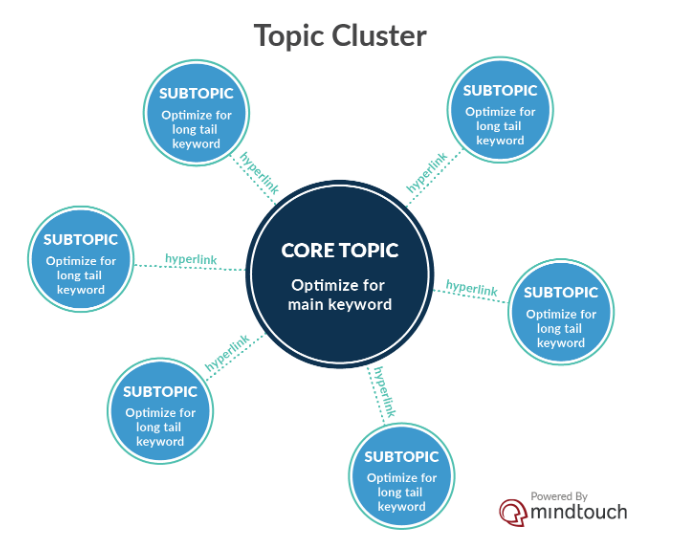
Here’s a visual representation of a topic cluster template:

template

Clusters can be broken down into two segments.

The image above refers to them as core topics and subtopics. However, they are also commonly referred to as pillar content and cluster content.

Your pillar topics will be broad. The clusters will be more descriptive.

For example, let’s say your company sells workout supplements. You can create a topic cluster using “workout routines” as the pillar.

Clusters related to this pillar would be:

  • home workout routines
  • workout routines to build muscle
  • workout routines to lose weight
  • outdoor workout routines
  • bodyweight workout routines
  • workout routines with weights

Each cluster takes a keyword and transforms it into a long-tail keyword.

When you publish such content on your website, you’ll be able to generate lots of internal links, ultimately improving your SEO ranking.

The pillar will link to each cluster, and each cluster will link back to the pillar with internal hyperlinks.

Here’s another example of a topic cluster using “GDPR Compliance” as the pillar:

GDPR

As you can see, each cluster includes the pillar.

All of these subtopics are more specific segments of the broad subject. That’s how your audience will search for topics online. These topic clusters will increase your site visibility in search engine results.

Optimize your website architecture

The application of your topic clusters will be related to your site architecture.

You need to make sure this structure is optimized for SEO purposes. Whether you realize it or not, how you design your architecture can determine whether your site is SEO-friendly or not.

You need to think about the user experience.

Make it as easy as possible for website visitors to navigate your site and find what they’re looking for in as few steps as possible.

If your site is structured properly, you won’t have as many bounce rates, and your dwell time will be improved as well. As a result, your search ranking will increase.

Let me show you what I mean.

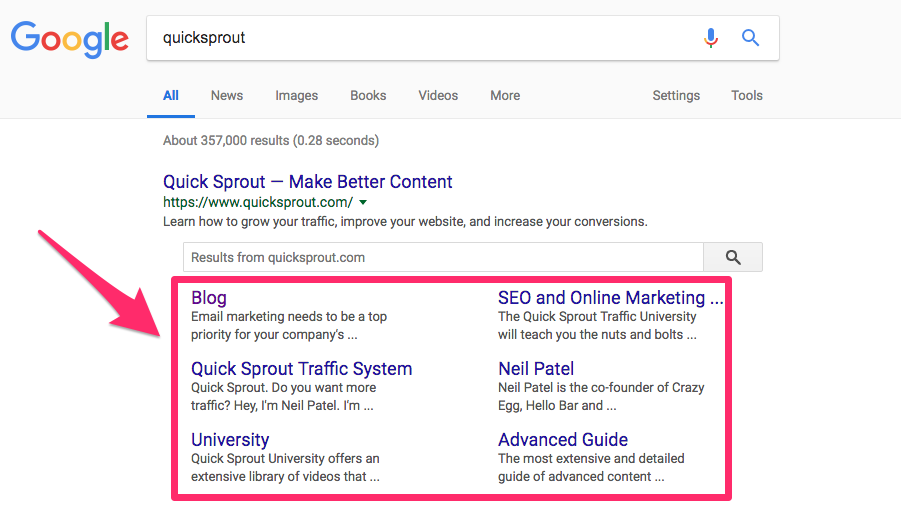
If you Google Quick Sprout, here is how it appears in the search results:

quicksprout

Check out the section I highlighted above. These are called sitelinks.

Sitelinks are subpages of a website that appear in Google SERPs. This will help a user navigate to a more relevant portion of a site, directly from the search engine.

These sitelinks create fewer steps in the conversion funnel. Users can click one of these hyperlinks instead of having to navigate to your homepage first.

Sitelinks are great for SEO purposes. However, you can’t contact Google and choose which site links get displayed unless you’re running paid campaigns with Google AdWords.

For organic search results, Google’s algorithm decides what to display. Your site structure will have a major impact on this.

You need to establish a logical hierarchy of pages and links on your site. Topic clusters will drastically improve these efforts.

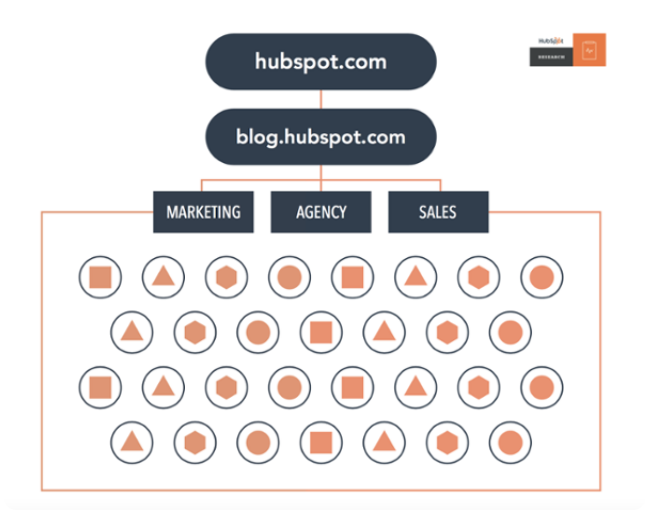
Let’s look at an example. Here’s a basic outline of the HubSpot’s website:

hubspot 1

From its homepage, you can navigate to its blog.

Once you reach the blog, you can navigate to three different topics:

  • marketing
  • sales
  • agency

All the blog posts fall into those three categories. It’s a typical architecture with a hierarchy that makes sense, but it can be improved with topic clusters.

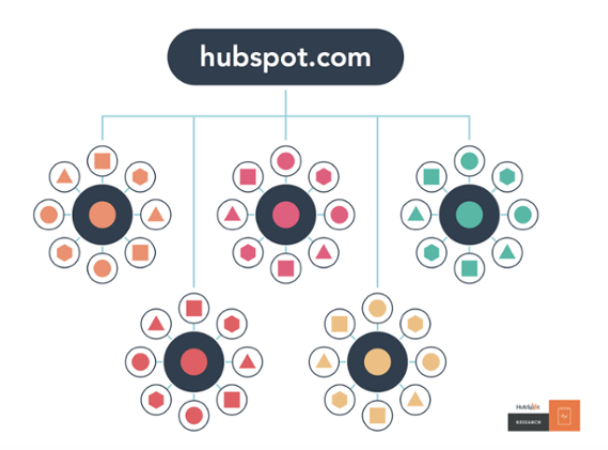
Now, let’s take a look at what this looks like with topic clusters:

hubpsot 2

This format follows the same template you saw earlier.

Each cluster has a pillar and related cluster content.

Now, when people search for long-tail keywords related to these subjects, the site’s content will be more likely seen as sitelinks in the SERPs.

Some of you may already have content published for your topic cluster strategy, but it’s not organized properly in terms of your site architecture.

You need to make the proper adjustments so that the flow follows the format of the second HubSpot image above as opposed to the first one.

Choosing the right topics

Now that you understand the basics, it’s time for you to start building topic clusters.

But before you can start producing content, you need to choose the right pillars that will drive results.

Where do you start?

Everything should begin with your target audience. Look at your current and prospective customers, and ask yourself questions such as:

  • What are these people looking for?
  • What problems do they have?
  • How does your business help solve those problems?

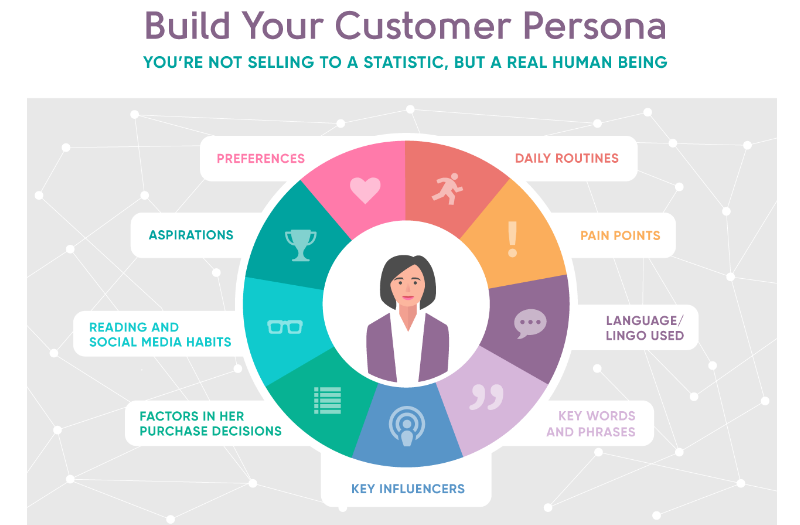
If you don’t already know the answers to these questions, it’s very helpful to start outlining a customer persona to give you a better understanding of your target audience.

customer persona

If you need further assistance with this part of the process, I have a complete guide on how to develop a customer persona that improves conversion rates.

Another way to come up with topics is to analyze your existing content.

What have you already published that has the most engagement? Your site visitors are clearly interested in it the most.

To determine your top-performing content, look at metrics such as traffic, page views, etc. and see what has been shared the most by your audience.

You can also look at which pages on your site have the highest search ranking. Topic clusters can help improve those rankings even more.

I recommend making a list of at least five main topics to start with. Those pillars will be enough for you to produce tons of content once you branch off into clusters for each one.

Conduct keyword research

Now that you have your pillars established, it’s time for you to come up with clusters.

The best way for you to approach this is by conducting keyword research.

Don’t just guess what long-tail keywords are related to your pillars. Find out exactly what people are searching for.

Many different tools and resources can help you with this task.

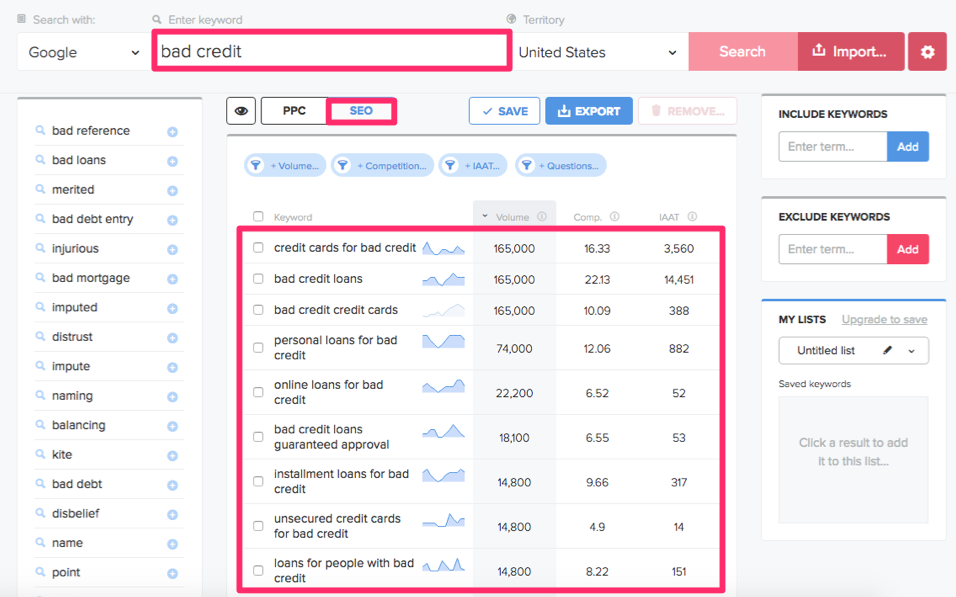
Here’s an example of how you can conduct basic keyword research with Wordtracker, which is free to use:

bad credit

Let’s say your business is in the financial industry. You reviewed your website and saw that content relating to bad credit had the highest performance metrics.

You plan to use “bad credit” as a pillar.

Once you enter that term into this tool, filter the search for SEO purposes and look at the results.

Everything on this list would be viable to use for your topic clusters:

  • credit cards for bad credit
  • bad credit loans
  • personal loans for bad credit
  • installment loans for bad credit
  • unsecured credit cards for bad credit

Don’t be afraid to create longer titles for your clusters.

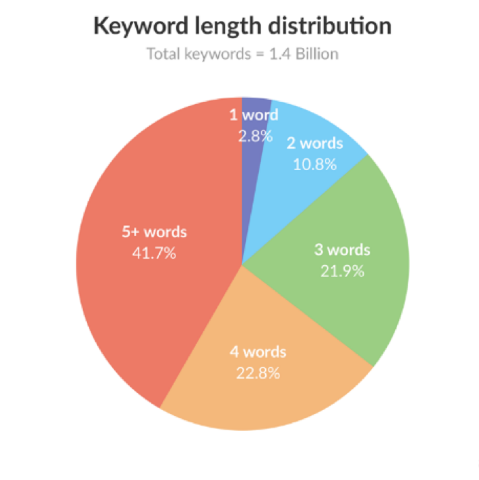
Just look at the average keyword length distribution based on a study of over 1.4 billion keywords:

keyword length

Over 64% of searches contain at least four keywords.

Producing topic clusters related to these keywords will not only improve your SEO ranking but also help ensure your traffic comes from qualified leads.

Create content based on these themes

Your keyword research is complete. Your pillars and subtopics have been defined for the clusters.

Now it’s time to create the supporting content.

You have many different options to choose from. I recommend using a diverse approach to creating highly relevant content.

Create landing pages that would be available in the learning center or resources section of your site. Something like this could be used as a hub for pillar content. You’ll use that to link to supporting clusters.

Write blog posts. Produce videos. Build infographics.

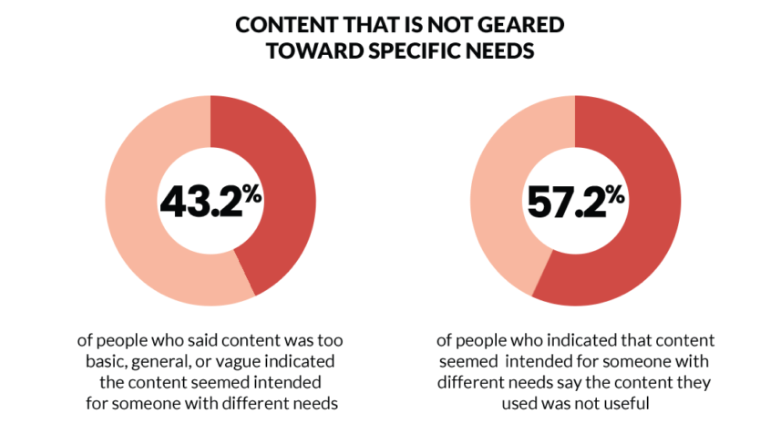
All of these will help you create more relevant content geared toward the specific needs of your target audience.

relevant content

If you can’t do this effectively, your audience won’t find your content useful.

This will defeat the whole purpose of your strategy. That’s why I’ve emphasized the importance of high quality content throughout this post.

Build your pillar pages

Once all your content has been produced, it’s time to publish everything.

Start by building your pillar pages. This will be the main spot where you’ll link to the supporting clusters.

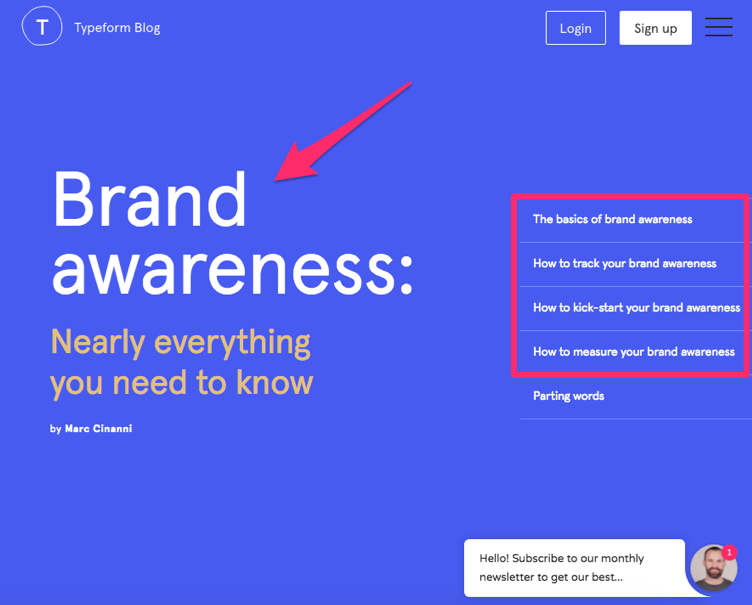
Take a look at this example from Typeform:

typeform

This landing page follows everything I talked about so far in terms of linking, keywords, site structure, and relevant content.

Brand awareness is the pillar.

Each topic cluster on the right side of the screen links to a more specific subtopic of brand awareness.

The landing page is very simple, which is perfect.

In fact, websites with simple designs have higher conversion rates.

Don’t feel you need to design a complex pillar page. A simple approach will be very effective.

Distribute your content

As you now know, your topic clusters will help SEO.

However, that doesn’t mean you should be publishing content without doing anything else with it.

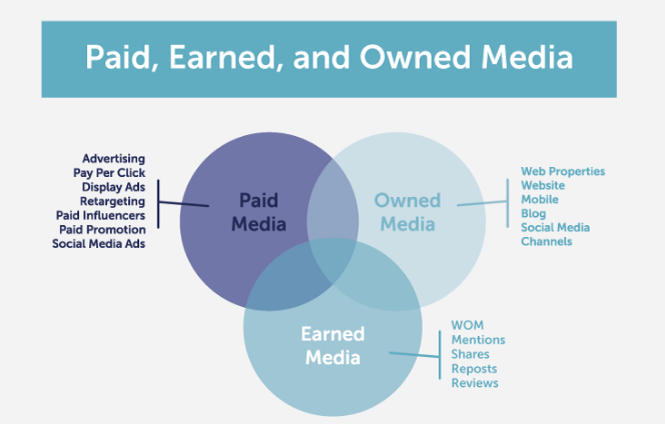
You need to focus on your distribution strategy. You can approach it in several different ways:

types of media

You should be taking advantage of all three different types of media.

This will help you distribute your content effectively across multiple channels.

Conclusion

Digital marketing is constantly evolving. Your business needs to keep up with these changes if you want to be successful.

Looking toward the future, it’s important for you to start improving your SEO strategy today.

One of the best ways to do this is with topic clusters.

First, you need to find the most popular topics relevant to what your audience is searching for. Then, you need to conduct keyword research to determine your cluster subtopics.

After you produce and publish your content, you need to make sure your site architecture is formatted for SEO purposes and sitelinks.

Once this process is complete, distribute all your content across as many different channels as possible.

Topic clusters aren’t re-inventing content marketing, but they are revolutionizing the way marketers create new content.

What types of topic clusters is your business using to improve your content strategy?


Source Quick Sprout https://ift.tt/2PVZsNu

Why I Trust Vanguard With My Investments

Whether I’m opening an IRA, brokerage account, or 529 savings account, or I’m simply choosing investments within a 401(k) or other investment account, I have thus far exclusively chosen Vanguard for my personal investments and I almost always recommend that my clients use them as well.

To be sure, I’d be perfectly comfortable using accounts and funds offered by plenty of other companies. Providers like Betterment, Schwab, Fidelity, iShares, TD Ameritrade, and others can all be good choices.

Some of those other providers even offer funds that cost less than what Vanguard offers, which is hugely important given that cost is the best predictor of future returns.

Still, Vanguard is almost always my first choice, and the main reason why comes down to trust.

Why I Trust Vanguard

Two of the first actions ever taken by Vanguard illustrate perfectly why they have earned my trust.

John Bogle founded Vanguard in 1975 with a unique ownership structure. Rather than being publicly owned, or being owned by a small group of partners, the company was owned by its mutual funds, which in turn were owned by the people purchasing shares in those mutual funds. That ownership structure was purposefully chosen so that business profits could be passed on to regular investors in the form of lower fees, rather than going to third-party shareholders.

The next year, in 1976, Vanguard launched the First Index Investment Trust, which was the first index fund ever made available to regular investors. This fund eventually became the Vanguard 500 fund, which is now one of the biggest and least expensive mutual funds in the world.

Those two events set a precedent that has been followed throughout the years. They signaled a commitment to minimizing fees, a commitment to index investing, and a commitment to maximizing the benefits for the everyday investor.

And that, really, is why I trust Vanguard over every other investment provider. Because they’ve followed through on that commitment year after year, I trust them to do the right thing.

Those other investment providers? Again, many of them can be used well, and in some cases can be used to minimize fees even further. But I don’t have the same trust in any of them that I do in Vanguard.

Let’s take Fidelity as an example. They recently introduced the industry’s first ever zero-fee, zero-expense ratio mutual funds, which is a big deal and is not something that Vanguard offers. They also offer many other index funds that are competitive with Vanguard in both price and quality.

But they also offer high-priced, actively managed mutual funds. They also charge you $50 to close an IRA, something that costs nothing at Vanguard. And they offer two types of target-date retirement funds, some of which are index-based and low cost, and some of which are not index-based and cost much more.

With Vanguard, I trust that there’s no bait and switch. With some of those other providers, I know that at least part of the reason they’re offering these low-cost funds is to get you in the door with the hope that they can eventually sell you something more expensive.

Given that investing is a long-term endeavor, that trust matters to me. While nothing is ever certain, I’m confident that Vanguard will continue to put my interests first.

The Downsides to Vanguard

Despite all the positives, there are some downsides to Vanguard that are worth mentioning.

The biggest is the fact that Vanguard mutual funds have relatively high minimum investment requirements. Their target date retirement funds all require $1,000 to get started, and almost every other mutual fund requires at least a $3,000 initial investment, though their ETFs do not have a minimum investment requirement.

In contrast, many other investment providers either don’t have a minimum investment or have a much lower bar to clear. Fidelity, for example, offers many funds with no minimum investment requirement, and Betterment also allows you to get started without any minimum balance.

If you’re just starting out and don’t have much to invest, you may be better off using another investment provider, at least for a while.

The other downside is simply the fact that you can, in some cases, find lower cost investments elsewhere. The difference is usually very small, but it can be a little more significant if you’re investing smaller amounts of money.

Fidelity’s new zero-cost mutual funds are a good example, though not the only one. Their Total Market Index Fund is free, compared to 0.14% per year for Vanguard’s Total Stock Market Index Fund (VTSMX) on investments up to $9,999 and 0.04% per year once your balance reaches $10,000.

On a $5,000 investment, that 0.14% difference means that you would pay an extra $7 per year to use Vanguard’s fund. That’s certainly not going to make or break your investment return, but it’s still something to be aware of.

It All Comes Back to Trust

None of this is to say that Vanguard is always the right choice or that you personally should always invest your money with Vanguard. There are many factors that go into choosing an investment provider and it’s impossible for me to tell you what the right choice is for your personal situation.

But when it comes to my personal investments, and typically those of my clients as well, Vanguard is the company I trust more than any other. They were founded with the mission of serving everyday investors and they have stuck by that mission ever since.

And when it comes to my family’s financial future, that trust means the world to me.

Matt Becker, CFP® is a fee-only financial planner and the founder of Mom and Dad Money, where he helps new parents take control of their money so they can take care of their families.

More by Matt Becker: 

The post Why I Trust Vanguard With My Investments appeared first on The Simple Dollar.


Source The Simple Dollar https://ift.tt/2POoZsb

الأحد، 11 نوفمبر 2018

8 Ways to Get Kids Napping Consistently so You Can Work More

You want to be home with the kids, so working from home seems like the perfect situation. But the reality is that some days you feel like you never get anything accomplished. Sure, the days are long, but somehow there never seem to be enough hours to hit those work goals. Working while your children […]

The post 8 Ways to Get Kids Napping Consistently so You Can Work More appeared first on The Work at Home Woman.


Source The Work at Home Woman https://ift.tt/2zOHNh0

Walmart vs. Whole Foods: Which Is Cheaper for Organic Food?

Organic foods don’t have to be a luxury, but they aren’t always cheaper in stores that typically offer a discount.

It’s been roughly four years since Walmart began pushing organic food at its U.S. stores. The discount store has attempted to lure more customers by increasing its organic offerings and taking a more upmarket approach to food in general.

In short, it wanted its grocery department to be a less-expensive Whole Foods.

What it didn’t expect was Whole Foods becoming an organic Walmart. Last year, Amazon bought Whole Foods for more than $13 billion and vowed that lower prices would follow. They did, for Amazon Prime members, but consumer advocates say they’ve seen little downward pressure on Whole Foods prices.

But before you make your uncle’s lame “Whole Paycheck” joke about the store’s pricing, just consider what a supposed “discount” chain like Walmart charges for organic goods. While consumer advocates put more than 100 items in their Whole Foods basket and compare prices by year, we picked 12 staples and browsed the aisles at both Whole Foods and Walmart. If you think you’re always getting a better deal at Walmart, you may want to check our receipt.

PEANUT BUTTER

This is one of the biggest problems we’ve encountered with Walmart’s organic section: Not a lot of cheaper store-brand items compared to Whole Foods’ vast 365 Everyday Value offerings. In this case, a jar of Adams costs roughly 27 cents an ounce compared to 25 for Whole Foods’ cheapest organic offering.

SHARP CHEDDAR CHEESE

This is one of those categories that made Whole Foods popular in the first place: Snacky, high-end foods you want more often than you need. In this case, however, Walmart comes out 10 cents less per ounce than its Whole Foods competitor. If you’ve got cravings, Walmart may be the better choice for protecting your budget.

BABY CARROTS

That said, if your munching impulses skew healthier, Whole Foods’ store-brand snack-sized carrots come in more than 28 cents per pound cheaper than Walmart’s.

EGGS

  • Walmart: Marketside Organic Large Brown Eggs, $3.97 for 12
  • Whole Foods: 365 Everyday Value Organic Large Brown Eggs, $3.99 for 12

This is what we saw more often than not: Whole Foods and Walmart offering near-equivalent pricing on the same products. Two cents isn’t a whole lot of savings, especially when you’re trying to argue that your competitor is out to steal your whole paycheck.

ICE CREAM

Humboldt is Walmart’s most value-priced organic ice cream, and it’s still nearly three cents per ounce more expensive than the Whole Foods version. In fact, a recent Walmart sale had to roll back the price of Humboldt pints to $2.48 just to reach parity with Whole Foods.

COFFEE

Without question, Walmart’s 41 cents per ounce is a better deal than Whole Foods’ 46. That said, this is Walmart’s lone organic offering, with Whole Foods fielding an entire line of house-brand coffees. In fact, the ground versions of Whole Foods’ coffees cost between 35 and 40 cents per ounce, or less than Walmart’s one Seattle’s Best variety.

MILK

It’s a difference of less than a cent per ounce between the two, but it still works in Whole Foods’ favor. Considering that milk is still nominally a staple, even with dairy consumption decreasing overall, those fractional cents can add up from week to week.

EXTRA VIRGIN OLIVE OIL

Those two sizes represent the largest and cheapest each store offered, and Walmart’s 23 cents per ounce still worked out to more than Amazon’s 21 cents an ounce. If you substituted this for butter a long time ago, buying it in the closest thing Walmart has to bulk isn’t saving you any money over buying it at a fraction of the size at Whole Foods.

BABY SPINACH

When it comes to triple-washed salad spinach, the price difference is pretty much a wash, too. Although Whole Foods comes in far cheaper at the 5-ounce size ($1.99 compared to $3.46 at Walmart).

SEEDED BREAD

That Walmart loaf is the only organic loaf it offers under its house brand. Whole Foods, meanwhile, offers several other options that all come in roughly 20 cents less per loaf than their Walmart counterpart.

SPAGHETTI

This is one of the cheapest items – organic or otherwise — you’ll find in any grocer, so it’s no surprise that Whole Foods and Walmart come in at about the exact same price. Yes, Walmart offers a bit more per package, but both are about 7 cents per ounce, so there’s no real “deal” to be found here.

PASTA SAUCE

Again, Whole Foods is marginally less expensive here. Sure, it’s by less than a tenth of a cent per ounce, but that’s still a significant margin for an upscale, niche food store going up against a ubiquitous discount giant.

The Verdict

After that little shopping trip, we aren’t sure if “Whole Paycheck” is the hoax it appears to be or if Walmart’s organic groceries are just far pricier than its reputation suggests. However, it’s clear that after Walmart’s foray into organic and Amazon’s Whole Foods shopping spree, the value of shopping Walmart over Whole Foods is more about perception than it is about price.

More by Jason Notte:

The post Walmart vs. Whole Foods: Which Is Cheaper for Organic Food? appeared first on The Simple Dollar.


Source The Simple Dollar https://ift.tt/2DejNqI

السبت، 10 نوفمبر 2018

Don't Let Your Kids' Schools Release Their Personal Data: Prevent Child Identity Theft With These Simple Steps

Criminals find children's identities anywhere they're stored in quantities, such as schools. Learn how to keeps your child's personal data safe.

Source CBNNews.com https://ift.tt/2SXJgtU

These Millennials Have Invested in Real Estate All Over the Country. Here’s How

From Financial Dependence to Financial Independence in Stages

When Sarah and I first started our financial turnaround, our long term goals were clear.

First, we wanted to buy a decent house to raise our family in and do the best job we could raising our children with the values and skills needed to be independent.

After that, we wanted to achieve our own financial independence as a couple as rapidly as possible.

Over the last twelve years or so, since we reached that financial turnaround point, we’ve felt ourselves move through what I would describe as a series of “stages,” where our financial freedom and opportunity has notably expanded. While the line between each stage wasn’t incredibly stark and clear, there were times when it was clear to us that things were significantly different and significantly better than they were beforehand.

I’ve tossed this concept around in my head for years and this is my best attempt at really explaining those “stages.” I’ve concluded that there are roughly seven such stages, and the road to financial independence for most starts at stage one or stage two and goes to stage seven. I would put Sarah and myself at stage five and on the precipice of stage six.

At each of these stages, I offer a few suggestions for how to move up to the next stage. It’s worth noting that these strategies are foundational – strategies for lower stages continue to help you as you’re moving onward and upward, though some of the strategies for higher levels may not apply yet.

It’s worth noting that although some people might like to use the word “retirement” to describe some of the things going on here, I don’t particularly like that term. I prefer the term “financial independence,” which means that the financial imperative to continue to work is no longer present, though you may continue to work (and probably will do so) for other reasons.

One final thing: it is completely okay to be at any of these levels, and some people will want to stop progressing at particular levels and focus on other life goals. For me, I’ve found that the benefit of looking at things in this fashion helps me to draw some bigger patterns about my own financial journey and where I want to check out and start focusing on other life ambitions.

What do these levels look like? Let’s take a look.

Stage 1: Complete Financial Independence on Others

This is a situation where your day to day life really only works through the direct financial assistance of people in your life. Without someone providing some of your basic needs for you (with no money or very little money in return), you would find it extremely difficult to survive.

Children are typically in this category. Adults who live with parents and enjoy lifestyle perks far above their income level are in this category, too. I’d put adults who financially rely on their parents or some other benevolent patron for day to day living to also be in this category. Many homeless people are in this category as well.

There are a lot of different reasons why adults find themselves in this category. There may be personality issues, psychological issues, disabilities, or reckless choices involved here. As a result, it is really hard to recommend specific steps to move away from this type of financial dependence.

My honest recommendation, if you find yourself here, is to ask for honest advice from a trusted source outside your dependence and trust that advice. Let that person see the reality of your life, listen to that person’s suggestions, and work to implement them.

It’s likely that the advice given to you will be painful advice and you won’t want to follow it. You might resent the advice giver or feel other negative emotions.

Don’t. Check those emotions. A person stepping in to give you advice at your request isn’t going to give you cruel advice. They’re going to give you accurate advice that might hurt but is intended to help.

Often, a key part of getting out of this state is finding some form of employment, even if you consider that employment “beneath” you. I know people who live with their parents and refuse to work because many jobs are “beneath” them, and that’s a mistake because they’re wasting years of their life without making financial progress or making themselves used to working every day (trust me, getting used to the realities of making money for yourself can be really hard, but for almost everyone, it needs to be done).

Another good strategy is to surround yourself with different people. People are often the average of the five people they spend the most time with, so if you’re spending most of your time alone or with people who seem to support you in staying put, find new people to associate with. This can be really hard if you’re dealing with psychological concerns, but figure it out. Get out of the house and start building relationships with people who have already achieved higher levels on this scale. Simply being around them will help you find your way up the scale.

There are plenty of ways to do that without spending. If you’re religious in any way, get involved with your local church. Try volunteering with a local charity. Check out what events are happening at the library. Check out what events are happening on Meetup. You don’t need to go to the bar or something like that to meet people – in fact, I’d actually recommend against it.

Stage 2: Financial Dependence on Debt

This is a situation where your day to day life really only works if there’s a constant availability of debt in your life. Most of the time, your bills overload your income and you’re only able to survive through a mix of loans – credit cards, car loans, a mortgage, payday loans, and so on.

Some American adults find themselves clearly in this category, either through lifestyle inflation far above their income level or a series of unfortunate events that lowered their income drastically without appropriate adjustments in lifestyle.

I would probably put Sarah and I in this category at our financial low point. We consistently spent above our income level for several years, which put us in a pretty rough financial state, with tens of thousands of dollars in consumer debt, tens of thousands of dollars in student loans each, car loans, and other debts on top of that. It wasn’t a pretty picture.

So, what can you do to break out of this situation? It’s important to note that these are foundational things – they’re things that you should be doing automatically at later stages in this progression.

First and foremost, you need to make some major lifestyle cuts. Your lifestyle has to be within the bounds of your paycheck – no ifs, ands, or buts about it. If you’re unwilling to do that, then you’re not breaking out of this state and you’re going to eventually fall off a financial cliff and find yourself forced to do so (while also being locked completely out of access to credit for a long while).

Sit down, look at how you’re spending money, and start cutting, starting with the things that are the least important in your life. Are you buying name brand things like ketchup and garbage bags? Switch to store brand. Are you eating out constantly and hitting bars and convenience stores? Cut back hard. Do you have a bunch of streaming services and a cable bill? Cut everything but one streaming service and then bounce from service to service in future months. Cut, cut, cut.

At the same time, start being more aggressive with how you make money. The whole ” Start a side gig or get another part time job. If you have a main career path, sit down with your boss and talk about what you specifically need to do to take the next big step in your career (which means better pay).

Stage 3: Financial Dependence on the Paycheck

A lot of Americans find themselves here. This is “paycheck to paycheck” living, a state that a great many Americans find themselves in. According to some studies, somewhere around three quarters of Americans find themselves at this level.

At this level, you can get by indefinitely as long as nothing significant changes in your life. You have to keep the job you’re working at and nothing significantly bad can happen in your life. No job loss without immediate unemployment. No serious illness. Even a major expense of some kind can knock some people back to stage two.

Sarah and I quickly got to this level once we took charge of our finances and axed a lot of spending. Our next step was to throw the kitchen sink at our debt, which, incidentally, is my first piece of advice to people at this level.

If you’re living paycheck to paycheck and you’ve already cut the low hanging fruit from your spending (from stage two), the next big step is to eliminate high interest debt and take care of other low hanging fruit. You need to construct a debt snowball and start hammering away at it.

I’m a big fan of the advice of Dave Ramsey for people at this level (I think his advice for people at other levels tends to go awry).

The next thing you should do is build an emergency fund, meaning that you’re stashing away some money in a savings account somewhere to protect yourself from genuine emergencies. An emergency fund is what you tap when something bad happens, like a car breakdown or an emergency trip or, when it gets larger, a short term job loss.

This isn’t meant to cover up personal financial errors (like forgetting bills or overspending on non-essentials) which are things that you should learn to manage without emergency money. Rather, it’s money for those genuine emergencies that you didn’t see coming that can disrupt things.

Along the way, you should automate some savings for the long term. Start by automating the emergency fund so that a small amount is deposited each week (your bank can probably do this). You should also consider automating some retirement savings by signing up for a 401(k) at work or a Roth IRA at home, both of which are automatically funded.

Automatic savings takes the decision to save out of your hands – that decision is effectively made for you, so you don’t have to think about it. It just happens. You’re then left with paying your other bills and covering your other expenses out of what’s left. It’s the embodiment of the idea of “paying yourself first.”

Stage 4: Short Term Financial Independence

At this level, you can survive for a while, up to a year or so, without income, but you’ll eventually need to return to work. You are protected from a lot of unfortunate life events, but that protection relies to an extent on continuing to work for a steady, healthy income.

After a few years, Sarah and I found ourselves at this level, a level that a lot of more affluent Americans, particularly those in their forties and fifties, find themselves eventually.

I found that the hallmark of this level is that one’s financial stress goes down significantly. Money worries tend to almost disappear at this level, leaving you with a sense that everything will be okay. At the same time, some degree of career stress still remains – although you know you could financially handle a career change, resetting without a real reason is probably not a good choice.

It was right on the cusp of this level that I switched careers myself, from working in a research lab to freelance writing. My reason for doing so was flexibility for our growing family (I spent a lot of time at home with the kids) and nurturing my writing gigs which I had cultivated in my spare time beforehand.

So, what can you do to keep moving toward the next level?

First, develop a clear written financial plan for getting there. This is the point at which a detailed financial plan becomes really helpful. Before this, financial planning is pretty straightforward – you’re mostly focused on getting out of debt and cutting spending. At this point, the focus starts to change toward lifelong goals and how to get there, and considering those issues and writing down what you want to do and how to get there becomes paramount.

A big part of that kind of financial planning is that you start authentically considering what your ideal life would look like, beyond mere daydreaming. It’s no longer daydreaming about winning the lottery, but realizing that you’re actually on a financial path that will result in the kind of life you want. But… what exactly is that kind of life you want? What do you really want to do with the rest of your life?

It’s a hard question, and you’ll find that the more you think about it, the more you tend to drift away from what your daydreams about winning the lottery looked like. Sarah and I used to dream of a big rambling home in the country with woodlands around us, but as we really thought about what we wanted once such things started to look as though they were possible, we realized that it didn’t actually capture what we wanted out of life.

For me, a key realization was that the things I wanted out of life largely didn’t cost very much, but that I deeply desired security around them and the freedom to spend as much time as I wanted on them. I really enjoy things like reading and writing and hiking and cooking and volunteering and tabletop gaming and learning new things, and none of those activities are particularly expensive. I can live a life I deeply value at a pretty low price, honestly.

For me, I found that developing a concrete plan that’s centered around what I actually wanted for my future motivated me strongly to save dramatically for deeper financial independence. Once I saw what I could actually have and how things were beginning to line up for it, I became extremely motivated to work for it and to give up accoutrements in my daily life.

Before this, frugality was just a tool to get my head above water and to kick off some of the shackles of debt. As I began to feel some freedom and really envision where I wanted to go, I began to see a lot of my spending as shackles, and frugality was about kicking them off. If I’m not spending money on something that’s either maintaining basic life requirements or bringing true lasting joy…. why exactly am I spending that money at all? For me, it was this stage where that idea became clear.

Stage 5: Medium Term Financial Independence

At this stage, you can survive for an indefinite period of time without work, but you can’t survive for the rest of your life without returning to a solid salary. Sarah and I are at this stage right now. Either one of us could probably walk away from our job for good, and both of us could do it for a while, but we still need some significant income over a significant period of time to be able to make it for the rest of our lives.

This stage brings a lot of flexibility with it. You’re basically protected from almost all smaller life emergencies. You can consider things like career changes and job changes without any real worry about the financial downside.

The first thing to do when you reach this stage is to consider whether your current career path or current job brings you genuine joy and meaning and, if not, make a change At this stage, there’s no reason to put up with a job or a career that brings you misery. What’s interesting is that a lot of the things that used to bring you misery when it comes to work fade away because you know you can just walk away from them if they become too egregious. It becomes much, much easier to stand up for yourself at work because the threat of repercussions or firing is pretty small.

For me, I found that this stage turned my professional life almost entirely into upside. If I don’t want to do something, I basically don’t have to do it. Instead, I focus on the things I want to do, that I really enjoy doing, and I produce enough value with those things that I can get paid reasonably well to do just those things. I have a ton of control over the projects I take on and the time I devote to them. I don’t really have to worry about aspects that I don’t enjoy.

Another key aspect here is to use your free time to experiment with your life to figure out what kind of life you desire in financial independence. Let’s say you reach a point where you don’t have to work for money in any way. How will you fill that time?

The thing is, all of the “I’d do nothing and read books and play video games” stuff burns itself out pretty quickly. What do you do then? What do you fill your life with that’s meaningful and cultivates happiness and further meaning?

There’s no consistent answer for everyone. The key is finding your own answer, and at this stage, you have the financial leeway to discover it for yourself. I will suggest that for many people – myself included – those answers involve good use of time and focus rather than using money. It’s not found in endless luxury.

Finally, automate, and be patient. Your finances at this point should be pretty much on autopilot, taking you straight to a state of complete financial independence if you don’t change anything significant about your life. Much of this stage is truly about patience, as things are in place for you to reach your goals if you just wait it out. Without a disaster or a major life change, you will reach further stages, but you just have to be patient through a period where it feels like things aren’t changing.

Patience is hard, trust me. I feel it all the time. That’s why it’s good to occupy your mind with finding genuine meaning in other aspects of your life so that you’re not tempted to jump off the path.

Stage 6: Partial Financial Independence (“Barista FI”)

At this point, you can survive for the rest of your life by doing something that seems enjoyable that earns at least some income at least some of the time, and you can probably make it for the rest of your life if you cut back on your current spending. Some retirement age Americans are here. Sarah and I aim to be here somewhere in our late forties.

If you’re here, you should step away from any work that isn’t joyful and meaningful for you, and seek out only work that makes you feel that way This was an option at the previous stage, but here, it’s pretty much a given. You have no reason to do work that isn’t providing some sort of significant value or meaning in your life beyond simply receiving income.

This might mean staying in your current career path, or it might mean something different. If you get a lot of meaning and value out of your current work, keep doing it. If you get meaning and value out of it but you’re sometimes overloaded, look at cutting back on your responsibilities a little, even if it means less pay. If you’re not getting meaning and value, find something else to do, like working for a charity or switching to a more altruistic job.

While you’re in this stage, aim to live as much as possible on your income so that your investments can grow unfettered. If you’re doing meaningful work, aim to live as much as possible on your income from that work. Yes, you might have to supplement from your investments, but the less you do that, the better. You’re close to being able to remove the need for income entirely from your life.

Sarah and I have already discussed what we’ll do at this point. Sarah loves to teach – it brings deep meaning into her life – and she’s going to consider where she can teach where she can make the greatest impact and likely switch to that teaching situation. For me, I’m going to stop taking on any writing gigs that don’t leave me with a strong sense of being meaningful or valuable for me or ones that eat up too much of my time.

Stage 7: Full Financial Independence or Early Retirement

At this stage, you never have to work for income again, though you may choose to work for non-financial reasons. Some retirement-age Americans are here, and Sarah and I hope to be there in our mid fifties when our children are completely out of the house.

Many people look at this state as being “retirement.” I look at this state as being “freedom.” It doesn’t mean that you sit down and idle for the rest of your life. It means that you have the freedom to fill every hour based on what’s actually meaningful, not in terms of what you need to do to make money and maintain your basic life requirements.

So, what do you do at this stage?

First of all, don’t idle. Fill your days with lots of meaningful, worthwhile things. Build new skills that you really care about. Read challenging books. Go on long hikes. Volunteer. Stuff your calendar full of things that are really important to you.

Idling is something we do when we’re worn out or are procrastinating. If you’re worn out, get genuine rest. If you’re procrastinating… why on earth are you procrastinating at this stage in your life? You shouldn’t have to do hardly anything that you don’t genuinely want to do.

Don’t idle. Don’t sit in your easy chair. Live life.

At the same time, take care to not let your spending inflate, and create caps for yourself. One good strategy is to simply set a withdrawal rate from your investments. Each month, withdraw something like 0.2% of your investment balance and live on that for the month. If you do that, you can live in perpetuity, and you’ll find that the amount you’re able to withdraw slowly grows.

You should still keep building things like an emergency fund and so on. Your goal should be to live on that 0.2% a month in every way, so that you never have to touch the balance of your investments. If that 0.2% allows you to inflate your lifestyle a bit, so be it, but focus on doing meaningful things, not just spending for spending’s sake.

You could obviously add a “stage eight” that centers around more wealth than you will ever need or that your children will ever need, but I see no real reason to do so.

Final Thoughts

The key thing to remember here is that this is a journey, one that’s fluid and a little different for everyone, and different people may be motivated in different ways by it. Some people might be happy where they’re at and this is irrelevant. Some people at level one or two might be content to get to level three and then focus on other life issues. Some people may aim for a particular stage and then, later on, change their life goals and start focusing on other things. You aren’t a “winner” if you made it to level six or seven. It’s just a way of evaluating one single aspect of your life – financial – and you may find it better for you to focus on the many other spheres in your life when you’re at a good financial point for you, even if it’s not a top level or even if it’s a pretty low one.

For me, the most valuable thing I’ve found in moving through these stages is that each stage has meant overall lower life stress and more time and focus on activities that really matter to me and aren’t just done to “escape” or to keep up with the Joneses. It has felt like a journey toward a more meaningful life, not just a journey to financial independence.

Also, while this whole thing has been a spectrum, each stage has felt noticeably different for me than the others. I can tell, just by reading old journal entries, when exactly I was in each stage of this journey, and I can see a couple of clear dividing lines up ahead of me when I reflect on where I’m headed.

Whatever you choose to do with these ideas, may it take you to a better place in your life. Good luck.

The post From Financial Dependence to Financial Independence in Stages appeared first on The Simple Dollar.


Source The Simple Dollar https://ift.tt/2FcHUbW