Thousands of courses for $10 728x90

الخميس، 20 ديسمبر 2018

Moneywise Children’s Savings Awards 2019

Children's Savings Awards 2019

Meet the winning companies that are helping children and their parents to choose cash and investment accounts wisely

Most children want to spend money the second they get their hands on it. Whether it’s sweets, collector cards, toys or comics, like many of us they enjoy the anticipation of a trip to the shops with money in their pockets and the heady rush of making a purchase. Without steering from parents or widespread financial education in schools, you can’t rely on teenagers to put money aside either.

However, there is plenty you can do to help your children – or grandchildren – get the savings bug.

For young children an instant- access savings account is a great start. By encouraging them to pay in some of their pocket money, as well as birthday or Christmas cash, and then letting them dip into it for some of those ‘must-have’ items, they will soon learn the benefit of saving and the rewards of delayed gratification.

An investment account can also be a helpful educational tool for older children and provide a good introduction to stock markets and how they work.

Alternatively, it may be that you want to put money away on their behalf – whether it’s to pay for that first car (and the horrendous insurance bill), university fees or the deposit on their first home.

Whatever your savings goal, the Moneywise Children’s Savings Awards are here to help you (and them!) make the right choices, with our pick of the best cash and investment accounts.

Best easy-access accounts

Every child should have an instant-access savings account: although children will still be able to access their money when they need or want it, it won’t be burning a hole in their pocket, forcing them to really think about whether or not they want to make a purchase.

Winner: Penrith Building Society

Current rate: 2.5% (includes 1.25% birthday bonus)
Minimum deposit: £1
Maximum balance: £10,000
Access: In branch or by post
Visit: Penrithbuildingsociety.co.uk

Highly commended: Santander 123 Mini Current Account

Here we looked at accounts that combine consistently competitive interest rates with hassle-free access. Accounts needed to have a low opening balance and be open to all young savers anywhere in the UK.

Our winner, for the third consecutive year, is Penrith Building Society Junior Saver. It currently pays a total of 2.5%, including a 1.25% bonus paid on the child’s birthday. You only need £1 to open an account and it has a maximum balance of £10,000. The account can be managed in branch or by post.

Tom Adams, head of research at Savings Champion, explains: “This account has been consistently competitive over the years and comes with some nice features, including a relatively high maximum balance of £10,000 and a ‘birthday bonus’, which is a great incentive to keep saving on a regular basis. This feature, in particular, will mean that the extra interest will be associated with receiving a gift and will hopefully reinforce the importance of getting as much interest as possible, both now and in the future. Straightforward and competitive, this account will tick a number of boxes for parents and is an ideal way to set up a child for the future.”

Coming a very close second is the Santander 123 Mini Account, which pays 1% on balances over £100, 2% over £200, and 3% for balances between £300 and £2,000. Available online, by mobile banking and over the phone, it’s an easier account to access than our winner but the interest is not as competitive for every saver.

Mr Adams says: “One of the very best interest rates currently available for a child, this account only misses out on the top spot because the headline rate is only available on balances between £300 and £2,000 – so those with smaller and larger amounts miss out. However, there are some great features, including being able to access the account in a variety of ways and ultimately the tiered interest rates can be an important early lesson in saving up money for a higher return. The rates have been unchanged since the account’s launch in 2014, so it’s certainly consistent and a great option to consider.”

“The birthday bonus is a great incentive to save regularly”

kids-savings-2.jpg
Children's Savings Awards 2019

Best youth account (11+)

Once children are older and potentially earning some extra money of their own, they may want something a little more sophisticated that allows them to monitor their money and get cash out of the wall.

Winner: HSBC MySavings

Current rate: 3% (AER)
Minimum deposit: £10
Maximum balance: £3,000
Access: In branch, online and mobile banking app
Visit: Hsbc.com

Highly commended: Santander 123 Mini Current Account

Our winner is HSBC MySavings. With an opening balance of just £10 it pays 3% on balances up to £3,000 (0.75% thereafter). Accounts can be managed in branches, online, over the phone and with its banking app.

Mr Adams says: “A consistent account that has improved since last year, following the base rate rise in August. Besides the great rate and the larger maximum interest-bearing balance, in comparison to other options, this account also comes with a current account, which includes a Visa debit card, for those over 11 years old. A great way to save up for your future and, of course, keeping your savings and your current account money separate can be an effective strategy and is a great habit to take into adulthood.”

Taking the runner-up position is last year’s winner, the Santander 123 Mini Current Account. It pays 1% on balances between £100 and £200, 2% up to £300 and 3% up to £2,000. “Consistently competitive since its launch in 2014, this account ticks two boxes, as it can be used as a current account and interest held in the account can earn a good rate of interest,” Mr Adams explains.

“Young people will be pleased with the independence that this account offers, allowing them to manage their own finances online or via a mobile – as well as the debit card that comes with it. The account has tiered rates, so a bit of planning and saving up will be needed to ensure that savings held into the account are getting the best rate possible, but this can be great practice for managing finances in the future and to get into the savings habit.”

kids-savings-3.jpg
Children's Savings Awards 2019

Best Junior Cash Isa

Instant-access accounts are great for helping kids save up for big-ticket items, but you may also want them to build a nest egg that they can’t touch until they are older. In the current tax year you can pay up to £4,260 into a Junior Isa (Jisa) and not pay any tax on their savings. However, the money cannot be accessed until the child’s 18th birthday.

Winner: Coventry Building Society

Current rate: 3.6%
Minimum deposit: £1
Access: In branch, telephone, online and post
Visit: Coventrybuildingsociety.co.uk

Highly commended: Darlington Building Society Junior Cash Isa

Tax shouldn’t be a big concern for children. They have the same personal allowance as adults (£11,850 in 2018/19), but if they earn more than £100 in interest a year from cash paid to them by their mum or dad, it will be taxed at their parents’ marginal rate.

As our winners show, another attraction of Jisas is that they will often pay a higher rate of interest than accounts that are easier to access.

Our winner in this category is the Coventry Building Society Junior Isa, which pays 3.6% on a minimum deposit of £1. It takes the award for an impressive six years in a row.

Mr Adams says it remains the clear choice. “The best rate on the market by some distance and it has been one of the very highest-paying Junior cash Isas for its entire lifetime. Already paying a competitive rate, the account saw the rate increased following the base rate rises in both November 2017 and August 2018, leaving it well ahead of the pack. A consistently high interest rate and head and shoulders above the competition, it’s simply the best Junior Cash Isa around.”

Runner-up this year is the Darlington Building Society Junior Cash Isa. It pays 3.2% on balances of £1 or more.

Mr Adams says: “A straightforward and competitive account, it has been around since day one and the rate has never been cut during its lifetime.

"Following August’s base-rate rise, the rate was put up by the full 0.25%, which is more unusual than you would think. Quite simply it’s the best of the rest.”

Tax shouldn't be a big concern for junior savers

Best Junior Stocks and Shares Isa

Isas are a great way of locking savings away until your children reach adulthood. However, if you want to get the best return on their savings it might be worth investing in an equity-based investment.

Winner: Hargreaves Lansdown

Minimum investment: £25 per month
Charges: Platform fee 0.45% (no fund dealing charges)
Investments: Over 2,500 funds, UK and overseas shares, investment trusts, bonds and ETFs
Visit: Hl.co.uk

Highly commended: Fidelity Junior Isa

Put £50 a month into a Junior Cash Isa paying 3%, and after 10 years it will be worth £6,987, according to Hargreaves Lansdown. It’s not a bad nest egg – especially when compared to the paltry rates paid on their mums’ and dads’ accounts. However, if that money was paid into an investment fund achieving an annual return of 6% a year after charges, that same £50 a month would result in a somewhat meatier £8,194 over the same period.

In this category, judges were looking at online investment platforms that were easy to use, with a good choice of investment options, competitive charges and low monthly contributions to ensure our winner is accessible to all.

Our winner this year is Hargreaves Lansdown, last year’s runner-up.Patrick Connolly, judge and chartered financial planner at IFA Chase De Vere, says: “The headline annual charge with Hargreaves Lansdown is 0.45%, which on the face of it makes it one of the most expensive platforms. However, many Jisa investors have smaller amounts to invest and/or will be making regular premiums.

“The fact that Hargreaves Lansdown doesn’t have fund dealing charges or make additional charges for low value investments means that its can be very competitive for many people. Add to this low minimum premium levels of £25 a month, access to an extensive range of investments and excellent customer service and research tools and this makes a strong proposition.”

The Fidelity Junior Isa is our runner-up. Martin Bamford, judge and chartered financial planner at IFA Informed Choice, is a fan.

“Fidelity offers a very wide range of investment choices, including investment trust and ETF [exchange traded funds],” he says. “The online application process is very straightforward and Fidelity offers a range of useful tools for first-time investors.”

Trusts can give returns a boost when markets are rising

kids-savings-4.jpg
Children's Savings Awards 2019

Best Investment Trust Savings Scheme

Outside of Isas, investment trust savings schemes are a popular way of saving for children, often accepting smaller deposits than funds.

Winner: Baillie Gifford Children's Savings Plan

Minimum investment: £100 lump sum or £25 a month
Investments: Choice of seven global and specialist trusts
Charges: No annual or plan charges but fees apply for the management of the trusts which vary according to those chosen
Visit: Bailliegifford.com

Highly commended: Aberdeen Asset Management

Like funds, investment trusts pool together investors’ money to buy a portfolio of shares. However, because trusts are listed companies in their own right, their price is influenced by supply and demand. Unlike funds, they are also able to borrow to invest, which can give returns a boost when markets are rising.

Taking top spot for an impressive fourth year on the trot is the Baillie Gifford Children's Saving Plan. Commenting on our winner, Gavin Haynes, judge and managing director of Whitechurch Securities says: “For long-term investors, Baillie Gifford is head and shoulders above the competition.

“They have a wide range of investment trusts that have strong track records of performance and very competitive management fees. My favourites would be the globally diversified global equity investment trusts Scottish Mortgage IT and Monks IT.

“It is very accessible with a minimum into each trust of just £100 and £25 a month, with no admin charge and dealing charges for purchases (although there is a charge for withdrawal) and you are allowed one free switch each year.”

For the second year in a row, our runner-up is Aberdeen Asset Management for its savings plan for children. Mr Connolly says: “This offers a wide range of investment trusts with minimum premiums of £30 a month. Aberdeen has a clear investment approach focused on holding good quality companies and buying them at the right price. This approach should produce fairly consistent long-term returns.

“Aberdeen offers core UK equity investment trusts, but is perhaps better known for its strength in emerging markets and Asia, regions for more adventurous investors where there is the potential to produce better returns, but with more risk.”

Methodology

Tom Adams, head of research at Savings Champion, selected the winners in our cash categories, basing decisions on three years of savings rates data. Accounts needed to be accessible to children across the UK and have no strings attached.

Our investment categories were judged by Patrick Connolly, chartered financial planner at IFA Chase De Vere, Gavin Haynes, managing director at Whitechurch Securities and Adrian Lowcock, head of personal investing at Willis Owen (not Junior Isa category) and Holly Mackay, founder and chief executive of Boring Money.

Thanks to Boring Money for supplying the stocks and shares Junior Isa shortlist, and the AIC for providing data for the investment trust savings schemes.


Section

Free Tag

Twitter

Workflow

Published


Source Moneywise http://bit.ly/2T2pHzT

What next for the winners of our Personal Finance Teacher of the Year awards?

Potential designs for the Ark currency

Six months ago, Moneywise awarded a primary and a secondary school our Personal Finance Teacher of the Year award – each received prize money of £3, 250. We went to catch up with the two winners to see how they have put the prize money to good use.

Rachel Rickard Straus visits Arkholme Primary School in Lancashire and meets prize winner, head teacher Joy Ingram

Winning our Personal Finance Teacher of the Year award was a big moment for the children of Arkholme Church of England Primary School.

“We could finally buy new glue sticks, ” Beau, aged 10, tells me gleefully when I visit the school, just before they broke up for Christmas.

At this friendly, tight-knit school nestled in the beautiful Lune Valley everyone, from the age of four onwards, is taught the value of things – and is invested in the school’s finances.


Pupils learn about money early


“I’m very open with them about our school budget, ” says Mrs Ingram. “I share with them facts such as when they break a pencil, for example, we have to find the money to buy a new one – and that that’s not always possible.

“Some children from more affluent families may not see this at home – I want to make sure they understand the cost of resources and learn to respect things and not just throw things away.”

Personal finance lessons start at age four, when children begin to handle money.

“At this age, the concept that each coin has a different value is quite difficult, ” says Mrs Ingram. “If you say this is a 1p, this is a 2p, this is a 5p piece and ask ‘what is the total value?’, the instinct is to see that there are three coins and to just do one plus one plus one makes three. However, a little later, the idea clicks into place.”

Two six-year-olds have just cracked it. “This silver coin has got the most money in it, ” says Beatrice, aged six and three-quarters, showing me a 10p piece.

Incredibly, by year four, children are learning about tax, national insurance and VAT, by year five about lending, and by year six about jobs and earning.

Important lessons are taught through fun and games: when I visit, some children are organising an Elf Run to make money for a local hospice and others have just learnt about budgeting through shopping for a class party.


Children hold a party to learn about budgeting
 

Remy, Thomas, Ruth and Archie tell me about their party, for which they all got the minibus to Sainsbury’s to buy the things on their lists with money they had been given by Mrs Ingram. “I was in charge of the savoury things, ” says Ruth.

Then they hit the cake aisle, where there were difficult decisions to be made.

“We wanted to buy a cake, which had sprinkles and chocolate icing on it, but it was too many pounds, ” pipes up Archie. “We bought a different one, though, and it was nice.”

It was not just glue sticks that the £3, 200 competition prize money allowed Arkholme School to buy.

“We’re a school of just 75 and our budget is around £3, 500 a year to cover everything – art materials, history topic books – everything. The prize money literally doubled our budget, ” says Mrs Ingram.


Mrs Ingram with her award
 

One use will be the launch of the school’s own currency: the Ark.

Members of the school council, elected children from each year group, are tasked with being the voice of the pupils when school decisions are made.

The group have just closed a competition that all children could enter to design Arks, and they are trying to decide on the winning design.

Arks will be given out to pupils who do good deeds or work, and they will be able to spend them at a school shop.

Members of the school council will run the shop and decide what to sell. The process is prompting questions about the very nature of money. “Who is going to print it?” they discuss. “What will one Ark cost?” “Can we save up millions of Arks and buy a house for everyone in the school to live in?”


Arkholme School
 

The prize money will also be used to fund an entrepreneurs’ challenge, in which groups of pupils will be given a small sum to see how they can use their entrepreneurial skills to grow it. Initial ideas include making decorations and lemonade to sell.

Watch this space; it seems the Moneywise prize money is set to grow and grow.

Edmund Greaves visits Dane Court Grammar School in Broadstairs, Kent, and meets prize winner Ceri Diffley

On a brisk Friday morning in late November, Ms Diffley has two double periods to teach.

The first starts early at 8:45am with her Year 13s. On the schedule for today is revision preparations.

The eight class members are set a task of writing summaries of a case study: a woman called Olga wants to go abroad for a friend’s wedding. What are the implications of foreign exchange for her?


A class at Dane Court School work on a personal finance project
 

The class works through a framework called PESTEL, which covers the transaction from political, economic, social, technology, environment and legal angles.

Using a relatively simple case-study exercise, the 17- to 18-year-olds forensically analyse every aspect of a foreign exchange transaction, from Brexit and the global financial crisis to online exchange platforms and credit cards.

It is extraordinarily in depth. The students learn about highly technical aspects of finance, such as the European Union Financial Transparency directive and other regulations.

Between the eight classmates, the PESTEL framework is divided up so they can, as a group, balance out the workload.

The purpose of this is to create a comprehensive set of revision notes for their exams, while sharing the workload to save time.

There is a lot to cover on the course, but what makes this exercise all the more remarkable is that the students are live-updating a shared Google document in real time. The shared work task is rendered effortless with modern technology.

Ms Diffley spent her prize money on 14 brand new state-of-the-art Google Chromebooks. In buying a set of laptops for her students she has made this kind of shared-work exercise completely seamless.

In the past, Ms Diffley has worked for a bank

And the impact of this technology has wider benefits. With her classes now 100% supplied for tech, other classes in the school feel less of a struggle for computer resources. Less blagging and borrowing of hardware from other resource-needy departments and classes.

But the impact of students having access to cloud resources at their fingertips goes even further. A few have their own devices, but most do not. Having access to course tools, documents and notes in the cloud is invaluable for these young adults.

With the laptops the student now use, they can get up-to-date information, and Ms Diffley is able to blend the structure of the course with current events of the day.

Some students come from multiple-household families – a common occurrence of modern life. Having unfettered cloud access to their class resources means never forgetting their notes or having to lug a binder full of papers when splitting their time between separated parents.

There is no doubt that teaching is a resource-hungry endeavour. Ms Diffley says the school is lucky that she has a background in finance – she was an HR rep at Barclays Bank before becoming a teacher.


Ms Diffley (above) used her award to buy state-of-the-art Chromebooks (below)


Without this she says she would struggle to relate course material to real-life situations. Sitting listening to her lesson, it was interesting to see how it was littered with personal anecdotes that give great colour to what she is trying to get across.

In the lesson with Year 12s on the difficulties of handling debt, Ms Diffley is able to deftly explain the gravity of a Company Voluntary Arrangement, while humorously engaging with the pupils.

The lesson even draws the students to recount their own family circumstances. This is clearly something that they are aware of, even if their parents don’t fully explain.

Assistance with the curriculum comes from other places, but is oddly unhelpful in some respects. Free textbooks turn up in the middle of the first term, when they would have been more useful six months earlier at a time when Ms Diffley was actually planning her course for the year.

When the Year 13s are asked what they want to do when they leave school, their responses are mixed. A few want to do apprenticeships in accountancy or digital marketing. Others want to go to university to study business management or building management and surveying. One wants to study Japanese.

But for all their different interests, the kids seem smart, engaged and articulate. And this seems a fair reflection of their teacher’s dedication.

Section

Free Tag

Twitter

Workflow

Published


Source Moneywise http://bit.ly/2S9kPsx

Eastburg-based startup receives state grant

An East-Stroudsburg-based business will be expanding its operations thanks to Pennsylvania’s Ben Franklin Technology Partners, a state-sponsored technology startup program. Ethnic Beauty Store LLC is one of two startups chosen this year for an early-stage company investment and will receive $65,000 to help boost its line of “Game Face Grooming” products.Both the Ethnic Beauty Store and Game Face Grooming brands were founded by entrepreneur Philip A. Williams and [...]

Source Business - poconorecord.com https://ift.tt/2SbVApz

U.S. Farmers Eye Hemp as a New Cash Crop

Congress passed the new farm bill with a provision that will legalize hemp farming on an industrial scale. Could this be America's next gold rush?

Source Business & Money | HowStuffWorks https://ift.tt/2EAq4xJ

U.S. Farmers Eye Hemp as a New Cash Crop

Congress passed the new farm bill with a provision that will legalize hemp farming on an industrial scale. Could this be America's next gold rush?

Source Business & Money | HowStuffWorks https://ift.tt/2EAq4xJ

The Smart Way This Stay-at-Home Mom Is Saving for a Trip to Disneyland

Your Holiday Survival Kit: 28 Smart Strategies To Keep Last Minute Holiday Costs from Exploding

You’re probably reading this during the “calm before the storm.” There’s a good chance that sometime in the next several days, there’s at least one big holiday event that you’re just utterly unprepared for with seemingly eighty things left to do.

You have to travel. You have to help prep a meal. You have to get a last minute gift (or three). There’s probably a combination of things going on. You’re also probably stressed out about it. It’s probably very, very tempting to just throw money at the problem… but that’s not going to help in the long run, is it?

(I know this sounds like me right now. This has been the holiday season to end all holiday seasons.)

Well, here’s my survival guide. What follows are seven tips for each of those issues that will help you get right through the problem without just throwing your wallet up in the air and watching the cash blow into the wind.

Let’s dig in.

Travel Tips to Help You Get There

You have to get from point A to point B during an absurdly busy travel period. You probably have to eat along the way. If you’re like me, you’re probably also hauling along some children. The costs are adding up (and so is the stress). Here are seven little things you can do to take the burden off.

Prepare your car a day or two before a road trip. Fill it up with gas and, while you’re there, air up your tires. Get an oil change if needed. Make sure you have some extra warm clothes and a blanket in there at least in case of an accident. Get everything prepped and ready to go so that you’re minimizing the chances of getting stuck somewhere and having to throw cash at a problem.

Use a packing list, like this one. Packing can be a stressful task on its own. A good approach is to have a packing checklist, and the “ultimate packing list” can be a good starting point. I keep a checklist on my phone for packing for any trip so I don’t have to think about it – I just go through the list and know that everything I need is packed away.

Fill up a water bottle and grab some snacks before you go. Not only will this give you a convenient treat in the car or on the bus or on the train or on the plane, it’s way cheaper than buying it at a convenience store or at an airport along the way. Just grab any old water bottle you have in your cupboard, fill it up with water, and grab some kind of snack from the pantry before you head out.

Don’t speed. If you speed 15 miles an hour over the speed limit on a 65 mph four lane highway, you’re only gaining about 14 minutes per hour of driving assuming you never stop and never have to slow down for any reason – so in reality, you’re saving less than that. The gap is even smaller in cities and on two lane highways. What do you get for saving a few minutes? You get a much higher likelihood of getting pulled over, which devours all of your time “savings,” gives you a fat speeding ticket, and probably causes a bump in your auto insurance. It’s not worth it. Don’t speed. Just set your cruise control to the speed limit and let the miles go by.

Give yourself tons of time at the airport. The airport is going to be crazy this time of year. The parking lots are going to be quite full and the lines are going to be long. Going to the airport when time is tight is begging for stress and a strong possibility of a missed flight. Instead, just give yourself tons of time at the airport and handle those last minute emails at the gate. This allows you to park with minimal stress in inexpensive parking, lets you go through the airport without worry, and you can take care of last minute electronic tasks when you get to your gate.

Travel with a minimal wardrobe. There’s no need to take a bunch of clothes changes for a few days with family. Take a small wardrobe and, if you can, fit it into your carry-on. This saves you the cost of checked luggage, saves you time and stress when you arrive at your destination, and eliminates the risk of lost luggage. If you’re driving, it makes filling up the trunk or the back of the van much easier.

If flying, take what would get you through the trip in your carry-on, so that lost luggage isn’t disastrous. If there’s something that if it didn’t arrive at your destination would cause a disaster, try to get that item into your carry-on or, if that’s impossible, have a backup plan for it that you’ve already thought through. Make sure you have at least a day’s worth of clothes and a few basic toiletries in your carry-on so that if your luggage doesn’t arrive, you’re not making a panicked trip to a retailer and throwing money at them to get those simple things.

Last Minute Meal Preparation Tips to Make Sure You’re Fed

Whether you’re in charge of preparing a big holiday meal or just a guest at one (and need to bring something), holiday meals can add another layer of challenge on top of an already difficult day. Here are seven simple things you can do to avoid some big costs and a bit of stress.

Have a really simple meal backup plan. What do you do if you burn the Christmas ham or if your oven breaks down on Saturday or Sunday or Christmas Day? That could be cause for panic and maybe a huge emergency bill from a repairman and probably a huge emergency food bill. Don’t let that happen. Instead, have a simple backup plan. Our backup plan is that we have some frozen soups in our freezer that we could simply thaw and serve with sandwiches. If you want to do that, make a big batch of soup in a slow cooker sooner rather than later and put the whole batch in containers in the freezer. That way, if things go sideways, you can pull that out and avert a big emergency repair bill and a big emergency food bill. (Plus, you end up looking like you have things completely under control.)

Do as much meal prep as possible in the days before the meal. There are many, many things you can prepare ahead of time. You can cook a lot of the items and store them in the fridge so that all you have to do is essentially heat them up. Cook the potatoes. Cook the grains. Make the pies. Whatever possible tasks you can do before the big meal, do them a day or two early and just stock the fridge with mostly-ready items.

Encourage a potluck from local guests. Ask local guests to bring specific things for the meal, both to take stress off your shoulders and to save a bit of money. Be as specific as you need to be while still giving the guest a little bit of freedom of choice (so they’re not running all over town looking for an exact product). For example, you don’t need to be more specific than “a good bottle of red wine” or “a nice loaf of French bread.”

If you’re a local guest, ask specifically what you can bring. There’s an expectation when you’re a guest at a meal that you bring something, but often, guests have no idea what to bring and they might just end up bringing something that doesn’t match the meal at all, which is a waste of money and doesn’t help the host. Just give the host a ring a few days before the meal and ask specifically what you can bring that will help make the meal go more smoothly. This not only helps the host by taking a stress and a cost off their shoulders, but it allows you to bring something genuinely meaningful to the meal.

If you’re a remote guest, offer to help. Offer to be a sous chef or to run quick errands or to do tasks like setting the table. Not only does this give you something to do, it also can give you an opportunity to bond with family members when you’re handling a task together. It’s also a good way to get to know someone new, like your niece’s apparently-serious boyfriend, and make them feel involved. While this isn’t strictly a money saver, it is a way to make everything flow easier.

Don’t buy overly expensive meal items; just serve them well. Don’t buy a $50 bottle of wine. Buy an inexpensive quality one and put it in a decanter so it can properly aerate and it’ll taste better anyway (and seem classier). Don’t buy expensive dinner rolls or bread; just select something that looks and smells good. No one is going to be impressed by some overly pricy food item at the holiday meal table; they just want good food and people they care about. Keep your wallet in your pocket.

Don’t throw away leftovers. At the end of the meal, there will likely be some leftovers. Simply box them up, put them in the fridge, and figure out what to do with them tomorrow. Don’t toss perfectly good food in the trash as you’re cleaning up, but don’t stress out about what to do with them. Just store them and make the decision later. In the end, you can make more meals out of them and you can end up freezing some of them for later use in the winter.

Last Minute Gift Ideas That Aren’t Awful

It’s your Christmas event and you realize that your niece just brought her boyfriend and he has nothing to open, or maybe you simply completely forgot about Uncle Frank when doing your shopping. It doesn’t hurt to have a couple of really good general items on hand to give as gifts, things you might enjoy yourself if you don’t end up needing to gift them. Here are seven last minute gift ideas that will surely please anyone for whom you have an unexpected need to provide a gift. They’re easy to pick out, you can stow them away out of sight and just bring them out if needed, and you can open them after the holidays and use them yourself if needed. Hint: they’re mostly consumables, as that’s always a great route to take in this situation.

Simply put a $20 bill in an envelope. This is almost always the most appreciated gift, especially for younger people who don’t have very much money at all with which to buy things for themselves. Just pair it with a nice card signed by you. This might seem “thoughtless,” but it’s often very appreciated. Again, if you don’t need it, just open the envelope and retrieve the $20 bill. I can certainly vouch that between the ages of about 10 and 24 or so, this would have been the best thing I could have possibly received from a lot of people that I didn’t know incredibly well who were giving me gifts (i.e., everyone but my parents).

Buy a six pack or a bomber of an unusual craft beer. Just go to a local liquor store and ask for something a bit unusual in either a bomber or a six pack. Take it home, wrap it up, and stick it in the closet. If there’s no need to give it as a gift, discreetly unwrap it and share it with guests as appropriate (or enjoy it yourself).

Buy a couple of bars of high quality chocolate. Get a few bars of something that seems interesting and delicious and wrap them up to have on hand. Just look for something interesting at a local candy store. You can always unwrap them and share them (or eat them yourself) if they aren’t needed.

Buy some good quality beef jerky. The easiest way to do this is to stop by a local meat market and buy a pound of their jerky, then wrap it up. Again, buy this if you could see yourself opening it after the holidays and enjoying it yourself. (This is kind of the “default” gift for my extended family, actually, because everyone enjoys it.)

Buy a nice journal and some good pens. I usually point people toward a Leuchtturm 1917 hardcover journal and some Uniball pens to go with it. This is a great gift for someone who likes to journal – if you have a quiet person, this might be perfect.

Buy some handmade soaps with interesting scents. Many stores sell handmade soaps; pick out a couple of bars that might have some unusual appeal and wrap them up together. As always, if you find that you don’t need the gift, you can always open it yourself and put it to use in your own bathroom.

Buy a gift card for a service you’d use. This would be a “gift of last resort,” of course, but it’s good to have a couple on hand if you think there’s any chance of needing an unplanned gift. Our strategy is to always have a couple of $25 Amazon gift cards around because of their utility. We can always use them ourselves if we need to.

Last Minute Stress Relief That Won’t Break the Bank

The holidays are stressful and it can be kind of tempting to go splurge on some sort of de-stressing item like a massage or a bottle of booze or something like that. Don’t. Not only will it not help over the long run, it’s also expensive. Obviously, the best way to de-stress is to just get the challenge over with, but if you need something to de-stress beforehand, here are seven quick ideas for doing that.

Rely on a helper for a bit and take a time out. If you have someone who’s helping you get ready, simply take a breather and let that person take care of things for a bit while you get out of the room for a while. Just go somewhere quiet and … well, do some of the things on this list. It will help clear your head and give you a moment’s peace, recharging you to tackle other things.

Meditate or pray. I tend to think of these two things as extremely similar activities, so I’m including them together. Just sit in a comfortable place, clear your mind, and just focus on your breath or on a particular phrase (think of a mantra or of rosary beads). Focus on that singular thing and, if you feel your mind drifting to other things, nudge it back. Do this for fifteen minutes and you’ll find yourself a lot less stressed out.

Drink a big glass of water. This helps more than you might think! Quite often, we’re running on the edge of dehydration whether we notice it or not and it can subtly affect our mood and energy level. If you’re feeling stressed out, just stop for a moment and drink a big glass of water.

Snack on healthy things, not unhealthy things. My favorite little holiday strategy is to put a bunch of tangerines in the kitchen. Then, whenever I have an urge for a snack, rather than eating something that’s going to sit in my stomach and bring my energy level down, I eat a tangerine. You can get large bags of tangerines inexpensively and they’re a great little healthy pick-me-up, plus they’re loaded with vitamin C.

If you do eat or drink something really unhealthy, just take a small portion. There’s no need to eat ten cookies or drink a six pack of beer or clean out the minibar. It’ll end up being expensive, won’t really help with your feelings of stress, and won’t help you feel good, either. Instead, take a small portion of such holiday treats and supplement it with something healthier, like a tangerine.

Get some exercise, even just a long walk. Take some time to work up a sweat and get out of breath for a while. If that’s not quite your thing, put on some appropriate clothes and go on a walk. There’s nothing that can’t wait for an hour or half an hour. That time outside in the fresh air getting a bit of sunshine will do nothing but help with your ability to handle stress. The same is true for the endorphins released in intense exercise.

Go hug someone you love. Grab someone you really love – a parent, a spouse, a child – and give that person a big long hug. You’d be surprised how effectively such a simple gesture can melt the stress you’re feeling in the moment. A big hug can make both people instantly feel better about the world.

Final Thoughts

The holiday season can be a real challenge, but these little strategies can really help make a difference in terms of the financial cost and the stress of the holidays.

Good luck!

The post Your Holiday Survival Kit: 28 Smart Strategies To Keep Last Minute Holiday Costs from Exploding appeared first on The Simple Dollar.


Source The Simple Dollar https://ift.tt/2SZvbLG

These 10 Occupations Could Face Labor Shortages as Older Workers Retire

Already Donated Plasma? Try These 4 Moves When Your Student Loans Are Due

3 Mistakes That Could Cost You a Ton of Money on Your Auto Loan

Buying a vehicle is one of the biggest purchases you’ll make. If you’re like most of us, you’ll need a loan to pay for it.

These days, Americans are shelling out a ton of cash on auto loan payments. The average monthly payment for new cars in the U.S. hit an all-time high of $531 in August 2018, according to sales data from Edmunds, the popular website that lists car prices.

There’s a lot of money at stake for you here, so you’ve got to be smart about taking out a car loan. Here are three common mistakes to avoid:

1. Getting a Loan From the Dealership

When you buy a vehicle, the dealership will offer to finance it for you. It’ll tell you reassuringly that it’s the same kind of car loan you’d get from a bank. Heck, maybe it’ll throw in some special incentives — today only! You can take care of all this right now without even leaving the building, my friend!

Suuuure. Just nod your head politely and ask for the dealership’s best terms. Then shop around, because it’s not uncommon for dealerships to mark up interest rates on loans, or to add unnecessary fees. You can typically get a better deal on a loan from your bank or credit union, or from an online lender.

If you’ve already made this mistake, don’t worry! If you already have an auto loan, it’s not too late to get a better one.

2. Not Looking for a Better Loan Than the One You Have

You probably haven’t given your car loan a second thought since you drove your newly purchased vehicle home from the dealership and parked it in your driveway for the first time.

After all, this is the deal you’re stuck with, right? What’s done is done.

Wrong! Most people have no idea how easy it is to refinance a car loan and how much money they could save.

A company we like, called MotoRefi, makes it easier than ever. It partners with lenders — like community and regional banks — that can offer you good rates. In less than a minute, you could pre-qualify for a lower monthly payment, lower interest rate or both.

It won’t impact your credit score to check your rates.

MotoRefi says it’s saving the average customer $100 per month. It operates in 40 states and is expanding quickly.

3. Getting a 7-Year (or Longer) Car Loan

It’s a fact: Americans keep taking out longer and longer auto loans. Over the past few years, there’s been a sharp increase in the number of car buyers signing up for six- and seven-year loans, instead of the more standard five-year loans, according to the Consumer Financial Protection Bureau. These longer loans now account for 42% of all auto loans.

“These loans are more expensive and can result in consumers continuing to owe even after they are no longer driving their car,” the bureau’s director said.

If you can, avoid auto loans that last longer than five years, financial experts advise. For one thing, look at all the extra interest you’d pay with a longer loan. And as your vehicle gets older and its parts wear out, you’d be shelling out money for car payments and car repairs at the same time.

Honestly, you’re better off buying a cheaper vehicle instead.

Look Beyond Your Monthly Payment

The amount of your monthly auto loan payment is determined by three things: the size of the loan, the interest rate and the length of the loan term.

If you’re thinking of refinancing your auto loan, check your rate with MotoRefi to see how much money you could save. But don’t focus solely on what your monthly payment could be. Look at the entire cost of the car!

Mike Brassfield (mike@thepennyhoarder.com) is a senior writer at The Penny Hoarder. He has bought four cars in his lifetime, and each car was given an inappropriate nickname.

This was originally published on The Penny Hoarder, which helps millions of readers worldwide earn and save money by sharing unique job opportunities, personal stories, freebies and more. The Inc. 5000 ranked The Penny Hoarder as the fastest-growing private media company in the U.S. in 2017.

The Penny Hoarder Promise: We provide accurate, reliable information. Here’s why you can trust us and how we make money.


source The Penny Hoarder https://ift.tt/2EzTdJa

Nonprofits Fear a Drop in Year-End Donations Under New Tax Law

The passage of the Tax Cut and Jobs Act of 2017 will have a variety of ramifications for the upcoming tax filing season, many of which are yet to be fully understood by taxpayers.

Among the changes that has remained somewhat under the radar is the impact the new tax law may have on charitable contributions made by individuals, particularly those who are seeking a deduction for such donations.

While the sweeping tax reform package left the charitable deduction itself intact, other tax law changes may reduce one’s incentive to claim the deduction moving forward.

Specifically, the standard deduction has been raised substantially — almost doubled — and is now $12,000 for individuals and $24,000 for married couples filing jointly.

With such a significant increase in the standard deduction, far fewer taxpayers may find it worthwhile to go to the trouble of itemizing, which in turn may discourage charitable giving in the first place.

A report from Fidelity Charitable estimates that the standard deduction change will result in a 59% decrease in the number of households that itemize their tax deductions — a drop from 46 million households to just 19 million.

The same report noted that more than 37 million taxpayers claimed a charitable giving deduction on their 2017 taxes, and that many people are still working through how the tax law changes will impact them.

While Fidelity’s research also shows that American’s are still very committed to supporting charitable causes they believe in, many taxpayers may not fully understand how the new reforms will impact them and are unaware of strategies that may help them keep the tax deductions they’re expecting while maintaining their charitable giving. The report concludes by noting that the jury’s still out on the true impact of the Tax Cuts and Jobs Act changes.

Nonprofits meanwhile, are already worried.

“The change is particularly concerning because there are so many nonprofits that are already overstretched and even a small decrease in donations could have devastating effects for a small nonprofit and the people they serve,” said Rick Cohen, chief operating officer for the National Council of Nonprofits, the largest network of nonprofits in the country with 28,000 members. “At a time when 57% of nonprofits were already unable to meet demand for services and 50% had three or fewer months of cash on hand, even a small decrease means [more] people that nonprofits won’t be able to serve.”

Experts say there just aren’t a ton of workarounds for those who no longer need to itemize but want to continue getting that tax deduction for charitable giving. But there are a few options to keep in mind.

‘Bunching’ Gifts

One of the simplest strategies in response to the increased standard deduction is a tactic known as “bunching.”

As the Fidelity Charitable report explains, bunching — sometimes called stacking — is where taxpayers “bundle multiple years of tax deductions into one year to surpass the standard deduction threshold and receive greater tax savings.”

That means making two years’ worth of contributions to a charity in one calendar year. In essence, you’d make your normal annual contribution to the charity (or charities) of your choice, and then also prepay the subsequent calendar year’s planned donation in December of the same year.

The idea is that doubling up on deductible contributions in one year can make it worthwhile to itemize your taxes that year, and then you’d simply take the standard deduction the following year, with no deductions for charitable giving.

As it turns out, according to Fidelity Charitable, only about 30% of itemizers have heard of bunching or stacking. That means a significant 70% of donors who have itemized tax deductions may be missing out on this approach to maximize their tax savings.

Fidelity Charitable has also created an online interactive Charitable Giving Tax Savings Calculator that allows users to see how accelerating giving via the bunching strategy can help them save more.

Establish a Donor Advised Fund or Charitable Giving Account

Creating a donor advised fund is another tool that can help reduce income taxes and fulfill one’s philanthropic goals, says certified financial planner Patrick Doherty, of Reby Advisors.

“This type of account is set up specifically for charitable giving, and it enables the person to claim a large charitable donation upfront and have the fund dispersed to the charity over time,” explained Doherty.

Here’s how it works: A donor advised fund is an investment account established at a public charity. Donors can make a substantial charitable contribution — of cash, stock, or real estate, for example — when creating the account and receive the tax deduction immediately, but the money does not have to be disbursed all at once. Rather, the donor can recommend grants from the fund over time as the money grows tax-free in the investment account.

Employing the bunching approach with this type of fund is another way to help push deductions high enough to make it worthwhile to itemize rather than taking the standard deduction, experts say. Once again, bunching your charitable giving would mean making multiple years’ worth of gifts to the fund, all in one year — except in this scenario, you could then disburse those funds gradually on a longer timeline.

“A donor advised fund enables you to do that bunching strategy really well,” said Amy Pirozzolo, head of donor engagement for Fidelity Charitable, the largest donor advised fund provider in the country, holding 108,000 accounts. “If you were going to give a couple thousand dollars to charity, it allows you to give it all at once and get the maximum tax deduction for it.”

Keep Charities Top of Mind

Cohen, of the National Council of Nonprofits, says there are some indicators that giving is already down this year versus last. But it’s hard to make any certain assessment just yet, as a large percentage of giving happens during the last couple days of the year.

And with regard to the impact of the new tax law, this year may not even tell the whole story. “We’ll see even more indicators next year because people haven’t gone through a tax filing season yet under the new law, and most don’t know how the new law will affect them. Once they get through that, we’ll really start to see the effects.”

Like the financial experts interviewed, Cohen suggests that bunching is the most effective response to the standard deduction change. For people who don’t have thousands of dollars to bunch, but were simply smaller donors who gave a few hundred dollars here and there, he hopes they continue to prioritize their support of important causes, even if it doesn’t come with any tax incentive.

“My tip would be, continue to think of the people being served by those nonprofits and keep them in your heart and mind as you’re making financial decisions,” Cohen said, noting that for many small local nonprofits, their bread and butter is those mid-level contributions.

And he noted, many of those mid-level contributions are likely coming from the approximately 27 million households that will no longer be itemizing on their taxes as a result of the tax law changes.

If enough of those donors who used to give $100 to local animal shelter and another $100 to the local soup kitchen decide to reduce their gifts to $50 in response to the deduction loss, and you have 100 or 200 donors cutting their contributions in half, then suddenly a small nonprofit is losing a substantial sum of money for its operating budget.

“The nonprofit world is concerned but optimistic,” Cohen added. “We’re optimistic because we believe in the generosity of people and we know that many people make contributions not because of the tax deduction but because they believe in the work a particular nonprofit is doing. The question many have, is whether people will continue to give as much as they used to. People give because they believe in the mission. They give more because they’re able to get that tax deduction. But when you take that tax deduction away, you take away the incentive and the ability to dig a little bit deeper. That’s what many are concerned about.”

Related Reading: 

The post Nonprofits Fear a Drop in Year-End Donations Under New Tax Law appeared first on The Simple Dollar.


Source The Simple Dollar https://ift.tt/2CoUFgf

الأربعاء، 19 ديسمبر 2018

8 Quick Fixes For A Safer Home This Holiday Season: How to Keep your Family and Guests Safe this Christmas

The holidays may be the most wonderful time of the year, but they are also a time of increased risk. Follow these steps to prepare you for a safe season.

Source CBNNews.com https://ift.tt/2CoG4Bk

Changes To Medicare In 2019: Sign Up for the Right Plan and Get the Most Out of Medicare

In 2019, changes to Medicare may improve the healthcare options and flexibility for beneficiaries. Learn how to benefit from Medicare changes.

Source CBNNews.com https://ift.tt/2SYX6eC

With US Debt Spiraling Out of Control at Nearly $22 Trillion, This Man Is Tasked With Slashing It

The US deficit has been soaring every year for the past decade, and all that deficit spending has spiked the US national debt to a stunning $21.8 trillion.

Source CBNNews.com https://ift.tt/2EDTBXZ

Fed Lifts Rates for 4th Time This Year but Sees Fewer Hikes

The Federal Reserve is raising its key interest rate for the fourth time this year to reflect the U.S. economy's continued strength but signaling that it expects to slow hikes next year.   

Source CBNNews.com https://ift.tt/2rKyo6g

How to Increase Engagement on Facebook Videos

Videos are a crucial component of your content marketing strategy. Once your videos are created, you need to distribute them on as many channels as possible.

With more than 2.2 billion monthly active users, it’s only logical for Facebook to be one of those distribution platforms.

Overall, this should be a winning strategy for your business. Here’s why.

According to research, 90% of consumers report that videos help them making purchasing decisions. And 64% of people say that watching a video increases their chances of buying something.

Further, 77% of businesses are using videos on their social media channels. Consumers are used to seeing this type of content from brands.

By using videos to improve your social media marketing strategy, your company will be able to:

  • generate leads
  • create brand awareness
  • increase website traffic
  • drive sales

But there’s a catch. You can’t assume that all your videos will be effective just because you published them on Facebook.

Your videos need to drive engagement.

If people aren’t engaging with your content, this strategy will not be effective.

Fortunately, there are plenty of ways for you to increase the engagement rates of your Facebook videos. That’s what inspired me to write this guide.

Use this as a reference to help you produce better videos moving forward and fix some of the videos you already shared. Here’s what you need to do.

Add subtitles

Usually, good audio is a key factor of a good video. Spoken words and other sounds can help you convey a message.

But if you’re relying on audio to drive engagement on Facebook videos, it’s going to be a problem.

That’s because 85% of videos on Facebook are watched without sound.

If people are speaking in your video, you need to add subtitles to the video. Even if your video doesn’t have people speaking, you can use subtitles as a way to narrate your video.

Explain what’s happening. Your video must be optimized for silent viewing.

Plus, Facebook videos automatically start playing on mute when users scroll through news feeds on both desktop and mobile devices.

If your videos require volume to get the message across, it could be why your engagement rates are so low.

Here’s an example of how Forbes Magazine used subtitles on this Facebook video:

forbes1 1

Dwayne “The Rock” Johnson is speaking throughout this entire video. But even those watching with the sound off will receive his message.

Here are the detailed instructions for how to add closed captions on Facebook.

You can also do this manually with editing software such as:

  • Adobe
  • Final Cut Pro
  • Animoto

Knowing that most people watch videos on silent on Facebook will change the way you produce content.

If you have videos that require audio, you could always add captions asking viewers to turn the sound on to experience the video in a better way.

Here’s an example from Tasty:

tasty

You don’t need to completely abandon audio. I’m not saying you should start creating videos without sound.

Just make sure they are optimized for silent viewing. Adding subtitles or captions is the easiest way to do that.

Publish a square format

Square videos have a 1:1 ratio. This format is much better for mobile users.

Why is this important?

Well, 92% of Facebook users access it on their mobile devices daily.

When square videos are played on these devices, they take up more real estate on the screen.

But engagement rates are higher on square videos on both mobile and desktop devices.

square

Furthermore, square videos have an average higher reach on mobile and desktop devices compared to landscape and letterbox formats.

The only time when a landscape video outperforms a square video is when it comes to the average completion rate on desktop devices.

Do you want people to watch your videos in full? Absolutely.

But remember, we’re trying to drive engagement.

Square videos still have a higher completion rate on mobile devices. If your desktop completion rate is the only metric that might suffer here, it’s still worth it to publish square videos.

It’s also worth noting that square videos get more average views per post on Facebook than landscape and letterbox videos combined.

Grab attention early

If people aren’t intrigued by your content within the first few seconds of your video, they won’t watch the whole thing and engage with it.

Avoid slow starts. Put your most interesting shots right in the beginning to pique viewers’ interest from the get go.

Here’s a great example of a video that Thrillist shared via the Matador Network:

attention early

As you can see, this video has more than 75 million views.

This perspective is amazing. It’s the type of shot that nearly makes you gasp when you see it.

Notice the progress bar. This is shown in the opening seconds of the video.

As a result, viewers will stick with the video because their attention has been grabbed early on.

This video also illustrates one of my previous points about subtitles.

If you look at the bottom right corner of the screenshot above, you can see that by default, the volume is muted. But you can still understand what’s happening from the captions on the screen.

I also like this example because it’s a shared post.

Not everything you publish needs to be your own. You can share someone else’s video on your page as Thrillist did here.

On the flip side, Matador Network benefits as well since its content is being shared.

The reason why you want people to share your content is it drives even more engagement when it’s viewed by more users. That’s what helped this video reach 75 million views.

Upload native videos

Native videos play in the feed, like in the examples you’ve seen so far. A native video will start playing automatically when a user scrolls to it on Facebook.

This is different from a video uploaded somewhere else and then shared on Facebook as a link, such as a link to a YouTube video.

If you’re not publishing native videos, it could be why you’re not satisfied with your current engagement rates.

Native videos have more comments than links to videos:

native 1

On average, native Facebook videos have a 110% higher interaction rate than YouTube videos.

They are also shared at a rate that’s 478% higher than links to YouTube videos.

As I said before, Facebook will automatically play videos on a user’s feed when they scroll on both desktop and mobile devices. But this happens only if the video is native.

Otherwise, you need to rely on the user clicking on the link you shared, getting redirected to another platform, and watching the content, and hope they engage with it.

That’s too many extra steps, decreasing your video  engagement rates.

Target your preferred audience

Who is watching your videos on Facebook?

The engagement of your videos will depend on who sees them. You want to make sure your video content is relevant.

You’ll need to identify your target audience. Once you determine who they are, use that information to define the audience for your videos.

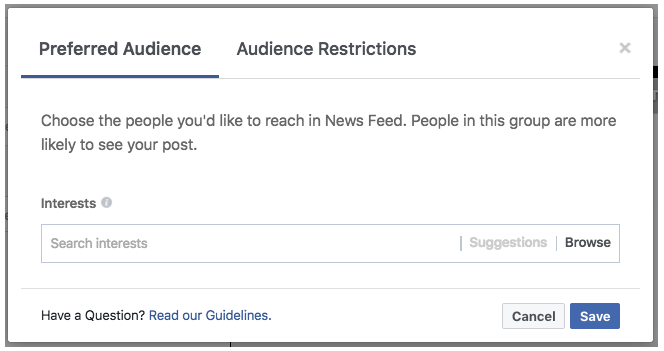
Before you publish anything, look for this option in the bottom left corner of the screen. Here’s what it looks like:

bottom left

Once you click on this button, you’ll see a popup with the option to select your preferred audience and restrictions for the video.

audience

With the preferred audience, you’ll be able to reach users based on factors such as the pages they’ve liked and their interests.

For example, you could choose interests like “swimming” or “baseball” depending on what type of business or industry you’re in.

The audience restrictions tab gives you the chance to narrow down users based on demographics such as:

  • age
  • gender
  • location
  • language

Making sure the audience is relevant will increase your engagement rates.

You can take this strategy one step further by publishing Facebook video ads. 71% of people say that the video ads they see on Facebook are relevant to them.

That’s because Facebook does a good job of giving businesses ways to target the right people with ad settings.

For example, you can use lifetime value to create a Facebook audience that converts.

Craft a striking title and description

You spent much time filming and editing the video. Time to publish it on Facebook, right? Not so fast.

You need to put the same effort into your title and description.

Learn how to increase clicks by mastering your headlines. The idea is to grab the attention of viewers and get them interested right away, before they even watch anything.

Descriptive videos will also increase your chances of being seen through organic searches on the platform.

There are more than 2 billion searches on Facebook each day. You definitely want your videos to be optimized for these searches.

I assume you’ll be using your Facebook videos on other distribution channels as well, which you should be. It’s a great idea to repurpose your content across multiple marketing platforms.

But your copy for these videos needs to be Facebook-specific.

Look at this data from Sprout Social about Facebook copy:

words

Furthermore, Facebook posts with 80 characters or fewer have 88% more engagement.

Facebook gives you a limit of 63,206 characters per post. You can experiment with a longer copy if you want.

But as you can see from the statistics above, fewer words and characters drive higher engagement rates.

Include a CTA

What should viewers do when they finish watching your videos?

If you don’t know the answer to this question, they certainly won’t have a clue.

Your Facebook videos need to have a CTA. That’s what’s going to drive engagement.

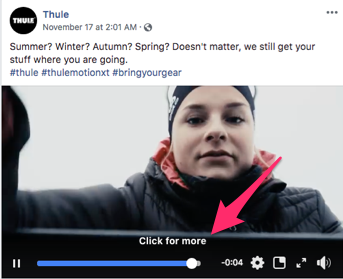
Here’s an example from Thule:

Thule

The CTA is a link to its website, trying to drive sales of the products showcased in the video.

That’s one approach.

But you can drive engagement by other means. It all depends on the goals of each campaign.

If you want to expand your reach and create brand awareness, you’ll want your videos to be shared on Facebook.

A potential CTA could be as simple as “share this video with your friends.”

Ask viewers to comment on it as well by ending the video with a question to spark a debate. All of these strategies will increase your engagement metrics.

Broadcast live

While you may not want to do it every day, live video streaming is a great way to boost engagement on Facebook.

With Facebook Live, you can have a more authentic interaction with your audience.

As you broadcast, they’ll be able to add comments and questions. This gives you the opportunity to respond to those users in real time.

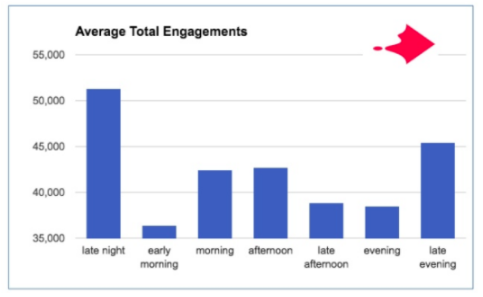
When should you go live?

live

Late at night and late in the evening are the two best times to go live if you’re trying to drive engagement.

I’d say you can use this strategy about once a week.

Try to stick to a schedule, similarly to a TV show. If your audience knows you’re going live every Wednesday night at 9:00 PM, you’ll have more viewers.

Showcase your best videos

Not all your content is the same.

As someone who produces tons of blog posts, videos, and podcasts, I know this reality firsthand.

It would be amazing if everything you produced and published was perfect, but that’s unrealistic.

Some of your videos will be better than others. You know it, and your audience knows it too.

That’s why those videos have more views, likes, shares, and comments.

Feature those videos on your Facebook page. Here’s an example from The Wall Street Journal:

WSJ

Usually, the most recent videos are displayed first.

But if a user navigates to your videos page on the left menu, you have the option to have your best videos shown ahead of your newest ones.

The idea behind this strategy is that you can hook people with your best videos.

Once they engage with that content, they’ll be more likely to watch your other videos and keep coming back for more in the future.

Conclusion

Your video content might be great, but it’s useless if nobody is engaging with it.

Since the vast majority of Facebook videos are played without sound, you need to add subtitles to optimize them for silent viewing.

Publish square videos. Your content should be native to be played automatically in everyone’s feed.

Start with your best content to grab your viewers’ attention early. Don’t slack when you’re writing a title and description.

Take advantage of the preferred audiences feature to make sure your videos are shown to relevant viewers. All of your videos should end with a CTA.

Go live. Highlight your best content as a featured video.

If you follow the advice I’ve outlined in this guide, you’ll see a major boost in engagement metrics for your Facebook videos moving forward.

What strategies is your company using to drive engagement on Facebook videos?


Source Quick Sprout https://ift.tt/2UZFoJR

Will It Help?

As I’ve mentioned before, one extremely helpful practice that I’ve been employing for years in terms of keeping my spending in a healthy place is something I call after action reporting and visualization. It’s simple and I do it all the time when I’ve got a few spare minutes, like when I’m in the car or waiting at the dentist’s office. I’ll write down more complicated ones in my journal.

All I do is reflect on a recent time when I spent money on something that wasn’t an obvious need. (I use it for other potential mis-steps in my life, too, but bad spending choices are a stellar example.) I’ll simply think back through the spending choice I recently made, ask myself whether or not it made sense, and look for potential alternatives that give me a better outcome, either in terms of spending less money or getting a better result. Then, I visualize myself doing it the “better” way the next time I’m in such a situation.

The part I really want to center on here, and it’s something that I use (and you can use) even in the heat of the moment, is the “ask myself whether or not it made sense” part.

For me, this really boils down to one question: will it help?

That question might need a bit of explanation.

I have a handful of really big long term goals – one might even call them life ambitions. I want to write some novels. I want to finish raising my children to successful adulthood and then, if it happens, be an involved grandparent. I want to “retire” early, which means I can move on to other activities without the need to earn an income (though one is welcome if it works out). I want to spend some extended time in every national park, hiking lots of trails. I want to be in good physical and mental shape for as long as I can. I want to establish and maintain a healthy handful of lifelong relationships and friendships. I want to be involved in the community, doing some of the grunt work of things like budget preparation that people don’t often see when they see a functional public service or community. Those are just a few key ones.

When I look at the thing I’m doing in the moment, the question I ask myself is whether or not the choice I’m about to make will help me move toward those life ambitions. Will it help?

For example, spending extra money to buy an unhealthy treat doesn’t help at all with several of those goals, so it gets a resounding “no” unless there is a very strong compelling reason to do otherwise. Spending money on a fleeting want does not help any of my long term goals. Eating an unhealthy treat does not help any of my long term goals. That choice just doesn’t help.

But what if I’m hungry? Well, in that case, I’m fulfilling a need, so it’s okay to spend some money to eat. However, that still doesn’t justify buying unhealthy food – unhealthy food doesn’t help with any of my long term goals.

But what if I’m with friends? I can go along with them and just skip out on eating if I’m not hungry. I don’t have to eat to be social.

But what if I’m with friends and hungry? That still doesn’t prevent me from choosing one of the healthiest options available? I don’t have to choose something absurdly unhealthy in that moment – I can seek out the healthiest option available.

I think you get the idea. “Will it help?” is a simple question that reframes a choice in the heat of the moment in the context of big goals and life ambitions.

You’re thinking about calling in sick to work today so you can play a video game. Will it help?

You’re thinking about sitting on the couch aimlessly channel surfing. Will it help?

You’re thinking about buying a book when you have a bunch already on the shelf and a great public library nearby. Will it help?

You’re thinking about skipping your daily workout so you can do some relatively unimportant chores. Will it help?

You get the idea.

But doesn’t “will it help?” just strip everything fun out of life? If the things you consider “fun” in life are in direct opposition to the big things you want out of life, then that’s a conflict you need to resolve before the question can really make your life better.

For example, let’s say I have the big lifelong goal of being healthy – being in decent physical shape and having a normal BMI. Yet, in the moment, I yearn for really unhealthy foods – I love having a few cookies each day and I love drinking several craft beers each day.

That’s a conflict that I need to resolve, because the short term “fun” is in direct opposition to what I want out of life. Which one is truly most important to me? Whichever answer I come to is entirely up to me, but it means effectively choosing one path over another. You can’t have both.

Thus, “will it help?” is also useful in helping a person clarify what they really want out of life. If you find that the question is “draining fun” out of how you’re spending your life, then your life ambitions are out of alignment with what you’re actually doing. The things you think you want aren’t in alignment with what your everyday actions are showing that you want. So… which is it that you actually want?

You might think that you want financial independence, but if you’re spending money on silly things all the time without a very strong and coherent reason, then you actually want the ability to spend frivolously more than you want financial freedom.

You might think that you want to be healthy, but if you’re choosing to veg out instead of exercise and you’re consistently choosing unhealthy foods, then you actually want other things more than you want to be healthy.

Again, there’s nothing really wrong with any of those paths. What matters is that the things you’re doing on a daily basis are in alignment with the big things you want out of life, and that simple “will it help” question pretty quickly reveals where they’re out of alignment.

If you find the question really helpful, then that’s great! You’re probably on the path to achieving the things you want most in life.

If you rather resent the question, then it probably means your daily actions and choices are out of alignment with your big ambitions and you haven’t figured out which one really matters more to you, and that means that some time for reflection is in order.

Lately, I’ve found this question to be incredibly powerful, whether it’s just helping me eliminate bad habits that I was doing without thinking or whether it’s helping me to see situations where my goals and values are opposing each other and not helping me make the progress I want to make. Those three simple words open up both paths. It’s been the source of a lot of thinking while I’ve been running errands as of late and it’s also been at the center of a lot of journal writing, too.

In terms of actual results, it’s been really nudging me to clean up my eating habits as well as some of my spending habits, too. It’s also made me think quite a lot about some of my choices about how I spend my leisure time.

Three simple words. Will it help? Ask yourself this about all of your choices and you might be surprised at what comes out the other end. Whatever it is, piecing through that answer and how you feel about it will put you in a better place.

Good luck!

The post Will It Help? appeared first on The Simple Dollar.


Source The Simple Dollar https://ift.tt/2UWgaMD