Thousands of courses for $10 728x90

الخميس، 16 مايو 2019

How to Use Google Keyword Planner Tool For SEO

There are so many different elements of SEO.

For the most part, all of these various aspects can be broken down into two main categories; on-page SEO, and off-page SEO.

The biggest factor of off-page SEO is backlinks. While on-page SEO is comprised of elements like content copy, title tags, meta descriptions, internal linking, and site architecture.

It’s nearly impossible (unless you get extremely lucky) to have a successful on-site SEO strategy without conducting keyword research.

There are tons of tools on the web to help you with finding keywords related to your business, but Google Keyword Planner is arguably the most powerful.

The best part about this tool is that it’s completely free for anyone to use. All you need is a Google Ads account.

It’s also worth noting that the primary purpose of the Keyword Planner is for PPC advertising.

But with that said, you don’t need to spend any money on ads to do your keyword research with this tool. The only thing you won’t be able to access is the exact monthly search volumes for specific keywords. As you’ll learn shortly, you’ll still be able to see an average range, but Google will only show exact volumes when you run an ad campaign.

I’m assuming that most of you already have a Google Ads account. If not, it’s very easy to set up. So go ahead and do that as soon as you’re ready to proceed.

Then just follow along this guide to learn how you can take full advantage of the Keyword Planner for bringing your SEO strategy to an elevated level.

Google Keyword Planner features

Before we dive too deep into the specifics, it’s important for you to understand exactly what the Keyword Planner can be used for.

As I said before, this tool is designed with PPC ads in mind. So about half of what you’ll see is going to be geared toward running a successful paid search campaign. These are some of the top benefits of Google Keyword Planner:

  • Find new keywords using words, phrases, websites, and categories.
  • Discover search volume trends and historical data of different keywords.
  • See performance forecasts for keywords based on your budget and average bid prices.
  • Narrow your results based on geographic location, language, and date ranges.
  • Filter results by average monthly searches, competition level, organic impressions, ad impressions, suggested bids, and organic average position.

It’s worth noting that some of these features are only available if you sync your Google Ads account with your Google Analytics account.

For our purposes today, we’re going to stick to the features that focus on finding keywords that you can use to improve your on-page SEO strategy.

Discover new keywords

The first thing you should use the Keyword Planner for is finding new keywords. This is very straightforward.

Once you know what keywords are related to your site, brand, niche, or a specific campaign, then you’ll be able to use those keywords to improve the content and on-page SEO of your website.

So log into your Google Ads account and navigate to the Keyword Planner.
Keyword Planner

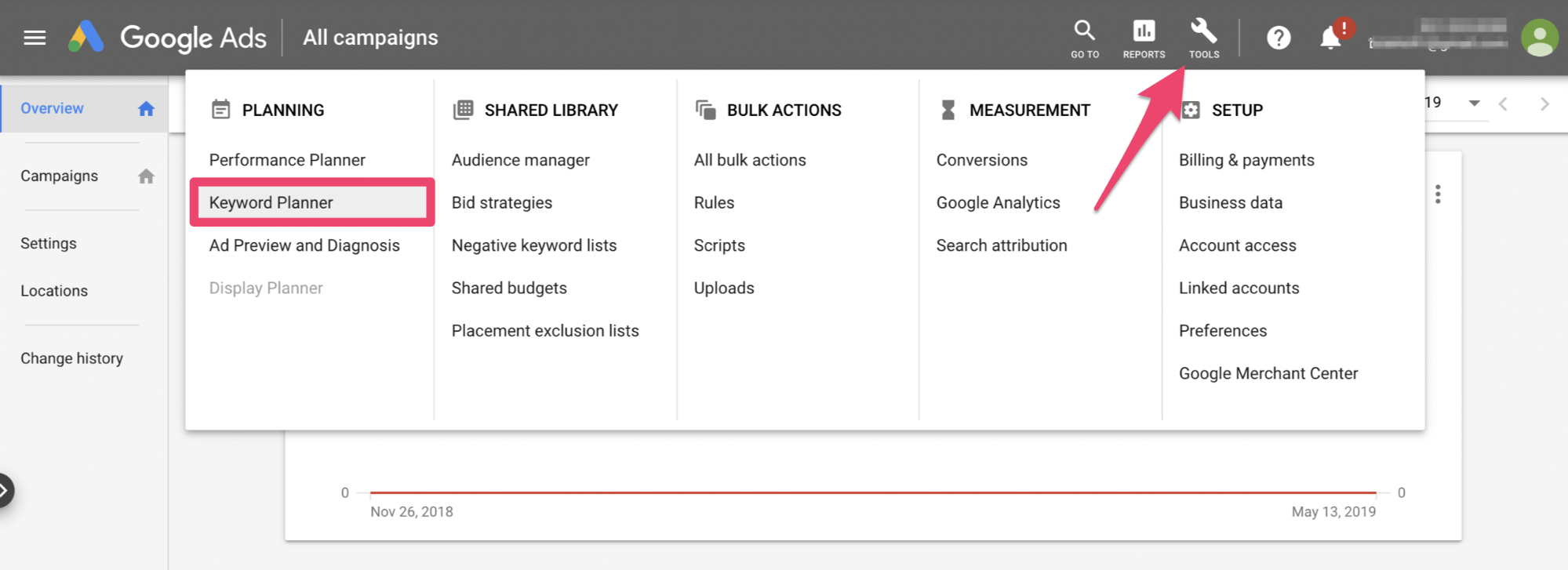
From your Google Ads dashboard, click on the “tools” icon in the top right corner menu bar. This will expand the menu, showcasing an additional five categories.

Now select “Keyword Planner” from the planning list on the left side of the expanded menu.

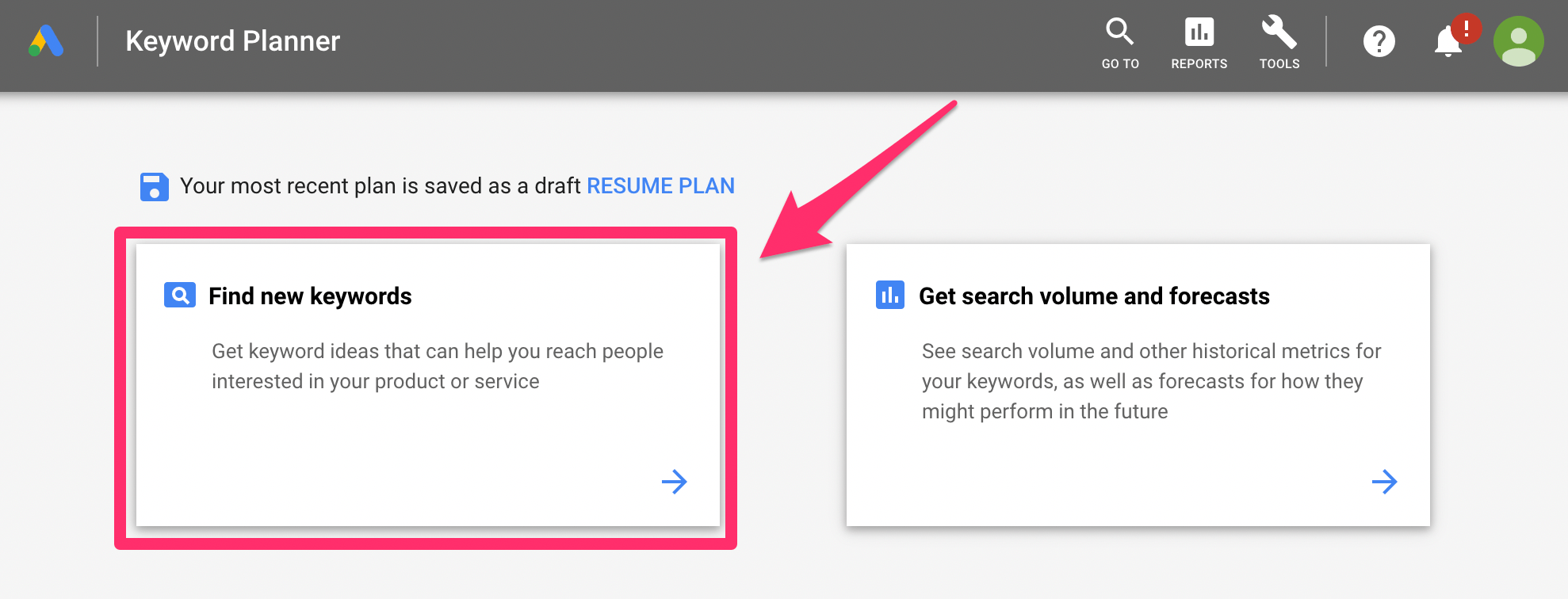
Next, you’ll be presented with two options.

  1. Find new keywords.
  2. Get search volume and forecasts.

For now, just select “find new keywords.”
Find Keywords

Next, it’s as simple as entering keywords into a search bar and letting Google take care of the rest for you. Although it seems simple, this is probably the most important step of the entire process.

The Keyword Planner tool is extremely advanced, but it can’t provide you with valuable keywords unless your initial search terms lead it in the right direction.

A great benefit of this search bar is that it allows you to enter words, phrases, and a URL that’s relevant to your business. To get the most out of your searches, I recommend taking full advantage of the search options at your disposal.

Here’s a look at an example of what a search would look like if I was conducting keyword research for content here at Quick Sprout.
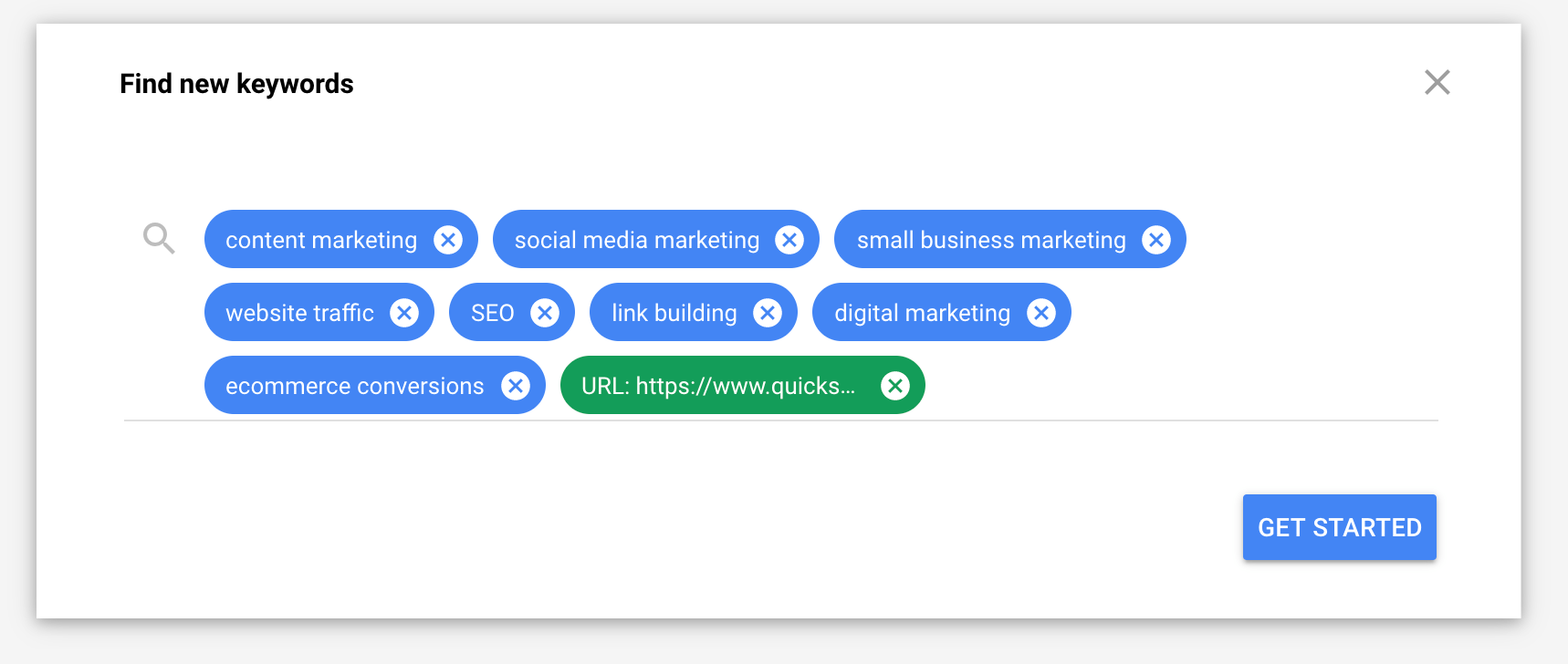
Example Keywords

As you can see, I used some single words like “SEO,” two-word phrases like “content marketing” or “ecommerce conversions,” and even some three-word phrases like “small business marketing.”

I also included a link to the Quick Sprout homepage to give the tool a better understanding of the content related to our site.

This is much better than just adding “marketing” to the search bar without adding anything else.

Analyze the search results

Once you begin your initial search, you’re going to get lots of information thrown at you. Do not be overwhelmed or intimidated by this. We’ll eventually narrow down the results.

Again, if you’re not planning to run any PPC campaigns, you can ignore some of this data.

First, let me show you how to read and interpret the results.
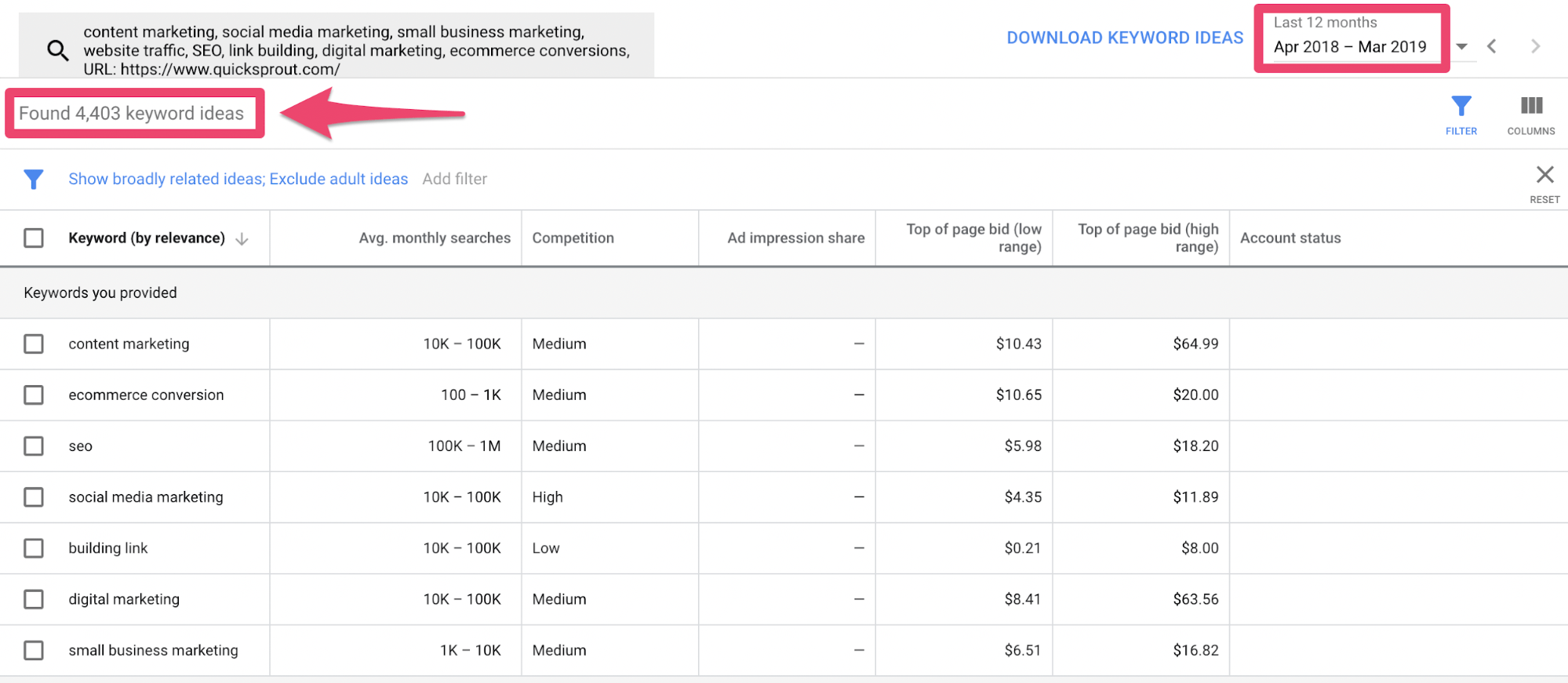
Interpret Results

There’s a couple of things I want to point out right away.

The Keyword Planner generated 4,403 keyword ideas based on my initial search. By default, the results that you’re going to see are based on the last twelve months of search data. But you can play around with that to see how the data changes if you view those keywords over a longer or shorter period of time.

Before you get new keyword ideas, the Keyword Planner shows you results for what you’ve already searched for.

The only columns you’re going to want to look at are average monthly searches and competition.

Ad impression share, top of page bids, and account status are all for pad ad campaigns.

As you can see, the average monthly search ranges are pretty broad. For example, it says that the search range for “SEO” is from 100,000 to 1 million.

There is a big difference between 150,000 searches and 950,000 searches, which both fall into that range. But the only way to get the exact data is by running an ad.

The competition data is crucial.

High competition keywords are going to be more challenging to rank for since more people are running paid ads for these words and phrases. But maybe you can try to gain an advantage over your competitors by taking steps to outrank them organically.

Some of you might have more success with low competition keywords. It all depends on your priority and the keywords in question.

By looking at the search results above, the term “social media marketing” has a high competition level, while “link building” is low. Let’s keep this information in mind as we continue.

Now it’s time to analyze the keyword ideas based on the keywords that we searched for.
Analyze Keywords

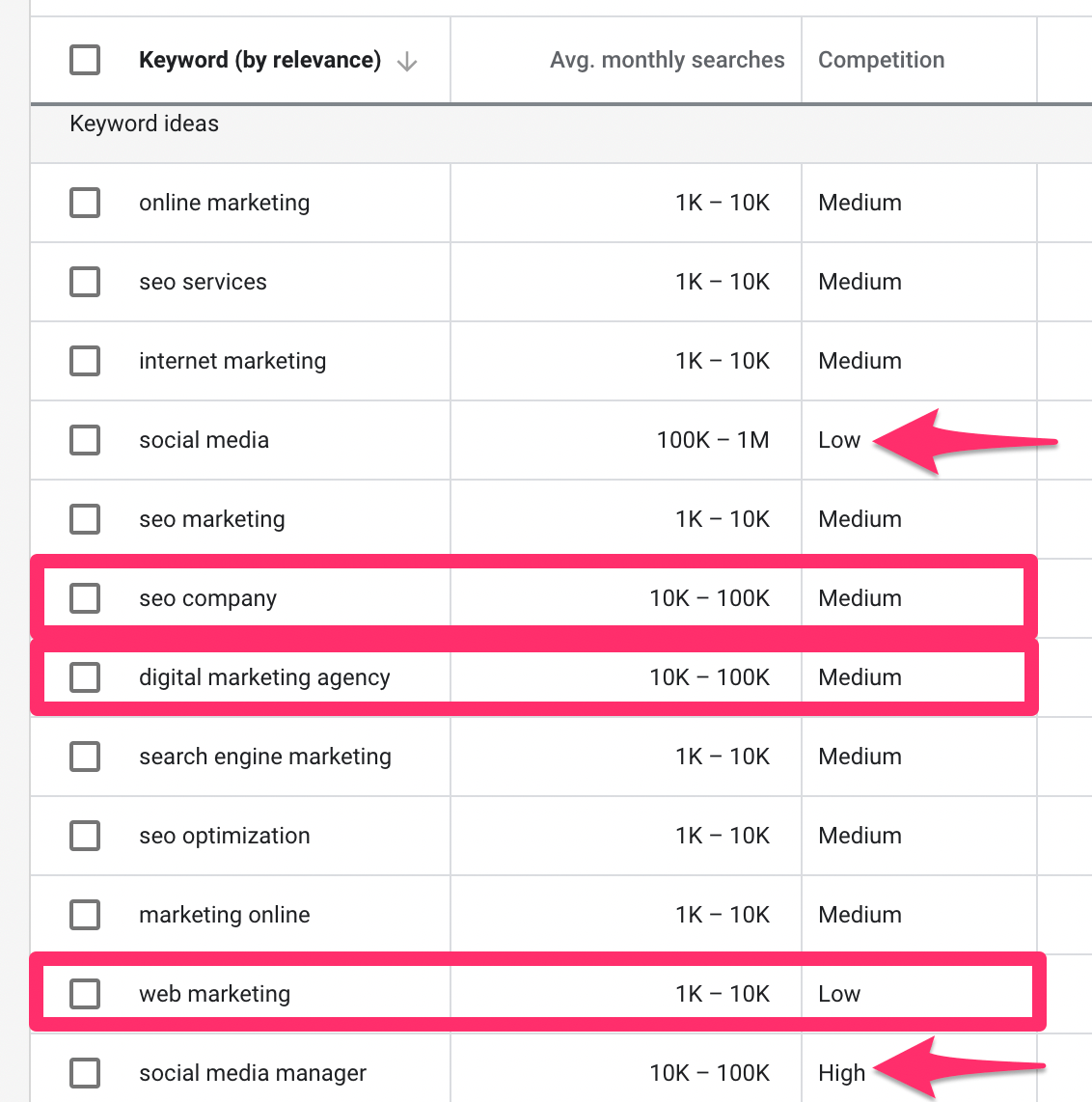
Here are the top 12 keyword ideas, sorted by keyword relevance.

I highlighted some of the suggestions to give you an idea of how you should be approaching this process.

All of the keywords on the list are useful and worth incorporating into your content. But you need to find ways to prioritize them.

Low competition keywords with high search volumes might seem like the easiest for you to rank for. But it doesn’t always work out that way.

For example, look at the data for “social media.”

It has a high search volume and low competition, so it must be a home run—right? Not necessarily.

Since that topic is so broad, it will be tough to rank for. That’s probably why people aren’t spending money on PPC campaigns to rank for that term.

On the flip side, “social media manager” at the bottom of the screenshot has a high search volume and high competition level, making it a challenging keyword to rank for.

Now let’s take a look at the keyword ideas that I boxed.

  • SEO company
  • Digital marketing agency

Both of these have high search volumes and medium competition levels. Ranking organically for these keywords won’t necessarily be easy, but it’s definitely not impossible.

Even though a term like “web marketing” has a lower search volume, it’s still in that 1,000 – 10,000 range, and has low competition. I boxed that as well because it’s related to the two other terms we’re discussing.

You could potentially use these three terms to conduct a new search that’s more specific. But we’ll get into that shortly.

Before you get into anything more complex, you should experiment with filtering the results.

Organize the keyword ideas by low competition, high competition, low search volume, and high search volume.

Narrow your search

Now that you’ve taken some time to sort your list of keywords, you’ve probably realized that 4,400+ keywords are too much. Lots of these keywords won’t be used by you.

So you’ll want to narrow the results to make sure that you’re only seeing ones that are the most relevant, and will actually benefit your SEO strategy.

The easiest way to do this right away is by changing one of the filters from “broadly related ideas” to “closely related ideas.”
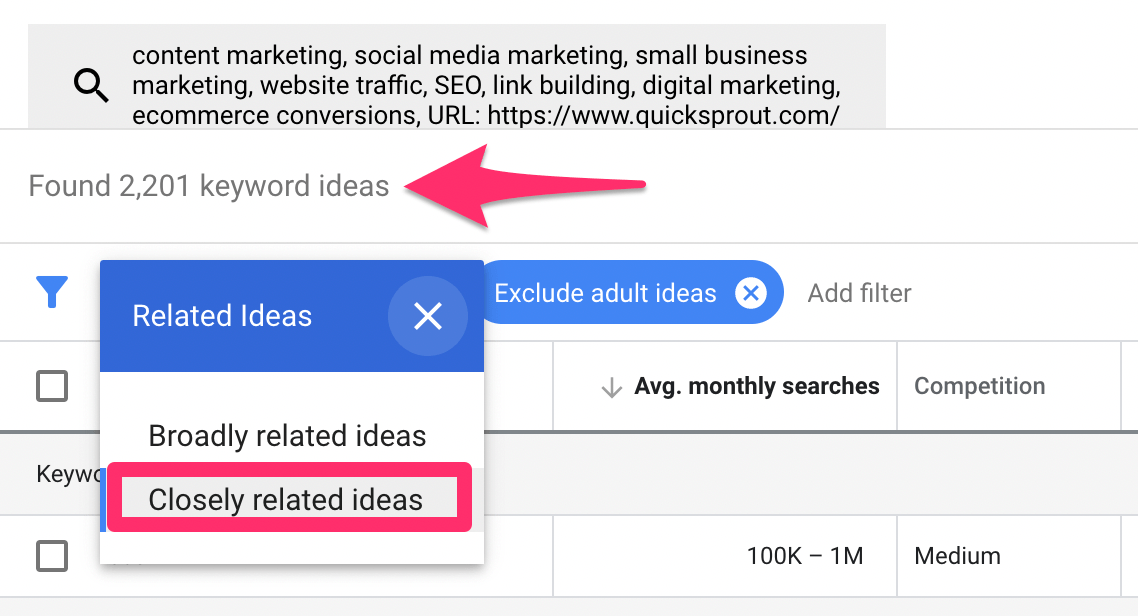
Related Ideas

As you can see, this filter alone cut the search results in half.

So scroll through and get more keyword ideas using the new results. Use the keywords on this list to help you create new searches that are highly relevant.

Refer back to what I did earlier.

I took SEO company, digital marketing agency, and web marketing from that initial list of ideas. Here’s what the search results look like for those keywords combined with the Quick Sprout URL.
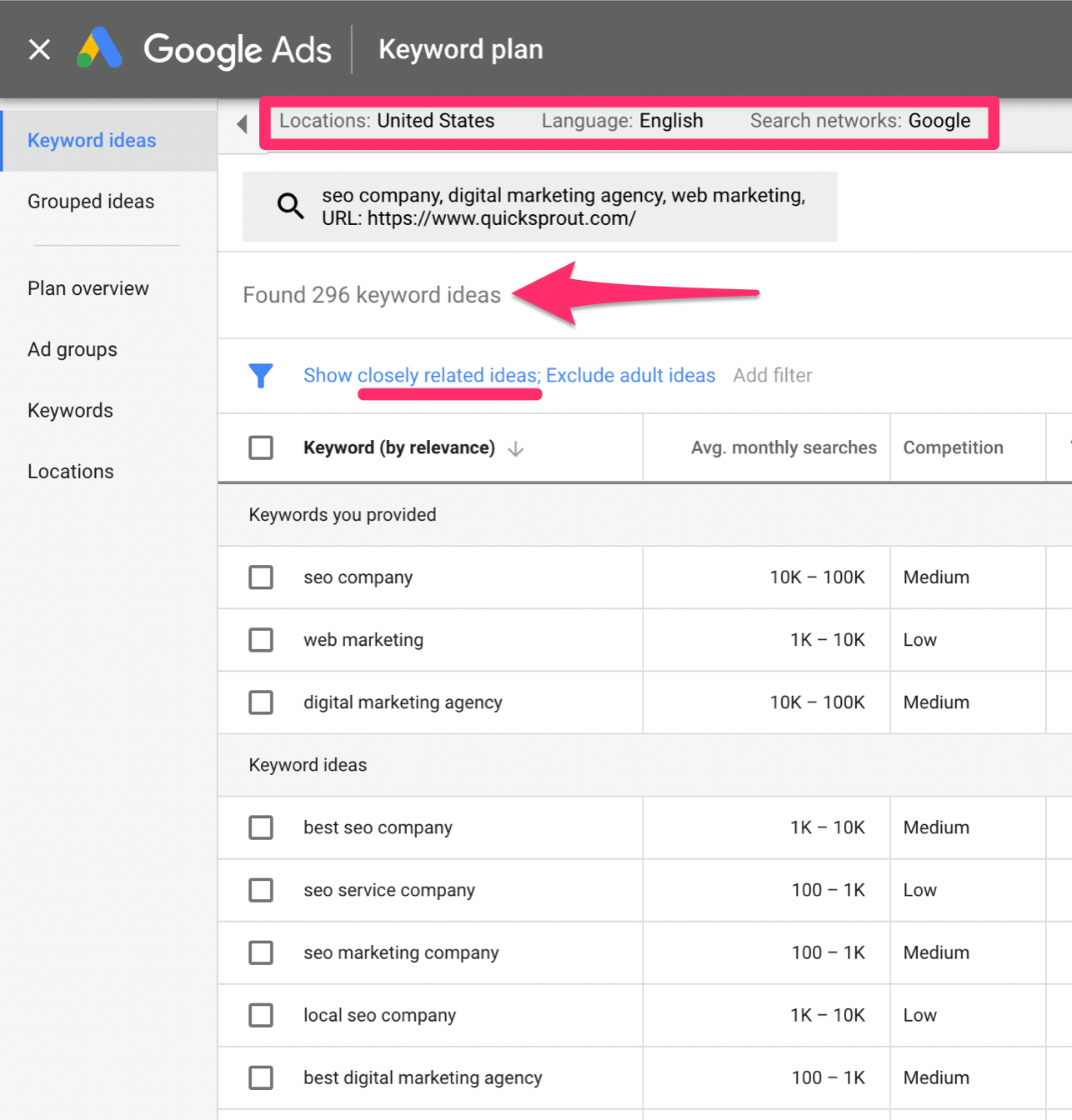
Location

Those new terms combined with the closely related filter yielded 296 keyword ideas.

This list is much more reasonable for you to manage.

As I mentioned earlier, you can also narrow your results by locations, language, and search networks.

For example, let’s say you have a local business that has retail locations scattered across New England. You don’t need to get data on the entire United States.
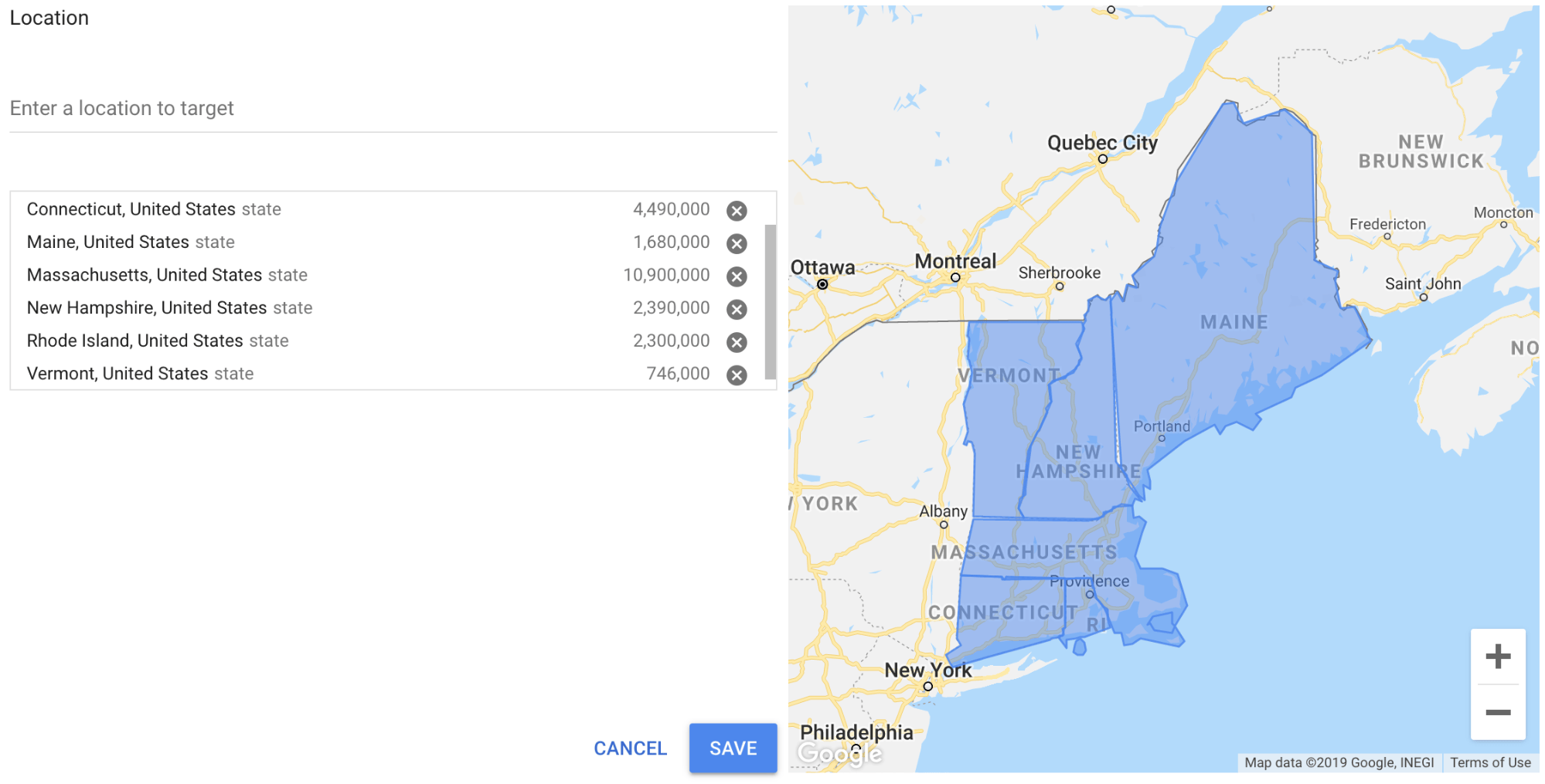
Map

Instead, you can just focus on those six states in New England.

With that said, this feature is definitely more beneficial for those of you who will ultimately run PPC campaigns. In this case, you can choose to only target users who are searching in that region.

But it’s still worth seeing how the competition and search volume changes if you adjust the location.

With each list of ideas, you can download the information as an excel spreadsheet as well.

In my opinion, this makes it easier for you to keep notes and organize the data in a way that aligns with your SEO plan and content strategy.

Download Keywords

Just look for the “download keyword ideas” button at the top right corner of each page.

View keyword forecasts

Head back to the main keyword planner page that we landed on earlier.

Only this time, we’re going to select the other option; get search volume and forecasts.
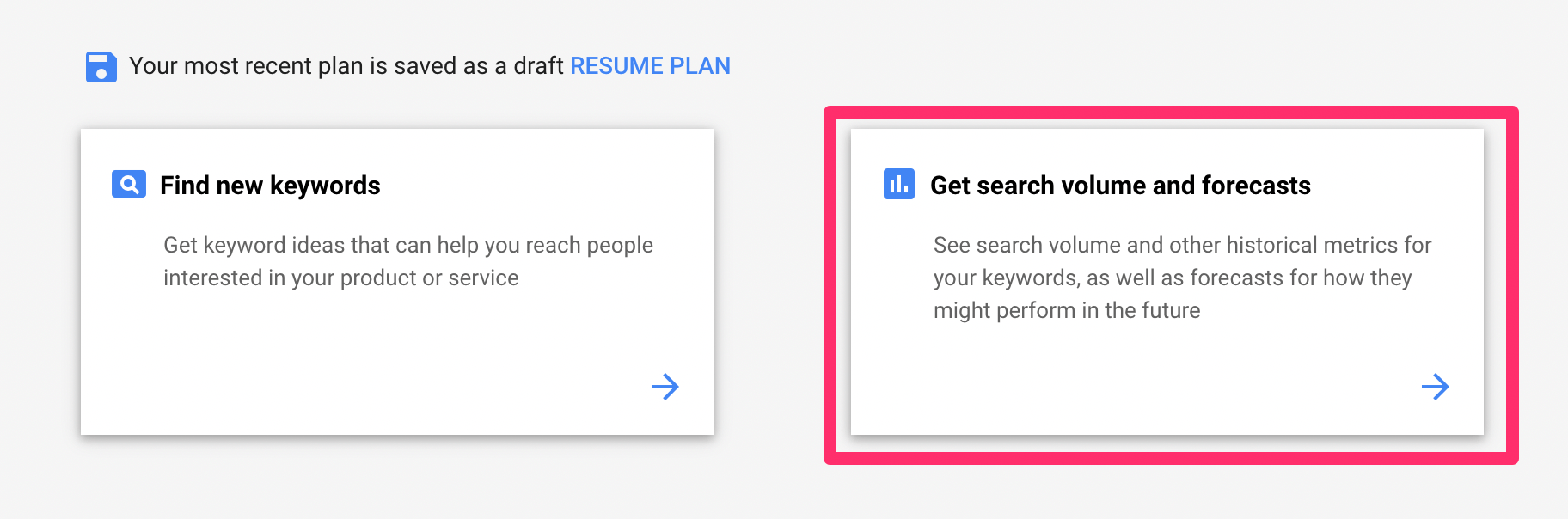
Search Volume Forecast

We previously saw the search volume when we were discovering new keywords. It showed us data from the past 12 months.

Maybe you changed around the date range and saw something different.

While the Keyword Planner tool won’t show you projected search volumes for the future, it will show you a forecast for your keywords if you decide to run a PPC campaign.

Based on those three keywords that we looked at most recently, Google projects that a PPC campaign would get 20,000 impressions and 280 clicks for $580 per month. The average search position would be #3.

This is not an ideal forecast. But it’s not awful either.

Personally, I wouldn’t proceed with it. But this decision is completely up to you.

You can use this tool to give you a better idea of how certain keywords will perform. If you can find a way to get 20,000 monthly impressions organically using these keywords, it will be better than paying for it.

But you might see forecasts that are worth pursuing based on the keywords, projections, and the budget that you’re willing to allocate for paid keywords.

Conclusion

Now that you have your list of keywords, it’s time to enhance your website’s on-page SEO.

Decide which keywords you want to prioritize, and then produce content that will help you rank for those terms. Write blog posts and guides. Create images, videos, and infographics. Produce content that’s a combination of these.

Focus on your title tags, header tags, and internal linking with exact-match keywords.

You can refer to my complete guide on SEO for more information on how to do this. There’s a section in here for on-site SEO that will help you out tremendously.

Start experimenting with Google Keyword Planner. Since it’s free to use, it can’t hurt to try.

Once you get familiar with navigating and searching, you can use this guide as a reference to help you find keywords that will be easier to rank for.


Source Quick Sprout http://bit.ly/2WJgmiQ

How to Start Trading Stocks for Free (and With No Minimum Balance Requirement)

Some of the links in this post are from our sponsors. We provide you with accurate, reliable information. Learn more about how we make money and select our advertising partners.

We all have that friend. The one who’s constantly checking the stock market like it’s a game and mumbling things like, “Ugh, I should’ve traded that yesterday!” You roll your eyes, but you also wonder: What am I missing out on?

Many financial experts encourage young people to invest in the stock market. Sure, it comes with risk, but it could pay out long term.

The only thing is… where do you start?

Lord knows you don’t want to ask that friend. Instead, you can start with as little as $1 and open fee-free account with SoFi Active Investing.

Investing for Beginners: Don’t Pay to Play

SoFi Active Investing leans into a “learn by doing” approach. That means you can experiment with buying and trading stocks — no fees and no account minimums attached.

If you buy something and immediately regret it? You can trade it seconds later. No penalty. (Honestly, it’s perfect for those of us with commitment issues.)

But maybe you have questions before you get to the whole buying and trading part… Take all the time you need to explore stocks through your SoFi dashboard.

For example, maybe you’ve heard everyone abuzz about Roku stock. Search for it on your dashboard, and you’ll see that SoFi has outlined the stock’s market price, its performance history and even recent company news hits — everything you need to know to make an informed decision is right there.

Pro tip: Add stocks you’re interested in to your SoFi watchlist. There, you can monitor their daily performances. Like what you’re seeing? Make a move as soon as you’re ready to buy.

If you want some human input? Reach out to a SoFi financial adviser for free via phone, email or chat at any time.

How to Open a Fee-Free Investing Account

Are you ready to give this whole investing thing a try?

Here’s how to start:

  1. Sign up here by clicking “Invest Now.”
  2. Connect your bank account. This will fund your investments. (There are bank-level layers of security, and SoFi won’t store your info, so you’re safe!)
  3. Ready to go? Click “Add Buying Power” to deposit money into your SoFi Active Investing account. Choose a one-time transfer or set up recurring monthly transfers. It’ll take up to four business days for this money to land in your SoFi account.

From there, invest the money from your SoFi account into stocks of your choice.

Don’t feel like you’re marrying these stocks. You can buy and trade fee-free at any time the market’s open, but remember: Some of the smartest investors suggest riding out the market’s ups and downs long term for the greatest gains.

Oh, and if you want to really get serious? Download the SoFi app. Then, when that friend starts talking about stocks, you can add your two cents.

Carson Kohler (carson@thepennyhoarder.com) is a staff writer at The Penny Hoarder. Her boyfriend inspired the character of that friend in this article.

This was originally published on The Penny Hoarder, which helps millions of readers worldwide earn and save money by sharing unique job opportunities, personal stories, freebies and more. The Inc. 5000 ranked The Penny Hoarder as the fastest-growing private media company in the U.S. in 2017.


source The Penny Hoarder http://bit.ly/2HAPNpM

Subaru Engine Failure, Plus More Class-Action Settlements for May

10 Clever Ways to Get Free Gift Cards This Month

How to Create an Expert Roundup Blog Post

In the past, I’ve shown you how to build links and traffic from link roundups. This strategy involves creating content that will get featured in a weekly or monthly roundup post on other websites.

Now I’m going to teach you how to create an expert roundup. What’s the difference between these two?

Rather than trying to get your link featured on another site’s roundup post, you’re going to create content on your own website using expert opinions.

At the end of the day, this will have similar advantages to getting featured on a link roundup. Creating expert roundups will still help you build backlinks, boost your website traffic, and add plenty of SEO value.

Why are expert roundup posts so great?

Here’s the thing. Not all of you have a well-known name or platform, especially if you’re just starting out as a blogger. That’s OK. We’ve all been there.

I’m not saying this to sound rude or harsh, but why should someone take your advice?

You might know what you’re talking about, but nobody knows that. If you’re an up and coming blogger, getting experts featured on your blog will give people a reason to visit your site and consume your content.

Here’s an analogy.

Let’s say you’re an avid golfer and you want to start giving people golf lessons. But if nobody knows who you are, they have no reason to listen to you, even if you’re offering excellent tips and advice.

Now let’s say you can get Tiger Woods to attend one of your golf camps. People will definitely listen to him since he’s a household name and arguably the best golfer on the planet. His presence at your golf lessons will get people to come and ultimately validate your legitimacy. You’ll get even more exposure if Tiger Woods promotes your golf lessons by telling people that he’ll be there.

You can apply this same analogy to your blog posts. Only instead of one expert, you’re going to get dozens to share their opinions.

So how do find these experts and get them to participate? I’ll explain everything you need to know in this guide.

Why expert roundup posts are so effective

Let me take a minute here to reverse the roles for a second.

Hypothetically speaking, pretend a blogger reached out to you to participate in their expert roundup. They value your opinion and want to share it on their website.

When their post gets published, you’d share it—right? Absolutely.

These posts get a ton of traffic since the experts who are part of the roundup will eventually share the content as well.

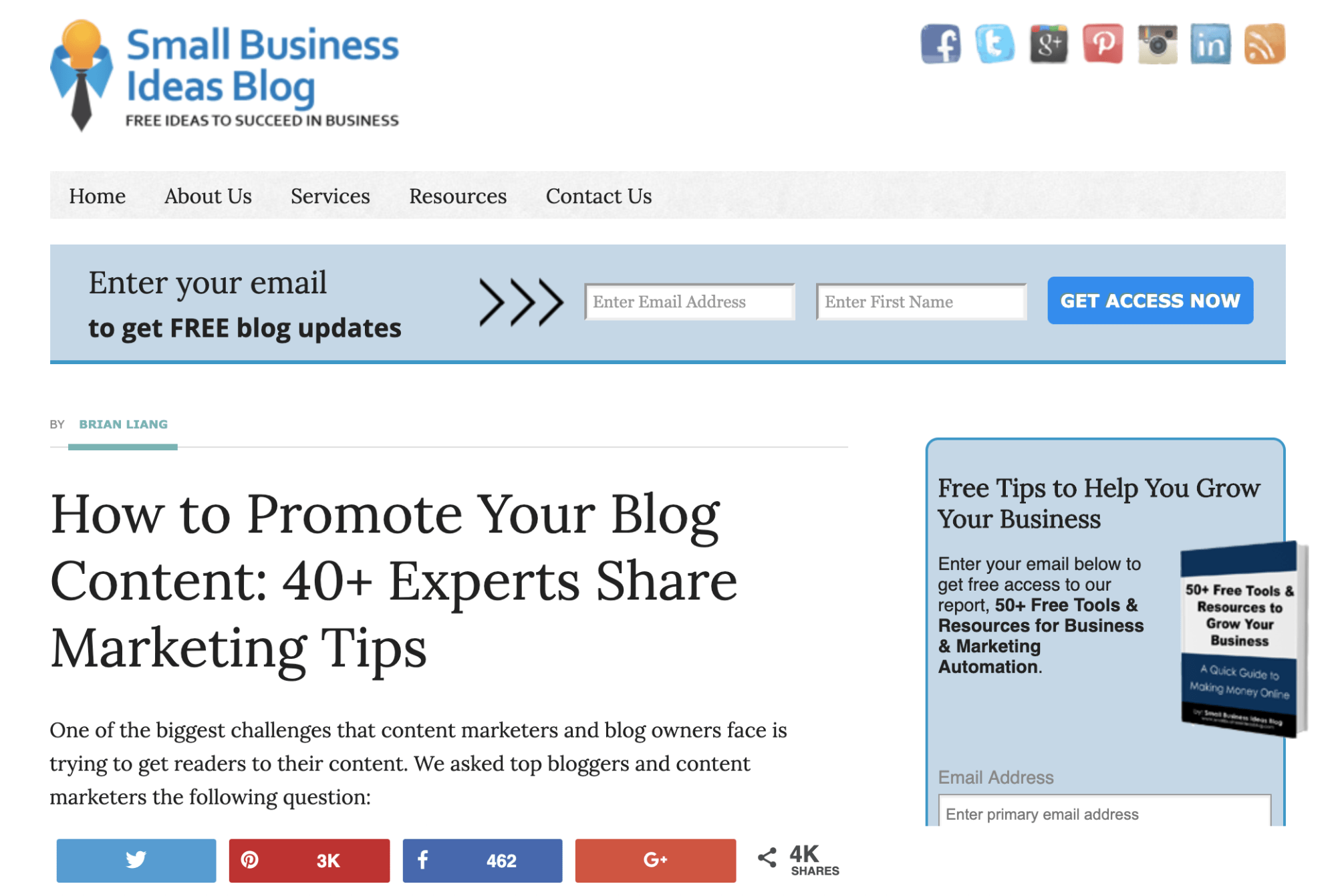
Here’s an example from the Small Business Ideas Blog.

Small Business Ideas Blog

Brian Liang wrote created this post about blog promotion, which is ironically related to the topic that we’re discussing right now.

He got 40 experts to share their marketing advice. All he did was ask them one simple question.

What can bloggers and marketers do to be more effective when promoting their content?

This is a question that so many people can relate to, and will be eager to hear the advice of experts in the industry. All different types of experts answered the question.

  • SEO experts
  • Affiliate marketers
  • Internet marketers
  • Business marketers

By getting people from different niches to participate, it increases the exposure even more.

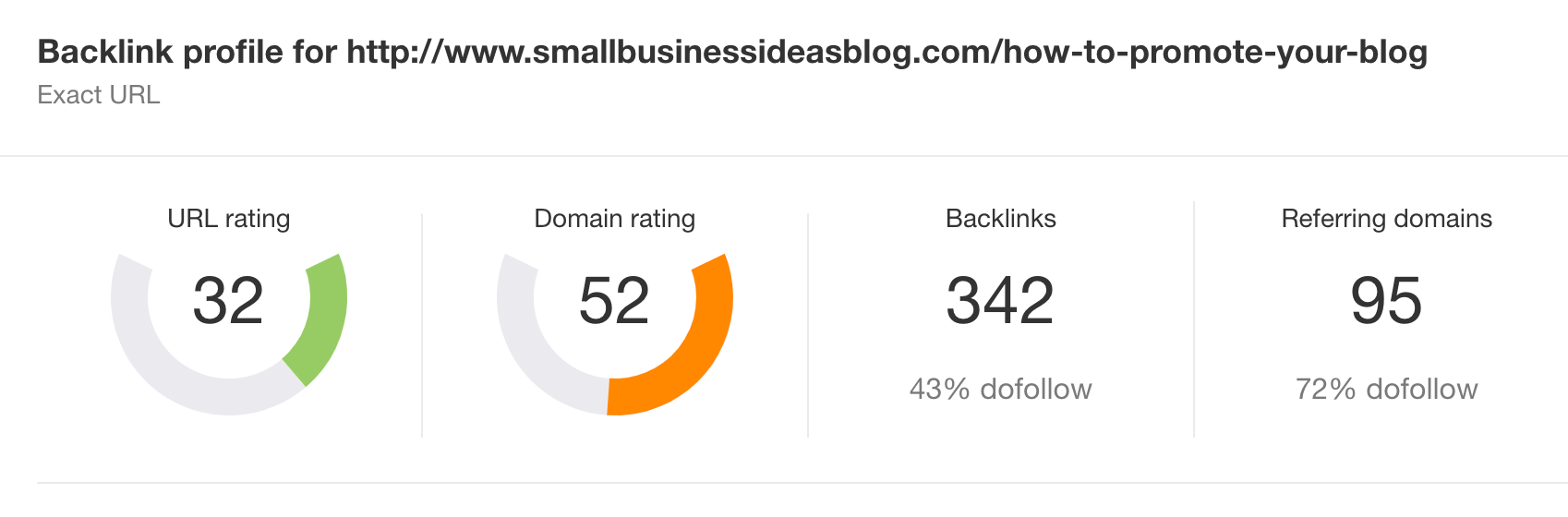
So, how did this post perform? Check out this information from the backlink checker at Ahrefs.

Backlink Profile

It has 342 backlinks from 95 referring domains.

If you look back to the first screenshot of the blog itself, you can see that it has more than 4,000 social media shares as well.

Expert roundups generate a ton of traffic.

That’s because everyone who participates will, at the very least, throw the link up on their social media platforms. As an industry expert, they most likely have large social followings. You might even get backlinks and your link shared with their email subscribers.

Since a roundup that contains insight from a wide range of experts is such a valuable piece of content, it has a greater chance of being shared by other people as well, even if they weren’t one of the contributors. It might even end up on a link roundup.

Expert roundups validate your website and build brand awareness.

The fact that all of these experts were willing to participate and be part of something on your website shows a lot about who you are. Industry leaders won’t do this for just any average Joe.

Plus, the backlinks you’ll get from major websites will boost your domain authority.

Roundup posts help you build strong bonds and relationships with influencers. This is a great networking opportunity for you.

These experts are building links with your roundup. Whenever you introduce an expert, it’s common practice to say who they are with a link to their website. So they benefit from the exposure as well. They might even ask you to write a guest post for their website or something like that in the future.

Another top benefit of a roundup post is that it adds a new perspective to your content. You get to switch it up instead of publishing the same thing over and over again.

Find industry experts

Obviously, you can’t write an expert roundup without the help of experts.

Don’t expect these people to come to you and say, “Hey! On the off chance that you create an expert roundup, I’d love to be included in it.”

That’s unrealistic. Instead, you need to get out there and find them.

The easiest way to do this is by looking for other expert roundup posts. So use Google to your advantage.

I’ll give you an example. Let’s say you want to create a roundup about blogging mistakes. Just run a search for something along the lines of “blogging mistakes expert roundup.”

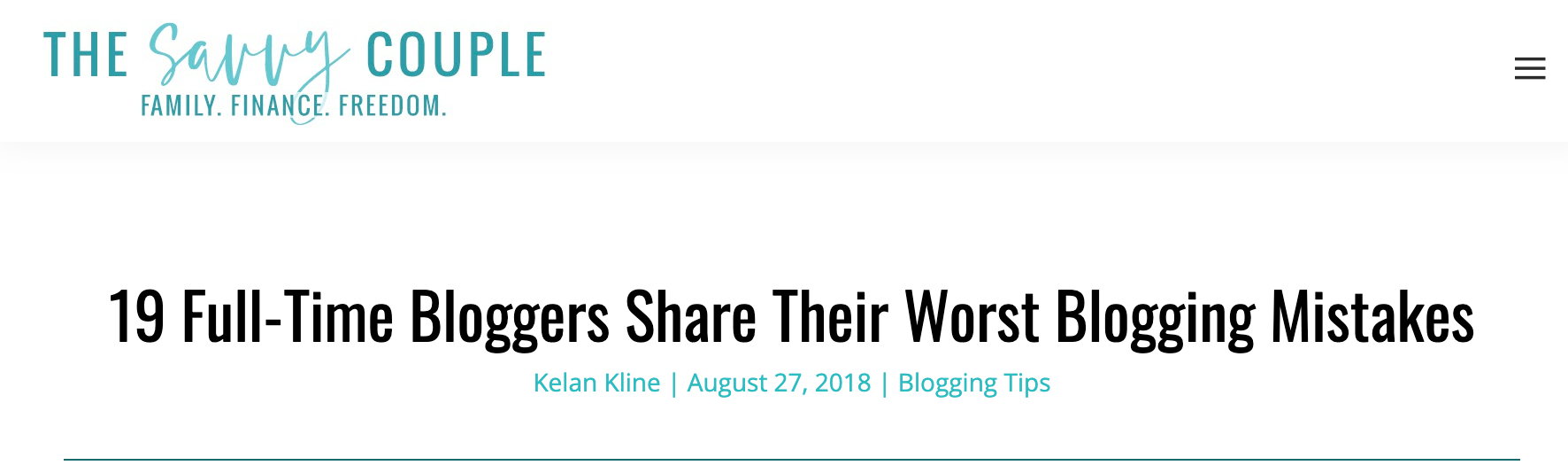
Here’s one of the top results.

TheSavvyCouple

19 blogging experts talk about their mistakes in this post.

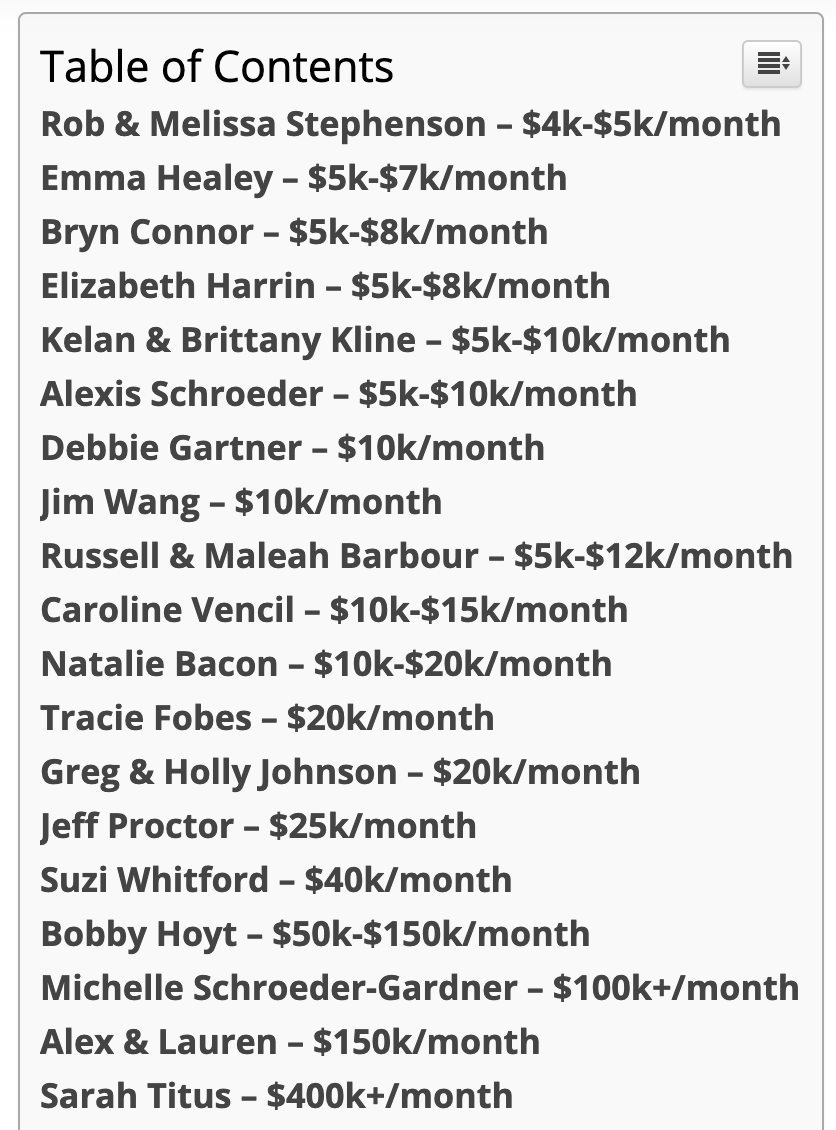
There is a table of contents that includes a list of the bloggers and the amount of money that their blog generates each month.

Table of Contents

Use this list as a resource. It’s up to you to prioritize which experts you want to contact.

You could just make a list of all of them, or go for the big ones who make $50k, $100k, or $400k per month.

Creating a spreadsheet is the best way to stay organized. The list should include:

  • Name of expert
  • Their website
  • Contact information
  • Status

In the status column, you’d put notes like, “Sent email on 5/14 — waiting for reply,” or something like that.

Don’t stop building your list of experts with just one post. Here’s another top post from that same Google search.

Self Hosted Life

This similar blog shares the opinions of 17 experts.

So between these two posts alone, you’ve got 36 potential experts to reach out to. Continue adding to the list. Eventually, you’re going to narrow it down.

Don’t just take their “expert” label at face value.

You need to check out their websites, credentials, and metrics like domain authority. Look at how frequently they publish content. View their social media pages to see if they’re willing to share content from other websites.

Make sure they’re a good writer and have a strong following.

If you see someone on your list that’s an expert, but they don’t have lots of social media followers, don’t publish content frequently, and have a site with a low domain authority, you don’t need to prioritize them. You may ultimately decide not to reach out to them or include them in your roundup.

Send your pitch

Once you have your list of experts compiled, it’s just a matter of finding their contact information, which should be pretty straightforward.

Rather than just submitting a general inquiry on a website form, it’s always better to try and get their personal email address.

For example, we’ll look at Adam Connell from Blogging Wizard as an example, since he was the first expert in the post that we were just talked about. I went to his website and navigated to the contact page.

Blogging Wizard Contact Page

This page shows an email address.

Normally, I wouldn’t like that because it’s so general. However, since this is Adam’s website, I’m confident that he’ll receive the message.

The page also states that all email inquiries need to start with “Hey Adam” to ensure it’s not a spam message. As you can see from this page, you could also reach out to him via social media.

Your outreach messages should be very concise. For this example, you could say something like:

Hey Adam!

I’m doing an expert roundup post on my website [link to website] about blogging. Could you please answer this question for me?

“What was the biggest struggle or hurdle that you had to overcome as a blogger?”

Thanks in advance for the help. I really appreciate it! I’ll include your name, brief bio, and a link to your website in the roundup as well.

After you send the message, update your spreadsheet with notes so you can keep track of managing your communication with all of these people.

Don’t go overboard and ask them for more than they’ll be willing to deliver. As you can see from the example, all I did was ask one question. So the response can be as long or as short as he’d like it to be.

If you ask an expert to send you a 2,500-word case study, don’t expect a response.

Follow-up with emails if you haven’t heard back after a week.

Hey! I know you’re busy but I just wanted to follow up with you on this question again. Do you have a rough idea for when you’ll be able to answer? No rush. I just want to plan accordingly. Thank you!

A follow-up message like this increases the chances that they’ll participate.

Top elements of an expert roundup

Now that you’ve reached out to the top experts in your niche, it’s time to go through their responses and start writing your roundup post. If you want the post to be successful, it needs to have the following elements:

A great question

The responses given by the experts will only be as good as the question you ask them. If you ask them a yes or no question, don’t expect a high-quality response. On the flip side, if you ask for their life story, it’s going to be too long and unappealing to the readers.

Instead, look for questions that will actually add value and help people who are looking for insight. Review blog comments, forums, and Google related search suggestions to get inspiration for crafting the perfect question.

Epic headline

Don’t make your expert roundup to sound like an average “how-to” post or guide. Let everyone know that this post is different.

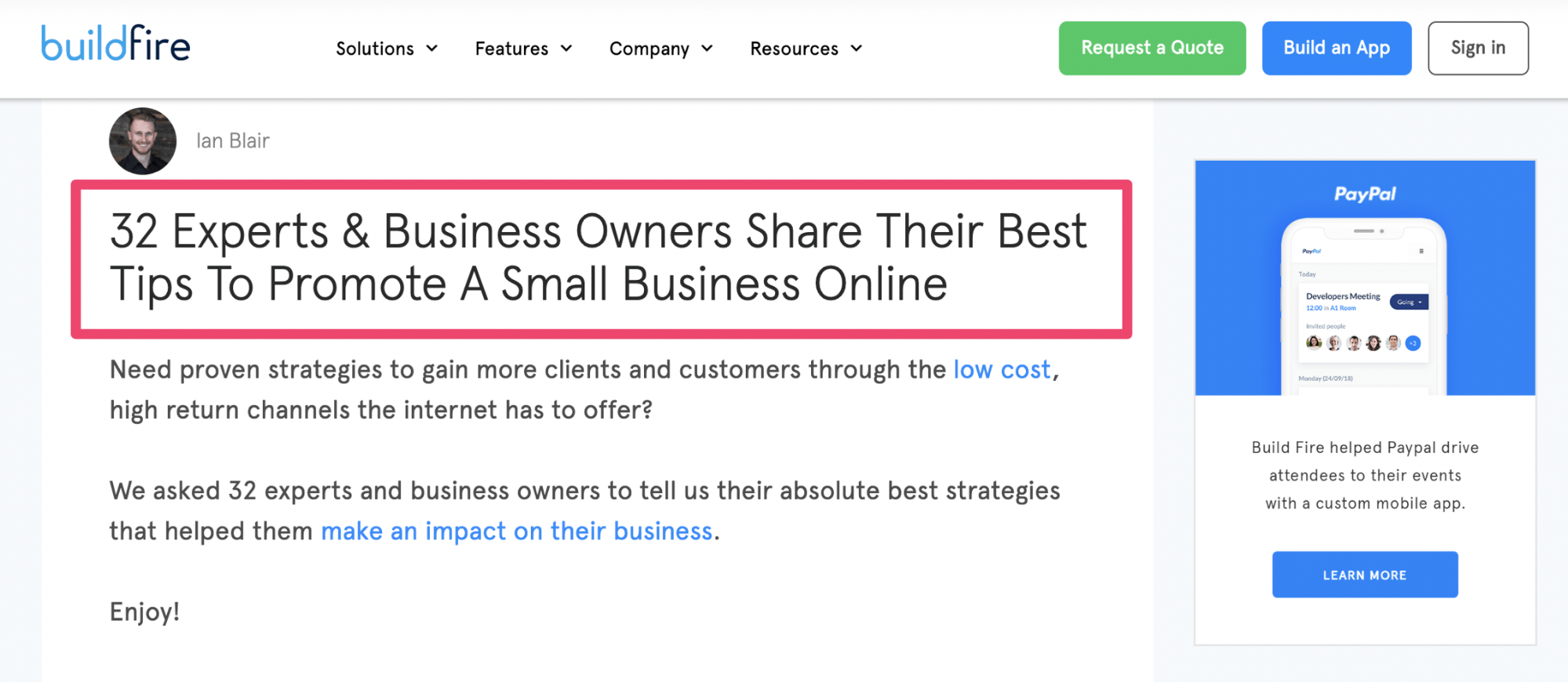
Here’s an example of a roundup written by Ian Blair at BuildFire.

Buildfire Headline

The title is great because it’s very clear. Readers know they’re getting advice from 32 different experts. They also know exactly what the post is going to be about.

For more assistance with this, check out my guide on writing attention-grabbing headlines that convert.

Skimmable headers

Expert roundups are long. So you need to make sure the post is formatted properly so it’s easy for readers to navigate.

Let’s say your blog has 25 experts answering a question. Realistically, people aren’t going to read all 25 responses. Your headers need to be clear so that anyone can scroll through and view the answers from specific experts.

Quality images

Images are another great way to break up the content and make your blog more reader-friendly. Consider using a picture of each expert with their name and bio.

We saw this with one of our example posts earlier.

Promotion

Your work isn’t done once the roundup has been published. Now it’s time to make sure that the post performs at a high level.

For starters, you’ll want to share it on all of your distribution channels (as with all of your blog posts). But you’ll also want to make sure the experts in your post do the same thing.

Don’t expect these participants to be refreshing your website every day waiting for the post to go live. Let them know that the post has been published and send them a link. The best way to do this is with a “thank you” message.

You might also want to consider asking top experts for an exclusive interview. This type of content can be used for your YouTube channel or podcast. Plus, it strengthens your relationship with them and increases the chances that they’ll consider you for guest posting opportunities.

Conclusion

Expert roundups and link roundups are not the same things.

However, both of these strategies can help you drive traffic to your website, build backlinks, improve brand awareness, and increase your authority.

In my experience, experts are willing to participate in these roundups because they get increased exposure as well. So it’s a win-win scenario for everyone involved.

You just need to make sure that you find the right experts, ask them the right question, and promote the blog properly to ensure that it performs at the highest possible level.

So keep this guide as a reference for creating epic expert roundup blog posts on your website.


Source Quick Sprout http://bit.ly/2LX8Yj0

How Sinking Funds Can Save You From Drowning in Big Expenses

The Million Dollar Question

What would you do if you had a million dollars?

This question seems to come up regularly as a conversation starter. I’ve found that the answers tend to fall into two groups.

In one group, you tend to have answers that involve radical life changes. That person would just move to another part of the world or go on a bunch of vacations or buy a ridiculously expensive home.

In another group, you have answers that involve financial security. That person would pay off debts, maybe buy a modest home or a reasonable car, and put the rest away for big future goals.

You might see a mix of the two, where the radical life change person does pay off credit card debt first or the financial security person does go on a great vacation, but most of their planning centers around their main objective. It’s either radical life changes or financial security, and it’s pretty clear which one is the focus.

I’m clearly in the “financial security” camp. If a million dollars suddenly fell on my lap, I’d put all of it away in investments with the intent to live off of 3% withdrawals for the rest of my life. That would add up to $30,000 a year just from the $1 million, not counting the other retirement savings we already have, nor counting the other investments we have. This would probably hasten our retirement to the pretty near future, but I don’t think we’d retire tomorrow. We’d just sit down and talk through what’s next, but it would mostly center around preserving the life we have right now.

Answering this question and daydreaming about that situation is a lot of fun, but there’s actually something really useful buried in this question. If you give it some serious thought, it’s actually an indication of what your personal plans should be, and thus what your financial plans and professional plans should be like.

For example, with my own million dollar dream, it’s really just an extension of the path I’m on, which happens to be the path I want to be on. I like my life in most ways; no life is perfect, but mine is pretty good, and I simply want to fortify and secure the life that I have and move early retirement, which is already in the plans, a bit earlier.

In other words, the real division between the kinds of answers that people give to the “million dollar question” is whether the answer is just an extension of the life path they’re already on or whether it constitutes a radical change in your life.

Those two types of answers point toward two completely different schools of financial and life advice.

“A Million Dollars Would Simply Accelerate My Already-Existing Life Plans!”

This is definitely the group I’m in and, I suspect, the group that many Simple Dollar readers find themselves in.

People in this group already know what they want out of their life and they’re working in that direction already. An infusion of money just contributes to the plans they already have in place.

My question to people who are in this group, and a question I ask myself all the time, is this: what can I do to hasten those plans? If having a million dollars dropping on my lap means I accelerate and secure the plans I have for my future, what can I actually do right now without that million dollars to accelerate and secure those plans? If this plan is so obviously important to me and so front and center in my life, what else can I be doing to secure and accelerate those plans?

For me, I’m already on a path to complete financial independence and early retirement. A million dollars would merely accelerate my journey down that path. This path is something Sarah and I have carefully considered and we’re in strong agreement on. It’s where we both want to go.

So, what can I do to get us there faster? What can I do to move that point of early retirement a year or two earlier? That’s the real question that the “million dollar question” is asking me.

The answer to that question, of course, goes back to spending less than I earn and doing something useful with the difference. Keeping a firm grip on my spending, looking for opportunities to bring in a little more income, and then using that gap to accelerate our goals is the recipe, and I’m always on the lookout for those things.

However, at the same time, chasing a bigger “gap” should not come at the expense of what I value in my current life. This is such a key personal finance lesson. You have to be able to distinguish between what’s actually important in your life right now – what makes it worthwhile for you – and what isn’t important, and be willing to discard the things that aren’t important for the things that are.

The recipe for accelerating your existing plan really centers around deciding what’s important in your current life and what really isn’t, discarding that unimportant stuff, and using those discards to accelerate the things that are important.

The really interesting side of all of this comes with the other answer to the million dollar question.

“A Million Dollars Would Change Everything!”

If you are in a situation where a million dollars would cause you to make radical changes to your life, altering your profession or your relationships or where you live or how you spend most of your time or some combination thereof, the clear question is why aren’t you orienting your life toward making those changes anyway?

The magic of the “million dollar question” is that it eliminates the issue of financial need from the question of what you want to do with your life. If the things you want to do with your life are drastically different than the things you are doing with your life, then there’s a good chance that you’re in a relatively unhappy cycle in your life, one that’s held in place solely by financial considerations.

If there’s ever a call in your life to start making some financial changes, it should be this one. If the things you most want to do with your life are significantly different than what you’re actually doing with your life, and the only thing that is keeping you on the current path is finances, then it’s time to radically reboot your finances so you can have that life.

I should know, I’ve been there.

For roughly a year before my financial turnaround, I felt like my life was stuck in a serious rut. My dreams and visions and plans were in one direction, yet day in and day out, I felt like my life was heading in a different one. I actually recognized it as it was happening; I wrote about that feeling in my journal and tried to process what it meant.

I knew only that my daily routine was one that was comfortable, but only in the most surface of ways. It was a life that, at a quick glance, should have brought me substantial joy, but what it brought me was fleeting tastes of pleasure and comfort and an underlying feeling that life wasn’t what I wanted it to be.

As I wrote back then:

Sometimes I feel like my life is completely without purpose and I’m just following some invisible pattern that someone else has put into place.

I was walking along a path and there were a lot of things that I liked along that path, but it wasn’t bringing me anything deeper or more meaningful. Rather, it was a path to a destination that I didn’t really want to go to. I loved the pleasures of my day to day life, but I didn’t want to find myself at age fifty without having actually achieved anything I wanted out of life. I didn’t want to be stuck at a stressful job with very little to show for it.

I had all of the little things I wanted today, but I was walking away from all of the big things I wanted out of my life.

If you had asked me the million dollar question then, my answer would have been full of radical life changes. I would have moved. I would have changed jobs. I would have likely splurged on a lot of things that I thought would bring me some joy. In short, I would have used that million dollars to try to stumble toward a life that was much different than my own.

If I knew that about my life and my life choices, then why on earth was I staying on that day to day path?

It took us several more months to really figure things out, and that’s when Sarah and I launched into our financial turnaround. Rather than wandering down a pleasant and comfortable path toward a destination we really didn’t want, we chose to wander down a bit more challenging path to a destination we really wanted. In other words, we started living our day to day life in a way that would lead to the things we would do if a million dollars fell in our lap.

That’s my advice to anyone who would make lots of life changes if a million dollars fell on your lap: start living your day to day life so that you’re heading toward those changes you want.

If you would change where you live, then that means you’re probably unhappy in some deep way with where you live. What can you be doing to aim yourself in a direction to go somewhere else?

If you would change who you spend time with, then that means you’re probably unhappy in some deep way with the people around you. What can you be doing to change your relationships and your social circle?

If you would change your job or your career, then that means you’re probably unhappy in some deep way with what you’re doing for a living. What can you be doing to change your career trajectory?

If you would splurge on a bunch of things, then that means you’re probably unhappy in some deep way with the things that you do for leisure. What can you be doing to explore new interests in your life without causing further financial chaos?

Underlying all of those questions is this one: what are the things in your daily life that you spend time and money on that aren’t in line with or guiding you to the things you would do if you had a million dollars?

Here’s the thing: most of the stuff that you’re dreaming about if you had a million dollars are things that are probably outside of your current financial and life reach. You can’t just snap your fingers and make them happen. If you could, then that’s what you’d be doing, right?

The question you should always be asking yourself is this: how can I spend today to move myself closer to that million dollar vision?

What I found, as I was moving through my financial turnaround, is that every day in which I did things that moved me closer to that million dollar question felt like a really good day. I didn’t have to be perfect about it, but I found that if I took several steps forward and only a few inadvertent steps back most days, it felt pretty good. It feels really good to be able to go to bed at night knowing that you spent the day doing things to move yourself toward the life you really want rather than just coasting through the motions of the life you have.

“What about the fun things, the little pleasures?” Don’t worry so much about the little pleasures that you fill your life with. Those are infinite in abundance, and many of them are free or exceedingly low cost.

More than anything, I found that if I started shaping my normal daily routine into something that I both enjoyed in the moment and which resulted in me being a little closer to that million dollar dream at the end of the day, things felt very, very good.

It takes a lot of experimentation. You have to try lots of new things and you have to try cutting out some old things, too.

It takes a willingness to cut some things out of your life that seem very fun and enjoyable and comfortable in the moment, just to see what life is like without them and whether there’s something else that can fill that space.

It takes a lot of commitment to building new habits. Many of your old daily routines aren’t going to work. You can’t keep going into work and going home and doing the same old things and magically expect new results. You’re going to have to knock down some of those routines and do new things.

It takes some frustration, too. You’re going to take steps that are the wrong steps for you. You’re going to cut out things that you shouldn’t have cut out, and part of you will be shouting that the whole plan is wrong. It isn’t. That’s just the animal part of your brain that resists change. Accept that you will make a few mistakes along the way, and that it’s completely okay to backtrack on some details and do them a different way.

It takes patience, and a lot of it. Even if your days are now headed in the right direction, that doesn’t mean you’ll achieve all of your big goals next week. Rather than staring at the million dollar dream all the time and getting frustrated that it’s not right here, right now, look at your daily life, the good things that it contains, and how it’s heading to where you want to go.

You can do this.

Final Thoughts

I invite you to spend some time seriously thinking about the million dollar question. What would you do with your life if you suddenly had a million dollars in after-tax money in your hands? Would you simply accelerate many of the things you already have in place? Or would you make some radical changes and embark on some major splurges?

If your answer is acceleration, then it’s worth looking at your life and asking how you can accelerate things. You’re likely happy with your life direction, so the question is how you can get to that million dollar dream just a little faster.

If your answer is splurges and big changes, then you should consider whether you’re living a daily life that you’re really happy with, considering that a sudden windfall would mean a radical change in direction. What’s keeping you from working on that radical change in direction right now? Furthermore, is it really that thing you’re blaming – your job, your spouse, your kids, whatever – or is it just your unwillingness to give up a comfortable daily routine and upset the cart a little bit?

In my heart of hearts, I truly believe that the best life we can be living is one where we’re living every day as another step or two toward our million dollar dream in each area of life. That might mean that our daily life isn’t quite as comfortable and easy as it could be, but it means that each day is in line with what we want most and each day builds upon the efforts of the last rather than working against it.

What is your million dollar dream? What are you doing today to get there?

The post The Million Dollar Question appeared first on The Simple Dollar.


Source The Simple Dollar http://bit.ly/2w1ZRT7

How to Write a Check

Many people don't write checks anymore — or didn't grow up having to fill them out. Still, there are times when the old check is the most convenient (or only) method of payment. So how do you fill one out?

Source Business & Money | HowStuffWorks http://bit.ly/2Jo8wYV

How to Write a Check

Many people don't write checks anymore — or didn't grow up having to fill them out. Still, there are times when the old check is the most convenient (or only) method of payment. So how do you fill one out?

Source Business & Money | HowStuffWorks http://bit.ly/2Jo8wYV

الأربعاء، 15 مايو 2019

7 Ways To Retire With $1 Million: Start Your Journey to The Millionaire's Neighborhood

How can you retire with $1 million in assets? Discover seven ways that can help you formulate a plan for retiring as a millionaire.

Source CBNNews.com http://bit.ly/2VDc0xe

How This Family of 4 Saves $3,600 a Year Living in a 200-Square-Foot Home

How to Be Your Own Boss: The Good, the Bad and the Ugly of Entrepreneurship

Some Thoughts on the Cost of Eating Out

A few weeks ago, I found myself in a situation where I was really hungry but there weren’t many food options around. I decided to keep my costs as low as possible, so I went into the only restaurant I could find, a nice little diner. I want to be clear during this article that I am not picking on this diner. It was a nice place to eat, the service was good, the food was good, and I was happy with it.

At the diner, I ordered an extremely simple breakfast. I had a cup of coffee, some scrambled eggs, some fried potatoes, and two pieces of toast. The total bill was about $10 – really, not that bad – and then I left a $2 tip, so the cost was $12.

During the meal, though, I couldn’t help but calculate the costs in the back of my head. I was served roughly three scrambled eggs with a little bit of cheese on them, probably a single potato’s worth of fried potatoes, two cups of coffee, and two pieces of toast with maybe a teaspoon of butter between them.

So, let’s look at the ingredient list of that meal:
+ three eggs
+ 1/4 cup shredded cheese
+ 1/2 potato
+ a small amount of onion in with the potatoes
+ two slices of bread
+ roughly a tablespoon of butter
+ two cups of black coffee
+ a negligible amount of salt and pepper

I could assemble those ingredients into a breakfast at home in about the same time it took them to get breakfast out to me at that restaurant, and then I’d have a few items that would go in the dishwasher afterwards.

So, what would the ingredients have cost me?

+ I can get a dozen eggs for $1.99, so three eggs cost $0.50.
+ I can get eight cups of shredded cheese at the local grocery store for $5, so 1/4 cup of shredded cheese would cost $0.16.
+ A typical potato weighs about 12 ounces and I’d estimate that I had half of a potato on my plate, and a pound of potatoes these days comes in around $1, so the potatoes cost about $0.38.
+ The small amount of onion was probably $0.05.
+ I can get a loaf of 20 slices of bread for about $2.50, so two slices cost $0.25.
+ I can get a stick of butter for about $0.75 and that contains 8 tablespoons, so a tablespoon of butter costs about $0.09.
+ I can make two cups of coffee at home for about $0.70 using my usual coffee making technique.
+ We’ll add on another $0.10 for seasonings like salt and pepper.

The total cost of those ingredients is $2.23. Even if you might quibble with the cost of each item and think that it would be more than I stated, you’d be hard pressed to get this over $3 unless you went very high end with each item.

As I noted earlier, I think my time investment would have been similar if I prepared and ate this meal at home, though I would have been busy in the kitchen for 15 minutes instead of reading the menu, ordering, and staring at my phone for 15 minutes waiting on the food. However, that effort would have saved me about $10.

The meal quality probably would have been pretty similar, but I’m pretty sure I would have at least liked my coffee at home better. I’m kind of picky about coffee and I really like my home brew recipe.

This experience reminded me of a few key principles of food frugality (and taught me a few things as well).

Eating out consistently is a very expensive endeavor. When you compare a meal prepared at home and a meal eaten out of similar quality, the meal eaten out will always be more expensive. When you eat out, you’re not only paying someone to prepare it for you and someone to serve it to you and often someone to clean up for you and someone to manage those folks, you’re also paying for the facilities to make and serve the food, the taxes, and some profit for the person who invested all the money to pay for all of these things.

Sure, you can sometimes find a decent meal at a restaurant that’s less expensive than a great meal at home, or a low quality meal at a restaurant that’s less expensive than a good meal at home, but you’re taking a serious cut in quality, and if you apply any sort of frugal planning and use low cost food staples at home, a restaurant is never going to consistently beat – or even come close to – the low cost of preparing food at home.

I was really paying for convenience, not the food. When I went to that restaurant, my focus was on getting a decent meal relatively quickly. It seemed to be the fastest option available to me at the moment, and thus I was really paying for convenience rather than the food itself.

That’s often a big consideration when people eat out. They do so because they’re hungry and they’re not near any options for preparing food themselves or to acquire low cost and quick to eat items. There are many places in America where the only convenient options for food are convenience stores and fast food restaurants, even in places where you might not expect this to be true.

Situations where you need to spend for the sake of convenience are often prevented by better preparation. Whenever you find yourself in a situation where you’re turning to a restaurant or a convenience store not because you want a nice meal on a special occasion, but because you need to do so out of convenience, it’s usually because either you didn’t plan ahead at all or you’re in a crisis moment.

An emergency is understandable, but many meals that people eat out do so solely because they didn’t plan ahead when they knew that there was a good chance that they might need to eat a quick meal or a hearty snack in a convenient way.

There are a lot of ways to prepare for those kinds of situations, where you need a quick, convenient meal. You can make a lot of meals at home in advance so that you have items that can be popped in the microwave or oven at your convenience. You can use a slow cooker for a lot of meals. You can mostly prepare meals in advance, leaving only final assembly for busy evenings. You can prepare sack lunches to take with you.

Or you can do this:

I could have prepared better by keeping more food items in my bag. My favorite technique for keeping hunger at bay when I’m out and about is to have a few food items in my backpack, which is pretty much always with me when I leave the house for more than a few minutes. It’s because I didn’t do this that I wound up in that “I’m hungry, there’s no other food options, time to go to a restaurant” situation.

My routine should be that if I know I’m going out and about soon, I make sure that my bag has some food items in it, just in case. Toss in an apple, some granola bars, a water bottle, a bag of nuts, maybe some crackers or something. The key is to just have something that’s low cost and easy to eat in my bag.

In fact, I usually have several granola bars and/or protein bars in my bag all the time for situations just like this one, but I’d consumed them all over the previous few weeks and there was nothing in my bag.

Eating out should be an experience you can’t recreate at home. The meal I ate was perfectly fine, but it was one that I ate solely for convenience. It wasn’t a special experience or a memorable experience. In fact, I probably would have forgotten about it had I not planned on writing this post. It would have become a forgotten $10 expense, the kind of “lost” $10 that ends up paving the road to financial struggles.

The best financial approach to food that I’ve found is to eat meals mostly prepared at home and mostly made out of low-cost staples and only eat out (or have treats) on genuinely special occasions. It’s easy to learn how to cook a ton of great meals with low cost staples, especially if you have a reasonably well stocked pantry.

On the other hand, special occasions are usually best when they’re really meaningful – you’re eating with someone special or it’s a truly special occasion – and when they’re planned in advance so you can anticipate it. I have far more financial concern about a $15 meal from a restaurant three or four times a week than a $75 meal at a restaurant once every month or two.

If that’s the financial path you’re on, it’s time to rethink the costs of eating out.

The post Some Thoughts on the Cost of Eating Out appeared first on The Simple Dollar.


Source The Simple Dollar http://bit.ly/2YvyInI

Adjustable-Rate Mortgages Are Making a Comeback – Is That a Good or Bad Thing?

Years after their fall from grace amid the subprime mortgage crisis, adjustable-rate mortgages (ARMs) are making a steady march back toward the mainstream.

According to a December 2018 report from Ellie Mae, a software company that process mortgages, the percentage of home purchases that used adjustable-rate mortgages ticked up to 9.2%. Not only was that the highest level in 2018, it was also an all-time high since Ellie Mae began tracking such data back in 2011.

While many personal finance and industry experts view this resurgence with concern, warning consumers to continue avoiding ARMs like the plague, that’s not the sentiment in all quarters.

ARMs do have their supporters, despite their involvement in the housing market crash that triggered the Great Recession. Here’s a closer look at the pros and cons of using an ARM to purchase a home.

What Are ARMs, and Why Are They Coming Back?

For those who are unfamiliar, ARMs are mortgages with an adjustable interest rate. They offer borrowers a lower initial interest for a fixed period of time, typically three, five, or seven years. After that, the rate fluctuates based on the market. A 5/1 ARM, for example, will have a fixed interest rate for the first five years, then reset to a new rate every year thereafter based on market conditions.

ARMs have been getting a boost in popularity as rates on 15- and 30-year fixed-rate mortgages climbed throughout 2018. The average rate on a 30-year, fixed-rate mortgage is back down to 4.14%, according to Freddie Mac, after hitting a high of 4.94% in November. However, average rates in the mid-3% range are probably long gone, and most experts expect rates to inch upward in coming years.

In general, when the economy improves, borrowing gets more expensive. ARM mortgage rates, however, often start out about 0.5% lower than fixed-rate loans.

In such an environment, borrowers looking for lower mortgage payments and interest rates are increasingly opting for ARMs.

“I’m not surprised to see ARMs making a comeback. As housing prices continue to rise, many potential homeowners are simply getting priced out,” said James Stefurak, CFA and founder of Florida-based Monarch Financial Research.

The Difference Between Present Day and the Run-Up to the Great Recession

For those who may now be considering an adjustable-rate mortgage thinking the lower interest rate will help them qualify for more home, think again, says Mike Ferraro, area manager for Bank of England Mortgage.

“One of the popular reasons people did an ARM prior to 2008 was to qualify for more of a house. At that time, lenders qualified borrowers at the initial lower rates with no consideration of any future rate increases,” explained Ferraro. “This led to many consumers taking adjustable-rate mortgages that per today’s standards would have actually been qualified for much less.”

Today, however, lenders qualify borrowers for ARMs based on a higher interest rate calculation, rather than the initial rate that’s offered, Ferraro said.

And overall, mortgage underwriting is far, far stricter now, said James McGrath, co-founder of the New York City real estate brokerage Yoreevo.

“Coming out of the downturn, ARMs got a bad reputation for good reason but the problem was more about underwriting rather than the product itself,” explained McGrath. “If you can’t afford a loan, you’re going to default, it’s as simple as that, and during the housing bubble, borrowers were able to lie about their income and banks didn’t care if they did.”

The Drawbacks of Adjustable-Rate Mortgages

Not having control over fluctuating interest rates can be a challenging experience, one that can sometimes end in disaster for the homeowner, as evidenced by the aforementioned housing crisis.

Borrowers who opt for this type of mortgage need to be prepared for, and comfortable with, a potential rollercoaster ride.

“Borrowers must realize that it is possible that their monthly mortgage payment could increase significantly depending on changes in the economy, interest rates, the money rate, or the housing market,” explained Patricia Russell, a certified financial planner and creator of the site FinanceMarvel. “Choosing an ARM with restrictions could also prevent a buyer from being able to switch to a fixed rate within a certain period of time.”

More specifically, when ARM fluctuations occur, it could translate into significantly higher mortgage payments almost overnight, which can be troublesome for low-income borrowers in particular.

“If rates move up quickly the borrower could spend hundreds in additional interest payment dollars in as little as one year,” said Matt Seu, principal at the financial services firm Actualize Consulting. “This increases the borrower’s chance of default significantly.”

If all of that’s not clear enough or doesn’t give you pause, spend a moment chatting about the topic with money expert Dave Ramsey.

The renowned financial advisor expresses his disdain for such mortgages in no uncertain terms, urging home buyers to avoid ARMs at all costs.

“I would never under any circumstances take an adjustable-rate mortgage,” said Ramsey. “Ask yourself this: Which way do you think the rates will ‘adjust?” If you said up, you’re right.”

“This isn’t rocket science,” Ramsey added. “The bank offers you a lower interest rate to get you in, and when rates adjust, they almost never adjust down… Make sure a house is a blessing and not a curse. Save for a down payment and get a 15-year fixed-rate mortgage and pay it off as soon as you can.”

The Benefits of Adjustable-Rate Mortgages

Still, there are plenty of industry experts who insist that there are plenty of benefits to using ARMs.

Depending on a borrower’s overall financial situation, an ARM may make sense, suggests Russell. The lower rates at the front of the loan make it possible for some new homebuyers to purchase a home and still have enough money available for other needs or renovations in their new home.

“An ARM now could allow someone to purchase a home they want with an affordable payment,” added Russell.

In addition, for high net worth borrowers, ARMs offer a lower interest payment allowing them to invest the difference, said Seu. When rates rise, this type of borrower can quickly refinance into a fixed-rate loan or simply pay off the note entirely.

How to Decide if an ARM Makes Sense for You

So how to decide if an ARM might be a good choice for you? Proceed with a good deal of caution, do your homework, and understand all of the possible outcomes.

In particular, analyze what the payment difference would be in today’s interest rate environment between an ARM and a fixed-rate mortgage.

“In certain interest rate environments, buyers should choose ARMs,” said McGrath. “In particular, when short-term interest rates are significantly lower than long-term interest rates, they make a ton of sense. Please note, that is not the case today as short-term interest rates are fairly close to longer term interest.”

Yet another factor to consider is how long you intend to be in the home. If you plan to sell the home before the introductory fixed rate expires, an ARM could make sense (though plans do change). If the answer is the rest of your life, however, then an ARM is not likely to be a good choice for you.

“If a consumer plans to be in a home their entire life, then they should not do these loans just for the initial lower rate, as it will surely adjust higher in the long run,” said Ferraro.

However, ARMs can be a good choice for people who know with some degree of certainty that their income is going to be higher in the future.

“If home loan rates rise and the monthly mortgage payment goes up, they know they can afford the higher payment,” explained James Stewart, a mortgage originator with national lender and servicer Planet Home Lending.

Examples of such situations might include:

  • You are finishing school and going into a high paying career with solid job prospects.
  • A stay-at-home partner or spouse will be going back to work when children start kindergarten.
  • Your secure job has predictable pay raises based on years on the job.

In addition to those situations, there are a few other instances in which an ARM might make sense, added Stewart.

These include buyers who are planning to pay off the home loan before the ARM adjusts, because they plan to move up to a new home or location, and buyers who intend to religiously pay extra principal each month on their mortgage.

“When an ARM gets adjusted, the new payment is based on the amount still owed,” said Stewart. “Reducing what you owe may give you lower payments.”

The bottom line, however, is this: When agreeing to an ARM, you’re taking on the risk that the monthly payment will rise, and it may rise quickly and significantly.
If that added risk is going to cause you to feel overly stressed, an ARM may not be for you, said Stewart.

Mia Taylor is an award-winning journalist with more than two decades of experience. She has worked for some of the nation’s best-known news organizations, including the Atlanta Journal-Constitution and the San Diego Union-Tribune. 

Read more:

The post Adjustable-Rate Mortgages Are Making a Comeback – Is That a Good or Bad Thing? appeared first on The Simple Dollar.


Source The Simple Dollar http://bit.ly/2W3V4iK

Here’s How to Start Investing When You Only Have $50 to Spare

Investing in the stock market might sound like something that only rich people do. But you can start with only $50 — and immediately double your money with a $50 match.

Swell Investing makes this super easy. You can get started online or through its app with $50 — the cost of a dinner for two at Olive Garden. Plus, when you invest $50, Swell will immediately match that with a $50 bonus! Just use the code PENNY after making your initial investment.

This is a much lower minimum than traditional investment companies will require for you to start investing — so you don’t have to be Warren Buffett or Thurston Howell III to become an investor with Swell.

Invest in Causes You Care About

If you’d like to be a socially conscious investor, Swell lets you support companies that share your values. Swell is an SEC-registered investment adviser with a socially responsible philosophy. It only invests in sustainable companies that are committed to solving global challenges.

With Swell, you can invest in any of seven portfolios of stocks that align with the United Nations Sustainable Development Goals: Clean Water, Disease Eradication, Green Tech, Healthy Living, Renewable Energy, Zero Waste or Swell’s Impact 400.

Each thematic portfolio includes 40 to 70 companies making a positive impact in these areas. Additionally, the Impact 400 portfolio features 400 companies across multiple sectors.

You can choose a custom blend of portfolios to invest. Or, to make things even simpler, Swell has created predetermined mixes of multiple stock portfolios. The mixes have names like the Environmentalist, the Generalist and the Tech Optimist. This way, you don’t have to choose yourself how to allocate your investment from scratch.

Now, just because you’d like to save the Earth, that doesn’t mean you can’t make some money at the same time.

Swell’s website and its iOS app make it easy to track each portfolio’s performance and change in value over the past week, month, six months, year — or all the way back to Swell’s launch in 2016.

No one can ever guarantee you a certain rate of return. But historically, investing in the stock market has shown to grow your money faster than keeping it in a savings account. If you want to start saving for retirement — or just save for the future — it’s best to start growing your money as quickly as possible.

Save Money by Avoiding Sneaky Fees

Through Swell, you get to invest in companies that share your morals. You probably wouldn’t want to invest in a company that’s destroying our oceans or cheating the system. With traditional investing you might be. For example, the top five retirement funds in the U.S. support oil companies.

Swell’s fee structure is simple. It won’t change depending on the product you use or the portfolio you invest in.

For example, Swell doesn’t charge any trading fees, there are no price tiers or expense ratios, and you won’t find any other obscure fees that might catch new investors by surprise. To save you from these hassles, it simply charges a 0.75% annual fee. For example, if you invest $500, that’s about the cost of one latte ($3.75) per year.

Depending on how much you invest, you could ultimately save hundreds of dollars this way. A traditional brick-and-mortar investment firm will charge you fees based on how much stock you own, how often you trade stocks and other factors.

So, got $50? Bingo! Just like that, you’re a member of the investor class.

Disclosure: We have a financial relationship with Swell Investing LLC and will be compensated if consumers apply for an account and/or fund an account with Swell through links in our content. However, the analysis and opinions expressed here are our own.

Mike Brassfield (mike@thepennyhoarder.com) is a senior writer at The Penny Hoarder.

This was originally published on The Penny Hoarder, which helps millions of readers worldwide earn and save money by sharing unique job opportunities, personal stories, freebies and more. The Inc. 5000 ranked The Penny Hoarder as the fastest-growing private media company in the U.S. in 2017.


source The Penny Hoarder http://bit.ly/2w2k1wd

Can I cancel my annuity and take a lump sum?

Question

I have a small pension through an annuity, which I am advised is worth £28,500. Under the government scheme, I would like to take this as a trivial commutation lump sum [ie, cash in the lump sum].

However, I have another small annuity which is £113 a year, which takes me over the £30,000 threshold.

I am told I cannot cancel the annuity. Is there any way that I can cancel it in order to access the lump sum?

From

AS/Swadlincote

Unfortunately, the decision to purchase an annuity is, in the vast majority of cases, irreversible so you would be unable to cancel it. At one point the government did announce that it was looking at plans that would allow people to cash in their annuities – the so-called secondary annuity market – but these were dropped in 2016.

In terms of your other small pot, you do not mention if it is a defined contribution (DC) or defined benefit (DB) pension but you do have options. If the pension is a DC one, then under the pension freedoms that came in in 2015, you would be able to take it as a cash lump sum less any tax due if you are over the age of 55.

If you have a DB plan, then you would need to do a DB to DC transfer if you wanted to be able to take your money as outlined above. Under current rules, you would not have to pay for regulated financial advice to make this switch as your pension is worth less than £30,000.

However, you may find that many providers will refuse to do a non-advised transfer so you may have to shop around.

Image

Section

Pensions Retirement lifestyle

Free Tag

annuities pensions

Ask Experts Blurb Top

This article was written in response to a reader’s question. If you have a financial or work/career question that has left you scratching your head ask our panel of experts who will aim to shine some light on the matter.


Source Moneywise http://bit.ly/2HlBExH

Not a happy bunny when insurers mess up

Insurance is a vital part of our financial armoury. It’s our backstop in case something goes wrong in our lives, be it a burglary, car crash or an illness that means time off work.

It’s not always mandatory, often voluntary, and yes it can sometimes feel as if you are pouring money down a big, black hole. But, in theory, it’s there to come riding to our rescue when the unexpected happens.

In recent weeks, I have drawn comfort from a couple of the insurance policies I hold.

The first was via the Axa PPP private medical insurance I pay for through my employer (Daily Mail and General Trust). A recent routine medical – arranged through work – showed a marked jump in my PSA score, an indicator of prostate cancer. I was advised to see a specialist as soon as possible.

My private medical insurance meant I was able to see Dr Christopher Ogden, a lovely individual and a pioneering urological surgeon, within days. Following an examination (not particularly pleasant) and an MRI scan, I now await a biopsy and Dr Ogden’s verdict. Thank goodness for my insurance – it could prove a life saver.

The second was through my dental policy. In the past couple of weeks, I have had the ‘pleasure’ of visiting my dental hygienist, an experience probably more daunting than Dr Ogden and his probes. The only blessing I could draw from the painful visit was that the cost (not the pain) of the cleaning process was slightly defrayed by the dental insurance I have with BUPA.

So no complaints?  Well, not exactly.  Take my medical insurance. Just after Dr Ogden had told me a biopsy would be required, I received a letter from Axa PPP stating in stark black and white: “We have been unable to pay this claim in full because of the benefit limitation on the scheme.”

Insurers could do much better if they put the customer first

Feeling a little emotional, it sent me into a tailspin, thinking the ‘prostate pathway’ I had been put on would have to be abandoned and I would be left in limbo.

It was only after a hurried phone call to the insurer that the letter’s contents were properly explained. Everything was fine, I was told. The letter was triggered by the £100 excess – the sum I must pay to make a claim – which meant a £100 ‘shortfall’ showed up between the treatment costs and the money paid over by the insurer to the medics.

Given that I had already paid the excess over the phone by credit card, there was actually no ‘action you need to take’ (the insurer’s words in its letter) and no shortfall. Indeed, there was no need for the letter. Correspondence, presumably, sent out automatically by computer without anyone at the insurance company checking whether it was appropriate or not. Simply not good enough.

For all the reassurance that most insurance brings, many providers still seem incapable of communicating with customers in language that can be instantly understood. They make everything so difficult.

My mother’s recent ‘spat’ with British Gas is further proof of this disconnect between insurer and customer. My mother has had HomeCare insurance with British Gas for donkey’s years. It provides her with a comfort blanket for when the heating packs up or the plumbing springs a leak. She rarely claims on it, but it is there just in case.

This year, British Gas tried to increase her premiums at renewal by 20%, a price hike my mother could ill-afford. After all, she’s a pensioner, lives alone (my younger son lives close by to keep an eye on her) and gets by on a state pension and a small annuity. So I urged her to complain by giving them a call.

Not one to overlook an argument, she gave the British Gas employee at the end of the phone an almighty ear bashing. The net result was a ‘new’ annual premium of £477.30 – instead of the £596.64 she had been quoted initially. Indeed, a premium lower than the one she had paid for the previous 12 months (£499.39).

Yes, a fantastic result, but it shouldn’t be this way. It should not have to take a phone call for her to get the deal she should have been given right from the word go.

It is great that insurance companies provide peace of mind every day of the year to millions of households and businesses across the country. Yet they could do so much better if only they became more consumer-friendly. It’s a Holy Grail they should strive to achieve soonest. Me and Mum would be happier bunnies, that’s for sure.

JEFF PRESTRIDGE is the personal finance editor of The Mail on Sunday. Email him at columnists@moneywise.co.uk.

Section

Insurance Health insurance

Free Tag

insurance

Image

Not a happy bunny when insurers mess up

Workflow

Published


Source Moneywise http://bit.ly/2Jn8mkC